



Landscape Spatial Analysis on Different Levels for Zhagana Ecological Settlement, Diebu, Gansu Province
Received date: 2011-02-23
Request revised date: 2011-10-04
Online published: 2012-04-20
Copyright
Zhagana village (Diebu County, Gansu Province) is a Chinese traditional settlement. Studying Zhagana’s landscape spatial structure is of vital importance in ecological research and planning. Based on multifunctional landscape concept and “Fengshui” theory, it was analyzed on four levels: regional environment level, village group level, individual village level and individual house level. On the level of regional environment, the landscape has an ecological circle structure towards horizontal and vertical directions, taking human architecture as the center. On the level of village group, influenced by natural force and traditional idea, four natural villages generate the natural linear drifting configuration and represent a kind of cluster mode. On the level of individual natural village, there is one or two uninterrupted interface. On the level of individual house, two kinds of horizontal structures can be detected in Zhagana’s Tibetan Ta-ban buildings, which are left-right structure and front-back structure, including living area and planting or breeding area. Considering its function for living, religion and storage, the Ta-ban building usually includes two or three layers vertically. This study establishes a foundation for Zhagana settlement’s protection and development. Further planning suggestions are also proposed. Firstly, taking Zhagana settlement as an integral protection area is a better way for settlement sustainable development. Secondly, environment protection based on religion is an ingenious way for ecological protection. The third is to improve Zhagana’s settlement model by spatial ecological planning.
SHI Li-sha , PENG Ying , HUANG Lu , YAN Li-jiao . Landscape Spatial Analysis on Different Levels for Zhagana Ecological Settlement, Diebu, Gansu Province[J]. SCIENTIA GEOGRAPHICA SINICA, 2012 , 32(4) : 485 -491 . DOI: 10.13249/j.cnki.sgs.2012.04.485
Table 1 Focus group questionnaire in Zhagana settlement表1 扎尕那聚落访谈调查情况 |
| 调 查 人 群 | 调查人数 (人或户) | 调 查 内 容 |
|---|---|---|
| 扎尕那行政村村长、书记 | 3人 | 扎尕那村概况,聚落发展历史及传说,聚落内三产基本情况 |
| 拉桑寺管理人员、活佛等僧侣 | 2人 | 寺院历史,宗教中的生态文化及其对聚落生产、生活的影响 |
| 扎尕那行政村村民 | 7户 | 聚落产业形态、特征,扎尕那村榻板房建筑特点 |
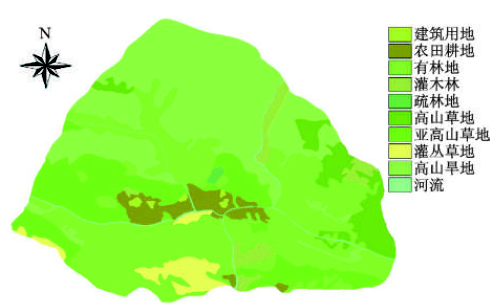
Fig.1 Land use types of Zhagana settlement图1 扎尕那聚落土地利用类型 |
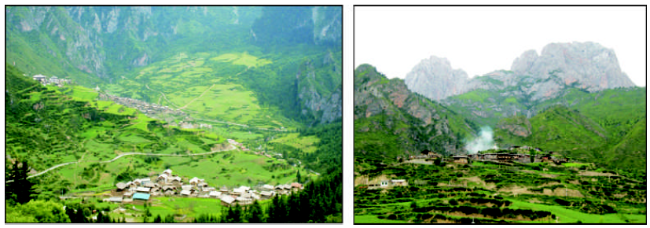
Fig.2 The photos of Zhagana village图2 扎尕那实地考察照片 |
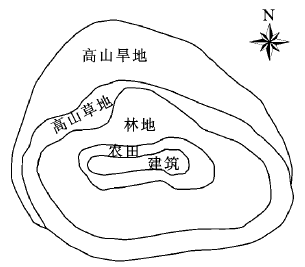
Fig.3 Horizontal spatial sequence of ‘World-in-pot’mode in Zhagana settlement图3 扎尕那聚落“壶天模式”景观水平空间 |
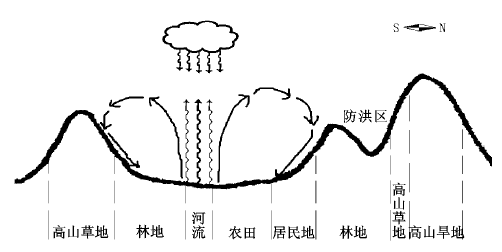
Fig.4 Vertical spatial sequence of ‘World-in-pot’ mode in Zhagana settlement图4 扎尕那聚落“壶天模式”景观垂直空间 |
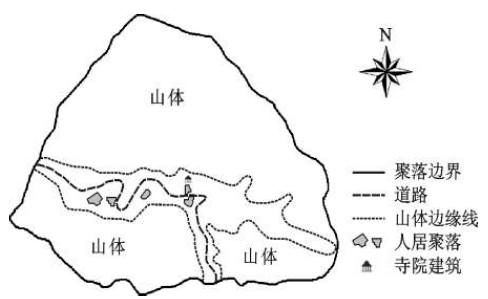
Fig.5 The horizontal spatial distribution of the four natural villages in Zhagana settlement图5 扎尕那聚落4个自然村落水平空间分布形态 |
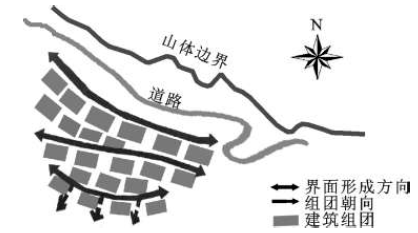
Fig.6 The space interface pattern of the four natural villages in Zhagana settlement图6 扎尕那聚落4个自然村落独立空间界面模式 |
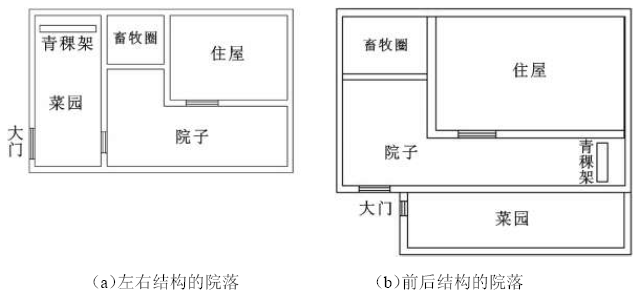
Fig.7 The horizontal structure of Zhagana local residence图7 扎尕那聚落建筑内部水平空间界面示意图 |
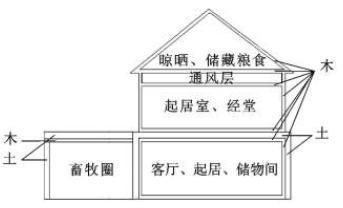
Fig.8 The vertical structure of Zhagana local residence图8 扎尕那聚落建筑内部垂直空间界面示意图 |
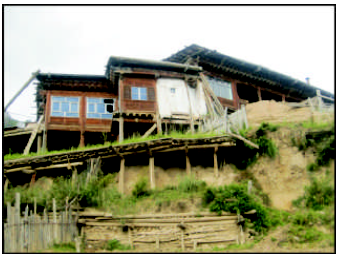
Fig.9 The photo of Zhagana local building图9 扎尕那村落榻板房建筑特点 |
The authors have declared that no competing interests exist.
| [1] |
|
| [2] |
|
| [3] |
|
| [4] |
甘南藏族自治州志编纂委员会.甘南藏族自治州志·民族志[M].北京:民族出版社,1999:986.
|
| [5] |
|
| [6] |
迭部县宗教文化源流[M].迭部县宗教局,2009.
|
| [7] |
|
| [8] |
|
| [9] |
|
| [10] |
李葱葱.文化内涵:景观设计的生命力[J].小城镇建设,2003,(1):44~49.
|
| [11] |
|
| [12] |
|
| [13] |
|
| [14] |
|
| [15] |
|
| [16] |
|
| [17] |
|
| [18] |
|
| [19] |
|
| [20] |
|
/
| 〈 |
|
〉 |