



Spatial Distribution and Network Community Structure of Expressway Car Flow in Jiangsu Province Based on Big Data Analysis of Toll Collection
Received date: 2020-04-28
Revised date: 2020-08-20
Online published: 2021-08-13
Supported by
National Natural Science Foundation of China(42071175)
National Natural Science Foundation of China(41701122)
Priority Academic Program Development of Jiangsu Higher Education Institutions(164320H116)
Copyright
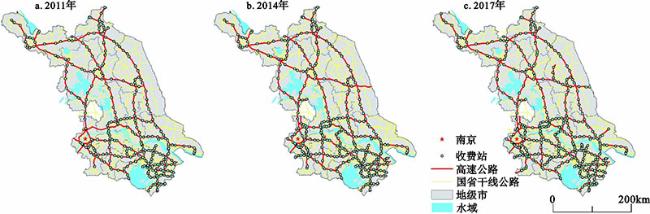
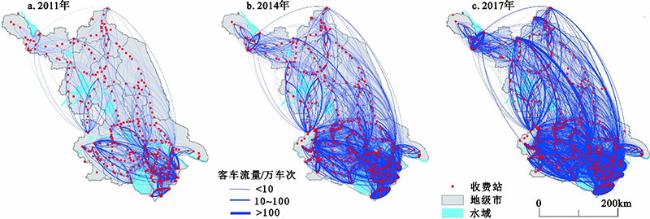
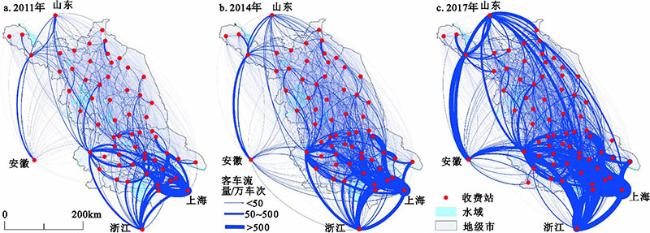
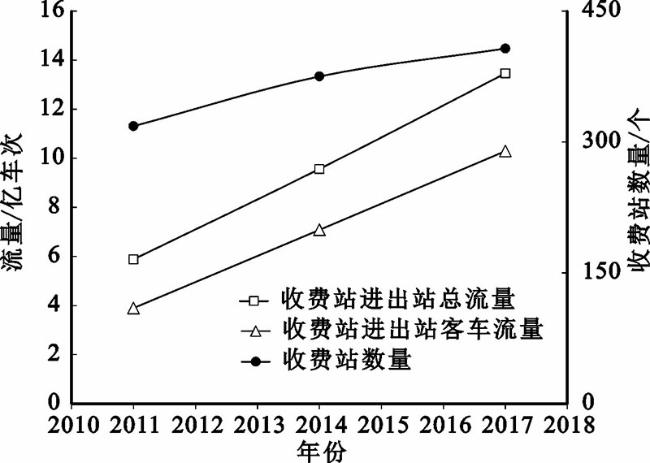
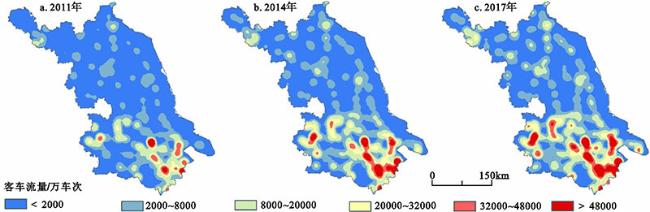
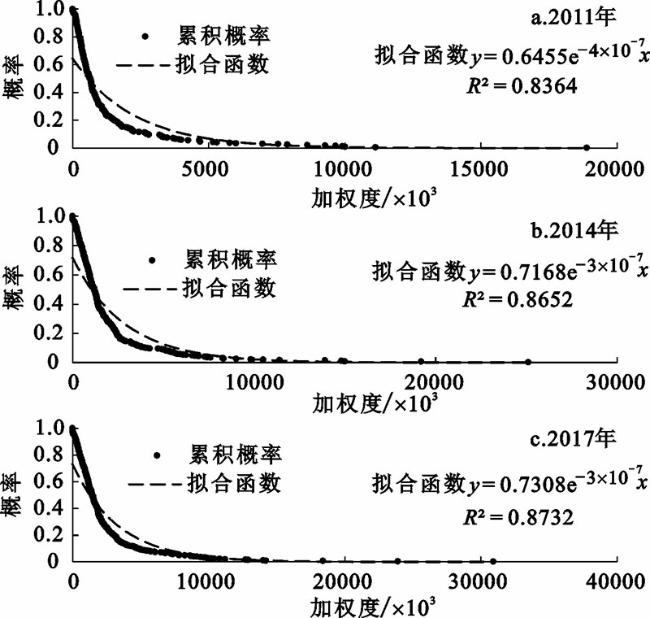
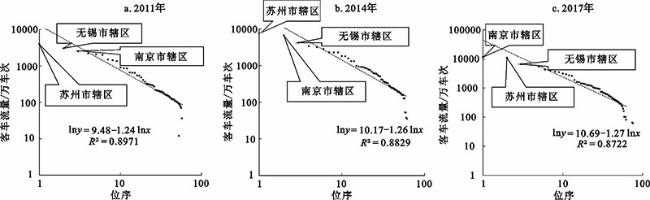
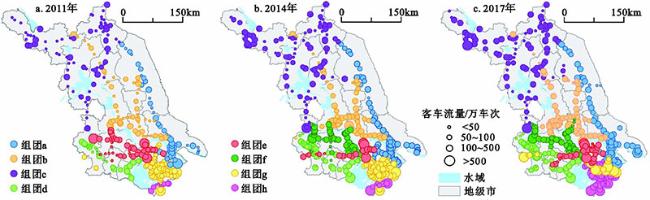
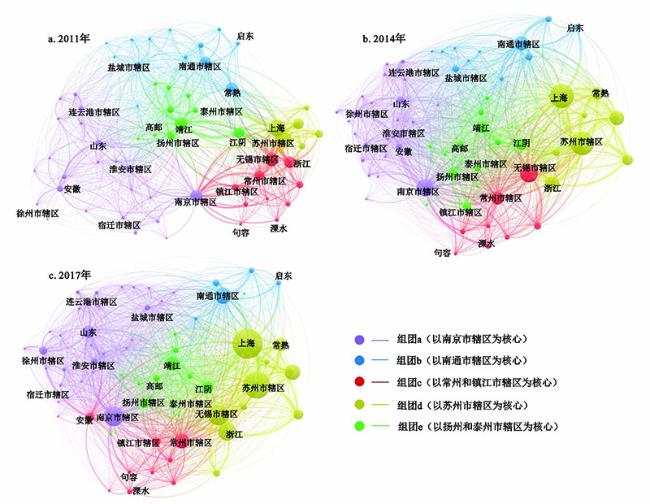
As an important part of modern transportation system, the huge traffic flow of expressway truly reflects the regional connection and has a profound impact on the social economy, people’s life and spatial structure. The massive expressway toll data collection is a significant support to analyse and reveal the traffic flow characteristics and the spatial structure evolution. According to the Jiangsu expressway toll collection data in 2011, 2014 and 2017, this paper selects car traffic to construct the O-D flow network and county connection network, so that the key toll stations and distribution characteristics of network degree are identified effectively, and the spatial pattern of car flow and the features of its network group structure are revealed. It is found that the spatial distribution of car flow shows a notable difference between the south and north of Jiangsu, with high-value points around the toll stations of central cities, provincial boundaries and cross-river bridges. The O-D flow network has an obvious scale-free feature, while the community structure is characterized by distribution along the expressway routes. The county connection network can be divided into 8 communities, with central cities as the cores.
Huang Zhenfang , Chen Yu , Huang Rui , Lu Yuqi . Spatial Distribution and Network Community Structure of Expressway Car Flow in Jiangsu Province Based on Big Data Analysis of Toll Collection[J]. SCIENTIA GEOGRAPHICA SINICA, 2021 , 41(6) : 998 -1008 . DOI: 10.13249/j.cnki.sgs.2021.06.009
| [1] |
Jin C, Xu J, Lu Y et al. The impact of Chinese Shanghai-Nanjing high-speed rail on regional accessibility[J]. Geografisk Tidsskrift-Danish Journal of Geography, 2013, 113(2): 133-145.
|
| [2] |
Sheller M, Urry J. The new mobilities paradigm[J]. Environment & Planning A, 2006, 38(2): 207-226.
|
| [3] |
Lordan O, Sallan J M, Simo P. Study of the topology and robustness of airline route networks from the complex network approach: A survey and research agenda[J]. Journal of Transport Geography, 2014, 37(5): 112-120.
|
| [4] |
金凤君, 王成金. 轴—辐侍服理念下的中国航空网络模式构筑[J]. 地理研究, 2005, 24(5): 774-784.
Jin Fengjun, Wang Chengjin. Hub-and-spoke system and China aviation network organization. Geographical Research, 2005, 24(5): 774-784.
|
| [5] |
Alderighi M, Gaggero A A. Flight availability and international tourism flows[J]. Annals of Tourism Research, 2019, 79(11): 102642
|
| [6] |
Shaw S L, Fang Z, Lu S et al. Impacts of high speed rail on railroad network accessibility in China[J]. Journal of Transport Geography, 2014, 40(3): 112-131.
|
| [7] |
Wang L. High-speed rail services development and regional accessibility restructuring: The case of the Yangtze River Delta, China[J]. Transport Policy, 2018, 72(9): 34-44.
|
| [8] |
吴康, 方创琳, 赵渺希, 等. 京津城际高速铁路影响下的跨城流动空间特征[J]. 地理学报, 2013, 68(2): 159-174.
Wu Kang, Fang Chuanglin, Zhao Miaoxi et al. The intercity space of flow influenced by high-speed rail: A case study for the rail transit passenger behavior between Beijing and Tianjin. Acta Geographica Sinica, 2013, 68(2): 159-174.
|
| [9] |
王成金. 城际集装箱交流枢纽的识别及其物流特征——以中国铁路运输为例[J]. 地理学报, 2010, 65(10): 1275-1286.
Wang Chengjin. Identification of inter-urban container transport hubs and their spatial characteristics: A case study of railway transportation in China. Acta Geographica Sinica, 2010, 65(10): 1275-1286.
|
| [10] |
Chen C L. Reshaping Chinese space-economy through high-speed trains: Opportunities and challenges[J]. Journal of Transport Geography, 2012, 22(1): 312-316.
|
| [11] |
张敏, 顾朝林. 近期中国省际经济社会要素流动的空间特征[J]. 地理研究, 2002, 21(3): 313-323.
Zhang Min, Gu Chaolin. Spatial characteristics of the recent inter-provincial flow of social-economic elements in China. Geographical Research, 2002, 21(3): 313-323.
|
| [12] |
徐建, 曹有挥, 孙伟. 基于公路运输成本的长三角轴—辐物流网络的构建[J]. 地理研究, 2009, 29(4): 911-919.
Xu Jian, Cao Youhui, Sun Wei. Construction of hub-and-spoke logistics network based on road traffic cost in Yangtze River Delta. Geographical Research, 2009, 29(4): 911-919.
|
| [13] |
王鑫磊, 王圣云. 中部地区“轴—辐”物流网络构建: 基于公路和铁路运输成本的分析视角[J]. 地理科学进展, 2012, 31(12): 1583-1590.
Wang Xinlei, Wang Shengyun. The Hub-and-Spoke logistics network system in central China based on road and railway transportation cost. Progress in Geography, 2012, 31(12): 1583-1590.
|
| [14] |
王海江, 苗长虹, 牛海鹏, 等. 中国中心城市公路客运联系及其空间格局[J]. 地理研究, 2016, 35(4): 745-756.
Wang Haijiang, Miao Changhong, Niu Haipeng et al. Highway passenger transport contact and its spatial distribution in the central cities of China. Geographical Research, 2016, 35(4): 745-756.
|
| [15] |
陈伟, 刘卫东, 柯文前, 等. 基于公路客流的中国城市网络结构与空间组织模式[J]. 地理学报, 2017, 72(2): 224-241.
Chen Wei, Liu Weidong, Ke Wenqian et al. The spatial structures and organization patterns of China’s city networks based on the highway passenger flows. Acta Geographica Sinica, 2017, 72(2): 224-241.
|
| [16] |
戢晓峰, 戈艺澄, 陈方. 基于公路交通流大数据的节假日旅游流时空分异特征——以云南省2017 年7 个节假日为例[J]. 旅游学刊, 2019, 34(6): 37-47.
Ji Xiaofeng, Ge Yicheng, Chen Fang. Spatial and temporal differentiation characteristics of holiday tourism flow based on highway traffic flow big data: A case study of 7 holidays in 2017 in Yunnan province. Tourism Tribune, 2019, 34(6): 37-47.
|
| [17] |
王成金, 程佳佳. 中国高速公路网的可达性格局及演化[J]. 地理科学, 2016, 36(6): 803-812.
Wang Chengjin, Cheng Jiajia. Spatial pattern of expressway network accessibility and evolution in China. Scientia Geographica Sinica, 2016, 36(6): 803-812.
|
| [18] |
Ribeiro A, Antunes A P, Páez A. Road accessibility and cohesion in lagging regions: Empirical evidence from Portugal based on spatial econometric models[J]. Journal of Transport Geography, 2010, 18(1): 125-132.
|
| [19] |
王成金. 中国高速公路网发展演化及区域效应研究[J]. 地理科学进展, 2006, 25(6): 126-137.
Wang Chengjin. Regional impaction and evolution of express way networks in China. Progress in Geography, 2006, 25(6): 126-137.
|
| [20] |
李夏苗, 王国明, 胡正东, 等. 城市群交通网络层级结构与组团结构识别[J]. 系统工程, 2012, 30(5): 81-88.
Li Xiamiao, Wang Guoming, Hu Zhengdong et al. Identifying hierarchical structure and community structure of the traffic networks of urban agglomeration. Systems Engineering, 2012, 30(5): 81-88.
|
| [21] |
汪德根, 孙枫. 长江经济带陆路交通可达性与城镇化空间耦合协调度[J]. 地理科学, 2018, 38(7): 1089-1097.
Wang Degen, Sun Feng. Geographic patterns and coupling-coordination between urbanization and land transportation accessibility in the Yangtze River Economic Zone. Scientia Geographica Sinica, 2018, 38(7): 1089-1097.
|
| [22] |
李一曼, 修春亮, 孔翔. 浙江陆路交通对区域旅游空间结构及发展的影响研究[J]. 地理科学, 2018, 38(12): 2066-2073.
Li Yiman, Xiu Chunliang, Kong Xiang. Influence of land transportation network evolution on spatial structure and development of regional tourism in Zhejiang Province. Scientia Geographica Sinica, 2018, 38(12): 2066-2073.
|
| [23] |
刘法建, 张捷, 章锦河, 等. 旅游流空间数据获取的基本方法分析——国内外研究综述及比较[J]. 旅游学刊, 2012, 27(6): 101-109.
Liu Fajian, Zhang Jie, Zhang Jinhe et al. Analysis of the basic method of collecting the spatial data of tourist flows: A study review and comparison both at home and abroad. Tourism Tribune, 2012, 27(6): 101-109.
|
| [24] |
陈卓, 金凤君, 王姣娥. 基于高速公路流的东北大都市区边界识别与结构特征研究[J]. 地理科学, 2019, 39(6): 929-937.
Chen Zhuo. Spatial boundaries and structural characteristics of metropolitan areas in Northeast China: A study using the data of expressway flows. Scientia Geographica Sinica, 2019, 39(6): 929-937.
|
| [25] |
陈卓, 金凤君, 杨宇, 等. 高速公路流的距离衰减模式与空间分异特征——基于福建省高速公路收费站数据的实证研究[J]. 地理科学进展, 2018, 37(8): 1086-1095.
Chen Zhuo, Jin Fengjun, Yang Yu et al. Distance-decay pattern and spatial differentiation of expressway flow: An empirical study using data of expressway toll station in Fujian Province. Progress in Geography, 2018, 37(8): 1086-1095.
|
| [26] |
柯文前, 陆玉麒, 陈伟, 等. 高速交通网络时空结构的阶段性演进及理论模型[J]. 地理学报, 2016, 71(2): 281-292.
Ke Wenqian, Lu Yuqi, Chen Wei et al. Evolutionary stages and theoretical model of high-speed traffic network spatio-temporal structure. Acta Geographica Sinica, 2016, 71(2): 281-292.
|
| [27] |
柯文前, 陆玉麒, 朱宇, 等. 交通流网络的时空特征解析——基于张量分解方法视角[J]. 地理科学, 2016, 36(11): 1679-1687.
Ke Wenqian, Lu Yuqi, Zhu Yu et al. Traffic flow network spatio-temporal characteristics analysis: Basis on the tensor decomposition method perspective. Scientia Geographica Sinica, 2016, 36(11): 1679-1687.
|
| [28] |
靳诚, 徐菁, 黄震方, 等. 基于高速公路联网收费数据的江苏省交通流动特征与影响因素[J]. 地理学报, 2018, 73(2): 248-260.
Jin Cheng, Xu Jing, Huang Zhenfang et al. Analysis of regional traffic flow characteristics and influence factors based on expressway network toll collection data: A case study in Jiangsu Province. Acta Geographica Sinica, 2018, 73(2): 248-260.
|
| [29] |
Barabási A L, Albert R. Emergence of scaling in random networks[J]. Science, 1999, 286(10): 509-512.
|
| [30] |
Zipf G K. Human behavior and the principle of least effort: An introduction to human ecology[M]. New Jersey: Addison Wesley, 1949.
|
| [31] |
Newman M E J, Girvan M. Finding and evaluating community structure in networks[J]. Physical Review E, 2004, 69 026113
|
| [32] |
Newman M E J. Fast algorithm for detecting community structure in networks[J]. Physical Review E, 2004, 69 066133
|
/
| 〈 |
|
〉 |