



Evaluation of Park Green Space Accessibility in Shenzhen from the Perspective of Social Equity
Received date: 2021-02-11
Revised date: 2021-05-01
Online published: 2022-05-20
Supported by
Social Science Fund of Shenzhen(20ZDA036)
National Natural Science Foundation of China(42101189)
Social Science Fund of Shenzhen(SZ2021B023)
Copyright
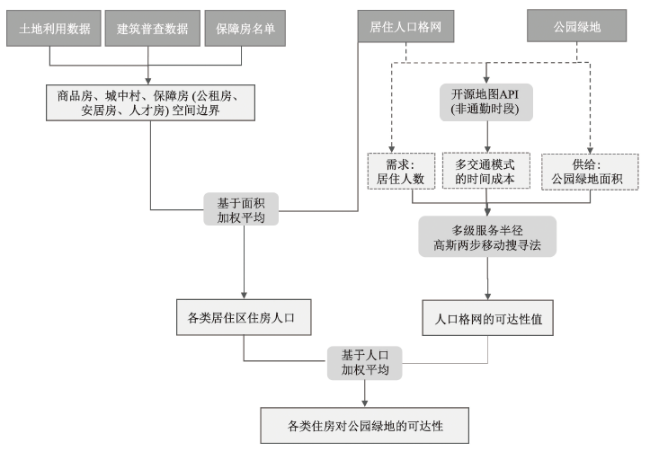
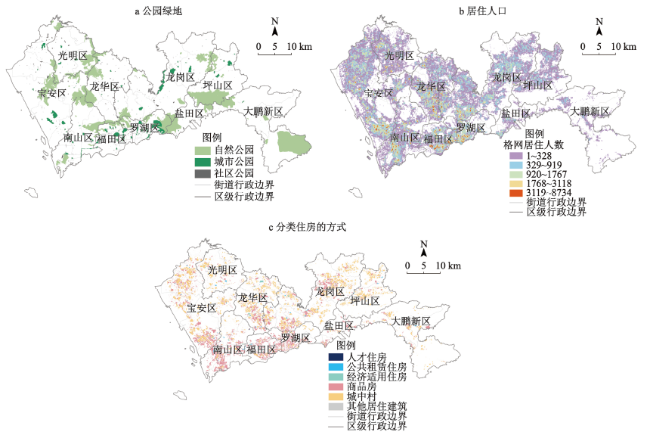
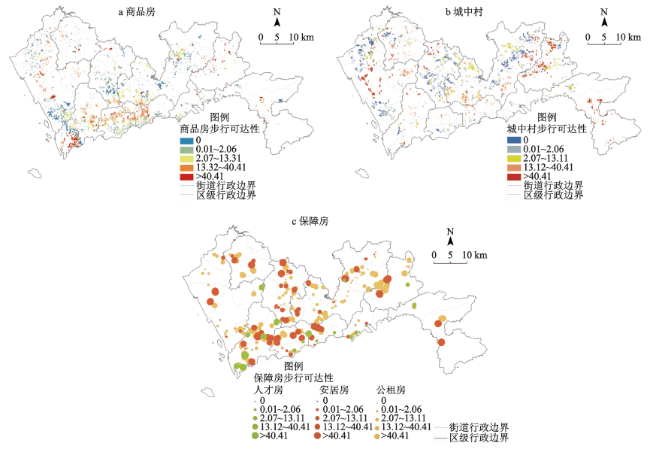
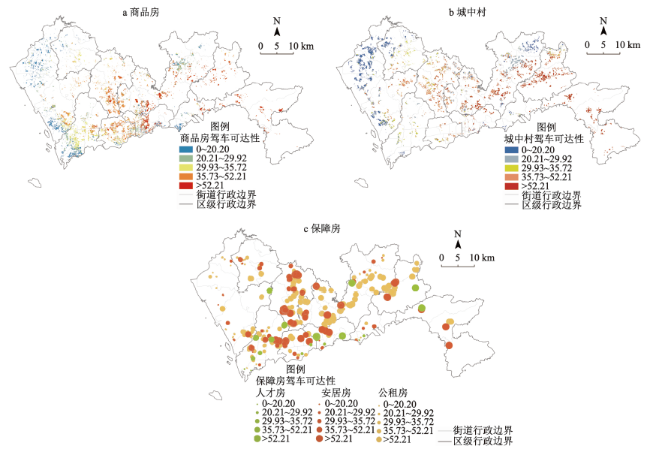
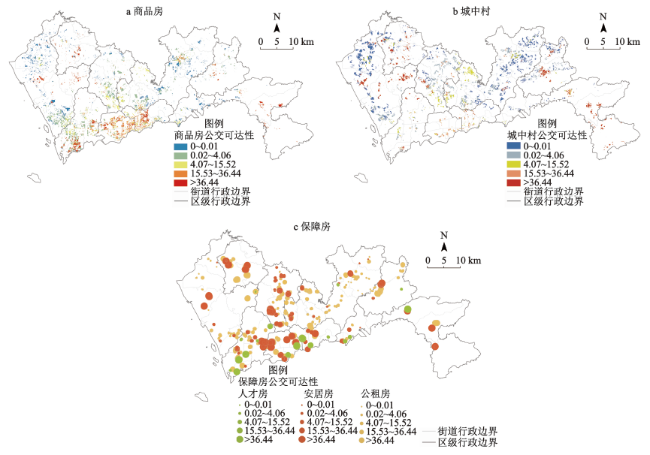
Park green space, which is important green infrastructure in the city, can provide opportunities for physical exercise, social communication, nature exposure and emergency hedge. Spatially fine-grained evaluation of accessibility to park green space has been limited by data availability. This study fills the research gap by using mobile SDK positioning data in Shenzhen. It uses this data to obtain population distribution; it uses the improved Gaussian two-step floating catchment area method to calculate park green space accessibility of neighborhood scale; it uses open source map API to calculate the travel time of different transportation modes. The accessibility indicators are analyzed by different housing groups: Urban villages, affordable housing and commodity housing. The results show first a social disparity in the accessibility of park green space in Shenzhen. The accessibility of urban villages is good and balanced. Public rental housing and economic and comfortable housing have poor accessibility to neighborhood parks, while the former has high accessibility to urban parks and the latter to natural parks. In addition, the accessibility of talent worker housing is the lowest. Talent housing has high accessibility to neighborhood parks, but poor accessibility to urban parks and natural parks, resulting in low overall accessibility. Third, Transportation mode has great influence on the accessibility to green space. Accessibility by driving among housing groups is nominal, but transit accessibility among them shows significant variation. Based on these findings, our study makes the following suggestions, including 1) improving the presence of neighborhood parks around public rental housing and economic and comfortable housing. 2) prioritizing transit service improvement for low-income residential areas, and 3) changing the planning requirement for green space supply in land development. Our study enriches existing literature by helping readers to understand park green space accessibility from the perspective of social equity in Chinese cities and by establishing a better connection to planning practice with spatially fine-grained data and evaluation indicators.
Huang Jiuju , Lin Yiting , Tao Zhuolin , Yang Jiawen . Evaluation of Park Green Space Accessibility in Shenzhen from the Perspective of Social Equity[J]. SCIENTIA GEOGRAPHICA SINICA, 2022 , 42(5) : 896 -906 . DOI: 10.13249/j.cnki.sgs.2022.05.015
表1 多交通模式下深圳各住房群体公园绿地可达性Table 1 Multi-model park green space accessibility of different residences in Shenzhen |
| 类型 | 社区公园 | 城市公园 | 自然公园 | 汇总 | |||||||||
| 步行 | 步行 | 公交 | 驾车 | 步行 | 公交 | 驾车 | 步行 | 公交 | 驾车 | ||||
| 1商品房 | 0.81 | 9.99 | 64.70 | 7.28 | 22.19 | 41.53 | 46.91 | 32.99 | 106.23 | 54.19 | |||
| 2城中村 | 0.89 | 9.13 | 7.79 | 5.31 | 41.63 | 45.08 | 45.64 | 51.66 | 52.86 | 50.95 | |||
| 3保障房 | 0.40 | 10.15 | 9.05 | 6.01 | 49.59 | 31.66 | 46.28 | 60.14 | 40.71 | 52.29 | |||
| ①公共租赁住房 | 0.32 | 11.61 | 9.68 | 6.46 | 33.66 | 23.61 | 49.90 | 45.59 | 33.29 | 56.36 | |||
| ②安居型商品房 | 0.53 | 7.75 | 4.58 | 5.04 | 87.23 | 51.08 | 40.29 | 95.51 | 55.66 | 45.32 | |||
| ③人才住房 | 0.85 | 1.57 | 46.17 | 6.20 | 6.18 | 5.10 | 25.78 | 8.61 | 51.28 | 31.99 | |||
| [1] |
王晓明, 李贞, 蒋昕, 等. 城市公园绿地生态效应的定量评估[J]. 植物资源与环境学报, 2005, 14(4): 42-45.
Wang Xiaoming, Li Zhen, Jiang Xin et al. Quantitative evaluation on the ecological benefit of public park green space. Journal of Plant Resources and Environment, 2005, 14(4): 42-45.
|
| [2] |
谢军飞, 李延明, 李树华. 北京城市公园绿地应急避险功能布局研究[J]. 中国园林, 2007, 23(7): 23-29.
Xie Junfei, Li Yanming, Li Shuhua. The layout study on the emergency and disaster-prevention functions of thegreen space of Beijing City Parks. Chinese Landscape Architecture, 2007, 23(7): 23-29.
|
| [3] |
Maas J. Green space, urbanity, and health: How strong is the relation?[J]. Journal of Epidemiology & Community Health, 2006, 60(7): 587-592.
|
| [4] |
谭少华, 洪颖. 居住绿地的使用与城市居民健康的关系研究[J]. 建筑与文化, 2015, 131(2): 108-109.
Tan Shaohua, Hong Ying. A study on the relationship between the residential green space use and city residents’ health. Architecture & Culture, 2015, 131(2): 108-109.
|
| [5] |
陈筝, 董楠楠, 刘颂, 等. 上海城市公园使用对健康影响研究[J]. 风景园林, 2017, 146(9): 99-105.
Chen Zheng, Dong Nannan, Liu Song et al. Study on the impacts of urban park use on public health in Shanghai. Landscape Architecture, 2017, 146(9): 99-105.
|
| [6] |
Maas J, van Dillen S M E, Verheij R A et al. Social contacts as a possible mechanism behind the relation between green space and health[J]. Health & Place, 2009, 15(2): 586-595.
|
| [7] |
袁媛, 韩焱, 张志君, 等. 居住区绿地率分区研究——以广州市番禺区为例[J]. 城市规划, 2015, 39(5): 97-104.
Yuan Yuan, Han Yan, Zhang Zhijun et al. Research onzoning of green area ratio in residential areas: Based on Panyu district of Guangzhou City. City Planning Review, 2015, 39(5): 97-104.
|
| [8] |
Nesbitt L, Meitner M J, Sheppard S R J et al. The dimensions of urban green equity: A framework for analysis[J]. Urban Forestry & Urban Greening, 2018, 34: 240-248.
|
| [9] |
江海燕, 周春山. 国外城市公园绿地的社会分异研究[J]. 城市问题, 2010, 177(4): 84-88.
Jiang Haiyan, Zhou Chunshan. Social differentiation of foreign urban public parks. Urban Problems, 2010, 177(4): 84-88.
|
| [10] |
Dai D. Racial/ethnic and socioeconomic disparities in urban green space accessibility: Where to intervene?[J]. Landscape and Urban Planning, 2011, 102(4): 234-244.
|
| [11] |
Macintyre S. Deprivation amplification revisited; or, is it always true that poorer places have poorer access to resources for healthy diets and physical activity?[J]. The International Journal of Behavioral Nutrition and Physical Activity, 2007, 4(1): 32-38.
|
| [12] |
Roemmich J N, Epstein L H, Raja S et al. Association of access to parks and recreational facilities with the physical activity of young children[J]. Preventive Medicine, 2006, 43(6): 437-441.
|
| [13] |
Kira Krenichyn. Women and physical activity in an urban park: Enrichment and support through an ethic of care[J]. Journal of Environmental Psychology, 2004, 24(1): 117-130.
|
| [14] |
Matsuoka R H, Kaplan R. People needs in the urban landscape: Analysis of Landscape and Urban Planning contributions[J]. Landscape & Urban Planning, 2008, 84(1): 7-19.
|
| [15] |
Xu M, Xin J, Su S et al. Social inequalities of park accessibility in Shenzhen, China: The role of park quality, transport modes, and hierarchical socioeconomic characteristics[J]. Journal of Transport Geography, 2017, 62: 38-50.
|
| [16] |
何格, 肖扬, 吴蓉, 等. 社会公平视角下广州市城市公园可达性研究[J]. 风景园林, 2020, 27(1): 90-96.
He Ge, Xiao Yang, Wu Rong et al. Study on urban park accessibility in Guangzhou from the perspective of social equity. Landscape Architecture, 2020, 27(1): 90-96.
|
| [17] |
Tan P Y, Samsudin R. Effects of spatial scale on assessment of spatial equity of urban park provision[J]. Landscape & Urban Planning, 2017, 158: 139-154.
|
| [18] |
Li Z, Fan Z, Song Y et al. Assessing equity in park accessibility using a travel behavior-based G2SFCA method in Nanjing, China[J]. Journal of Transport Geography, 2021: 96.
|
| [19] |
宋伟轩, 毛宁, 陈培阳, 等. 基于住宅价格视角的居住分异耦合机制与时空特征——以南京为例[J]. 地理学报, 2017, 72(4): 589-602.
Song Weixuan, Mao Ning, Chen Peiyang et al. Coupling mechanism and spatial-temporal pattern of residential differentiation from the perspective of housing prices: A case study of Nanjing. Acta Geographica Sinica, 2017, 72(4): 589-602.
|
| [20] |
余思奇, 朱喜钢, 刘风豹, 等. 社会公平视角下城市公园绿地的可达性研究——以南京中心城区为例[J]. 现代城市研究, 2020(8): 18-25.
Yu Siqi, Zhu Xigang, Liu Fengbao et al. The evaluation of accessibilities to urban parks from the perspective of social justice: A case study of Nanjing. Modern Urban Research, 2020(8): 18-25.
|
| [21] |
Culyer A J, Wagstaff A. Equity and equality in health and health-care[J]. Journal of Health Economics, 1993, 12(4): 431-457.
|
| [22] |
Tsou K W, Hung Y T, Chang Y L. An accessibility-based integrated measure of relative spatial equity in urban public facilities[J]. Cities, 2005, 22(6): 424-435.
|
| [23] |
Pereira R, Schwanen T, Banister D. Distributive justice and equity in transportation[J]. Transport Reviews, 2017, 37(2): 170-191.
|
| [24] |
Neutens T. Accessibility, equity and health care: Review and research directions for transport geographers[J]. Journal of Transport Geography, 2015, 43: 14-27.
|
| [25] |
Whitehead J, Pearson A L, Lawrenson R et al. How can the spatial equity of health services be defined and measured? A systematic review of spatial equity definitions and methods[J]. Journal of Health Services Research & Policy, 2019, 24(4): 270-278.
|
| [26] |
Zhu L, Zhong S, Tu W et al. Assessing spatial accessibility to medical resources at the community level in Shenzhen, China[J]. International Journal of Environmental Research and Public Health, 2019, 16(2): 242.
|
| [27] |
Yin H W, Kong F. Accessibility and equity assessment on urban green space[J]. Acta Ecologica Sinica, 2008, 28(7): 3375-3383.
|
| [28] |
廖含文. 北京中心城区开放性绿色空间格局、评价与优化思考[J]. 现代城市研究, 2019(9): 104-111.
Liao Hanwen. Mapping, evaluation and improvement of open accessible green spaces in central urban districts of Beijing. Modern Urban Research, 2019(9): 104-111.
|
| [29] |
蔡彦庭, 文雅, 程炯, 等. 广州中心城区公园绿地空间格局及可达性分析[J]. 生态环境学报, 2011, 20(11): 1647-1652.
Cai Yanting, Wen Ya, Cheng Jiong et al. Spatial pattern and accessibility of urban park greenland in center of Guangzhou City. Ecology and Environmental Sciences, 2011, 20(11): 1647-1652.
|
| [30] |
仝德, 孙裔煜, 谢苗苗. 基于改进高斯两步移动搜索法的深圳市公园绿地可达性评价[J]. 地理科学进展, 2021, 40(7): 1113-1126.
Tong De, Sun Yiyu, Xie Miaomiao. Evaluation of green space accessibility based on improved Gaussian two-step floating catchment area method: A case study of Shenzhen City, China. Progress in Geography, 2021, 40(7): 1113-1126.
|
| [31] |
杨文越, 李昕, 陈慧灵, 等. 基于多出行模式两步移动搜索法的广州多尺度绿地可达性与公平性研究[J]. 生态学报, 2021, 41(15): 1-11.
Yang Wenyue, Li Xin, Chen Huiling et al. Multi-scale accessibility of green spaces and its equity in Guangzhou based on multi-mode two-step floating catchment area method (M2SFCA). Acta Ecologica Sinica, 2021, 41(15): 1-11.
|
| [32] |
Kwan M. Space-time and integral measures of individual accessibility: A comparative analysis using a point-based framework[J]. Geographical Analysis, 1998, 30(3): 191-216.
|
| [33] |
Tao Z, Yao Z, Kong H et al. Spatial accessibility to healthcare services in Shenzhen, China: Improving the multi-modal two-step floating catchment area method by estimating travel time via online map APIs[J]. BMC Health Services Research, 2018, 18(1): 32-39.
|
| [34] |
Dai D. Black residential segregation, disparities in spatial access to health care facilities, and late-stage breast cancer diagnosis in metropolitan Detroit[J]. Health & Place, 2010, 16(5): 1038-1052.
|
| [35] |
Xing L, Liu Y, Liu X. Measuring spatial disparity in accessibility with a multi-mode method based on park green spaces classification in Wuhan, China[J]. Applied Geography, 2018, 94: 251-261.
|
| [36] |
陶卓霖, 程杨. 两步移动搜寻法及其扩展形式研究进展[J]. 地理科学进展, 2016, 35(5): 589-599.
Tao Zhuolin, Cheng Yang. Research progress of the two-step floating catchment area method and extensions. Progress in Geography, 2016, 35(5): 589-599.
|
| [37] |
浩飞龙, 张浩然, 王士君. 基于多交通模式的长春市公园绿地空间可达性研究[J]. 地理科学, 2021, 41(4): 695-704.
Hao Feilong, Zhang Haoran, Wang Shijun. Spatial accessibility of urban green space in central area of Changchun: An analysis based on the multi-trip model. Scientia Geographica Sinica, 2021, 41(4): 695-704.
|
| [38] |
吴健生, 司梦林, 李卫锋. 供需平衡视角下的城市公园绿地空间公平性分析——以深圳市福田区为例[J]. 应用生态学报, 2016, 27(9): 2831-2838.
Wu Jiansheng, Si Menglin, Li Weifeng. Spatial equity analysis of urban green space from the perspective of balance between supply and demand: A case study of Futian District, Shenzhen, China. Chinese Journal of Applied Ecology, 2016, 27(9): 2831-2838.
|
| [39] |
住房与城乡建设部.城市绿地分类标准(CJJ/T85-2017)[S]. 2017.
Ministry of Housing and Urban-Rural Development of the People’s Republic of China.Standard for classification of urban green space (CJJ/T85-2017). 2017.
|
| [40] |
李孟桐, 杨令宾, 魏冶. 高斯两步移动搜索法的模型研究——以上海市绿地可达性为例[J]. 地理科学进展, 2016, 35(8): 990-996.
Li Mengtong, Yang Lingbin, Wei Ye. Improved Gaussian based 2-step floating catchment area method: A case study of green space accessibility in Shanghai. Progress in Geography, 2016, 35(8): 990-996.
|
| [41] |
住房与城乡建设部. 城市绿地规划标准(GB/T51346-2019)[S].2019.
Ministry of Housing and Urban-Rural Development of the People’s Republic of China.Standard for planning of urban green space (GB/T51346-2019).2019.
|
| [42] |
深圳市住房和建设局. 深圳住房保障发展规划(2016-2020) [EB/OL]. http://zjj.sz.gov.cn/xxgk/ghjh/content/post_9597083.html,2016-12-21.
Shenzhen Housing and Construction Bureau. Shenzhen public housing development plan (2016-2020). http://zjj.sz.gov.cn/xxgk/ghjh/content/post_9597083.html,2016-12-21.
|
| [43] |
Lotfi S, Koohsari M J. Measuring objective accessibility to neighborhood facilities in the city (A case study: Zone 6 in Tehran, Iran)[J]. Cities, 2009, 26(3): 133-140.
|
| [44] |
郑思齐, 师展. “土地财政”下的土地和住宅市场: 对地方政府行为的分析[J]. 广东社会科学, 2011, 148(2): 5-10.
Zheng Siqi, Shi Zhan. Land and housing market under “land finance”: An analysis of local government behavior. Social Sciences in Guangdong, 2011, 148(2): 5-10.
|
/
| 〈 |
|
〉 |