



Relationship between urban spatial morphology factors and land surface temperature in summer: A case of the central district of Tianjin
Received date: 2021-10-27
Revised date: 2022-02-12
Online published: 2023-02-20
Supported by
National Key Research and Development Program of China(2018YFA0606300)
Copyright
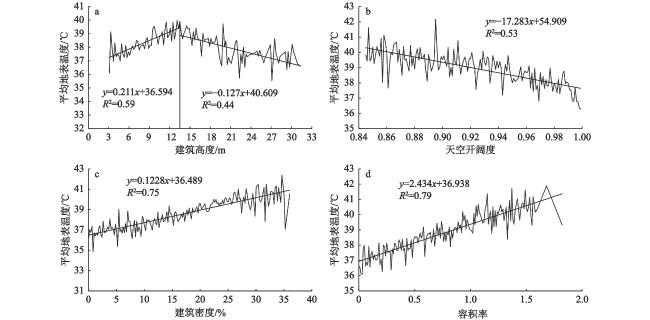
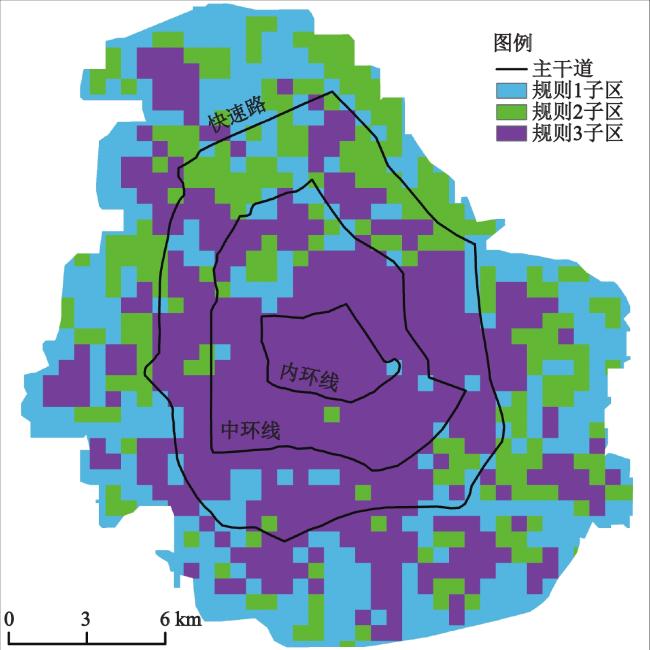
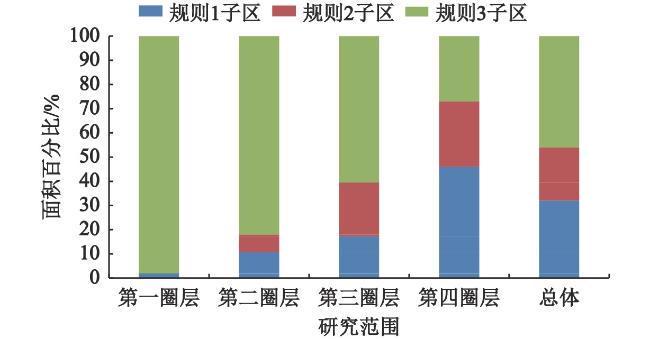
This study uses RS and GIS technique to invert key spatial morphology factors and land surface temperature in the central district of Tianjin. Based on linear regression model and the Cubist model, an in-depth analysis of the relationship between spatial morphology factors (i.e. building density, floor area ratio, building height, and sky view factor) and land surface temperature is accomplished, and the thresholds of key morphology factors are clarified. This study finds that: 1) There is a piecewise linear relationship between building height and land surface temperature, and the response threshold for the mutant change is 13.5 meters; There is a linear negative correlation between sky view factor and land surface temperature. Both building density and floor area ratio show a linear positive correlation with land surface temperature. 2) The Cubist model delineates threshold of building density as 13% and sets the threshold of building height as 9.9 meters. Three sub-rules are established: Rule 1 shows that building density is a positive contributing factor for low development intensity scenarios; Rule 2 shows floor area ratio is a positive contributing factor for medium development intensity scenario; Rule 3 shows that building density and floor area ratio belong to the positive contributing factors, while building height and sky view factor are negative contributing factors for high development intensity scenarios. 3) The Cubist model is more applicable than the global regression model, and it establishes a linear relationship between independent variables and dependent variables for subarea representing different rules which is partitioned by the thresholds of independent variables.
Song Xinbo , Li Gen , Liang Dongpo , Huang He , Guo Jun . Relationship between urban spatial morphology factors and land surface temperature in summer: A case of the central district of Tianjin[J]. SCIENTIA GEOGRAPHICA SINICA, 2023 , 43(2) : 360 -369 . DOI: 10.13249/j.cnki.sgs.2023.02.017
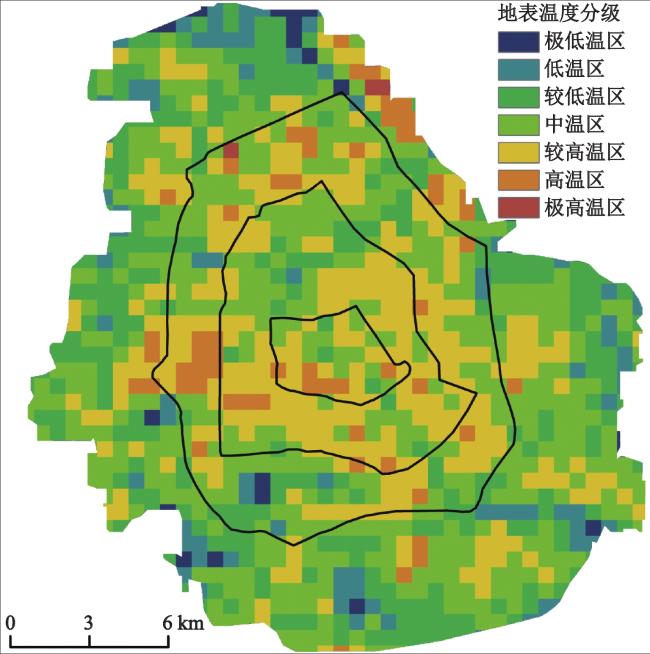
表1 不同研究范围内温度分区面积比例Table 1 Area proportions of LST zones in different research scopes |
| 地表温度分区 | 地表温度区间/℃ | 面积比例/% | ||||
| 第一圈层 | 第二圈层 | 第三圈层 | 第四圈层 | 研究区总体 | ||
| 极低温区 | <33.91 | 0.00 | 0.00 | 0.68 | 1.96 | 1.30 |
| 低温区 | 33.91~35.79 | 0.00 | 0.61 | 2.60 | 9.23 | 6.06 |
| 较低温区 | 35.79~37.68 | 8.04 | 9.18 | 11.81 | 30.53 | 22.02 |
| 中温区 | 37.68~39.57 | 34.18 | 34.03 | 38.68 | 39.45 | 38.41 |
| 较高温区 | 39.57~41.46 | 42.69 | 51.59 | 36.92 | 15.17 | 26.80 |
| 高温区 | 41.46~43.35 | 15.09 | 4.58 | 9.00 | 3.40 | 5.16 |
| 极高温区 | >43.35 | 0.00 | 0.00 | 0.32 | 0.26 | 0.24 |
表2 不同空间形态因子在Cubist模型中的条件贡献与模型贡献Table 2 Condition and submodel contribution of different morphology factors in Cubist model |
| 因子 | 条件贡献/% | 子模型贡献/% |
| 注:空白处为无此项。 | ||
| 建筑密度(BD) | 100 | 81 |
| 建筑高度(BH) | 60 | 41 |
| 容积率(FAR) | 60 | |
| 天空开阔度(SVF) | 41 | |
| [1] |
周伟奇, 田媪钰. 城市三维空间形态的热环境效应研究进展[J]. 生态学报, 2020, 40(2): 416-427.
Zhou Weiqi, Tian Yunyu. Effects of urban three-dimensional momphology on thermal environment: A review. Acta Eicologica Sinica, 2020, 40(2): 416-427.
|
| [2] |
林中立, 徐涵秋. 基于LCZ的城市热岛强度研究[J]. 地球信息科学学报, 2017, 19(5): 713-722.
Lin Zhongli, Xu Hanqiu. A study of urban heat island intensity based on ''local climate zones''. Journal of Geoinformation Science, 2017, 19(5): 713-722.
|
| [3] |
Zhou Weiqi, Wang Jia, Cadenasso Mary L. Effects of the spatial configuration of trees on urban heat mitigation: A comparative study[J]. Remote Sensing of Environment, 2017, 195: 1-12.
|
| [4] |
黄亚平, 卢有朋, 单卓然, 等. 武汉市主城区热岛空间格局及其影响因素研究[J]. 城市规划, 2019, 43(4): 41-47.
Huang Yaping, Lu Youpeng, Shan Zhuoran et al. Study on spatial layout and influencing factors of heat island in the main urban area of Wuhan. City Planning Review, 2019, 43(4): 41-47.
|
| [5] |
崔胜辉, 徐礼来, 黄云凤, 等. 城市空间形态应对气候变化研究进展及展望[J]. 地理科学进展, 2015, 34(10): 1209-1218.
Cui Shenghui, Xu Lilai, Huang Yunfeng et al. Progress and prospect of study on urban spatial patterns to cope with climate change. Progress in Geography, 2015, 34(10): 1209-1218.
|
| [6] |
岳文泽, 刘学. 基于城市控制性详细规划的热岛效应评价[J]. 应用生态学报, 2016, 27(11): 3631-3640.
Yue Wenze, Liu Xue. Assessment on heat island effect based on urban regulatory planning. Chinese Journal of Applied Ecology, 2016, 27(11): 3631-3640.
|
| [7] |
Scarano M, Mancini F. Assessing the relationship between sky view factor and land surface temperature to the spatial resolution[J]. International Journal of Remote Sensing, 2017, 38(23): 6910-6929.
|
| [8] |
Yin C H, Yuan M, Lu Y P et al. Effects of urban form on the urban heat island effect based on spatial regression model[J]. Science of the Total Environment, 2018, 634: 696-704.
|
| [9] |
Zheng Z, Zhou W Q, Yan J L et al. The higher, the cooler? Effects of building height on land surface temperatures in residential areas of Beijing[J]. Physics and Chemistry of the Earth, 2019, 110: 149-156.
|
| [10] |
孙喆. 高密度城区形态要素对热环境的影响作用——以北京市五环内区域为例[J]. 生态环境学报, 2020, 29(10): 2020-2027.
Sun Zhe. Impact of urban morphology factors on thermal environment in high density urban areas: A case of Beijing within 5th ring road. Ecology and Environmental Sciences, 2020, 29(10): 2020-2027.
|
| [11] |
郭冠华, 陈颖彪, 魏建兵, 等. 粒度变化对城市热岛空间格局分析的影响[J]. 生态学报, 2012, 32(12): 3764-3772.
Guo Guanhua, Chen Yingbiao, Wei Jianbing et al. Impacts of grid sizes on urban heat island pattern analysis. Acta Ecologica Sinica, 2012, 32(12): 3764-3772.
|
| [12] |
刘丹, 于成龙. 城市扩张对热环境时空演变的影响——以哈尔滨为例[J]. 生态环境学报, 2018, 27(3): 509-517.
Liu Dan, Yu Chenglong. Urban expansion and its influence on spatio-temporal variation of thermal environment: A case study of Harbin City. Ecology and Environmental Sciences, 2018, 27(3): 509-517.
|
| [13] |
Chun B, Guhathakurta S. The impacts of three-dimensional surface characteristics on urban heat islands over the diurnal cycle[J]. The Professional Geographer, 2017, 69(2): 191-202.
|
| [14] |
潘玥, 廖明伟, 廖明, 等. 鄱阳湖核心流域地区城市地表形态的异质性对地表温度的影响研究[J]. 生态环境学报, 2017, 26(8): 1358-1367.
Pan Yue, Liao Mingwei, Liao Ming et al. Study on the impacts of urban morphology heterogeneity on land temperature in the core area of Poyang Lake. Ecology and Environmental Sciences, 2017, 26(8): 1358-1367.
|
| [15] |
陈康林, 龚建周, 陈晓越, 等. 广州城市绿色空间与地表温度的格局关系研究[J]. 生态环境学报, 2016, 25(5): 842-849.
Chen Kanglin, Gong Jianzhou, Chen Xiaoyue et al. The pattern relationship research of greenspace and surface temperature in Guangzhou City. Ecology and Environmental Sciences, 2016, 25(5): 842-849.
|
| [16] |
王耀斌, 赵永华, 韩磊, 等. 西安市景观格局与城市热岛效应的耦合关系[J]. 应用生态学报, 2017, 28(8): 2621-2628.
Wang Yaobin, Zhao Yonghua, Han Lei et al. Coupling relationship of landscape pattern and urban heat island effect in Xi'an, China. Chinese Journal of Applied Ecology, 2017, 28(8): 2621-2628.
|
| [17] |
郭宇, 王宏伟, 张喆, 等. 南京市热环境与地表覆被的时空尺度效应及驱动机制研究[J]. 生态环境学报, 2020, 29(7): 1403-1411.
Guo Yu, Wang Hongwei, Zhang Zhe et al. Spatio-temporal scale effect and driving mechanism of thermal environment and land surface cover in Nanjing. Ecology and Environmental Sciences, 2020, 29(7): 1403-1411.
|
| [18] |
Cai H Y, Xu X L. Impacts of built-up area expansion in 2D and 3D on regional surface temperature[J]. Sustainability, 2017, 9(10): 1-16.
|
| [19] |
Wong N H, Jusuf S K, Syafii N I et al. Evaluation of the impact of the surrounding urban morphology on building energy consumption[J]. Solar Energy, 2011, 85(1): 57-71.
|
| [20] |
Perini K, Magliocco A. Effects of vegetation, urban density, building height, and atmospheric conditions on local temperatures and thermal comfort[J]. Urban Forestry and Urban Greening, 2014, 13(3): 495-506.
|
| [21] |
蔡智, 韩贵锋. 山地城市空间形态的地表热环境效应——基于LCZ的视角[J]. 山地学报, 2018, 36(4): 617-627.
Cai Zhi, Han Guifeng. Assessing land surface temperature in the mountain city with different urban spatial form based on Local Climate Zone scheme. Mountain Research, 2018, 36(4): 617-627.
|
| [22] |
Berger C, Rosentreter J, Voltersen M et al. Spatio-temporal analysis of the relationship between 2D/3D urban site characteristics and land surface temperature[J]. Remote Sensing of Environment, 2017, 193: 225-243.
|
| [23] |
张海龙, 祝善友, 高玚, 等. 城市空间形态学参数与晴好天气下热岛强度关系[J]. 应用气象学报, 2016, 27(2): 249-256.
Zhang Hailong, Zhu Shanyou, Gao Yang et al. The relationship between urban spatial morphology paramenters and urban heat island intensity under fine weather condition. Journal of Applied Meteorological Science, 2016, 27(2): 249-256.
|
| [24] |
冯章献, 王士君, 金珊合, 等. 长春市城市形态及风环境对地表温度的影响[J]. 地理学报, 2019, 74(5): 902-911.
Feng Zhangxian, Wang Shijun, Jin Shanhe et al. Effects of urban morphology and wind conditions on land surface temperature in Changchun. Acta Geographica Sinica, 2019, 74(5): 902-911.
|
| [25] |
Guo G H, Wu Z F, Xiao R B et al. Impacts of urban bio-physical composition on land surface temperature in urban heat island clusters[J]. Landscape and Urban Plan, 2015, 135: 1-10.
|
| [26] |
Yu S Y, Chen Z Q, Yu B L et al. Exploring the relationship between 2D/3D landscape pattern and land surface temperature based on explainable Extreme Gradient Boosting Tree: A case study of Shanghai, China[J]. Science of the Total Environment, 2020, 725: 138229.
|
| [27] |
刘焱序, 彭建, 王仰麟. 城市热岛效应与景观格局的关联: 从城市规模景观组分到空间构型[J]. 生态学报, 2017, 37(23): 7769-7780.
Liu Yanxu, Peng Jian, Wang Yanglin. Relationship between urban heat island and landscape patterns: From city size and landscape composition to spatial configuration. Acta Ecologica Sinica, 2017, 37(23): 7769-7780.
|
| [28] |
Sobrino J A, Jiménez-Muñoz J C, Paolini L. Land surface temperature retrieval from Landsat TM5[J]. Remote Sensing of Environment, 2004, 90(4): 434-440.
|
| [29] |
孙喆. 北京市第一道绿化隔离带区域热环境特征及绿地降温作用[J]. 生态学杂志, 2019, 38(10): 3496-3505.
Sun Zhe. Thermal environment characteristic and cooling effect of greenery in Beijing First Green Belt area. Chinese Journal of Ecology, 2019, 38(10): 3496-3505.
|
| [30] |
Zhou X L, Okaze T, Ren C et al. Evaluation of urban heat islands using local climate zones and the influence of sea-land breeze[J]. Sustainable Cities and Society, 2020, 55: 102060.
|
| [31] |
Pan X Z, Zhao Q G, Chen J et al. Analyzing the variation of building density using high spatial resolution satellite images: The example of Shanghai City[J]. Sensors, 2008, 8(4): 2541-2550.
|
| [32] |
Xu Y, Ren C, Ma P F et al. Urban morphology detection and computation for urban climate research[J]. Landscape and Urban Planning, 2017, 167: 212-224.
|
| [33] |
孔繁花, 尹海伟, 刘金勇, 等. 城市绿地降温效应研究进展与展望[J]. 自然资源学报, 2013, 28(1): 171-181.
Kong Fanhua, Yin Haiwei, Liu Jinyong et al. A review of research on the urban green space cooling effect. Journal of Natural Resources, 2013, 28(1): 171-181.
|
| [34] |
Srivanit M, Kazunori H. The influence of urban morphology indicators on summer diurnal range of urban climate in Bangkok metropolitan area, Thailand[J]. International Journal of Civil & Environmental Engineering, 2011, 11(5): 34-46.
|
| [35] |
Chun B, Guldmann J M. Spatial statistical analysis and simulation of the urban heat island in high-density central cities[J]. Landscape and Urban Planning, 2014, 125: 76-88.
|
| [36] |
韩贵锋, 蔡智, 谢雨丝, 等. 城市建设强度与热岛的相关性——以重庆市开州区为例[J]. 土木建筑与环境工程, 2016, 38(5): 138-147.
Han Guifeng, Cai Zhi, Xie Yusi et al. Correlation between urban construction and urban heat island: A case study in Kaizhou District, Chongqing. Journal of Civil, Architectural & Environmental Engineering, 2016, 38(5): 138-147.
|
| [37] |
谢苗苗, 王仰麟, 付梅臣. 城市地表温度热岛影响因素研究进展[J]. 地理科学进展, 2011, 30(1): 35-41.
Xie Miaomiao, Wang Yanglin, Fu Meichen. An overview and perspective about causative factors of surface urban heat island effect. Progress in Geography, 2011, 30(1): 35-41.
|
| [38] |
Guo G H, Zhou X Q, Wu Z F et al. Characterizing the impact of urban morphology heterogeneity on land surface temperature in Guangzhou, China[J]. Environmental Modelling & Software, 2016, 84: 427-439.
|
| [39] |
黄群芳. 城市空间形态对城市热岛效应的多尺度影响研究进展[J]. 地理科学, 2021, 41(10): 1832-1842.
Huang Qunfang. Effects of urban spatial morphology on urban heat island effect from multi-spatial scales perspectives. Scientia Geographica Sinica, 2021, 41(10): 1832-1842.
|
/
| 〈 |
|
〉 |