



Evolution of economic linkage network structure in China-Russia Border Regions
Received date: 2022-10-26
Revised date: 2023-03-11
Online published: 2023-11-20
Supported by
National Natural Science Foundation of China(42071162)
National Natural Science Foundation of China(42101165)
Special Investigation Project of National Science and Technology Basic Resources(2017FY101303-1)
Research Planning of Philosophy and Social Sciences in Heilongjiang Province(21JLC201)
Copyright
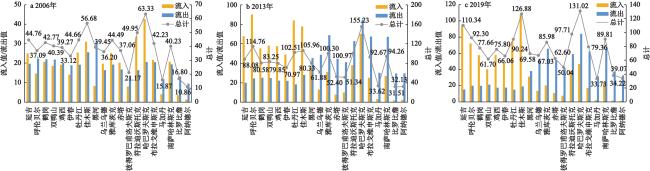
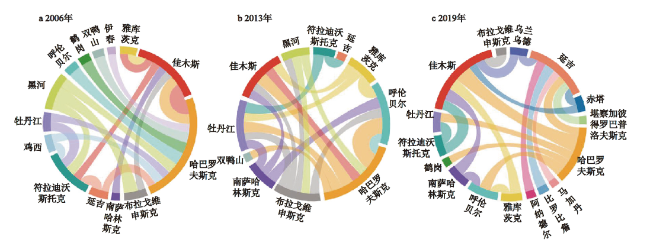
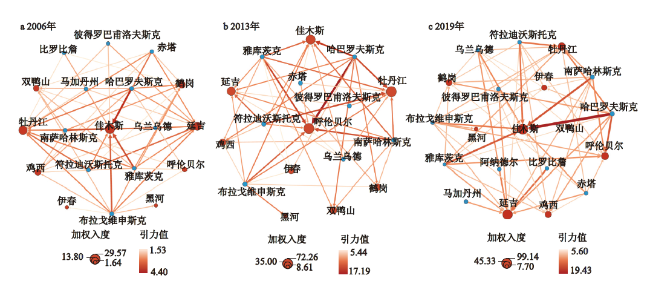
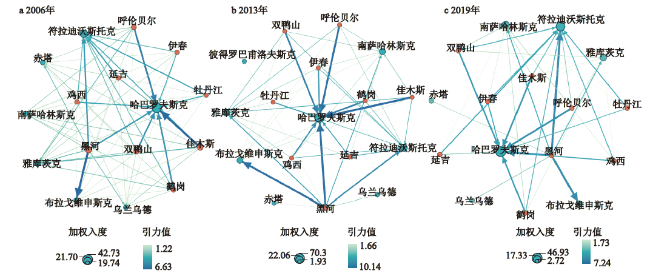
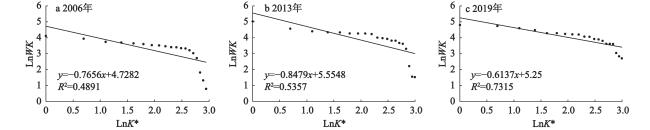
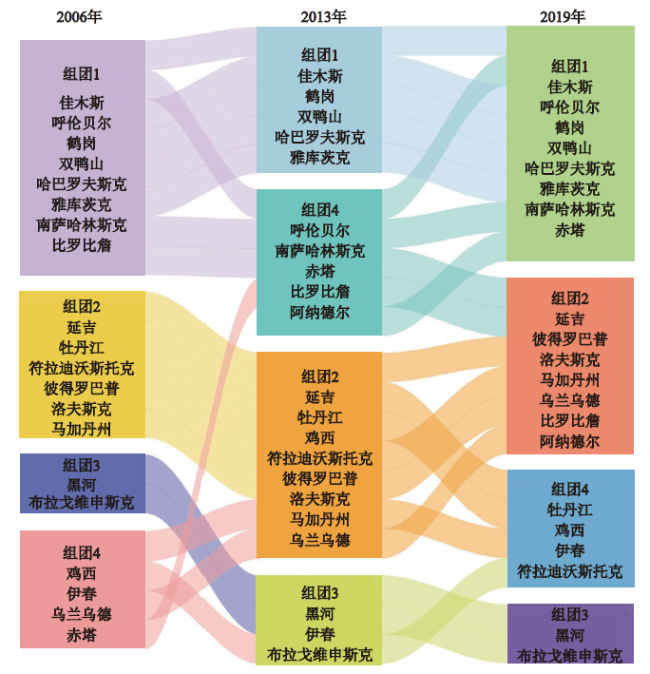
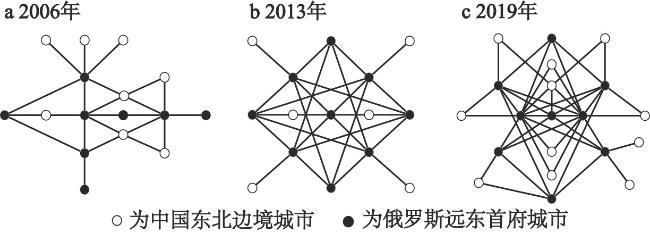
Under the background of complicated international situation, the economic cooperation in China-Russia border region is facing new development opportunities. This paper takes 9 China-Russia border cities in Northeast China and 11 regional central cities in Far East Russia as the research objects, adopts the modified gravity model to build a directional weighted network, analyzes the evolution pattern and structural characteristics of economic linkage from 2006 to 2019, and further abstracts the network structural mode to determine the evolution quality. The results show that: 1) The economic linkage between Chinese and Russian cities tends to be closer, in which the attraction of Chinese border cities is significantly improved, while the radiation effect of Russian Far East cities is gradually weakened. The evolution pattern of the economic linkage network has both path dependence and path creation, and the spatial situation of neighborhood effect and hierarchical effect interweaves and coexists. 2) The networking capacity of the border cities in Northeast China increased significantly in the past 13 years, forming a radial structure with Jiamusi, Yanji and Mudanjiang as the core nodes. The siphon effect of Khabarovsk and Vladivostok made the network flow direction and flow rate more and more dependent on the role of high-priority nodes. 3) From 2006 to 2013, the hierarchy of network improved but the matching weakened, and the network structural showed dependence and lock-in. From 2013 to 2019, the network structure changed from stereoscopic to flat, from closed to open, and the flexibility and complexity of network structure showed significant improvement. At the same time, the core community has promoted the collaborative development with other functional communities under the significant spillover effect. 4) The structural mode of economic linkage network showed a typical heteromatching hub-spoke structure. From 2006 to 2013, the "core-edge" structure of the network system became more and more obvious, and the core cities had the strongest control and transmission power; From 2013 to 2019, the network structure transitioned to a new state of evolution, and the network system entered a coordinated development trend with core-prominent and edge-flat.
Li Yuxin , Zhang Pingyu , Chu Nanchen , Yang Qifeng . Evolution of economic linkage network structure in China-Russia Border Regions[J]. SCIENTIA GEOGRAPHICA SINICA, 2023 , 43(11) : 1921 -1933 . DOI: 10.13249/j.cnki.sgs.2023.11.005
表1 城市经济引力评价指标体系Table 1 Evaluation index system of urban economic gravity |
| 要素层 | 指标层 | 单位 | 权重/% |
| 经济规模 | 固定资产投资总额 | 万元 | 8.61 |
| 地方财政预算收入 | 万元 | 5.92 | |
| 地方财政预算支出 | 万元 | 9.21 | |
| 产业活动 | 社会消费品零售总额 | 万元 | 15.04 |
| 产业活动单位数 | 个 | 12.15 | |
| 单位职工月均工资 | 元 | 3.54 | |
| 人力资本 | 人口密度 | 人/km2 | 5.98 |
| 年末单位从业人数 | 万人 | 7.98 | |
| 交通联系 | 公路密度 | km/100(km)2 | 11.21 |
| 铁路站点数量 | 个 | 6.04 | |
| 机场数量 | 个 | 8.31 | |
| 口岸数量 | 个 | 6.01 |
表2 中俄边境主要城市节点经济联系的中心性特征Table 2 Centrality of economic linkage among major cities in the China-Russia border regions in 2006—2019 |
| 2006年 | 2013年 | 2019年 | |||||||||
| 节点中 心度 | 强度中 心度 | 加权净 溢出度 | 节点中 心度 | 强度中 心度 | 加权净 溢出度 | 节点中 心度 | 强度中 心度 | 加权净 溢出度 | |||
| 注:节点中心度为入度和出度的总和,强度中心度为加权入度和加权出度的总和,加权净溢出度为加权出度与加权入度的差值;—为无数据。 | |||||||||||
| 延吉 | 15 | 38.59 | 6.03 | 11 | 71.45 | 51.69 | 12 | 99.44 | 90.40 | ||
| 呼伦贝尔 | 7 | 20.83 | –16.95 | 11 | 96.31 | 77.13 | 10 | 72.70 | 59.68 | ||
| 鹤岗 | 13 | 33.75 | –6.77 | 8 | 50.83 | 34.33 | 10 | 58.61 | 39.77 | ||
| 双鸭山 | 11 | 28.47 | –11.61 | 8 | 53.17 | 36.69 | 8 | 36.97 | 17.67 | ||
| 鸡西 | 10 | 24.96 | –8.20 | 9 | 55.21 | 41.31 | 10 | 57.98 | 40.84 | ||
| 伊春 | 6 | 15.28 | –15.28 | 7 | 39.48 | 26.58 | 10 | 49.20 | 32.20 | ||
| 牡丹江 | 14 | 36.74 | 8.32 | 10 | 81.97 | 70.61 | 10 | 72.52 | 64.22 | ||
| 佳木斯 | 16 | 51.70 | 4.06 | 9 | 76.44 | 56.16 | 12 | 113.73 | 101.71 | ||
| 黑河 | 8 | 30.38 | –26.34 | 6 | 45.34 | –28.12 | 6 | 37.30 | –21.90 | ||
| 乌兰乌德 | 12 | 27.90 | 8.28 | 8 | 45.55 | –45.55 | 8 | 50.41 | –50.41 | ||
| 雅库茨克 | 15 | 40.58 | 9.82 | 9 | 71.22 | –60.44 | 9 | 66.62 | –58.86 | ||
| 赤塔 | 13 | 30.07 | 10.43 | 7 | 37.46 | –37.46 | 7 | 44.89 | –44.89 | ||
| 彼得罗巴甫洛夫斯克 | 3 | 6.20 | –6.20 | 5 | 27.36 | –27.36 | 7 | 37.49 | –37.49 | ||
| 符拉迪沃斯托克 | 12 | 42.22 | 24.88 | 10 | 71.55 | –47.87 | 15 | 88.08 | –24.50 | ||
| 哈巴罗夫斯克 | 16 | 61.25 | 24.21 | 17 | 152.25 | –11.65 | 15 | 121.18 | –41.34 | ||
| 布拉戈维申斯克 | 12 | 32.08 | –2.16 | 10 | 77.29 | –57.87 | 10 | 69.31 | –55.11 | ||
| 马加丹州 | 2 | 3.79 | –3.79 | 2 | 9.27 | –9.27 | 3 | 17.06 | –17.06 | ||
| 南萨哈林斯克 | 14 | 34.39 | 3.49 | 9 | 68.83 | –59.49 | 9 | 67.44 | –58.96 | ||
| 比罗比詹 | 1 | 2.22 | –2.22 | 1 | 4.78 | –4.78 | 3 | 20.99 | –20.99 | ||
| 阿纳德尔 | — | — | — | 1 | 4.64 | –4.64 | 2 | 14.98 | –14.98 | ||
表3 2006—2019年中俄边境城市经济联系网络的总体特征指标Table 3 Economic network of the China-Russia border regions in 2006—2019 |
| 引力指向 | 中国 | 俄罗斯 | |||||
| 2006年 | 2013年 | 2019年 | 2006年 | 2013年 | 2019年 | ||
| 联系临界值 | 1.53 | 5.44 | 5.60 | 1.22 | 1.66 | 1.73 | |
| 网络密度 | 0.16 | 0.18 | 0.16 | 0.26 | 0.17 | 0.15 | |
| 网络节点数 | 19 | 17 | 20 | 16 | 17 | 16 | |
| 网络关系数 | 56 | 48 | 59 | 63 | 46 | 37 | |
| [1] |
衣保中, 张洁妍. 东北亚地区“一带一路”合作共生系统研究[J]. 东北亚论坛, 2015, 24(3):: 65-74+127-128.
Yi Baozhong, Zhang Jieyan. Study on the cooperative symbiosis system of the "one belt and one road" in Northeast Asia. Northeast Asia Forum, 2015, 24(3):: 65-74+127-128.
|
| [2] |
宋涛, 刘卫东, 李玏. 国外对地缘视野下边境地区的研究进展及其启示[J]. 地理科学进展, 2016, 35(3): 276-285.
Song Tao, Liu Weidong, Li Le. International research on the border regions with a geopolitical perspective and revelation. Progress in Geography, 2016, 35(3): 276-285.
|
| [3] |
刘清才, 齐欣. “一带一路”框架下中国东北地区与俄罗斯远东地区发展战略对接与合作[J]. 东北亚论坛, 2018, 27(2): 34-51+127.
Liu Qingcai, Qi Xin. On the regional development strategic connectivity and cooperation between Northeast China and the Far East of Russia under the framework of belt and road initiative. Northeast Asia Forum, 2018, 27(2): 34-51+127.
|
| [4] |
杨文龙, 游小珺, 杜德斌. 商品贸易网络视角下地缘经济系统的属性与功能演进[J]. 地理研究, 2021, 40(2): 356-372.
Yang Wenlong, You Xiaojun, Du Debin. The evolutionary properties and functions of the geo-economic system from the perspective of global commodity trade network. Geographical Research, 2021, 40(2): 356-372.
|
| [5] |
张天媛, 黄季夏, 王利. 2030—2070年中俄油气资源海运可达性与通航成本演变预估[J]. 地理学报, 2021, 76(5): 1122-1135.
Zhang Tianyuan, Huang Jixia, Wang Li. Maritime accessibility and navigation cost evolution estimation of Sino-Russian oil and gas resources from 2030 to 2070. Acta Geographica Sinica, 2021, 76(5): 1122-1135.
|
| [6] |
李飞, 张克, 董锁成, 等. 中蒙俄经济走廊耕地资源格局与合作战略研究[J]. 地理研究, 2021, 40(11): 3063-3072.
Li Fei, Zhang Ke, Dong Suocheng et al. Distribution of arable land resources and cooperation policies in the China-Mongolia-Russia economic corridor. Geographical Research, 2021, 40(11): 3063-3072.
|
| [7] |
初楠臣, 张平宇. 基于可达性的中俄跨国班列沿线城市经济联系——以中俄K19/K20班列为例[J]. 经济地理, 2018, 38(6): 10-18.
Chu Nanchen, Zhang Pingyu. Transnational urban economic connection based on railway accessibility—Taking sino-Russian K19/K20 class train as an example. Economic Geography, 2018, 38(6): 10-18.
|
| [8] |
Матвеевская А С, Погодин С Н, Тао В Ц. Россия и Китай в сфере международного туризма.Вестник Санкт-Петербургского университета логия [J]. Философия И Конфликтология 2020, 36(2): 384-393.
|
| [9] |
初楠臣, 张平宇, 吴相利, 等. 俄罗斯西伯利亚和远东联邦区首府的空间经济联系与格局特征研究[J]. 地理研究, 2021, 40(11): 2986-3001.
Chu Nanchen, Zhang Pingyu, Wu Xiangli et al. Study on the spatial economic linkage and pattern characteristics of the capitals in Siberian and Far East Federal Districts in Russia. Geographical Research, 2021, 40(11): 2986-3001.
|
| [10] |
贝斯特里茨基, 扎乌萨耶夫, 鲁岑科, 等. 俄罗斯远东地区与中国边境合作的新构想[J]. 东欧中亚市场研究, 2002(10): 36-40.
Bystritski, Zau Sayef, Ruzenko et al. A new idea of border cooperation between Far East Russia and China. Journal of Eurasian Economy, 2002(10): 36-40.
|
| [11] |
Izotov D. A.Trade interaction between Chinese regions and Russia: The border effect[J]. Spatial Economics Prostranstvennaya Ekonomika, 2020(3): 24-51.
|
| [12] |
马腾, 葛岳静, 黄宇, 等. 基于流量数据的中美两国与东北亚地缘经济关系研究[J]. 地理学报, 2020, 75(10): 2076-2091.
Ma Teng, Ge Yuejing, Huang Yu et al. Geo-economic relations of China and the US in Northeast Asia: An analysis based on flow data. Acta Geographica Sinica, 2020, 75(10): 2076-2091.
|
| [13] |
黄晓东, 马海涛, 苗长虹. 基于创新企业的中国城市网络联系特征[J]. 地理学报, 2021, 76(4): 835-852.
Huang Xiaodong, Ma Haitao, Miao Changhong. Connectivity characteristics for city networks in China based on innovative enterprises. Acta Geographica Sinica, 2021, 76(4): 835-852.
|
| [14] |
黄宇, 葛岳静, 刘晓凤. 基于库仑引力模型的中美日地缘经济关系测算[J]. 地理学报, 2019, 74(2): 285-296.
Huang Yu, Ge Yuejing, Liu Xiaofeng. Calculation of the geoeconomic relationships between China, the USA and Japan based on Coulomb force model. Acta Geographica Sinica, 2019, 74(2): 285-296.
|
| [15] |
李梦程, 王成新, 刘海猛, 等. 黄河流域城市发展质量评价与空间联系网络特征[J]. 经济地理, 2021, 41(12): 84-93.
Li Mengcheng, Wang Chengxin, Liu Haimeng et al. Evaluation of urban development quality and characteristics of spatial connection network in the Yellow River Basin. Economic Geography, 2021, 41(12): 84-93.
|
| [16] |
蒋自然, 曹卫东, 王成金, 等. 基于势能联系模型的区域潜在经济关系研究——长三角26 个城市的实证分析[J]. 地理科学, 2020, 40(12): 1967-1977.
Jiang Ziran, Cao Weidong, Wang Chengjin et al. Regional potential economic relations based on the potential energy connection model: Empirical analysis of 26 cities in Yangtze River Delta. Scientia Geographica Sinica, 2020, 40(12): 1967-1977.
|
| [17] |
谢永顺, 王成金, 韩增林, 等. 哈大城市带网络结构韧性演化研究[J]. 地理科学进展, 2020, 39(10): 1619-1631.
Xie Yongshun, Wang Chengjin, Han Zenglin et al. Structural resilience evolution of multiple urban networks in the Harbin-Dalian urban belt. Progress in Geography, 2020, 39(10): 1619-1631.
|
| [18] |
Boschma R, Frenken K. The spatial evolution of innovation networks: A proximity perspective[M]//Stephan Heblich. The handbook of evolutionary Economic Geography. Cheltenham: Edward Elgar, 2010: 120-135.
|
| [19] |
吴康, 方创琳, 赵渺希. 中国城市网络的空间组织及其复杂性结构特征[J]. 地理研究, 2015, 34(4): 711-728.
Wu Kang, Fang Chuanglin, Zhao Miaoxi. The spatial organization and structure complexity of Chinese intercity networks. Geographical Research, 2015, 34(4): 711-728.
|
| [20] |
冯颖, 侯孟阳, 姚顺波. 中国粮食生产空间关联网络的结构特征及其形成机制[J]. 地理学报, 2020, 75(11): 2380-2395.
Feng Ying, Hou Mengyang, Yao Shunbo. Structural characteristics and formation mechanism of spatial correlation network of grain production in China. Acta Geographica Sinica, 2020, 75(11): 2380-2395.
|
| [21] |
Zhikharevich B S, Rusetskaya O V. Fluctuations in the relative dynamics of development of Russia's regional centers in 2003—2013[J]. Regional Research of Russia, 2018, 8(1): 34-45.
|
| [22] |
Newman M E J. Assortative mixing in networks[J]. Physical Review Letters, 2002, 89(20): 208701
|
| [23] |
Newman M E J. Modularity and community structure in networks[J]. Proceedings of the National Academy of Sciences, 2006, 103(23): 8577-8582.
|
| [24] |
初楠臣, 张平宇, 吴相利, 等. 俄罗斯西伯利亚与远东联邦区人口收缩的空间格局与影响因素[J]. 经济地理, 2021, 41(11): 1-8.
Chu Nanchen, Zhang Pingyu, Wu Xiangli et al. Spatial pattern and influencing factors of population shrinkage in Siberian and Far East Federal Districts in Russia. Economic Geography, 2021, 41(11): 1-8.
|
| [25] |
初楠臣, 张平宇, 吴相利, 等. 俄罗斯城镇化发展水平测度及空间分异[J]. 世界地理研究, 2021, 30(2): 257-266.
Chu Nanchen, Zhang Pingyu, Wu Xiangli et al. Measurement and spatial differentiation of urbanization development in Russia. World Regional Studies, 2021, 30(2): 257-266.
|
| [26] |
孙斌栋, 丁嵩. 大城市有利于小城市的经济增长吗?——来自长三角城市群的证据[J]. 地理研究, 2016, 35(9): 1615-1625.
Sun Bindong, Ding Song. Do large cities contribute to economic growth of small cities? Evidence from Yangtze River Delta in China. Geographical Research, 2016, 35(9): 1615-1625.
|
| [27] |
林柄全, 谷人旭, 王俊松, 等. 从集聚外部性走向跨越地理边界的网络外部性——集聚经济理论的回顾与展望[J]. 城市发展研究, 2018, 25(12): 82-89.
Lin Bingquan, Gu Renxu, Wang Junsong et al. From agglomeration externalities to network externalities of crossing borders: Frontier progress of agglomeration economics. Urban Development Studies, 2018, 25(12): 82-89.
|
| [28] |
魏冶, 修春亮. 城市网络韧性的概念与分析框架探析[J]. 地理科学进展, 2020, 39(3): 488-502.
Wei Ye, Xiu Chunliang. Study on the concept and analytical framework of city network resilience. Progress in Geography, 2020, 39(3): 488-502.
|
| [29] |
Li L, Liu S, Li C et al. What matters for regional economic resilience amid multi shock situations: Structural or agency? Evidence from resource-based cities in China[J]. Sustainability, 2022, 14(9): 5701
|
| [30] |
宋涛, 程艺, 刘卫东, 等. 中国边境地缘经济的空间差异及影响机制[J]. 地理学报, 2017, 72(10): 1731-1745.
Song Tao, Cheng Yi, Liu Weidong et al. The spatial disparity and impact mechanism of geo-economy in the border areas of China. Acta Geographica Sinica, 2017, 72(10): 1731-1745.
|
/
| 〈 |
|
〉 |