



Influence of geography major studies on university students’ human-environment coordination concept using Implicit Association Test
Received date: 2025-01-03
Revised date: 2025-02-14
Online published: 2025-06-24
Supported by
Natural Science Foundation of Guangdong Province for Distinguished Young Scholar(2022B1515020087)
National Natural Science Foundation of China(42430515)
Guangdong Provincial Philosophy and Social Science Planning Project(GD24CJY02)
Science and Technology Program of Guangzhou (Institute)(2023A03J0063)
Hunan Provincial Basic Education Teaching Reform Research Project(Y2024947)
Guangdong Rural Regional System Field Scientific Observation and Research Station(2021B1212050026)
Copyright
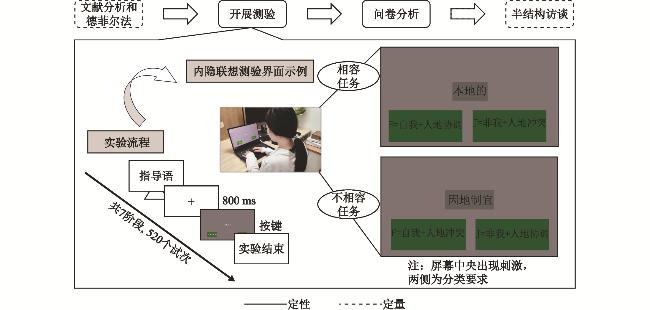
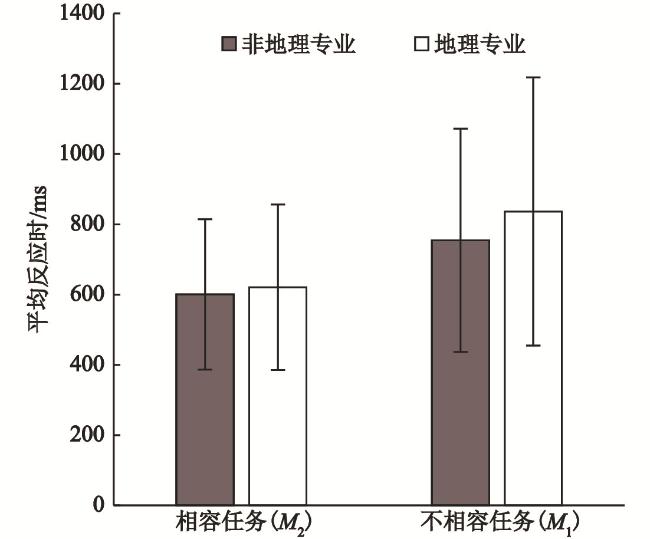
The ‘International Charter on Geography Education’ explicitly states that helping students understand human-environment relationships is crucial for sustainable development education. Among these, the human-environment coordination concept, as a fundamental value in geography, is a key objective in the development of core competencies at the higher education level. However, current research on the assessment of human-environment coordination concept mainly focuses on basic geography education and predominantly utilizes explicit measurement methods such as paper-and-pencil tests or questionnaires. This study first uses literature analysis and the Delphi method to collect and design vocabulary for the experiment, followed by the use of the Implicit Association Test (IAT) and survey methods to measure university students’ implicit and explicit attitudes towards human-environment coordination concept. Finally, interviews are conducted to triangulate the evaluation results. The participants were third- and fourth-year undergraduate students from both geography and non-geography majors at a comprehensive university in China. The results show: 1) Both the IAT effect values and explicit measurement scores of students are relatively high, reflecting a generally positive recognition of human-environment coordination concept; 2) Geography students exhibit significantly higher IAT effects than non-geography students, indicating a notable difference in implicit connection strength; 3) Geography students’ response times in both compatible and incompatible tasks are significantly longer than those of non-geography students; 4) A dissociation effect is observed between implicit and explicit recognition of human-environment coordination concept, validating the effectiveness and value of the IAT as a tool for measuring human-environment coordination. These findings not only verify the positive role of geography in cultivating college students’ human-environment coordination concept, but provide dual-perspective measurement evidence of explicit attitude and implicit attitude for geography education reform and offer practical insights for enhancing university students’ core competencies.
Yuan Zhenjie , He Jun’an , Yang Liguo . Influence of geography major studies on university students’ human-environment coordination concept using Implicit Association Test[J]. GEOGRAPHICAL SCIENCE, 2025 , 45(6) : 1193 -1205 . DOI: 10.13249/j.cnki.sgs.20250001
表1 被试者基本信息Table 1 Basic information of subjects |
| 性别/人 | 城市户籍/人 | 农村户籍/人 | 占比/% | |
| 地理专业 | 男:14 | 7 | 7 | 22.6 |
| 女:18 | 8 | 10 | 29.0 | |
| 非地理专业 | 男:15 | 7 | 8 | 24.2 |
| 女:15 | 6 | 9 | 24.2 |
表2 内隐联想测验概念词与属性词列表Table 2 List of conceptual words and attribute words in Implicit Association Test |
| 内容 | 词条 | |
| 概念词 | 自我词 | 我、我的、我们、我们的、自己、自己的、本人、本人的、本地、本地的 |
| 非我词 | 他、他的、他们、他们的、别人、别人的、他人、他人的、外地、外地的 | |
| 属性词 | 正向词 | 可持续发展、人地共存、循环利用、物种多样、生态平衡、尊重规律、天人合一、绿色发展、 因地制宜、和谐共生 |
| 负向词 | 人地冲突、乱砍滥伐、土地盐碱化、物种灭绝、过度捕捞、环境污染、不可持续、水土流失、 生态破坏、多样性减少 | |
表3 内隐联想测验程序设计Table 3 Implicit Association Test procedures design |
| 阶段 | 任务描述 | 按F键 | 按J键 | 试次/次 |
| 1 | 初始概念词辨别 | 自我词 | 非我词 | 40 |
| 2 | 联想属性词辨别 | 人地协调的正向词 | 人地协调的负向词 | 40 |
| 3 | 相容联合辨别(练习) | 正向词+自我词 | 负向词+非我词 | 40 |
| 4 | 相容联合辨别(正式) | 正向词+自我词 | 负向词+非我词 | 160 |
| 5 | 相反属性词辨别 | 人地协调的负向词 | 人地协调的正向词 | 40 |
| 6 | 不相容联合辨别(练习) | 负向词+自我词 | 正向词+非我词 | 40 |
| 7 | 不相容联合辨别(正式) | 负向词+自我词 | 正向词+非我词 | 160 |
4 Descriptive statistics and single factor analysis of variance for Implicit Association Test (D)IAT效应(D)的描述性统计及单因素方差分析 |
| 变量 | Dmean | SD | df | 均方差 | F | P | |
| 性别 | 男 | 0.607 | 0.220 | 1 | 0.026 | 0.507 | 0.479 |
| 女 | 0.649 | 0.235 | |||||
| 户籍 | 城市 | 0.625 | 0.246 | 1 | 0.005 | 0.005 | 0.945 |
| 农村 | 0.629 | 0.212 | |||||
| 专业 | 地理 | 0.687 | 0.192 | 1 | 0.222 | 4.591 | 0.036 |
| 非地理 | 0.566 | 0.243 | |||||
表5 反应时数据的重复测量方差分析Table 5 Repeated measures analysis of variance on reaction time data |
| 变量 | df | 均方差 | F | P | |
| 任务 | 1 | 0.000 | 0.176 | ||
| 专业 | 1 | 133.568 | 0.000 | 0.014 | |
| 任务×专业 | 1 | 56.955 | 0.000 | 0.006 |
| [1] |
Shi J G, Xu K, Si H Y et al. Investigating intention and behaviour towards sorting household waste in Chinese rural and urban-rural integration areas. Journal of Cleaner Production, 2021, 298:126827
|
| [2] |
Tuan Y. Topophilia: A study of environmental perception, attitudes, and values[M]. New York: Columbia University Press, 1974.
|
| [3] |
The International Geographical Union Commission on Geographical Education. Lucerne declaration on geographical education for sustainable development[EB/OL]. http://www. igu-cge.org,2007-07-31.
|
| [4] |
朱雪梅, 姚慧. 从《地理教育国际宪章》看地理基础教育的改革发展[J]. 中国教育学刊, 2020(3):93-97.
Zhu Xuemei, Yao Hui. On the reform and development of geographical education from the International Charter on Geographical Education. Journal of Chinese Education, 2020(3):93-97.
|
| [5] |
马振明, 常华锋. 指向地理核心素养的“必修课程” 教学实践与思考——兼述《普通高中地理课程标准(2017年版2020年修订)》学习体会[J]. 地理教学, 2020(19):31-35.
Ma Zhenming, Chang Huafeng. Teaching practice and thinking of “compulsory course” aiming at the core literature of geography—A review of the learning experience of Geography Curriculum Standards for General Senior High Schools (2017 edition, 2020 revision). Geography Teaching, 2020(19):31-35.
|
| [6] |
Miao S, Meadows M E, Duan Y S et al. How does the geography curriculum contribute to education for sustainable development?lessons from China and the USA. Sustainability, 2022, 14(17):10637
|
| [7] |
Bagoly-Simó P, Hemmer I, Reinke V. Training ESD change agents through geography: Designing the curriculum of a master’s program with emphasis on Education for Sustainable Development (ESD). Journal of Geography in Higher Education, 2018, 42(2):174-191.
|
| [8] |
Li X J, Kong Y F, Peng B Y. Development of geography in higher education in China since 1980. Journal of Geography in Higher Education, 2007, 31(1):19-37.
|
| [9] |
郭玉珊, 和晓江, 孙俊, 等. 1980年以来中国高等地理教育机构的发展: 类型、增长与分布演变[J]. 地理科学进展, 2021, 40(11):1911-1924.
Guo Yushan, He Xiaojiang, Sun Jun et al. The development of higher geography education institutions in China since 1980: Type, growth and distribution evolution. Progress in Geography, 2021, 40(11):1911-1924.
|
| [10] |
García de la Vega Alfonso. A proposal for geography competence assessment in geography fieldtrips for sustainable education. Sustainability, 2022, 14(3):1429
|
| [11] |
Milfont T L, Duckitt J. The environmental attitudes inventory: A valid and reliable measure to assess the structure of environmental attitudes. Journal of Environmental Psychology, 2010, 30(1):80-94.
|
| [12] |
Bakir-Demir T, Berument S K, Sahin-Acar B. The relationship between greenery and self-regulation of children: The mediation role of nature connectedness. Journal of Environmental Psychology, 2019, 65:101327
|
| [13] |
McBeth W, Volk T L. The national environmental literacy project: A baseline study of middle grade students in the United States. The Journal of Environmental Education, 2009, 41(1):55-67.
|
| [14] |
Dunlap R E, Van Liere K D. The “new environmental paradigm”. The Journal of Environmental Education, 1978, 9(4):10-19.
|
| [15] |
Liu P H, Teng M M, Han C F. How does environmental knowledge translate into pro-environmental behaviors? The mediating role of environmental attitudes and behavioral intentions. Science of the Total Environment, 2020, 728:138126
|
| [16] |
段玉山, 姚泽阳. 地理学科核心素养测评——基于现代测量理论的视角[J]. 中国考试, 2018(2):24-29.
Duan Yushan, Yao Zeyang. Assessing the core competences of Geography: From the perspective of modern measurement theory. China Examinations, 2018(2):24-29.
|
| [17] |
黄雯倩, 卢晓旭. 人地协调观量表的开发与检验[J]. 地理教育, 2023(12):3-6,12.
Huang Wenqian, Lu Xiaoxu. Development and test of man-land coordination scale. Education of Geography, 2023(12):3-6,12.
|
| [18] |
姚泽阳, 段玉山. 地理核心素养下高中生人地观念的测量分析[J]. 中国考试, 2019(11):14-21.
Yao Zeyang, Duan Yushan. Measuring the man-land relationship view of high school students in the context of key competencies of geography. China Examinations, 2019(11):14-21.
|
| [19] |
Wilson T D, Lindsey S, Schooler T Y. A model of dual attitudes. Psychological Review, 2000, 107(1):101-126.
|
| [20] |
Gawronski B, Bodenhausen G V. Associative and propositional processes in evaluation: An integrative review of implicit and explicit attitude change. Psychological Bulletin, 2006, 132(5):692-731.
|
| [21] |
Greenwald A G, McGhee D E, Schwartz J L. Measuring individual differences in implicit cognition: The implicit association test. Journal of Personality and Social Psychology, 1998, 74(6):1464-1480.
|
| [22] |
侯珂, 邹泓, 张秋凌. 内隐联想测验: 信度、效度及原理[J]. 心理科学进展, 2004(2):223-230.
Hou Ke, Zou Hong, Zhang Qiuling. Implicit Association Test: Reliability, validity and principle. Advances in Psychological Science, 2004(2):223-230.
|
| [23] |
Axt J R, Feng T Y, Bar-Anan Y. The good and the bad: Are some attribute words better than others in the implicit association test?. Behavior Research Methods, 2021, 53(6):2512-2527.
|
| [24] |
王敏, 朱竑, 王盈盈, 等. 城市再开发背景下的社区感知——基于内隐联想测验的研究[J]. 地理科学, 2018, 38(12):2006-2013.
Wang Min, Zhu Hong, Wang Yingying et al. Sense of community in the background of urban redevelopment: Research with Implicit Association Test. Scientia Geographica Sinica, 2018, 38(12):2006-2013.
|
| [25] |
周晓虹. 认同理论: 社会学与心理学的分析路径[J]. 社会科学, 2008(4):46-53,187.
Zhou Xiaohong. Identity theory: An analyzing method of sociology and psychology. Journal of Social Sciences, 2008(4):46-53,187.
|
| [26] |
Erikson H E. Childhood and society[M].New York: W·W·Norton, 1963: 261.
|
| [27] |
贾英健. 认同的哲学意蕴与价值认同的本质[J]. 山东师范大学学报(人文社会科学版), 2006, 51(1):10-16.
Jia Yingjian. The philosophical meaning of identification and the essence of value identification. Journal of Shandong Teachers University (Humanities and Social Sciences), 2006, 51(1):10-16.
|
| [28] |
王洪, 岳童, 符明秋. 从情感认同到自我认同: 价值观认同的内隐实验研究[J]. 广东社会科学, 2021(5):64-73.
Wang Hong, Yue Tong, Fu Mingqiu. From emotional identification to self identification: An implicit experimental study of value identification. Social Sciences in Guangdong, 2021(5):64-73.
|
| [29] |
Wang J, Geng L N, Schultz P et al. Mindfulness increases the belief in climate change: The mediating role of connectedness with nature[J]. Environment and Behavior, 2019, 51(1): 3-23.
|
| [30] |
Schultz P W, Tabanico J. Self, identity, and the natural environment: Exploring implicit connections with Nature. Journal of Applied Social Psychology, 2007, 37(6):1219-1247.
|
| [31] |
Brick C, Lai C K. Explicit (but not implicit) environmentalist identity predicts pro-environmental behavior and policy preferences. Journal of Environmental Psychology, 2018, 58:8-17.
|
| [32] |
Bruni C M, Schultz P W. Implicit beliefs about self and nature: Evidence from an IAT game. Journal of Environmental Psychology, 2010, 30(1):95-102.
|
| [33] |
Falk E, Scholz C. Persuasion, influence, and value: Perspectives from communication and social neuroscience. Annual Review of Psychology, 2018, 69:329-356.
|
| [34] |
Thomas G O, Walker I. The development and validation of an implicit measure based on biospheric values. Environment and Behavior, 2016, 48(5):659-685.
|
| [35] |
吴瑞林, 卫静远, 雷宇. 基于SC-IAT的中华民族认同感内隐测量——来自少数民族大学生的数据[J]. 心理学探新, 2021, 41(5):424-430.
Wu Ruilin, Wei Jingyuan, Lei Yu. Implicit measurement of Chinese national identity based on SC-IAT data from minority college students. Psychological Exploration, 2021, 41(5):424-430.
|
| [36] |
Vicente-Molina M A, Fernández-Sainz A, Izagirre-Olaizola J. Does gender make a difference in pro-environmental behavior? The case of the Basque Country University students. Journal of Cleaner Production, 2018, 176:89-98.
|
| [37] |
Echavarren J M. The gender gap in environmental concern: Support for an ecofeminist perspective and the role of gender egalitarian attitudes. Sex Roles, 2023, 89(9):610-623.
|
| [38] |
范叶超, 洪大用. 差别暴露、差别职业和差别体验 中国城乡居民环境关心差异的实证分析[J]. 社会, 2015, 35(3):141-167.
Fan Yechao, Hong Dayong. Differential-exposure, differential-occupation, and differential-experience: An empirical analysis on differences in Chinese urban-rural residents’ environmental concern. Chinese Journal of Sociology, 2015, 35(3):141-167.
|
| [39] |
Kowalewski D. Environmental attitudes in town and country: A community survey. Environmental Politics, 1994, 3(2):295-311.
|
| [40] |
王民, 张元元, 蔚东英, 等. 高中地理核心素养水平划分标准研究(连载二) “综合思维” 水平划分标准与案例研究[J]. 中学地理教学参考, 2017(13):28-31.
Wang Min, Zhang Yuanyuan, Wei Dongying et al. A study on the classification standard of senior high school geography core literacy level (part II): The classification standard and case study of “comprehensive thinking”. Teaching Reference of Middle School Geography, 2017(13):28-31.
|
| [41] |
李金波, 许百华. 人机交互过程中认知负荷的综合测评方法[J]. 心理学报, 2009, 41(1):35-43.
Li Jinbo, Xu Baihua. Synthetic assessment of cognitive load in human-machine interaction process. Acta Psychologica Sinica, 2009, 41(1):35-43.
|
| [42] |
钱淼, 周立霞, 鲁甜甜, 等. 幼儿友好型内隐联想测验的建构及有效性[J]. 心理学报, 2015, 47(7):903-913.
Qian Miao, Zhou Lixia, Lu Tiantian et al. Construction and validity of child-friendly implicit association test. Acta Psychologica Sinica, 2015, 47(7):903-913.
|
| [43] |
施生旭, 甘彩云. 环保工作满意度、环境知识与公众环保行为——基于CGSS2013数据分析[J]. 软科学, 2017, 31(11):88-92.
Shi Shengxu, Gan Caiyun. Environmental protection job satisfaction, environmental knowledge and public environmental behavior—An analysis of the 2013 Chinese general social survey. Soft Science, 2017, 31(11):88-92.
|
| [44] |
Lankenau G R. Fostering connectedness to nature in higher education. Environmental Education Research, 2018, 24(2):230-244.
|
| [45] |
Barton K. Exploring the benefits of field trips in a food geography course. Journal of Geography, 2017, 116(6):237-249.
|
| [46] |
Gómez-Ruiz M L, Morales-Yago F J, de Lázaro-Torres M L. Outdoor education, the enhancement and sustainability of cultural heritage: Medieval Madrid. Sustainability, 2021, 13(3):1106
|
| [47] |
Brendl C M, Markman A B, Messner C. How do indirect measures of evaluation work? Evaluating the inference of prejudice in the Implicit Association Test. Journal of Personality and Social Psychology, 2001, 81(5):760-773.
|
/
| 〈 |
|
〉 |