



Spatio-temporal dynamic evolution and driving mechanism of efficiency of urban-rural integration development in the Yangtze River Economic Belt
Received date: 2024-10-25
Revised date: 2025-03-10
Online published: 2025-07-18
Supported by
National Natural Science Foundation of China(41771162)
National Natural Science Foundation of China(41971188)
Copyright
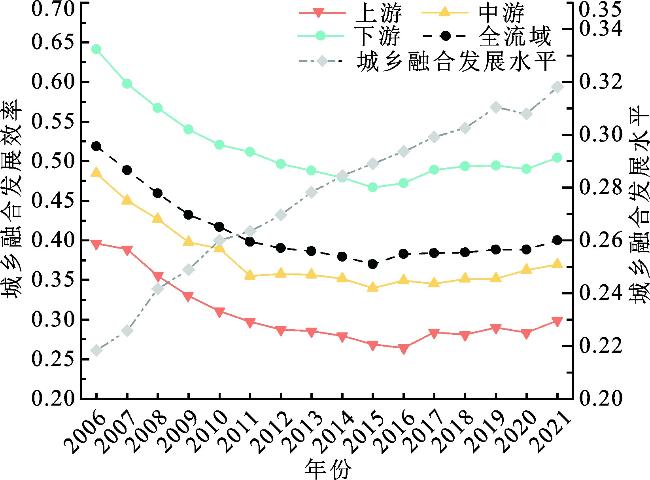
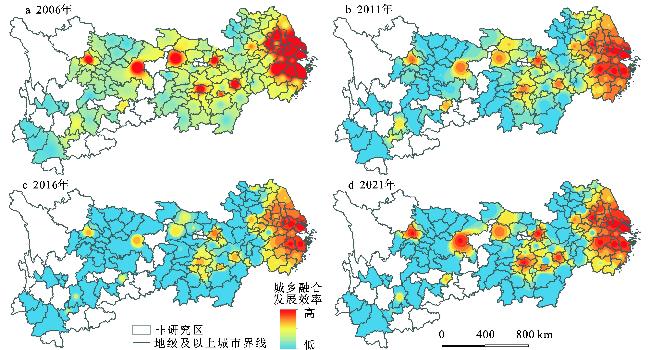
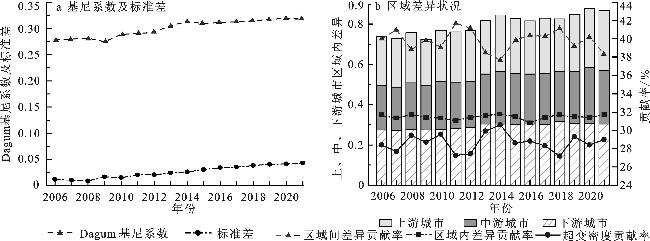
Improving the efficiency of urban-rural integration development is a crucial scientific issue related to efficiency and quality changes. It is a vital approach for promoting coordinated regional economic development and meeting people’s needs for a better life. This paper uses methods such as the super-efficiency EBM model, Dagum Gini coefficient, spatial Markov chain, and spatial Durbin model to analyze the spatiotemporal dynamic evolution and driving mechanisms of the urban-rural integration development efficiency in the Yangtze River Economic Belt from 2006 to 2021. The study finds that: 1) From 2006 to 2021, the efficiency of urban-rural integration development in the Yangtze River Economic Belt showed a “decline-rise” trend, with the differentiation trend between cities showing a “decrease-increase-decrease” pattern. Regional differences between river basins are the main reasons for the divergence in urban-rural integration development efficiency. The overall spatial pattern shows a clear hierarchical “core-periphery” structure diffusion trend. 2) The urban-rural integration development efficiency in the Yangtze River Economic Belt exhibits “path dependence” and “self-locking” effects, with significant spatial transmissibility. High-efficiency areas have a positive spatial spillover effect on neighboring regions. 3) The level of informatization and financial development have a negative and positive impact, respectively, on improving the efficiency of urban-rural integration development in both local and neighboring areas. The degree of openness and the level of human capital are important factors for improving local efficiency but have negative spillover effects on adjacent areas. The level of social consumption does not significantly affect the efficiency of urban-rural integration development.

Wang Zhaofeng , Yu Peixin . Spatio-temporal dynamic evolution and driving mechanism of efficiency of urban-rural integration development in the Yangtze River Economic Belt[J]. GEOGRAPHICAL SCIENCE, 2025 , 45(7) : 1407 -1419 . DOI: 10.13249/j.cnki.sgs.20241234
表1 城乡融合发展效率评价指标体系Table 1 Evaluation index system for efficiency of urban-rural integration development |
| 指标类型 | 指标体系 | 具体内容 | ID |
| 投入指标 | 资本要素投入 | 科学技术/亿元 | I1 |
| 劳动力要素投入 | 教育/亿元 | I2 | |
| 医疗卫生/亿元 | I3 | ||
| 社会要素投入 | 社会保障和就业/亿元 | I4 | |
| 土地要素投入 | 农林水事务/亿元 | I5 | |
| 资源要素投入 | 节能环保/亿元 | I6 | |
| 产出指标 | 期望产出 | 城乡融合发展水平 | O1 |
| 非期望产出 | 碳排放量/万t | O2 |
表2 城乡融合发展水平评价指标体系Table 2 Evaluation index system for level of urban-rural integration development |
| 子系统 | 指标层 | 指标计量或描述 | 属性 | 权重 |
| 经济融合 | 人均地区生产总值 | GDP/平均人口/(元/人) | 正 | 0.074 |
| 城乡居民人均收入比 | 城镇居民人均可支配收入/农村居民人均可支配收入/% | 负 | 0.080 | |
| 人口融合 | 非农与农业从业比重 | 第二、三产业从业人数/第一产业从业人数/% | 正 | 0.080 |
| 人口城镇化水平 | 人口城镇化率/% | 正 | 0.079 | |
| 城乡恩格尔系数比 | 城市恩格尔系数/农村恩格尔系数/% | 正 | 0.079 | |
| 社会融合 | 城乡交通通讯对比系数 | 城镇居民人均交通通讯支出/农村居民人均交通通讯支出/% | 负 | 0.081 |
| 城乡文教娱乐对比系数 | 城镇居民人均文教娱乐服务支出/农村居民人均文教娱乐 服务支出/% | 负 | 0.081 | |
| 城乡失业保险覆盖率 | 城乡居民失业保险参保人数/常住人口数/% | 正 | 0.070 | |
| 空间融合 | 公路路网密度 | 公路运营里程/土地总面积/(km/km2) | 正 | 0.073 |
| 土地城镇化水平 | 建成区面积/土地总面积/% | 正 | 0.063 | |
| 生态融合 | 生活垃圾处理 | 生活垃圾无害化处理率/% | 正 | 0.080 |
| 节能减排能力 | 能源消耗总量/GDP/(万J/万元) | 负 | 0.081 | |
| 污染治理能力 | 污水处理率/% | 正 | 0.080 |
表3 传统马尔可夫转移矩阵Table 3 Traditional Markov Transition Matrix |
| 滞后类型 | 类型 | Ⅰ | Ⅱ | Ⅲ | Ⅳ |
| 注:Ⅰ、Ⅱ、Ⅲ、Ⅳ为城乡融合发展效率低、较低、较高、高4个类型。 | |||||
| 无滞后 | Ⅰ | 0.825 | 0.175 | 0 | 0 |
| Ⅱ | 0.102 | 0.759 | 0.139 | 0 | |
| III | 0 | 0.116 | 0.733 | 0.151 | |
| IV | 0 | 0 | 0.064 | 0.936 | |
表4 空间马尔可夫转移矩阵Table 4 Spatial Markov Transition Matrix |
| 滞后类型 | 类型 | Ⅰ | Ⅱ | Ⅲ | Ⅳ |
| 注:Ⅰ、Ⅱ、Ⅲ、Ⅳ含义见表3。 | |||||
| Ⅰ | Ⅰ | 0.886 | 0.114 | 0 | 0 |
| Ⅱ | 0.182 | 0.713 | 0.105 | 0 | |
| Ⅲ | 0.000 | 0.189 | 0.685 | 0.126 | |
| Ⅳ | 0 | 0 | 0.047 | 0.953 | |
| Ⅱ | Ⅰ | 0.753 | 0.247 | 0 | 0 |
| Ⅱ | 0.043 | 0.803 | 0.154 | 0 | |
| Ⅲ | 0 | 0.162 | 0.706 | 0.132 | |
| Ⅳ | 0 | 0 | 0.034 | 0.966 | |
| Ⅲ | Ⅰ | 0.662 | 0.338 | 0 | 0 |
| Ⅱ | 0.037 | 0.761 | 0.202 | 0 | |
| Ⅲ | 0 | 0.054 | 0.789 | 0.157 | |
| Ⅳ | 0 | 0 | 0.043 | 0.957 | |
| Ⅳ | Ⅰ | 0.882 | 0.118 | 0 | 0 |
| Ⅱ | 0 | 0.667 | 0.242 | 0.091 | |
| Ⅲ | 0 | 0.074 | 0.748 | 0.178 | |
| Ⅳ | 0 | 0 | 0.008 | 0.992 | |
表5 面板空间计量模型检验结果Table 5 Verification results of panel space econometric model |
| 检验方法 | 反距离矩阵 | 空间邻接矩阵 | 检验方法 | 反距离矩阵 | 空间邻接矩阵 | |
| 注: splg、spem分别表示spatial lag、spatial error; **、***分别表示在5%,1%水平上显著。 | ||||||
| Moran’s I | 56.850*** | 26.459*** | LR-splg | 45.150*** | 127.730*** | |
| LM-splg | 653.530*** | 541.541*** | LR-spem | 36.680*** | 125.430*** | |
| LM-spem | 689.221*** | Wald-splg | 11.920** | 62.010*** | ||
| Robust-LM-splg | 1.090 | 7.604*** | Wald-spem | 13.540*** | 71.210*** | |
| Robust-LM-spem | 155.284*** | LR-ind | 34.110*** | 83.430*** | ||
| Hausman | 25.600*** | 23.860** | LR-time | |||
表6 空间面板杜宾模型点估计结果Table 6 Point estimation of spatial panel Durbin model |
| 变量 | 反距离矩阵 | 空间邻接矩阵 |
| 注:W为空间滞后项;ρ为空间溢出效应;括号内为标准误差;FIN为金融发展水平;DEG为人口集聚程度;INF为信息化水平;TRA为交通水平;ENV为环境规制强度;*、**、***分别为在10%,5%,1%水平上显著。 | ||
| FIN | 0.007***(0.002) | 0.006***(0.002) |
| DEG | 0.004*(0.002) | 0.004*(0.002) |
| INF | −0.001 (0.001) | −0.001 (0.001) |
| TRA | 0.044**(0.021) | 0.044**(0.022) |
| ENV | 0.010 (0.017) | 0.006 (0.017) |
| W×FIN | 0.068***(0.019) | 0.008***(0.002) |
| W×DEG | 0.002 (0.028) | 0.004 (0.004) |
| W×INF | −0.025***(0.009) | −0.004*(0.002) |
| W×TRA | 0.029 (0.139) | 0.009 (0.036) |
| W×ENV | −0.403** (0.182) | −0.020 (0.030) |
| 时间 | 固定 | 固定 |
| 空间 | 固定 | 固定 |
| R2 | 0.158 | 0.003 |
| ρ | 0.250** | 0.148*** |
| Log-likelihood | ||
表7 空间效应分解结果Table 7 Decomposition results of spatial effects |
| 变量 | 反距离矩阵 | 空间邻接矩阵 | |||||
| 直接效应 | 间接效应 | 总效应 | 直接效应 | 间接效应 | 总效应 | ||
| 注:括号内数值为标准误差;*、**、***分别表示在10%,5%,1%水平上显著;变量解释见表6。 | |||||||
| FIN | 0.007*** | 0.095*** | 0.102*** | 0.006*** | 0.011*** | 0.017*** | |
| (0.002) | (0.030) | (0.030) | (0.002) | (0.002) | (0.003) | ||
| DEG | 0.004* | 0.004 | 0.008 | 0.004* | 0.005 | 0.010 | |
| (0.002) | (0.040) | (0.041) | (0.002) | (0.005) | (0.006) | ||
| INF | −0.001 | −0.034*** | −0.035*** | −0.001 | −0.004** | −0.006** | |
| (0.001) | (0.013) | (0.013) | (0.001) | (0.002) | (0.002) | ||
| TRA | 0.044** | 0.064 | 0.108 | 0.045** | 0.020 | 0.065* | |
| (0.020) | (0.186) | (0.180) | (0.021) | (0.038) | (0.036) | ||
| ENV | 0.008 | −0.531** | −0.522** | 0.006 | −0.020 | −0.014 | |
| (0.017) | (0.260) | (0.262) | (0.017) | (0.033) | (0.039) | ||
| 1 |
方创琳. 城乡融合发展机理与演进规律的理论解析[J]. 地理学报, 2022, 77(4):759-776.
Fang Chuanglin. Theoretical analysis of the mechanism and evolution law of urban-rural integration development[J]. Acta Geographica Sinica, 2022, 77(4):759-776.
|
| 2 |
周德, 戚佳玲, 钟文钰, 等. 城市群城乡融合发展: 测度评价、障碍因素与驱动因素[J]. 地理研究, 2023, 42(11):2914-2939.
Zhou De, Qi Jialing, Zhong Wenyu et al. Urban and rural integration development in urban agglomerations?Measurement and evaluation, obstacle factors, and driving factors[J]. Geographical Research, 2023, 42(11):2914-2939.
|
| 3 |
方创琳, 李广东, 戚伟, 等. “胡焕庸线”东西部城乡发展不平衡趋势及沿博台线微突破策略[J]. 地理学报, 2023, 78(2):443-455.
Fang Chuanglin, Li Guangdong, Qi Wei et al. Unbalanced trend of urban and rural development on the east and west sides of Hu Huanyong Line and micro-breakthrough strategy along the Bole-Taipei Line[J]. Acta Geographica Sinica, 2023, 78(2):443-455.
|
| 4 |
Lewis W A. Economic development with unlimited supplies of labour[J]. The Manchester School of Economic and Social Studies, 1954, 22(2):139-191.
|
| 5 |
弗朗索瓦·佩鲁. 略论“增长极”概念[J]. 李仁贵, 译. 经济学译丛, 1988(9):69-71.
François Perroux. On the concept of “growth pole”. Translated by Li Rengui[J]. Translation Series of Economics, 1988(9):69-71.
|
| 6 |
Friedmann John, Douglass Mike. Agropolitan development: Towards a new strategy for regional planning in Asia[M]. Los Angeles: University of California, 1975: 101-146.
|
| 7 |
刘彦随. 现代人地关系与人地系统科学[J]. 地理科学, 2020, 40(8):1221-1234.
Liu Yansui. Modern human earth relations and human earth system science[J]. Scientia Geographica Sinica, 2020, 40(8):1221-1234.
|
| 8 |
Li Y H. Ubran-rural interaction patterns and dynamic land use: Implicarions for urban-rural integration in China[J]. Regional Environmental Change, 2012, 12(4):803-812.
|
| 9 |
Liu Y S, Long H L, Chen Y F et al. Progress of research on urban-rural transformation and rural development in China in the past decade and future prospects[J]. Journal of Geographical Sciences, 2016, 26(8):1117-1132.
|
| 10 |
陈明星, 郭莎莎, 陆大道. 新型城镇化背景下京津冀城市群流动人口特征与格局[J]. 地理科学进展, 2018, 37(3):363-372.
Chen Mingxing, Guo Shasha, Lu Dadao. The characteristics and pattern of floating population in the Beijing-Tianjin-Hebei Urban Agglomeration under the background of new urbanization[J]. Progress in Geography, 2018, 37(3):363-372.
|
| 11 |
郑瑜晗, 龙花楼. 中国城乡融合发展测度评价及其时空格局[J]. 地理学报, 2023, 78(8):1869-1887.
Zheng Yuhan, Long Hualou. Measurement and spatio-temporal pattern of urban-rural integrated development in China[J]. Acta Geographica Sinica, 2023, 78(8):1869-1887.
|
| 12 |
丁焕峰, 张蕊, 周锐波. 城市更新是否有利于城乡融合发展?——基于资源配置的视角[J]. 中国土地科学, 2021, 35(9):84-93.
Ding Huanfeng, Zhang Rui, Zhou Ruibo. Whether urban renewal is beneficial to urban-rural integration? From the perspective of resource allocation[J]. China Land Science, 2021, 35(9):84-93.
|
| 13 |
周佳宁, 毕雪昊, 邹伟. “流空间”视域下淮海经济区城乡融合发展驱动机制[J]. 自然资源学报, 2020, 35(8):1881-1896.
Zhou Jianing, Bi Xuehao, Zou Wei. Driving mechanism of urban-rural integration in Huaihai economic zone: Based on the space of flow[J]. Journal of Natural Resources, 2020, 35(8):1881-1896.
|
| 14 |
Zhan L Y, Wang S J, Xie S X et al. Spatial path to achieve urban-rural integration development-analytical framework for coupling the linkage and coordination of urban-rural system functions[J]. Habitat International, 2023, 142 102953
|
| 15 |
王凯, 谭佳欣, 甘畅. 湘西地区旅游发展与城乡融合协同演化及影响因素研究[J]. 地理科学进展, 2023, 42(8):1468-1485.
Wang Kai, Tan Jiaxin, Gan Chang. Degree of synergy of regional tourism development and urban-rural integration and influencing factors in the Western Hunan region[J]. Progress in Geography, 2023, 42(8):1468-1485.
|
| 16 |
舒季君, 周建平, 陈亦婷, 等. 中国省域数字经济的空间演化特征及其城乡融合效应[J]. 经济地理, 2022, 42(8):103-111.
Shu Jijun, Zhou Jianping, Chen Yiting et al. The spatial evolution characteristics of China’s provincial digital economy and its urban-rural integration effect[J]. Economic Geography, 2022, 42(8):103-111.
|
| 17 |
龙花楼, 徐雨利, 郑瑜晗, 等. 中国式现代化下的县域城乡融合发展[J]. 经济地理, 2023, 43(7):12-19.
Long Hualou, Xu Yuli, Zheng Yuhan et al. Urban-rural integrated development at county level under Chinese path to modernization[J]. Economic Geography, 2023, 43(7):12-19.
|
| 18 |
王大超, 赵红. 中国城乡融合发展效率评价及其影响因素研究[J]. 财经问题研究, 2022(10):101-109.
Wang Dachao, Zhao Hong. Research on the efficiency evaluation and influencing factors of urban rural integration development in China[J]. Research on Financial and Economic Issues, 2022(10):101-109.
|
| 19 |
施建刚, 段锴丰, 吴光东, 等. 碳排放约束下长三角地区城乡融合发展效率[J]. 经济地理, 2021, 41(6):57-67.
Shi Jiangang, Duan Kaifeng, Wu Guangdong et al. Efficiency of urban-rural integration development in the Yangtze River Delta region under carbon emission constraints[J]. Economic Geography, 2021, 41(6):57-67.
|
| 20 |
张文斌, 张志斌, 董建红, 等. 迈向城乡共治: 改革开放以来城乡关系演变解读[J]. 地理科学进展, 2021, 40(5):883-896.
Zhang Wenbin, Zhang Zhibin, Dong Jianhong et al. Towards urban rural co governance: An interpretation of the evolution of urban rural relations since the reform and opening up[J]. Progress in Geography, 2021, 40(5):883-896.
|
| 21 |
金晓斌, 叶超, 岳文泽, 等. 新时代中国城乡融合发展: 挑战与路径[J]. 自然资源学报, 2024, 39(1):1-28.
Jin Xiaobin, Ye Chao, Yue Wenze et al. Urban-rural integrated development in China in the new era: Challenges and paths[J]. Journal of Natural Resources, 2024, 39(1):1-28.
|
| 22 |
邵海琴, 吴卫, 王兆峰. 长江经济带旅游资源绿色利用效率与新型城镇化的时空耦合协调[J]. 经济地理, 2021, 41(8):204-213.
Shao Haiqin, Wu Wei, Wang Zhaofeng. Temporal and spatial coupling coordination of green utilization efficiency of tourism resources and new urbanization in the Yangtze River Economic Belt[J]. Economic Geography, 2021, 41(8):204-213.
|
| 23 |
马志飞, 宋伟轩, 王捷凯, 等. 长三角地区城乡融合发展水平、演化及影响因素[J]. 自然资源学报, 2022, 37(6):1467-1480.
Ma Zhifei, Song Weixuan, Wang Jiekai et al. The development level, evolution and influencing factor of urban-rural integration in the Yangtze River Delta[J]. Journal of Natural Resources, 2022, 37(6):1467-1480.
|
| 24 |
黄锡生, 王中政. 论城乡融合发展的双重逻辑及制度统合[J]. 现代经济探讨, 2021(5):1-9.
Huang Xisheng, Wang Zhongzheng. On the dual logic and institution integration of urban rural integration development[J]. Modern Economic Research, 2021(5):1-9.
|
| 25 |
王颖, 孙平军, 李诚固, 等. 2003年以来东北地区城乡协调发展的时空演化[J]. 经济地理, 2018, 38(7):59-66.
Wang Ying, Sun Pingjun, Li Chenggu et al. The spatiotemporal evolution of coordinated urban-rural development in northeast China since 2003[J]. Economic Geography, 2018, 38(7):59-66.
|
| 26 |
朱媛媛, 罗源. 中国乡村社会空间重构过程再认知及展望——基于人口城乡逆流视角[J]. 地理科学进展, 2024, 43(2):374-386.
Zhu Yuanyuan, Luo Yuan. Re-conceptualization and prospects of rural social space reconstruction processes in China: Based on the perspective of counter-stream of rural-urban migration[J]. Progress in Geography, 2024, 43(2):374-386.
|
| 27 |
李雯骐, 张立, 张尚武. 中国城乡融合研究的议题、评述及展望[J]. 城市规划学刊, 2022(6):36-43.
Li Wenqi, Zhang Li, Zhang Shangwu. A review on main research issues of urban-rural integration in China and the future prospect[J]. Urban Planning Forum, 2022(6):36-43.
|
| 28 |
袁方成, 周韦龙. 要素流动何以推动县域城乡融合: 经验观察与逻辑诠释——以佛山市南海区全域土地综合整治为例[J]. 南京农业大学学报(社会科学版), 2024, 24(2):63-74.
Yuan Fangcheng, Zhou Weilong. Factor mobility and its impact on the integration of urban and rural areas at the county level: Experiential observations and logical interpretations—A case study of comprehensive land consolidation in Nanhai District[J]. Journal of Nanjing Agricultural University (Social Sciences Edition), 2024, 24(2):63-74.
|
| 29 |
代亚强, 张玥, 柯新利, 等. 乡村地域多功能的空间关联网络结构特征及其对城乡融合发展的影响——以河南省为例[J]. 自然资源学报, 2023, 38(8):2059-2075.
Dai Yaqiang, Zhang Yue, Ke Xinli et al. Structural characteristics of spatial correlation network of rural territorial multi-functions and its impact on urban-rural integrated development: A case study of Henan Province[J]. Journal of Natural Resources, 2023, 38(8):2059-2075.
|
| 30 |
徐雪, 王永瑜. 城乡融合的逻辑机理、多维测度及区域协调发展研究——基于新型城镇化与乡村振兴协调推进视角[J]. 农业经济问题, 2023(11):49-62.
Xu Xue, Wang Yongyu. Research on the logical mechanism, multidimensional measurement, and regional coordinated development of urban rural integration: From the perspective of coordinated promotion of new urbanization and rural vitalization[J]. Issues in Agricultural Economy, 2023(11):49-62.
|
| 31 |
陈钊, 陆铭. 从分割到融合: 城乡经济增长与社会和谐的政治经济学[J]. 经济研究, 2008(1):21-32.
Chen Zhao, Lu Ming. From segmentation to integration: Political economy of urban-rural economic growth and social harmony[J]. Economic Research Journal, 2008(1):21-32.
|
| 32 |
张溢堃, 王永生. 中国省域城乡要素流动测度方法与时空特征[J]. 地理学报, 2023, 78(8):1888-1903.
Zhang Yikun, Wang Yongsheng. Measurement methods and spatio-temporal characteristics of urban-rural factor flow in China[J]. Acta Geographica Sinica, 2023, 78(8):1888-1903.
|
| 33 |
Tone K, Tsutsui M. An epsilon-based measure of efficiency in DEA—A third pole of technical efficiency[J]. European Journal of Operational Research, 2010, 207(3):1554-1563.
|
| 34 |
Jia W X, Wu S N. Spatial differences and influencing factors of energy poverty: Evidence from provinces in China[J]. Frontiers in Environmental Science, 2022, 10(1075):1-17.
|
| 35 |
王兆峰, 张先甜. 中国省域旅游发展与民生福祉的动态响应及协调效应研究[J]. 旅游科学, 2023, 37(3):1-19.
Wang Zhaofeng, Zhang Xiantian. A study on the dynamic response and coordination effect of provincial tourism development and livelihood welfare in China[J]. Tourism Science, 2023, 37(3):1-19.
|
| 36 |
国家统计局. 中国城市统计年鉴[M]. 2007—2022. 北京: 中国统计出版社, 2007—2022
National Bureau of Statistics. China city statistical yearbook. 2007—2022. Beijing: China Statistics Press, 2007—2022.
|
| 37 |
住房和城乡建设部. 中国城市建设统计年鉴[M]. 2007—2022. 北京: 中国统计出版社, 2007—2022
Ministry of Housing and Urban-Rural Development of the People’s Republic of China. China urban construction statistical yearbook. 2007—2022. Beijing: China Statistics Press, 2007—2022.
|
| 38 |
陈诗一, 陈登科. 雾霾污染、政府治理与经济高质量发展[J]. 经济研究, 2018, 53(2):20-34.
Chen Shiyi, Chen Dengke. Haze pollution, government governance, and high-quality economic development[J]. Economic Research Journal, 2018, 53(2):20-34.
|
/
| 〈 |
|
〉 |