



Resilience measurement and spatio-temporal evolution characteristics of specialized villages in Henan Province: A case study of 50 specialized villages
Received date: 2024-05-25
Revised date: 2024-09-10
Online published: 2025-10-24
Supported by
National Natural Science Foundation of China(42371223)
National Natural Science Foundation of China(42201220)
Zhongyuan Leading Talent Program in Science and Technology Innovation(254200510057)
Copyright
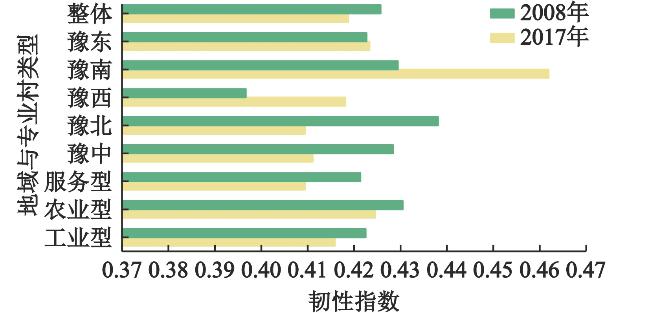
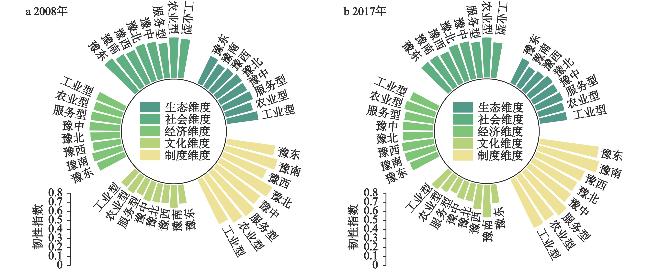
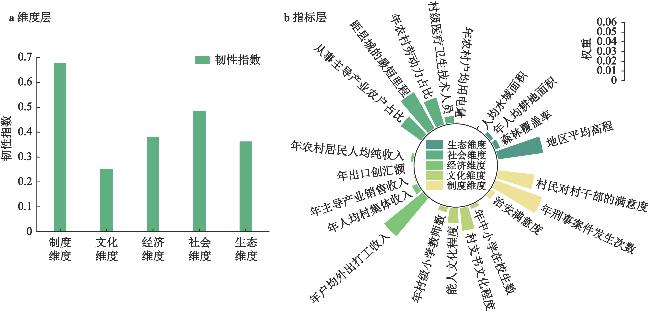
Specialized villages are the boosters of industrial prosperity and an important hand for rural revitalization. Studying the level of specialized villages' resilience and its evolution characteristics is of great significance for optimizing the specialized villages system, enhancing the economic development of agricultural areas, and promoting the implementation of the rural revitalization strategy. Based on the sample data of 50 specialized villages from 2008 to 2017 tracking survey in Henan Province, this article measures the resilience level of specialized villages and explores its evolution characteristics by constructing a specialized villages resilience evaluation index system and combining it with mathematical and theoretical models. The study shows that: 1) 56% of the comprehensive toughness of specialized villages in Henan Province is negative, concentrated in the northern part of Henan Province, the comprehensive toughness of the southern part of Henan Province has increased by nearly 10%, the toughness of service-type specialized villages has declined significantly compared with that of other types of specialized villages, and the area of high value of toughness of agricultural-type specialized villages has shifted from the east to the south. 2) Institutional toughness contributes most to the comprehensive toughness of specialized villages. The ecological toughness of 78% of the specialized villages in Henan Province declined, concentrated in the east of Henan. The cultural toughness and ecological toughness in central Henan Province have both decreased by about 10%, and the cultural toughness and economic toughness in southern and western Henan Province have both increased by more than 35%, with growth hotspots evolving from central and eastern Henan Province to western and southern Henan Province. Industrial-type specialized villages' cultural resilience increased by 16%, but ecological resilience declined by nearly 14%. Service-oriented specialized villages' cultural toughness declined by more than 10%. 3) The cultural dimension is the main short-board element affecting the comprehensive toughness of each type of specialized villages, and the amount of export foreign exchange, the annual sales income of the leading industries, the annual average electricity consumption of rural households, and the per capita water area are specific limiting factors.
Xiao Jie , Qiao Jiajun , Liu Yang , Han Dong , Wang Weiwen . Resilience measurement and spatio-temporal evolution characteristics of specialized villages in Henan Province: A case study of 50 specialized villages[J]. GEOGRAPHICAL SCIENCE, 2025 , 45(10) : 2202 -2214 . DOI: 10.13249/j.cnki.sgs.20241476
表1 专业村韧性评价指标体系Table 1 Specialized villages resilience evaluation index system |
| 维度层 | 指标层 | 指标解释与说明 | 属性 | 权重 |
| 注:能人是指农村中具有企业家精神的农民。 | ||||
| 生态维度[3,28-29] A | A1 地区平均高程/m | 该县海拔最低点和最高点的平均值 | - | |
| A2 森林覆盖率/% | 林地总面积/全村行政面积 | + | ||
| A3 年人均耕地面积/m2 | 耕地总面积/全村年人口数 | + | ||
| A4 人均水域面积/m2 | 水域总面积/全村年人口数 | + | ||
| 社会维度[1,3,28] B | B1 年农村户均用电 量/kWh | 全村家庭年用电量/全村户数 | + | |
| B2 村级医疗卫生技术人员/人 | 有执业(助理)医师资格证的村级医生人数 | + | ||
| B3 年农村劳动力占 比/% | 全村年劳动力人数/全村年人口数 | + | ||
| B4 距县城的最短里 程/km | 该村到最近县城核心区的最短通车距离 | - | ||
| B5 从事主导产业农户占比/% | 从事主导产业农户数/全村户数 | + | ||
| 经济维度[1,3,28] C | C1 年农村居民人均纯收入/元 | (农村居民年家庭总收入-家庭年经营费用支出-年生产性固定资产折旧-年税金、上交和承包费用-年调查补贴)/农村居民家庭年常住人口 | + | |
| C2 年出口创汇额/104元 | 专业村主导产品销售到国外的年外汇收入 | + | ||
| C3 年主导产业销售收入/104元 | 专业村主导产品年销售所得资金 | + | ||
| C4 年人均村集体收 入/104元 | 全村年经济总收入/全村年人口数 | + | ||
| C5 年户均外出打工收入/元 | 全村年务工收入/全村户数 | - | ||
| 文化维度[21,28,30] D | D1 年村级小学教师 数量/人 | 村小学年末有教师编制及合同的教师人数 | + | |
| D2 能人文化程度 | 反映该村能人的受教育程度(学历分为:1 小学、2 初中、3 中专/高中、4 大专、5 本科、6 硕士研究生、7 博士研究生) | + | ||
| D3 村支书文化程度 | 反映该村村支书受教育程度(学历分为:1 小学、2 初中、3 中专/高中、4 大专、5 本科、6 硕士研究生、7 博士研究生) | + | ||
| D4 年中小学在校生 数/人 | 反映该村中小学学生学籍在籍情况 | + | ||
| 制度维度[1,29,31] E | E1 治安满意度 | 对该村整体治安水平的认可情况(1 十分满意;2 满意;3 不太满意;4 不满意) | + | |
| E2 年刑事案件发生次数/次 | 该村年内发生的刑事案件次数 | - | ||
| E3 村民对村干部的满意度占比/% | 反映村民对该村村干部管理能力的认可情况,1 非常不满意(0,50];2 不太满意(50,80];3 一般(80,90];4 比较满意(90,95];5 很满意(95,100] | + | ||
| [1] |
李玉恒, 黄惠倩, 宋传垚. 贫困地区乡村经济韧性研究及其启示——以河北省阳原县为例[J]. 地理科学进展, 2021, 40 (11): 1839-1846.
Li Yuheng, Huang Huiqian, Song Chuanyao. Rural economic resilience in poor areas and its enlightenment: Case study of Yangyuan County, Hebei Province. Progress in Geography, 2021, 40 (11): 1839-1846.
|
| [2] |
白玉玲, 陈佳, 尹莎, 等. 乡村振兴背景下脱贫山区乡村韧性演变及影响因素——以陕南秦巴山区为例[J]. 生态学报, 2024, 44 (19): 8798-8811.
Bai Yuling, Chen Jia, Yin Sha et al. Evolution and influencing factors of rural resilience in poverty alleviation Qinling Daba Mountains areas under the background of rural revitalization. Acta Ecologica Sinica, 2024, 44 (19): 8798-8811.
|
| [3] |
Tao Tianmin, Ma Libang, Liu Ye et al. A systematic framework for rural resilience assessment in the rural Gansu Province, China[J]. Environmental Impact Assessment Review, 2025, 110: 107715
|
| [4] |
Scott M. Resilience: A conceptual lens for rural studies?[J]. Geography Compass, 2013, 7 (9): 597-610.
|
| [5] |
刘彦随. 中国乡村振兴规划的基础理论与方法论[J]. 地理学报, 2020, 75 (6): 1120-1133.
Liu Yansui. The basic theory and methodology of rural revitalization planning in China. Acta Geographica Sinica, 2020, 75 (6): 1120-1133.
|
| [6] |
吴娜琳, 乔家君, 梁展鹏, 等. 河南省不同演化类型专业村的特征及其影响因素分析[J]. 地理研究, 2023, 42 (6): 1560-1576.
Wu Nalin, Qiao Jiajun, Liang Zhanpeng et al. Characteristics and influencing factors of different evolutionary types of specialized villages in Henan Province. Geographical Research, 2023, 42 (6): 1560-1576.
|
| [7] |
魏艺. “韧性” 视角下乡村社区生活空间适应性建构研究[J]. 城市发展研究, 2019, 26 (11): 50-57.
Wei Yi. Research on the adaptive construction of rural community living space from the perspective of “resilience”. Urban Development Studies, 2019, 26 (11): 50-57.
|
| [8] |
Su Huizhen, Zhao Xueyan, Wang Lucang et al. How rural community resilience evolves after a disaster? A case study of the eastern Qinghai-Tibetan Plateau, China[J]. Applied Geography, 2024, 165: 103238
|
| [9] |
Zheng Zhiqiang, Chou Rungjiun. Rebuilding the resilience of mountainous rural communities by enhancing community capital through industrial transformation: A case study from rural Fujian, China[J]. Habitat International, 2024, 149: 103086
|
| [10] |
王雨村, 李月月, 潘斌. 精准扶贫视域下河南乡村产业韧性化发展策略[J]. 规划师, 2018, 34 (12): 39-45.
Wang Yucun, Li Yueyue, Pan Bin. Resilient development strategies of precise industrial poverty alleviation, Henan Province. Planners, 2018, 34 (12): 39-45.
|
| [11] |
田健, 曾穗平. 城市边缘区乡村产业系统风险评估与韧性格局重构——以天津市西郊乡村地区为例[J]. 城市规划, 2021, 45 (10): 19-30+58.
Tian Jian, Zeng Suiping. Systematic risk assessment and resilient pattern reconstruction of rural industry in urban fringe areas: A case study on the western suburbs of Tianjin City. City Planning Review, 2021, 45 (10): 19-30+58.
|
| [12] |
李晋, 戴旭宏. 脱贫摘帽后原深贫山区乡村的经济韧性建构——以四川省凉山州卢家营盘村为例[J]. 农村经济, 2021(11) 45-52.
Li Jin, Dai Xuhong. Construction of economic resilience in the former deep-poor mountainous villages after getting rid of poverty—A case study of Lujiayingpan Village in Liangshan prefecture, Sichuan Province. Rural Economy, 2021(11) 45-52.
|
| [13] |
袁晓梅, 朱锦心, 李凌, 等. 传统农耕智慧下的乡村社会生态韧性——福建省南靖县世界文化遗产河坑土楼群聚落景观解析[J]. 中国园林, 2021, 37 (7): 31-36.
Yuan Xiaomei, Zhu Jinxin, Li Ling et al. Resilience of the rural social-ecological system with traditional farming wisdom: A case study of the landscape of world cultural heritage Tulou settlement in Hekeng Village, Nanjing County, Fujian Province. Chinese Landscape Architecture, 2021, 37 (7): 31-36.
|
| [14] |
李红波. 韧性理论视角下乡村聚落研究启示[J]. 地理科学, 2020, 40 (4): 556-562.
Li Hongbo. Rural settlements research from the perspective of resilience theory. Scientia Geographica Sinica, 2020, 40 (4): 556-562.
|
| [15] |
颜文涛, 卢江林. 乡村社区复兴的两种模式: 韧性视角下的启示与思考[J]. 国际城市规划, 2017, 32 (4): 22-28.
Yan Wentao, Lu Jianglin. Two models for revitalizing village: Enlightenments under resilient perspective. Urban Planning International, 2017, 32 (4): 22-28.
|
| [16] |
王薇然, 杜海峰. 基于多元治理主体的乡村韧性比较研究[J]. 公共行政评论, 2021, 14 (4): 4-24+196.
Wang Weiran, Du Haifeng. A comparative study of rural resilience based on multiple governance subjects. Journal of Public Administration, 2021, 14 (4): 4-24+196.
|
| [17] |
雷晓康, 汪静. 乡村振兴背景下农村贫困地区韧性治理的实现路径与推进策略[J]. 济南大学学报(社会科学版), 2020, 30 (1): 92-99+159.
Lei Xiaokang, Wang Jing. Implementing path and promoting strategy of resilience governance in poverty-stricken areas under the background of rural revitalization. Journal of University of Jinan (Social Science Edition), 2020, 30 (1): 92-99+159.
|
| [18] |
巩蓉蓉, 何定泽, 吴本健. 乡村振兴背景下脱贫地区韧性治理: 机理与路径[J]. 世界农业, 2021(11) 35-45+55.
Gong Rongrong, He Dingze, Wu Benjian. Resilience governance in poverty alleviation areas under the background of rural revitalization: Mechanism and path. World Agriculture, 2021(11) 35-45+55.
|
| [19] |
Wang Rong, Zhao Xueyan. Can multiple livelihood interventions improve livelihood resilience of out-of-poverty farmers in mountain areas? A case study of Longnan mountain area, China[J]. Chinese Geographical Science, 2023, 33 (5): 898-916.
|
| [20] |
汪樱, 唐兰云, 王卫雯, 等. 农户生计韧性驱动机理及其生计环境效应[J]. 长江流域资源与环境, 2023, 32 (3): 665-677.
Wang Ying, Tang Lanyun, Wang Weiwen et al. Driving mechanism of rural households' livelihood resilience and its environmental effects. Resources and Environment in the Yangtze Basin, 2023, 32 (3): 665-677.
|
| [21] |
Wu Nalin, Wei Yike, Fan Sizhe et al. Attributes of specialized households resilience and its impact on rural industrial advancement: A case study of national musical instrument production specialized households in Lankao County, Henan, China[J]. Chinese Geographical Science, 2024, 34 (3): 383-400.
|
| [22] |
刘润秋, 黄志兵, 曹骞. 基于乡村韧性视角的宅基地退出绩效评估研究——以四川省广汉市三水镇为例[J]. 中国土地科学, 2019, 33 (2): 41-48.
Liu Runqiu, Huang Zhibing, Cao Qian. Performance evaluation of rural residential land exit from the perspective of rural resilience: A case of Sanshui Town, Guanghan City, Sichuan Province. China Land Science, 2019, 33 (2): 41-48.
|
| [23] |
Qiao Jiajun, Lee J, Ye Xinyue. Spatiotemporal evolution of specialized villages and rural development: A case study of Henan Province, China[J]. Annals of the Association of American Geographers, 2016, 106 (1): 57-75.
|
| [24] |
Xiao Jie, Qiao Jiajun, Han Dong et al. Spatial distribution and transformation mechanism of specialized villages in typical agricultural areas: Case study of Henan Province, China[J]. Habitat International, 2024, 146: 103034
|
| [25] |
刘晨光. 黄河流域专业村空间格局演化及影响因素[J]. 资源科学, 2020, 42 (12): 2300-2313.
Liu Chenguang. Spatial evolution of specialized villages and influencing factors in the Yellow River Basin. Resources Science, 2020, 42 (12): 2300-2313.
|
| [26] |
肖杰, 乔家君, 朱乾坤. 2013—2022年中国专业村研究进展与展望[J]. 人文地理, 2023, 38 (4): 34-44.
Xiao Jie, Qiao Jiajun, Zhu Qiankun. Research progress and prospect of specialized villages in China from 2013 to 2022. Human Geography, 2023, 38 (4): 34-44.
|
| [27] |
周灿, 李小建. 河南省农业专业村发展与地理环境关系研究[J]. 地域研究与开发, 2015, 34 (4): 130-135.
Zhou Can, Li Xiaojian. Relationships between agricultural specialized villages and geographical environment in Henan Province. Areal Research and Development, 2015, 34 (4): 130-135.
|
| [28] |
胡霄, 李红波, 李智, 等. 河北省县域乡村韧性测度及时空演变[J]. 地理与地理信息科学, 2021, 37 (3): 89-96.
Hu Xiao, Li Hongbo, Li Zhi et al. Measurement and spatio-temporal evolution of rural resilience at county level in Hebei Province. Geography and Geo-Information Science, 2021, 37 (3): 89-96.
|
| [29] |
李玉恒, 黄惠倩, 王晟业. 基于乡村经济韧性的传统农区城乡融合发展路径研究——以河北省典型县域为例[J]. 经济地理, 2021, 41 (8): 28-33+44.
Li Yuheng, Huang Huiqian, Wang Shengye. Path of urban-rural integrated development in traditional agricultural zones based on rural economic resilience: The study of typical counties of Hebei Province. Economic Geography, 2021, 41 (8): 28-33+44.
|
| [30] |
Liu, Runqiu, Zhang Lie, Tang Yudi et al. Understanding and evaluating the resilience of rural human settlements with a social-ecological system framework: The case of Chongqing Municipality, China[J]. Land Use Policy, 2024, 136: 106966
|
| [31] |
Zhou Yuyang, Gu Hao. Enhancing rural resilience through the rural revitalisation strategy in rural China: Evidence from Wushi Village, Hunan Province[J]. Journal of Rural Studies, 2025, 113: 103493
|
| [32] |
朱媛媛, 汪紫薇, 顾江, 等. 基于“乡土-生态” 系统韧性的红色旅游资源利用空间格局优化研究——以大别山革命老区为例[J]. 自然资源学报, 2021, 36 (7): 1700-1717.
Zhu Yuanyuan, Wang Ziwei, Gu Jiang et al. The spatial optimization of red tourism resources utilization based on the resilience of “ruralism-ecology” system: A case study of Dabie Mountains Old Revolutionary Base Area. Journal of Natural Resources, 2021, 36 (7): 1700-1717.
|
| [33] |
张国俊, 邓毛颖, 姚洋洋, 等. 广东省产业绿色发展的空间格局及影响因素分析[J]. 自然资源学报, 2019, 34 (8): 1593-1605.
Zhang Guojun, Deng Maoying, Yao Yangyang et al. Comprehensive level of the green development of industry in Guangdong Province and spatial econometric analysis of the influencing factors. Journal of Natural Resources, 2019, 34 (8): 1593-1605.
|
| [34] |
于伟, 张鹏. 中国农业发展韧性时空分异特征及影响因素研究[J]. 地理与地理信息科学, 2019, 35 (1): 102-108.
Yu Wei, Zhang Peng. Study on the spatial-temporal differentiation characteristics and influencing factors of agricultural development resilience in China. Geography and Geo-Information Science, 2019, 35 (1): 102-108.
|
| [35] |
朱乾坤, 乔家君, 韩冬, 等. 河南省专业村空间格局与集聚测度[J]. 地理科学进展, 2022, 41 (3): 396-408.
Zhu Qiankun, Qiao Jiajun, Han Dong et al. Spatial distribution and agglomeration measurement of specialized villages in Henan Province. Progress in Geography, 2022, 41 (3): 396-408.
|
| [36] |
马玉玲, 乔家君, 刘晨光, 等. 专业村集聚时空演化特征——以河南太行山麓为例[J]. 地理研究, 2018, 37 (11): 2259-2272.
Ma Yuling, Qiao Jiajun, Liu Chenguang et al. Spatio-temporal evolution of specialized villages agglomeration: A case study of foothills of Taihang Mountains in Henan. Geographical Research, 2018, 37 (11): 2259-2272.
|
| [37] |
刘洋, 乔家君, 肖杰, 等. 河南省乡村人口-经济空间耦合研究[J]. 世界地理研究, 2024, 33 (7): 172-183.
Liu Yang, Qiao Jiajun, Xiao Jie et al. Spatial coupling relationship between rural population and economy in Henan Province. World Regional Studies, 2024, 33 (7): 172-183.
|
| [38] |
楚纯洁, 高向茹. 河南省旅游生态效率时空演变及其影响因素研究[J]. 旅游研究, 2024, 16 (4): 40-53.
Chu Chunjie, Gao Xiangru. Spatial-temporal evolution and influencing factors of tourism eco-efficiency in Henan Province. Tourism Research, 2024, 16 (4): 40-53.
|
| [39] |
吴娜琳, 李立, 李二玲, 等. 特色种植的空间持续性及其影响因素研究——以河南省封丘县树莓产业为例[J]. 地理科学, 2018, 38 (3): 428-436.
Wu Nalin, Li Li, Li Erling et al. The spatial continuity of specialized plantation: A case study of raspberry farm in Fengqiu County, Henan Province. Scientia Geographica Sinica, 2018, 38 (3): 428-436.
|
| [40] |
乔家君. 专业村视角下黄河流域乡村振兴理论研究[J]. 河南大学学报(自然科学版), 2022, 52 (1): 1-8.
Qiao Jiajun. A theoretical research on rural revitalization in Yellow River Basin from the perspective of specialized villages' development. Journal of Henan University (Natural Science), 2022, 52 (1): 1-8.
|
| [41] |
张晓溪. 乡村文化新内生发展路径的实践探索——基于主体性身体技术视角的社会学分析[J]. 贵州社会科学, 2022(5) 150-157.
Zhang Xiaoxi. Practical exploration on the new endogenous development path of rural culture—Sociological analysis from the perspective of subjective body technology. Guizhou Social Sciences, 2022(5) 150-157.
|
| [42] |
冯玲玲. 文化韧性视角下特色保护类村庄公共空间优化策略研究[J]. 城市住宅, 2021, 28 (5): 76-78.
Feng Lingling. Research on optimization strategies of the public space in characteristic protected villages from the perspective of cultural resilience. City & House, 2021, 28 (5): 76-78.
|
| [43] |
Liu Yang, Qiao Jiajun, Xiao Jie et al. Evaluation of the effectiveness of rural revitalization and an improvement path: A typical old revolutionary cultural area as an example[J]. International Journal of Environmental Research and Public Health, 2022, 19 (20): 13494
|
| [44] |
吴娜琳, 李小建. 我国农区专业村消失因素的分析——以河南省郏县前王庄村为例[J]. 经济地理, 2016, 36 (1): 127-134.
Wu Nalin, Li Xiaojian. The causes for the disappearance of specialized village: A case study of Qianwang Village, Jia County in Henan Province, China. Economic Geography, 2016, 36 (1): 127-134.
|
/
| 〈 |
|
〉 |