



Influence and heterogeneity of inter-provincial border on intercity population flow in China from the perspective of network
Received date: 2024-07-03
Online published: 2025-12-15
Supported by
National Natural Science Foundation of China(42371226)
National Natural Science Foundation of China(41771124)
Copyright
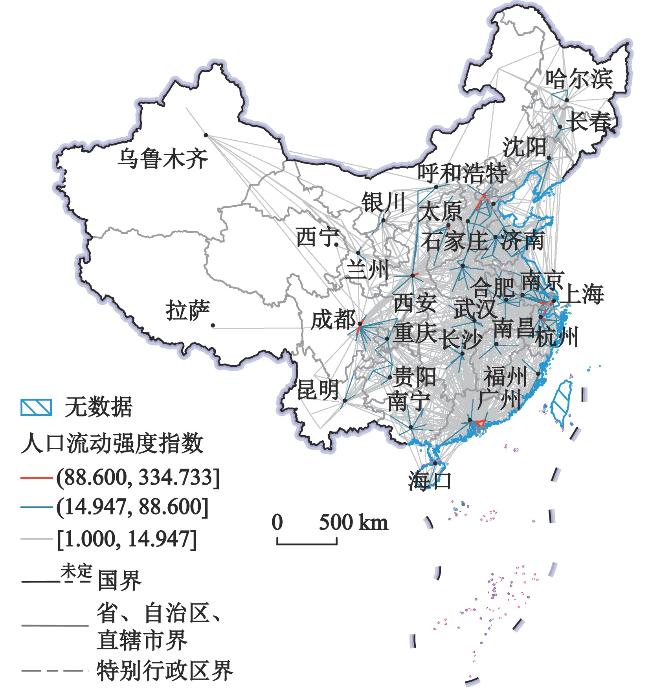
Breaking the shielding effect of administrative boundaries is a key issue to promote regional population flow. From a network perspective, this article uses Baidu migration big data to explore the impact of inter-provincial boundaries on China’s inter-city population flow and its heterogeneity in different urban agglomerations. Specifically, the impact of inter-provincial boundaries on the formation of inter-city population flow relationships was analysed using ERGM, the impact of inter-provincial boundaries on the intensity of population flow relationships was analysed using VERGM, and the regional heterogeneity of the impact of inter-provincial boundaries on population flow was analysed using QAP. It is found that the inter-provincial boundaries inhibit the formation and strengthening of the inter-city population flow network in China. At the same time, the intensity of the shielding effect decreases with the increase of the intensity of population flow. The heterogeneity analysis of urban agglomerations shows that there are significant differences in the shielding effect of inter-provincial boundaries on population flow in different urban agglomerations. Firstly, the effect of inter-provincial boundaries in the Beibu Gulf urban agglomeration is significantly stronger than in other urban agglomerations, mainly due to the lower degree of regional integration development and the natural barriers of the Beibu Gulf and Qiongzhou Strait. Secondly, the boundary effect in the urban agglomerations of the middle reaches of the Yangtze River, Central Plains, Harbin-Changchun, and Guanzhong Plain is at a relatively medium level. These urban agglomerations are guided by the strong provincial capital strategy, with population flow mainly within the province and supplemented by inter-provincial mobility. Finally, the role of inter-provincial boundaries in the Yangtze River Delta urban agglomeration is the weakest. The Yangtze River Delta urban agglomeration has a high level of social and economic development and integration, and also has a relatively unified and coherent system in economic policies and labour market management. Regional central cities such as Shanghai, Nanjing, Hangzhou, and Suzhou not only play an important role in division of labour and cooperation and functional roles in their own provinces, but also in neighbouring provinces (municipalities directly under the central government), reducing the barrier effect of inter-provincial boundaries. Based on the above research, while compressing the time and space distance through large-scale construction of regional high-speed transportation, establishing and improving the coordination mechanism among provincial governments, reducing policy barriers, administrative barriers, and institutional constraints that affect regional factor flows, can effectively enhance regional population flow, which is crucial for accelerating the construction of a unified national market and a new development pattern of “dual circulation” with domestic circulation as the mainstay. Based on the network perspective and the empirical study of urban agglomeration comparison, this article expands the scientific understanding of the inter-provincial border effect, and has clear practical significance for establishing and improving the inter-provincial government coordination mechanism and promoting the development of regional integration.
Zhao Ziyu , Yuan Zexin , Zhao Shiyao , Li Yuxuan , Wang Shijun . Influence and heterogeneity of inter-provincial border on intercity population flow in China from the perspective of network[J]. GEOGRAPHICAL SCIENCE, 2025 , 45(11) : 2508 -2518 . DOI: 10.13249/j.cnki.sgs.20240679
表1 人口流动影响因素选取Table 1 Selection of factors influencing population flow |
| 类型 | 变量名称 | 平均值 | 标准差 | ||
| 注:为减弱异方差,部分节点属性变量取对数处理,用ln标识。 | |||||
| 外生网络变量 | 核心解释变量 | 省际边界 | bou | 1.952 | 0.229 |
| 网络控制变量 | 方言距离 | dia | 3.559 | 1.065 | |
| 地理距离 | dist | 1.542 | 0.867 | ||
| 空气质量距离 | PM | 16.644 | 12.735 | ||
| 温度距离 | temp | 5.858 | 4.532 | ||
| 节点属性变量 | 节点控制变量 | 规模以上工业企业资产及利润总额(对数) | ln_ass | 16.453 | 1.155 |
| 对外经济贸易总额(对数) | ln_tra | 14.428 | 2.076 | ||
| 专利数量(对数) | ln_pat | 8.478 | 1.512 | ||
| 城镇人口总量(对数) | ln_popu | 5.113 | 0.762 | ||
| 人均GDP(对数) | ln_GDP | 11.085 | 0.456 | ||
| 三产占比 | prop | 53.523 | 9.746 | ||
表2 省际边界对人口流动网络关系形成的影响Table 2 Influence of inter-provincial border on the formation of population flow network |
| 效应 | 变量 | 全部流 | 前50% | 前25% | |||||
| 估计值 | 标准误 | 估计值 | 标准误 | 估计值 | 标准误 | ||||
| 注:***表示P<0.01;**表示P<0.05;变量含义参见表1。 | |||||||||
| 外生网络变量 | bou | –6.773*** | 0.257 | –4.946*** | 0.095 | –3.781*** | 0.074 | ||
| dia | –0.450*** | 0.013 | –0.471*** | 0.016 | –0.523*** | 0.021 | |||
| dist | –2.441*** | 0.030 | –2.763*** | 0.046 | –3.128*** | 0.074 | |||
| PM | –0.024*** | 0.001 | –0.028*** | 0.001 | –0.042*** | 0.002 | |||
| temp | 0.026*** | 0.005 | 0.045*** | 0.007 | 0.100*** | 0.011 | |||
| 节点属性变量 | ln_tra | 0.182*** | 0.009 | 0.170*** | 0.013 | 0.197*** | 0.018 | ||
| ln_ass | 0.436*** | 0.019 | 0.643*** | 0.026 | 0.701*** | 0.035 | |||
| ln_pat | 0.115*** | 0.015 | 0.137*** | 0.022 | 0.005 | 0.029 | |||
| ln_popu | 0.781*** | 0.025 | 0.657*** | 0.033 | 0.567*** | 0.044 | |||
| prop | 0.066*** | 0.001 | 0.063*** | 0.001 | 0.062*** | 0.002 | |||
| ln_GDP | 0.208*** | 0.036 | –0.199*** | 0.048 | –0.322*** | 0.064 | |||
| 边数 | –24.141*** | 0.798 | –25.928** | 0.813 | –26.272*** | 1.034 | |||
| AIC | |||||||||
| BIC | |||||||||
表3 省际边界对人口流动网络关系强度的影响Table 3 The influence of inter-provincial border on the strength of population flow network |
| 效应 | 变量 | 全部流 | 前50% | 前25% | |||||
| 估计值 | 标准误 | 估计值 | 标准误 | 估计值 | 标准误 | ||||
| 注:***表示P<0.01;**表示P<0.05;变量解释见表1。 | |||||||||
| 外生网络变量 | bou | –1.551*** | 0.027 | –1.584*** | 0.030 | –1.271*** | 0.033 | ||
| dia | –0.253*** | 0.009 | –0.239*** | 0.010 | –0.201*** | 0.012 | |||
| dist | –1.845*** | 0.022 | –2.091*** | 0.032 | –2.542*** | 0.049 | |||
| PM | –0.020*** | 0.001 | –0.024*** | 0.001 | –0.028*** | 0.001 | |||
| temp | 0.009*** | 0.003 | 0.021*** | 0.005 | 0.051*** | 0.007 | |||
| 节点属性变量 | ln_tra | 0.078*** | 0.006 | 0.057*** | 0.008 | 0.052*** | 0.008 | ||
| ln_ass | 0.286*** | 0.012 | 0.316*** | 0.014 | 0.262*** | 0.015 | |||
| ln_pat | 0.009 | 0.010 | –0.031** | 0.012 | –0.090*** | 0.012 | |||
| ln_popu | 0.520*** | 0.015 | 0.514*** | 0.018 | 0.462*** | 0.019 | |||
| prop | 0.036*** | 0.001 | 0.034*** | 0.001 | 0.031*** | 0.001 | |||
| ln_GDP | –0.051** | 0.021 | –0.099*** | 0.025 | –0.063** | 0.027 | |||
| 边权总数 | –18.79*** | 0.363 | –17.07*** | 0.417 | –14.11*** | 0.450 | |||
| 非零边数 | 4.533*** | 0.035 | 3.194*** | 0.038 | 1.719*** | 0.043 | |||
| AIC | – | – | – | ||||||
| BIC | – | – | – | ||||||
表4 省际边界对人口流动网络影响的区域差异Table 4 Regional differences in the influence of inter-provincial border on population flow networks |
| 变量 | 成渝 城市群 | 京津冀 城市群 | 长江中游 城市群 | 长三角 城市群 | 北部湾 城市群 | 中原 城市群 | 哈长 城市群 | 关中平原 城市群 |
| 注:***表示P<0.01,**表示P<0.05,*表示P<0.1;变量解释见表1。 | ||||||||
| bou | –0.045 | 0.180 | –0.243*** | –0.118** | –0.372*** | –0.190*** | –0.297** | –0.267** |
| dia | 0.040 | –0.150* | –0.059 | 0.103* | –0.031 | –0.204*** | 0.123 | –0.001 |
| dist | –0.298*** | –0.493*** | –0.224*** | –0.359*** | –0.270** | –0.205*** | –0.447*** | –0.557*** |
| PM | –0.038 | 0.459* | –0.042 | –0.005 | 0.042 | −0.063 | 0.158 | –0.105 |
| temp | –0.060 | −0.209 | 0.014 | –0.052 | –0.041 | 0.016 | –0.078 | 0.155 |
| ln_tra | 0.000 | −0.186 | 0.172*** | –0.171** | –0.026 | 0.276*** | 0.159 | 0.185 |
| ln_ass | –0.267* | 0.125 | 0.048 | 0.154** | 0.449*** | 0.059 | –0.025 | 0.059 |
| ln_pat | 0.515*** | 0.241** | 0.212*** | 0.128* | 0.203** | 0.111* | 0.188 | 0.211 |
| ln_popu | 0.173 | –0.164 | –0.071* | –0.082* | –0.110 | –0.156*** | –0.037 | –0.064 |
| prop | 0.355*** | 0.075 | 0.056* | 0.218*** | –0.066 | 0.079* | 0.021 | 0.120 |
| ln_GDP | –0.032 | 0.022 | 0.051 | –0.083* | 0.085 | 0.038 | 0.113 | –0.050 |
| 截距项 | 0.000 | 0.000 | 0.000 | 0.000 | 0.000 | 0.000 | 0.000 | 0.000 |
| AdjR2 | 0.479 | 0.370 | 0.363 | 0.260 | 0.600 | 0.383 | 0.411 | 0.628 |
| [1] |
马胜春. 中国省际人口流动的特征及影响因素的空间分析[J]. 人口研究, 2022, 466: 59-71.
Ma Shengchun. Spatial patterns and influencing factors of inter-provincial migration in China. Population Research, 2022, 466: 59-71.
|
| [2] |
杨凡, 杜姗姗, 陶涛. 中国流动人口失业状况及其影响因素——基于2015年全国1%人口抽样调查数据的分析[J]. 人口研究, 2018, 424: 14-26.
Yang Fan, Du Shanshan, Tao Tao. Patterns and determinants of migrant unemployment in China: An analysis of data of 2015 national one-percent population sample survey. Population Research, 2018, 424: 14-26.
|
| [3] |
赵梓渝, 魏冶, 杨冉, 等. 中国人口省际流动重力模型的参数标定与误差估算[J]. 地理学报, 2019, 742: 203-221.
Zhao Ziyu, Wei Ye, Yang Ran et al. Gravity model coefficient calibration and error estimation: Based on Chinese interprovincial population flow. Acta Geographica Sinica, 2019, 742: 203-221.
|
| [4] |
王桀, 张琴悦. 边界效应概念再议及其在旅游研究中的应用与发展[J]. 地理科学进展, 2022, 415: 905-921.
Wang Jie, Zhang Qinyue. Revisiting the concept of border effect and its application and development in tourism research. Progress in Geography, 2022, 415: 905-921.
|
| [5] |
王雪微, 赵梓渝, 曹卫东, 等. 长三角城市群网络特征与省际边界效应——基于人口流动视角[J]. 地理研究, 2021, 406: 1621-1636.
Wang Xuewei, Zhao Ziyu, Cao Weidong et al. Study of network characteristics and inter-provincial boundary effect of the Yangtze River Delta Urban Agglomeration: From the perspective of population flow. Geographical Research, 2021, 406: 1621-1636.
|
| [6] |
郑晴晴, 周素红, 文萍. 边界效应下居民跨珠海−澳门边界活动特征与机制分析[J]. 世界地理研究, 2022, 313: 662-672.
Zheng Qingqing, Zhou Suhong, Wen Ping. Characteristics and mechanism of residents’ cross-border activities between Zhuhai and Macao under the border effect. World Regional Studies, 2022, 313: 662-672.
|
| [7] |
唐为. 分权、外部性与边界效应[J]. 经济研究, 2019, 543: 103-118.
Tang Wei. Decentralization, externalities and border effects. Economic Research Journal, 2019, 543: 103-118.
|
| [8] |
刘修岩, 王峤. 知识溢出的边界效应——来自专利引用数据的证据[J]. 经济研究, 2022, 5711: 84-101.
Liu Xiuyan, Wang Qiao. The border effect of knowledge spillover: Evidence from patent citation data. Economic Research Journal, 2022, 5711: 84-101.
|
| [9] |
唐锦玥, 罗守贵. 企业之间创新联系的行政区边界效应[J]. 地理科学进展, 2022, 4112: 2286-2296.
Tang Jinyue, Luo Shougui. Border effects of innovation connections between firms. Progress in Geography, 2022, 4112: 2286-2296.
|
| [10] |
易柳池, 甄峰, 席广亮, 等. 人流视角下南京都市圈市际毗邻地区边界效应与一体化发展[J]. 经济地理, 2023, 436: 65-73+117.
Yi Liuchi, Zhen Feng, Xi Guangliang et al. Border effects and integrated development of inter-municipal adjacent areas in Nanjing metropolitan area from the perspective of pedestrian flow. Economic Geography, 2023, 436: 65-73+117.
|
| [11] |
赵梓渝, 杨冉, 魏冶, 等. 中国人口流动重力模型回归系数的定量估算及其空间异质性研究[J]. 地理科学, 2018, 389: 1439-1448.
Zhao Ziyu, Yang Ran, Wei Ye et al. Quantitative estimation and spatial heterogeneity of the regression coefficient of the population flow gravity model in China. Scientia Geographica Sinica, 2018, 389: 1439-1448.
|
| [12] |
Anderson J E, van Wincoop E. Gravity with gravitas: A solution to the border puzzle[J]. American Economic Review, 2003, 931: 170-192.
|
| [13] |
赵梓渝, 魏冶, 庞瑞秋, 等. 基于人口省际流动的中国城市网络转变中心性与控制力研究——兼论递归理论用于城市网络研究的条件性[J]. 地理学报, 2017, 726: 1032-1048.
Zhao Ziyu, Wei Ye, Pang Ruiqiu et al. Alter-based centrality and power of Chinese city network using inter-provincial population flow. Acta Geographica Sinica, 2017, 726: 1032-1048.
|
| [14] |
唐锦玥, 张维阳, 王逸飞. 长三角城际日常人口移动网络的格局与影响机制[J]. 地理研究, 2020, 395: 1166-1181.
Tang Jinyue, Zhang Weiyang, Wang Yifei. The pattern and influencing factors of daily population movement network in the Yangtze River Delta. Geographical Research, 2020, 395: 1166-1181.
|
| [15] |
刘涛, 靳永爱. 人口流动视角下的中国新冠疫情扩散时空动态——传统数据和大数据的对比研究[J]. 人口研究, 2020, 445: 44-59.
Liu Tao, Jin Yongai. Human mobility and spatio-temporal dynamics of COVID-19 in China: Comparing survey data and big data. Population Research, 2020, 445: 44-59.
|
| [16] |
赵梓渝, 王士君. 2015年我国春运人口省际流动的时空格局[J]. 人口研究, 2017, 413: 101-112.
Zhao Ziyu, Wang Shijun. A spatial-temporal study of inter-provincial migration pattern during Chinese Spring Festival travel rush. Population Research, 2017, 413: 101-112.
|
| [17] |
杨冕, 谢泽宇. 新冠肺炎疫情防控对中国人口流动的影响——基于百度地图迁徙大数据的实证研究[J]. 人口研究, 2020, 444: 74-88.
Yang Mian, Xie Zeyu. Impacts of fighting COVID-19 on China’s population flows: An empirical study based on Baidu migration big data. Population Research, 2020, 444: 74-88.
|
| [18] |
费孝通. 乡土中国[M]. 北京: 人民出版社, 2008
Fei Xiaotong. From the soil. Beijing: People’s Publishing House, 2008.
|
| [19] |
Wu W J, Wang J H, Daiz T S. The geography of cultural ties and human mobility: Big data in urban contexts[J]. Annals of the American Association of Geographers, 2016, 1063: 612-630.
|
| [20] |
黄宗晔, 杨静. 方言对省际人口迁移的影响[J]. 人口研究, 2020, 444: 89-101.
Huang Zongye, Yang Jing. The impact of dialect on inter-provincial migration in China. Population Research, 2020, 444: 89-101.
|
| [21] |
Mai X, Wang J J. Situational differences, migratory duration, and social integration of internal migrants in urban China[J]. Cities, 2022, 125: 103596.
|
| [22] |
Akerlof G A. Social distance and social decisions[J]. Econometrica, 1997, 655: 1005-1027.
|
| [23] |
刘毓芸, 徐现祥, 肖泽凯. 劳动力跨方言流动的倒U型模式[J]. 经济研究, 2015, 5010: 134-146+162.
Liu Yuyun, Xu Xianxiang, Xiao Zekai. The pattern of labor cross-dialects migration. Economic Research Journal, 2015, 5010: 134-146+162.
|
| [24] |
中国社会科学院语言研究所, 中国社会科学院民族学与人类学研究所, 香港城市大学语言资讯科学研究中心. 中国语言地图集(第2版) [M]. 北京: 商务印书馆, 2012
Institute of Linguistics, Chinese Academy of Social Sciences, The Institute of Ethnology and Anthropology, Chinese Academy of Social Science, Language Information Sciences Research Centre, City University of Hong Kong. Language atlas of China (2nd ed). Beijing: The Commercial Press, 2012.
|
| [25] |
祁琪, 马瑞光, 殷江滨, 等. 地方环境对流动人口回流意愿的非线性影响—基于流入地与户籍地的比较分析[J]. 地理科学, 2024, 442: 228-237.
Qi Qi, Ma Ruiguang, Yin Jiangbin et al. Non-linear influence of regional contexts on return migration intentions: A comparative study between the place of origin and destination. Scientia Geographica Sinica, 2024, 442: 228-237.
|
| [26] |
国家统计局城市社会经济调査司. 中国城市统计年鉴2022 [M]. 北京: 中国统计出版社, 2022
Department of Urban Suveys of National Bureau of Statistics of China. China city statistical yearbook 2022. Beiing: China Statistics Press, 2022.
|
| [27] |
国务院人口普查办公室, 国家统计局人口和就业统计司. 中国2020年人口普查分县资料[M]. 北京: 中国统计出版社, 2020
Population Census Office Under the State Council, Department of Population, Employment Statistics Under the National Bureau of Statistics. Tabulation on the 2020 population census of China by county. Beijing: China Statistics Press, 2020.
|
| [28] |
Lusher D, Koskinen J, Robins G. Exponential random graph models for social networks: Theory, methods, and applications [M]. Cambridge: Cambridge University Press, 2013.
|
| [29] |
Krivitsky P N. Exponential family random graph models for valued networks[J]. Electronic Journal of Statistics, 2012, 6: 1100-1128.
|
| [30] |
Wang X R, Xu S, Wang D. Analysis of regional resilience network from the perspective of relational and dynamic equilibrium[J]. Journal of Cleaner Production, 2023, 425: 138859.
|
| [31] |
周伟, 徐子璇, 赵骁弈, 等. 东道国数字化水平、多维距离对中国OFDI的影响[J]. 统计与决策, 2023, 3921: 149-153.
Zhou Wei, Xu Zixuan, Zhao Xiaoyi et al. The influence of digitization level and multi-dimensional distance of host country on China’s OFDI. Statistics & Decision, 2023, 3921: 149-153.
|
| [32] |
柯文前, 肖宝玉, 林李月, 等. 中国省际城乡流动人口空间格局演变及与区域经济发展的关系[J]. 地理学报, 2023, 788: 2041-2057.
Ke Wenqian, Xiao Baoyu, Lin Liyue et al. Interprovincial urban and rural floating population evolution of China and its relationship with regional economic development. Acta Geographica Sinica, 2023, 788: 2041-2057.
|
| [33] |
赵梓渝, 韩钟辉, 魏冶, 等. 中国人口流动管控应对COVID-19疫情效应评估[J]. 地理学报, 2022, 772: 426-442.
Zhao Ziyu, Han Zhonghui, Wei Ye et al. Effect of population flow control in restraining COVID-19 in China. Acta Geographica Sinica, 2022, 772: 426-442.
|
| [34] |
李涛, 王姣娥, 高兴川. 中国居民工作日与节假日的城际出行网络异同性研究[J]. 地理学报, 2020, 754: 833-848.
Li Tao, Wang Jiao’e, Gao Xingchuan. Comparison of inter-city travel network during weekdays and holiday in China. Acta Geographica Sinica, 2020, 754: 833-848.
|
| [35] |
刘张, 千家乐, 杜云艳, 等. 基于多源时空大数据的区际迁徙人群多层次空间分布估算模型: 以COVID-19疫情期间自武汉迁出人群为例[J]. 地球信息科学学报, 2020, 222: 147-160.
Liu Zhang, Qian Jiale, Du Yunyan et al. Multi-level spatial distribution estimation model of the inter-regional migrant population using multi-source spatio-temporal big data: A case study of migrants from Wuhan during the spread of COVID-19. Journal of Geo-information Science, 2020, 222: 147-160.
|
| [36] |
胡泰, 林李月, 朱宇, 等. 基于2000—2020年人口普查数据的福建省流动人口结构时空演化及影响因素[J]. 地理科学, 2024, 4412: 2176-2184.
Hu Tai, Lin Liyue, Zhu Yu et al. Spatial-temporal evolution of floating population structure and its influencing factors in Fujian Province based on census data from 2000 to 2020. Scientia Geographica Sinica, 2024, 4412: 2176-2184.
|
| [37] |
刘涛, 杨梦, 彭荣熙. 东北三省人口流失的结构性与流向特征—基于长时序人口普查数据的区域比较分析[J]. 地理科学, 2024, 446: 1016-1025.
Liu Tao, Yang Meng, Peng Rongxi. Structure and destination choices of out-migrants from northeast China: Based on long-term comparative analysis of census data. Scientia Geographica Sinica, 2024, 446: 1016-1025.
|
/
| 〈 |
|
〉 |