



Progress and prospect of water-energy-food nexus in the transboundary river basins
Received date: 2022-03-10
Revised date: 2022-06-21
Online published: 2023-08-30
Supported by
National Key Research and Development Program of China(2016YFA0601600)
Copyright
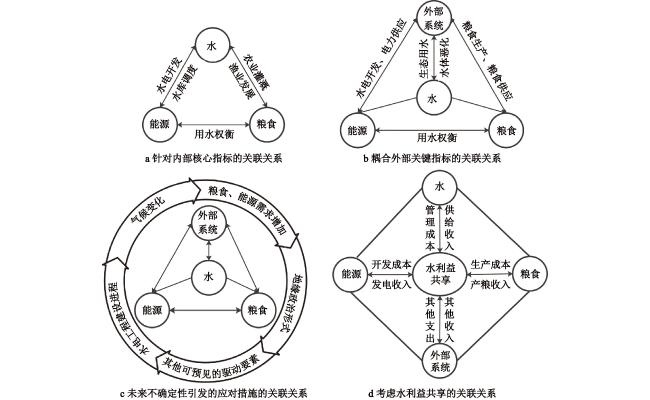
In the context of transboundary river basins, the water-energy-food nexus is of great significance for water security and ecological security, as well as for maintaining the geopolitical security and sustainable development of transboundary countries. The present study systematically reviewed the frontier progress of the water-energy-food nexus research in the transboundary river basins. These studies can be grouped into four categories: research on the internal core nexus, research on the nexus between coupling internal and external systems, research on the nexus of response measures caused by future uncertainty, and research on transboundary cooperation considered water benefit sharing. We recognize the types, characteristics, and challenges of current quantitative assessment methods, and point out the future development trends from the perspective of actual needs of transboundary basins, i.e., promoting information sharing and data mining, revealing the coupling and feedback mechanism of the water-energy-food nexus, enhancing the development and application of quantitative assessment model of the water-energy-food nexus, strengthening the researches on future uncertainty of the water-energy-food nexus, and promoting multi-stakeholder cooperation. This review will facilitate the rational development and utilization of water resources in the transboundary river basins and realize deeper international cooperation.
Xu Ziyue , Ma Kai , Yuan Xu , He Daming , Su Yan . Progress and prospect of water-energy-food nexus in the transboundary river basins[J]. SCIENTIA GEOGRAPHICA SINICA, 2023 , 43(8) : 1442 -1450 . DOI: 10.13249/j.cnki.sgs.2023.08.013
表1 跨境流域水-能源-粮食关联关系研究方法Table 1 Methodology of water-food-energy nexus in the transboundary river basins |
| 研究方法 | 方法类型 | 解决的问题 | 主要应用的流域 | 文献来源 |
| 系统动力学模型 | 仿真模型 | 定量分析水-能源-粮食关联关系的动态演变,揭示水资源利用价值对不同管理方案的反馈 | 青尼罗河 | [54] |
| 贝叶斯网络 | 概率图模型 | 模拟关联关系的强弱与不确定性,提升对复杂水资源系统演变过程中关联关系变化的认知 | 锡尔河 | [38] |
| 基于主体的耦合模型 | 集成模型 | 揭示自然界供水系统(降雨、河流径流)和人类用水部门之间的互馈关系 | 澜沧江-湄公河、尼日尔河 | [39,42] |
| NEST | 集成模型 | 模拟水、能源及土地资源系统应对未来经济发展和气候变化的脆弱性 | 印度河 | [55] |
| DSS | 集成模型 | 评估水-能源-粮食-环境关联关系,对流域可预见的决策方案进行模拟优化 | 梅克鲁河 | [56] |
| 水文经济模型 | 集成模型 | 量化关联关系系统指标的经济效益,模拟变化环境下资源效益变化特征 | 喜马拉雅河、青尼罗河、塞内加尔河 | [40,57-58] |
| 社会水文模型 | 集成模型 | 揭示气候变化、工程调度和政治权重变化、补偿机制等对跨境合作演化的影响规律 | 澜沧江-湄公河 | [59] |
| [1] |
Mccracken M, Wolf A T. Updating the register of international river basins of the world[J]. International Journal of Water Resources Development, 2019, 35(5): 732-782.
|
| [2] |
何大明, 刘昌明, 冯彦, 等. 中国国际河流研究进展及展望[J]. 地理学报, 2014, 69(9): 1284-1294.
He Daming, Liu Changming, Feng Yan et al. Progress and perspective of international river researches in China. Acta Geographica Sinica, 2014, 69(9): 1284-1294.
|
| [3] |
李芳, 吴凤平, 陈柳鑫, 等. 基于加权破产博弈模型的跨境流域水资源分配研究[J]. 地理科学, 2021, 41(4): 728-736.
Li Fang, Wu Fengping, Chen Liuxin et al. Transboundary river water resource allocation based on weighted bankruptcy game model. Scientia Geographica Sinica, 2021, 41(4): 728-736.
|
| [4] |
王涛, 刘承良, 杜德斌. 1948—2018年国际河流跨境水冲突的时空演化规律[J]. 地理学报, 2021, 76(7): 1792-1809.
Wang Tao, Liu Chengliang, Du Debin. Spatio-temporal dynamics of international freshwater conflict events and relations from 1948 to 2018. Acta Geographica Sinica, 2021, 76(7): 1792-1809.
|
| [5] |
周婷, 郑航. 科罗拉多河水权分配历程及其启示[J]. 水科学进展, 2015, 26(6): 893-901.
Zhou Ting, Zheng Hang. Review of water rights allocation in Colorado River and its enlightenment. Advances in Water Science, 2015, 26(6): 893-901.
|
| [6] |
何大明, 刘恒, 冯彦, 等. 全球变化下跨境水资源理论与方法研究展望[J]. 水科学进展, 2016, 27(6): 928-934.
He Daming, Liu Heng, Feng Yan et al. Perspective on theories and methods study of transboundary water resources under the global change. Advances in Water Science, 2016, 27(6): 928-934.
|
| [7] |
Salmoral G, Schaap N, Walschebauer J et al. Water diplomacy and nexus governance in a transboundary context: In the search for complementarities[J]. Science of the Total Environment, 2019, 690: 85-96.
|
| [8] |
林志慧, 刘宪锋, 陈瑛, 等. 水-粮食-能源关联关系研究进展与展望[J]. 地理学报, 2021, 76(7): 1591-1604.
Lin Zhihui, Liu Xianfeng, Chen Ying et al. Water-food-energy nexus: Progress, challenges and prospect. Acta Geographica Sinica, 2021, 76(7): 1591-1604.
|
| [9] |
Chen J F, Ding T H, Wang H M et al. Research on total factor productivity and influential factors of the regional water-energy-food: A case study on Inner Mongolia, China[J]. International Journal of Environment Research and Public Health, 2019, 16(17): 1-21.
|
| [10] |
Hoff H. Understanding the nexus-background paper for the Bonn 2011 Conference: The water, energy and food security nexus[R]. Stockholm: Stockholm Environment Institute, 2011.
|
| [11] |
丁童慧, 陈军飞. 水-能源-粮食纽带关系研究综述及前景展望[J]. 资源与产业, 2022, 24(2): 19-29.
Ding Tonghui, Chen Junfei. Review and prospect of researches on water-energy-food nexus. Resources & Industries, 2022, 24(2): 19-29.
|
| [12] |
Gulati M, Jacobs I, Jooste A et al. The water-energy-food security nexus: Challenges and opportunities for food security in South Africa[J]. Aquatic Procedia, 2013, 1: 150-164.
|
| [13] |
Endo A, Tsurita I, Burnett K et al. A review of the current state of research on the water, energy, and food nexus[J]. Journal of Hydrology: Regional Studies, 2017, 11: 20-30.
|
| [14] |
匡洋, 李浩, 夏军, 等. 气候变化对跨境水资源影响的适应性评估与管理框架[J]. 气候变化研究进展, 2018, 14(1): 67-76.
Kuang Yang, Li Hao, Xia Jun et al. Impacts of climate change on transboundary water resources and adaptation management framework. Climate Change Research, 2018, 14(1): 67-76.
|
| [15] |
杨珍华. 中印跨界水资源开发利用法律问题研究[D].武汉: 武汉大学, 2014.
Yang Zhenhua. The research on legal issues of development and utilization of transboudary water resources in Sino-China. Wuhan:Wuhan University, 2014.
|
| [16] |
李峰平, 章光新, 董李勤. 气候变化对水循环与水资源的影响研究综述[J]. 地理科学, 2013, 33(4): 457-464.
Li Fengping, Zhang Guangxin, Dong Liqin. Studies for impact of climate change on hydrology and water resources. Scientia Geographica Sinica, 2013, 33(4): 457-464.
|
| [17] |
Milly P C D, Dunne K A, Vecchia A V. Global pattern of trends in streamflow and water availability in a changing climate[J]. Nature, 2005, 438(7066): 347-350.
|
| [18] |
Digna R F, Mohamed Y A, van der Zaag P et al. Impact of water resources development on water availability for hydropower production and irrigated agriculture of the Eastern Nile Basin[J]. Journal of Water Resources Planning and Management, 2018, 144(5): 05018007
|
| [19] |
Li R. Transboundary water conflicts in the Nile Basin[J]. Water Encyclopedia, 2005, 2: 590-594.
|
| [20] |
李芳, 吴凤平, 陈柳鑫, 等. 非对称性视角下跨境水资源冲突与合作的鹰鸽博弈模型[J]. 中国人口·资源与环境, 2020, 30(5): 157-166.
Li Fang, Wu Fengping, Chen Liuxin et al. Hawk-dove game model of transboundary water resources conflict and cooperation from an asymmetric perspective. China Population Resources and Environment, 2020, 30(5): 157-166.
|
| [21] |
纪道斌, 龙良红, 徐慧, 等. 梯级水库建设对水环境的累积影响研究进展[J]. 水利水电科技进展, 2017, 37(3): 7-14.
Ji Daobin, Long Lianghong, Xu Hui et al. Advances in study on cumulative effects of construction of cascaded reservoirs on water environment. Advances in Science and Technology of Water Resources, 2017, 37(3): 7-14.
|
| [22] |
Salman S M A. Downstream riparians can also harm upstream riparians: The concept of foreclosure of future uses[J]. Water International, 2010, 35(4): 350-364.
|
| [23] |
Zeitoun M, Warner J. Hydro-hegemony: A framework for analysis of trans-boundary water conflicts[J]. Water Policy, 2006, 8(5): 435-460.
|
| [24] |
De Strasser L, Lipponen A, Howells M et al. A methodology to assess the water energy food ecosystems nexus in transboundary river basins[J]. Water, 2016, 8(2): 59
|
| [25] |
Wang W, Lu H, Leung L R et al. Dam construction in Lancang-Mekong River basin could mitigate future flood risk from warming-induced intensified rainfall[J]. Geophysical Research Letters, 2017, 44(20): 10378-10386.
|
| [26] |
Basheer M, Elagib N A. Temporal analysis of water-energy nexus indicators for hydropower generation and water pumping in the Lower Blue Nile Basin[J]. Journal of Hydrology, 2019, 578: 124085
|
| [27] |
Ahmed A M M. Effects of seasonal variation on fish catching in Jebel Aulia reservoir on the White Nile, Sudan[J]. International Journal of Fisheries and Aquaculture, 2017, 7(1): 15-22.
|
| [28] |
Huang F, Xia Z, Guo L et al. Effects of reservoirs on seasonal discharge of Irtysh River measured by Lepage test[J]. Water Science and Engineering, 2014, 7(4): 363-372.
|
| [29] |
Zhai H, Cui B, Hu B et al. Prediction of river ecological integrity after cascade hydropower dam construction on the mainstream of rivers in Longitudinal Range-Gorge Region (LRGR), China[J]. Ecological Engineering, 2010, 36(4): 361-372.
|
| [30] |
钟勇. 基于互惠合作的跨界河流开发利用博弈模型研究[D]. 北京: 清华大学, 2016.
Zhong Yong. Study on game theory of reciprocity cooperation of transboundary rivers. Beijing: Tsinghua University, 2016.
|
| [31] |
Davis N. Global risks 2011 report (6th edition)[R]. Cologne: World Economic Forum, 2011.
|
| [32] |
Keskinen M, Someth P, Salmivaara A et al. Water-energy-food nexus in a transboundary river basin: The case of Tonle Sap Lake, Mekong River Basin[J]. Water, 2015, 7(10): 5416-5436.
|
| [33] |
Al-Saidi M, Hefny A. Institutional arrangements for beneficial regional cooperation on water, energy and food priority issues in the Eastern Nile Basin[J]. Journal of Hydrology, 2018, 562: 821-831.
|
| [34] |
Zhang J, Yang Y C E, Li H et al. Examining the food-energy-water-environment nexus in transboundary river basins through a human dimension lens: Columbia River Basin[J]. Journal of Water Resources Planning and Management, 2021, 147(10): 05021019
|
| [35] |
施海洋, 罗格平, 郑宏伟, 等. 基于“水-能源-食物-生态”关联因果关系和贝叶斯网络的锡尔河流域用水分析[J]. 地理学报, 2020, 75(5): 1036-1052.
Shi Haiyang, Luo Geping, Zheng Hongwei et al. Water use analysis of Syr Darya River Basin: Based on "Water-Energy-Food-Ecology" nexus and Bayesian network. Acta Geographica Sinica, 2020, 75(5): 1036-1052.
|
| [36] |
Jalilov S-M, Varis O, Keskinen M. Sharing benefits in transboundary rivers: An experimental case study of Central Asian water-energy-agriculture nexus[J]. Water, 2015, 7(9): 4778-4805.
|
| [37] |
Ziv G, Baran E, Nam S et al. Trading-off fish biodiversity, food security, and hydropower in the Mekong River Basin[J]. Proceedings of the National Academy of Sciences, 2012, 109(15): 5609-5614.
|
| [38] |
Shi H, Luo G, Zheng H et al. Coupling the water-energy-food-ecology nexus into a Bayesian network for water resources analysis and management in the Syr Darya River Basin[J]. Journal of Hydrology, 2019, 581: 124387
|
| [39] |
Khan H F, Yang Y, Hua X et al. A coupled modeling framework for sustainable watershed management in transboundary river basins[J]. Hydrology and Earth System Sciences Discussions, 2017, 21(12): 1-28.
|
| [40] |
Tilmant A, Pina J, Salman M et al. Probabilistic trade-off assessment between competing and vulnerable water users—The case of the Senegal River Basin[J]. Journal of Hydrology, 2020, 587: 124915
|
| [41] |
Elsayed H, Djordjević S, Savić D A et al. The Nile water-food-energy nexus under uncertainty: Impacts of the Grand Ethiopian Renaissance Dam[J]. Journal of Water Resources Planning and Management, 2020, 146(11): 04020085
|
| [42] |
Yang J, Yang Y-C E, Khan H F et al. Quantifying the sustainability of water availability for the water-food-energy-ecosystem nexus in the Niger River Basin[J]. Earths Future, 2018, 6(9): 1292-1310.
|
| [43] |
Yang Y-C E, Wi S, Ray P A et al. The future nexus of the Brahmaputra River Basin: Climate, water, energy and food trajectories[J]. Global Environmental Change, 2016, 37: 16-30.
|
| [44] |
United Nations Educational, Scientific and Cultural Organization. The United Nations world water development report 2021: Valuing water[R]. New York: United Nations, 2021.
|
| [45] |
刘艳丽, 赵志轩, 孙周亮, 等. 基于水利益共享的跨境流域水资源多目标分配研究——以澜沧江-湄公河为例[J]. 地理科学, 2019, 39(3): 387-393.
Liu Yanli, Zhao Zhixuan, Sun Zhouliang et al. Multi-objective water resources allocation in trans-boundary rivers based on the concept of water benefit-sharing: A case in the Lancang-Mekong River. Scientia Geographica Sinica, 2019, 39(3): 387-393.
|
| [46] |
蔡方园, 何艳虎, 陈晓宏. 澜沧江流域枯水年发电效益与下游生态-出境水互馈博弈研究[J]. 水利学报, 2020, 51(5): 536-544.
Cai Fangyuan, He Yanhu, Chen Xiaohong. Game study of Lancang River Basin's power generation benefit and downstream ecological water-outbound water in the dry years. Journal of Hydraulic Engineering, 2020, 51(5): 536-544.
|
| [47] |
Arjoon D, Tilmant A, Herrmann M. Sharing water and benefits in transboundary river basins[J]. Hydrology and Earth System Sciences, 2016, 20(6): 2135-2150.
|
| [48] |
康立芸, 孙周亮, 刘艳丽, 等. 水利益共享理论及其应用概述[J]. 人民黄河, 2021, 43(1): 77-81.
Kang Liyun, Sun Zhouliang, Liu Yanli et al. Overview of water benefit sharing theory and its application. Yellow River, 2021, 43(1): 77-81.
|
| [49] |
Matthews N, Motta S. Chinese state-owned enterprise investment in Mekong hydropower: Political and economic drivers and their implications across the water, energy, food nexus[J]. Water, 2015, 7(11): 6269-6284.
|
| [50] |
Filho F A S, Lall U, Porto R L L. Role of price and enforcement in water allocation: Insights from game theory[J]. Water Resources Research, 2008, 44(12): W12420
|
| [51] |
Read L, Madani K, Inanloo B. Optimality versus stability in water resource allocation[J]. Journal of Environmental Management, 2014, 133: 343-354.
|
| [52] |
Eleftheriadou E, Mylopoulos Y. Game theoretical approach to conflict resolution in transboundary water resources management[J]. Journal of Water Resources Planning and Management, 2008, 134(5): 466-473.
|
| [53] |
Yu Y, Zhao J, Li D et al. Effects of hydrologic conditions and reservoir operation on transboundary cooperation in the Lancang-Mekong River Basin[J]. Journal of Water Resources Planning and Management, 2019, 145(6): 04019020
|
| [54] |
Tan C C, Erfani T, Erfani R. Water for energy and food: A system modelling approach for Blue Nile River Basin[J]. Environments, 2017, 4(1): 15
|
| [55] |
Vinca A, Parkinson S, Byers E et al. The NExus Solutions Tool (NEST) v1. 0: An open platform for optimizing multi-scale energy-water-land system transformations[J]. Geoscientific Model Development, 2020, 13(3): 1095-1121.
|
| [56] |
Udias A, Pastori M, Dondeynaz C et al. A decision support tool to enhance agricultural growth in the Mekrou river basin (West Africa)[J]. Computers and Electronics in Agriculture, 2018, 154: 467-481.
|
| [57] |
Amjath-Babu T S, Sharma B, Brouwer R et al. Integrated modelling of the impacts of hydropower projects on the water-food-energy nexus in a transboundary Himalayan River Basin[J]. Applied Energy, 2019, 239: 494-503.
|
| [58] |
Basheer M, Wheeler K G, Ribbe L et al. Quantifying and evaluating the impacts of cooperation in transboundary river basins on the water-energy-food nexus: The Blue Nile Basin[J]. Science of The Total Environment, 2018, 630: 1309-1323.
|
| [59] |
Lu Y, Tian F, Guo L et al. Socio-hydrologic modeling of the dynamics of cooperation in the transboundary Lancang-Mekong River[J]. Hydrology and Earth System Sciences, 2021, 25(4): 1883-1903.
|
| [60] |
Hui R, Lund J R, Madani K. Game theory and risk-based leveed river system planning with noncooperation[J]. Water Resources Research, 2016, 52(1): 119-134.
|
| [61] |
Zawahri N A, Mitchell S M L. Fragmented governance of international rivers: Negotiating bilateral versus multilateral treaties[J]. International Studies Quarterly, 2011, 55(3): 835-858.
|
/
| 〈 |
|
〉 |