



基于城市拼装视角的共享单车理论解释——以广州市中心城区为例
|
曹婧(1996—),女,甘肃张掖人,博士研究生,研究方向为社会文化地理。E-mail: 1374145557@qq.com |
收稿日期: 2023-10-28
修回日期: 2024-02-28
网络出版日期: 2024-12-19
基金资助
国家自然科学基金项目(42371239)
国家自然科学基金项目(42071191)
国家自然科学基金项目(42071189)
国家自然科学基金项目(42101232)
广东省普通高校哲学社会科学重点实验室项目(2022WSYS004)
广东乡村地域系统野外科学观测研究站项目(2021B1212050026)
版权
Theoretical explanation of bike-sharing based on the urban assemblage perspective: A case study of Central Guangzhou
Received date: 2023-10-28
Revised date: 2024-02-28
Online published: 2024-12-19
Supported by
National Natural Science Foundation of China(42371239)
National Natural Science Foundation of China(42071191)
National Natural Science Foundation of China(42071189)
National Natural Science Foundation of China(42101232)
Guangdong Provincial Key Laboratory of Philosophy and Social Sciences in Colleges and Universities(2022WSYS004)
Guangdong Rural Regional System Field Scientific Observation Station Project(2021B1212050026)
Copyright
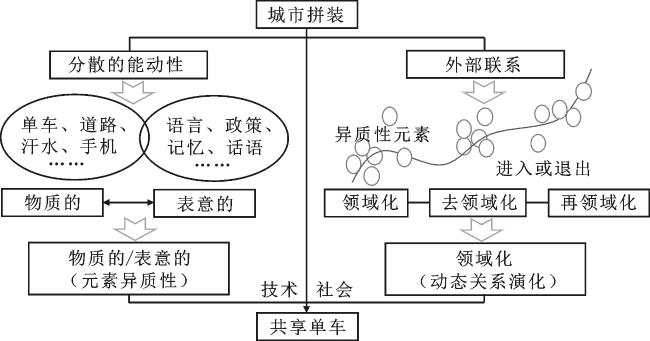
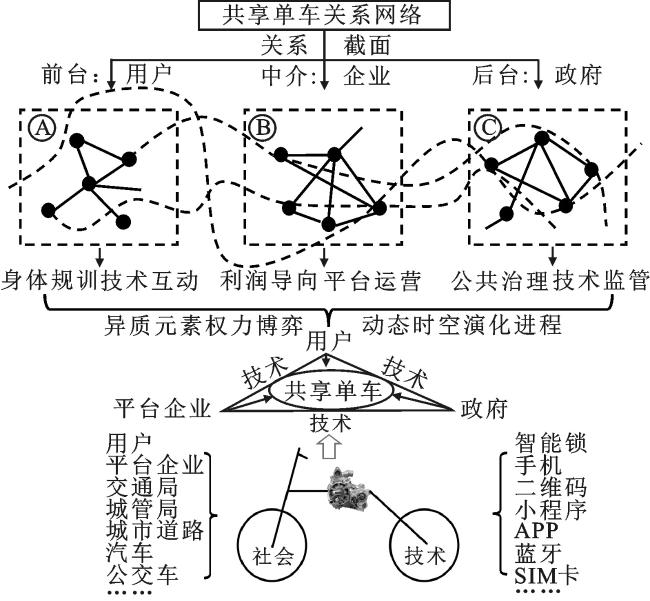
共享单车是与城市绿色发展相关的低碳基础设施。为了弥补现有研究对共享单车能动性关注不足的问题,文章以城市拼装为方法论,运用质性研究方法揭示共享单车关系“黑箱”。首先,通过非线性和动态的关系视角阐释了共享单车在城市公共空间的日常实践,发现共享单车是人与非人元素不断协商的社会关系产物;其次,从城市本体、社会-技术互动、技术对主体性影响3个方面反思,以期人文地理学者能结合全球城市化和智能化新趋势进行地理知识生产。通过对共享单车多元权力博弈和空间演化过程的分析,洞见了更广范围的社会和技术互动,并从新的视角为中国城市转型发展和治理提供新思考。
曹婧 , 李溁锋 , 王亚 , 蔡晓梅 . 基于城市拼装视角的共享单车理论解释——以广州市中心城区为例[J]. 地理科学, 2025 , 45(2) : 364 -375 . DOI: 10.13249/j.cnki.sgs.20231071
Bike-sharing is a new urban infrastructure with low-carbon and environmentally friendly pratices, directly contributing to the sustainable development of cities. However, most existing studies overlook both the distributed agency of bike-sharing and the dynamic ralational networks and operational logics underpinning it. Agency, as emphasized in assemblage theory, is not exclusive to humans but extends to non-human entities. Therefore, this paper adopts the urban assemblage perspective as its methodological freamework to analyze how bike-sharing is embedded into the fabric of everyday urban life and to uncover the theoretical logic behind this phenomenon. Urban assemblage provides a lens to navigate the complexity of urban systems, characterized by entangled materiality, emotions, governance, and non-linear causality. This study incorpoates two axes of material/expressive and territorialization, and two core concepts, distributed agency and relations of exteriority, to reveal the “black box” of bike-sharing through qualitative research methods. First, it examines the temporarily stabilized, multidimensional relational network of “human-technology-bike-space”, explaining the daily practices of bike-sharing in urban public spaces through a dynamic and non-linear perspective. The findings highlight that bike-sharing emerges as a product of continuous negotiation between human and non-human elements. Second, the paper reflects on urban ontology, social-technological interaction and technology influence on subjectivity, aiming to inspire social and cultural geographers to generate geographical knowledge aligned with the global trends of urbanization and intelligence. Finally, through the interpretive framework of multiple power game and spatial evolution, the research broadens the scope of society-technology interactions, offering novel insights into the transformation and sustainable development of Chinese cities from a new perspective.
Key words: bike-sharing; assemblage theory; urban assemblage; distributed agency; technology
表1 共享单车访谈样本Table 1 Sample interview on the bike-sharing |
| 访谈对象 | 职业 | 访谈次数 | 访谈时长/min | |
| 用户 | MY-1 | 公司职员 | 1 | 40 |
| FY-2 | 大学教师 | 1 | 38 | |
| MY-3 | 在读研究生 | 1 | 45 | |
| MY-4 | 在读研究生 | 1 | 60 | |
| MY-5 | 自由职业 | 1 | 40 | |
| FY-6 | 硕士研究生 | 1 | 35 | |
| FY-7 | 实习生 | 1 | 72 | |
| MY-8 | 辛拉面员工 | 1 | 41 | |
| FY-9 | 公司职员 | 1 | 40 | |
| MY-10 | 公司职员 | 1 | 50 | |
| 企业 | MQ-1 | 企业员工 | 2 | 170 |
| MQ-2 | 企业部门主管 | 5 | 200 | |
| 政府 | FC-1 | 区城管职员 | 1 | 45 |
| MC-2 | 区城管职员 | 1 | 60 | |
| MC-3 | 区城管职员 | 1 | 57 | |
| MC-4 | 区城管主任 | 1 | 67 | |
| MJ-1 | 市交通局负责人员 | 1 | 94 |
| [1] |
Nations U. World cycling day | United Nations[EB/OL]. United Nations [2023-10-29]. https://www.un.org/zh/observances/bicycle-day.
|
| [2] |
Latham A, Nattrass M. Autonomous vehicles, car-dominated environments, and cycling: Using an ethnography of infrastructure to reflect on the prospects of a new transportation technology[J]. Journal of Transport Geography, 2019, 81: 102539.
|
| [3] |
Fishman E. Bikeshare: A review of recent literature[J]. Transport reviews, 2016, 36(1): 92-113.
|
| [4] |
Eren E, Uz V E. A review on bike-sharing: The factors affecting bike-sharing demand[J]. Sustainable Cities and Society, 2020, 54: 101882.
|
| [5] |
Fishman E, Washington S, Haworth N. Bike share: A synthesis of the literature[J]. Transport Reviews, 2013, 33(2): 148-165.
|
| [6] |
王宁. 共享经济是“伪共享”吗?——共享经济的社会学探析[J]. 学术月刊, 2021, 53(4): 129-141.
Wang Ning. Is sharing economy “pseudo sharing”—A sociological investigation into sharing economy. Academic Monthly, 2021, 53(4): 129-141.
|
| [7] |
申犁帆, 王烨, 张纯, 等. 轨道站点合理步行可达范围建成环境与轨道通勤的关系研究——以北京市44个轨道站点为例[J]. 地理学报, 2018, 73(12): 2423-2439.
Shen Lifan, Wang Ye, Zhang Chun et al. Relationship between built environment of rational pedestrian catchment areas and URT commuting ridership: Evidence from 44 URT stations in Beijing. Acta Geographica Sinica, 2018, 73(12): 2423-2439.
|
| [8] |
高枫, 李少英, 吴志峰, 等. 广州市主城区共享单车骑行目的地时空特征与影响因素[J]. 地理研究, 2019, 38(12): 2859-2872.
Gao Feng, Li Shaoying, Wu Zhifeng et al. Spatial-temporal characteristics and the influencing factors of the ride destination of bike sharing in Guangzhou City. Geographical Research, 2019, 38(12): 2859-2872.
|
| [9] |
郭文峰, 万义良, 金瑞, 等. 基于共享单车轨迹的精细路网更新方法[J]. 地理与地理信息科学, 2022, 38(1): 86-93.
Guo Wenfeng, Wan Yiliang, Jin Rui et al. A fine-grained road network update method based on shared bike trajectory. Geography and Geo-Information Science, 2022, 38(1): 86-93.
|
| [10] |
Zhang J. What is shared in shared bicycles? Mobility, space, and capital[J]. Mobilities, 2022, 17(5): 711-728.
|
| [11] |
Miller H J, Goodchild M F. Data-driven geography[J]. GeoJournal, 2015, 80: 449-461.
|
| [12] |
Kurnicki K. What do cars do when they are parked? Material objects and infrastructuring in social practices[J]. Mobilities, 2022, 17(1): 37-52.
|
| [13] |
郭文. 面向新唯物主义的文化地理学研究[J]. 地理学报, 2023, 78(12): 2922-2938.
Guo Wen. Research on new materialism in Cultural Geography. Acta Geographica Sinica, 2023, 78(12): 2922-2938.
|
| [14] |
Anderson B, Mcfarlane C. Assemblage and geography[J]. Area, 2011, 43(2): 124-127.
|
| [15] |
Duarte F. Disassembling bike-sharing systems: Surveillance, advertising, and the social inequalities of a global technological assemblage[J]. Journal of Urban Technology, 2016, 23(2): 103-115.
|
| [16] |
Deleuze G, Parnet C. Dialogues II[M]. New York: Columbia University Press, 2002: 54-69.
|
| [17] |
Delanda M. A new philosophy of society: Assemblage theory and social complexity[M]. London and New York: Continuum, 2006: 3-6.
|
| [18] |
Delanda M. Assemblage theory[M]. Edinburgh: Edinburgh University Press, 2016: 142.
|
| [19] |
蔡晓梅, 曹婧, 刘俊. 拼装理论在人文地理学研究中的应用与展望[J]. 地理学报, 2022, 77(10): 2633-2649.
Cai Xiaomei, Cao Jing, Liu Jun. The application and prospect of assemblage theory in Human Geography research. Acta Geographica Sinica, 2022, 77(10): 2633-2649.
|
| [20] |
Farías I. The politics of urban assemblages[J]. City, 2011, 15(3-4): 365-374.
|
| [21] |
McFarlane C. The city as assemblage: Dwelling and urban space[J]. Environment and Planning D: Society and Space, 2011, 29(4): 649-671.
|
| [22] |
Gandy M. Cyborg urbanization: Complexity and monstrosity in the contemporary city[J]. International Journal of Urban and Regional Research, 2005, 29(1): 26-49.
|
| [23] |
Mccann E, Ward K. Assembling urbanism: Following policies and ‘studying through’ the sites and situations of policy making[J]. Environment and Planning A, 2012, 44(1): 42-51.
|
| [24] |
Bennet J. The agency of assemblages and the North American blackout[J]. Public Culture, 2005, 17(3): 445-465.
|
| [25] |
Lieto L. How material objects become urban things?[J]. City, 2017, 21(5): 568-579.
|
| [26] |
Lea T, Buchanan I, Fuller G et al. New problems for assemblage thinking: Materiality, governance and cycling in Sydney, Australia[J]. Journal of Environmental Policy & Planning, 2022, 24(3): 343-354.
|
| [27] |
郭鹏, 林祥枝, 黄艺, 等. 共享单车: 互联网技术与公共服务中的协同治理[J]. 公共管理学报, 2017, 14(3): 1-10.
Guo Peng, Lin Xiangzhi, Huang Yi et al. Bike sharing: Collaborative governance in internet technology and public services. Journal of Public Management, 2017, 14(3): 1-10.
|
| [28] |
Weiser M. The computer for the 21 st century[J]. Scientific American, 1991, 265(3): 94-105.
|
| [29] |
Rosen J, Alvarez León L F. The digital growth machine: Urban change and the ideology of technology[J]. Annals of the American Association of Geographers, 2022, 112(8): 2248-2265.
|
| [30] |
Deleuze G, Guattari F. A thousand plateaus: Capitalism and schizophrenia[M]. London: Continuum, 1987: 2-406.
|
| [31] |
Osman R, Mulíček O. Urban chronopolis: Ensemble of rhythmized dislocated places[J]. Geoforum, 2017, 85: 46-57.
|
| [32] |
Crang M. Urban morphology and the shaping of the transmissable city[J]. City, 2000, 4(3): 303-315.
|
| [33] |
蔡晓梅, 黄玉玲, 曹婧, 等. 太极疗愈拼装物的建构过程: 一个实证研究探索[J]. 地理研究, 2023, 42(5): 1163-1176.
Cai Xiaomei, Huang Yuling, Cao Jing et al. The formation process of Taichi therapeutic assemblage: An empirical investigation. Geographical Research, 2023, 42(5): 1163-1176.
|
| [34] |
Dant T. The driver-car[J]. Theory, Culture & Society, 2004, 21(4-5): 61-79.
|
| [35] |
Anderson B, Kearnes M, McFarlane C et al. On assemblages and geography[J]. Dialogues in Human Geography, 2012, 2(2): 171-189.
|
| [36] |
阮云星, 高英策. 赛博格人类学: 信息时代的“控制论有机体”隐喻与智识生产[J]. 开放时代, 2020(1): 162-175+9.
Ruan Yunxing, Gao Yingce. Cyborg anthropology: The metaphor of cybernetic organism and intellectual knowledge production in the information age. Open Times, 2020(1): 162-175+9.
|
| [37] |
Dixon D P, Whitehead M. Technological trajectories: Old and new dialogues in geography and technology studies[J]. Social & Cultural Geography, 2008, 9(6): 601-611.
|
| [38] |
Dewsbury J D. The Deleuze-Guattarian assemblage: Plastic habits[J]. Area, 2011, 43(2): 148-153.
|
| [39] |
Jones P. Sensory indiscipline and affect: A study of commuter cycling[J]. Social & Cultural Geography, 2012, 13(6): 645-658.
|
| [40] |
Simpson P. A sense of the cycling environment: Felt experiences of infrastructure and atmospheres[J]. Environment and Planning A: Economy and Space, 2017, 49(2): 426-447.
|
| [41] |
张茂元. 技术红利共享——互联网平台发展的社会基础[J]. 社会学研究, 2021, 36(5): 91-112+228.
Zhang Maoyuan. Technology dividend sharing: Social foundation for internet platform development. Sociological Studies, 2021, 36(5): 91-112+228.
|
| [42] |
渠敬东, 周飞舟, 应星. 从总体支配到技术治理——基于中国30年改革经验的社会学分析[J]. 中国社会科学, 2009, 180(6): 104-127.
Qu Jingdong, Zhou Feizhou, Ying Xing. From macromanagement to micromanagement—Reflections on thirty years of reform from the sociological perspective. Social Sciences in China, 2009, 180(6): 104-127.
|
| [43] |
Brayne S. Big data surveillance: The case of policing[J]. American Sociological Review, 2017, 82(5): 977-1008.
|
| [44] |
Ghoddousi P, Page S. Using ethnography and assemblage theory in Political Geography[J]. Geography Compass, 2020, 14(10): e12533.
|
| [45] |
Datta A, Ahmed N. Intimate infrastructures: The rubrics of gendered safety and urban violence in Kerala, India[J]. Geoforum, 2020, 110: 67-76.
|
| [46] |
郭杰, 王珺, 姜璐, 等. 从技术中心主义到人本主义: 智慧城市研究进展与展望[J]. 地理科学进展, 2022, 41(3): 488-498.
Guo Jie, Wang Jun, Jiang Lu et al. From technocentrism to humanism: Progress and prospects of smart city research. Progress in Geography, 2022, 41(3): 488-498.
|
| [47] |
徐辰烨, 彭兰. 从“人”到“赛博格”: 技术物如何影响日常交往行为?——以耳机为例[J]. 新闻界, 2023(4): 34-46.
Xu Chenye, Peng Lan. From the “human” to the “Cyborg”: How technical objects influence daily communication behaviors— An analysis based on the earphones. Journalism and Mass Communication, 2023(4): 34-46.
|
/
| 〈 |
|
〉 |