



旅游信息流空间的城市群关系网络——以中国新疆为例
|
黄玉玲(1996—),女,广东揭阳人,博士研究生,主要研究方向为社会文化地理、中小旅游企业管理。E-mail: huangyl_1021@163.com |
收稿日期: 2024-09-06
修回日期: 2024-12-04
网络出版日期: 2025-10-24
基金资助
暨南大学管理学院重点学科建设育题基金项目(GY21017)
暨南大学企业发展研究所课题资助
版权
Relational network of city clusters in the space of tourism information flow: A case of Xinjiang, China
Received date: 2024-09-06
Revised date: 2024-12-04
Online published: 2025-10-24
Supported by
Key Discipline Construction Education Fund of the School of Management of Jinan University(GY21017)
Research Institute of Enterprise Development of Jinan University
Copyright
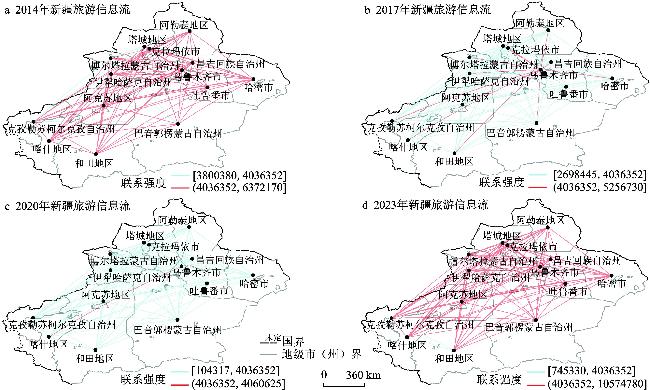
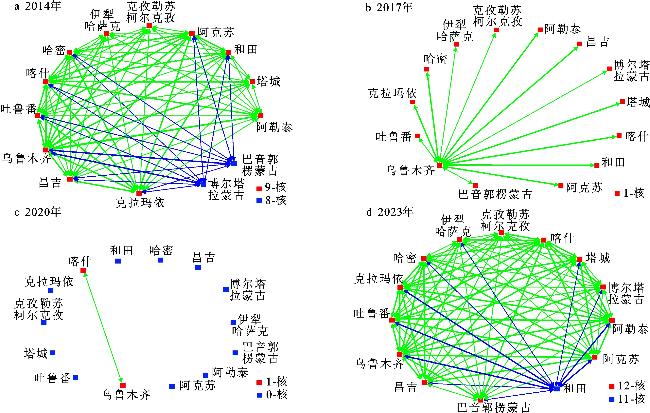
本文采用社会网络分析方法探究新疆旅游信息流关系网络结构的时空演变特征。结果表明:①从关系网络看,乌鲁木齐市虽具有一定优势,但并没有呈现出传统地理网络中的“虹吸效应”,而是超越地理边界建构复杂的流关系网络;②核心-边缘关系网络结构具有层级性,且层级分类并非以自身固有资源优劣势作为单一衡量标准,而是取决于节点间的连接数;③核心-边缘的层级结构呈现出动态的变化过程,通过与核心节点相连,原先被视为处于边缘层级的节点也能够跃升至核心层级。本文不仅验证了网络具有层级性的创新性观点,还通过时空演变揭示了层级的动态变化,为处于边缘的旅游目的地跻身核心旅游区提供新的实践启示。
黄玉玲 , 文彤 , 凯丽比努尔·阿木提 . 旅游信息流空间的城市群关系网络——以中国新疆为例[J]. 地理科学, 2025 , 45(10) : 2164 -2174 . DOI: 10.13249/j.cnki.sgs.20240980
The interaction and construction of urban relationship networks have always been the focus of attention for urban geographers. In the information age, the virtual space is the mapping and extension of the real space. The search and connection volume of online tourism information can be regarded as the hotspots of social development or represent the potential travel intentions of consumers. Through the analysis of the informal flow space network, certain reference value can be provided for the tourism industry development planning of various regions. Establishing cross-scale spatial linkages between individuals-regions from virtual space can complement traditional geospatial perceptions. In this paper, we obtain the frequency of tourism information co-occurrence in two cities and municipalities in Xinjiang in Baidu index, and use social network analysis to explore the spatial and temporal evolution of the spatial network structure of tourism information flow in Xinjiang. The results show that: 1) Urumqi City has certain advantages in terms of destination tourism information flow and relationship network, but it does not show the “siphon effect” in the traditional geographic network, but constructs a complex flow relationship network beyond the geographic boundary. This suggests that tourists' willingness to embark on multi-region travel, even travelling across longer geographical distances, is crucial for promoting the balanced development of Xinjiang's regional tourism. 2) In the relational network space, the core-edge network structure is not entirely horizontal, but is hierarchical, and the hierarchical categorization is not based on its own inherent resource strengths and weaknesses as a single measure, but rather depends on the number of connections between nodes. It can be seen that in the information flow space, establishing information links becomes one of the ways for edge nodes to enter the core subgroups. 3) The core-edge hierarchical structure shows a dynamic change process, which challenges the idea of “the strongest is stronger than the strongest”, and by connecting to the core nodes, the nodes that were originally regarded as peripheral nodes can also be promoted to the core nodes, such as Hotan and Kashgar. The dynamic nature of real-time “reshuffling” and replacement of the positions of each node in the network reflects the importance of observing the development status of cities from informal networks, and can provide new insights for establishing interactive development relationships among cities. This paper not only verifies the innovative idea that networks are hierarchical, but also reveals the dynamic process of hierarchical change through spatial and temporal evolution characteristics, which provides new insights into the establishment of interactive development relationships between cities and provides new practical insights for marginal tourist destinations to become core tourist areas.
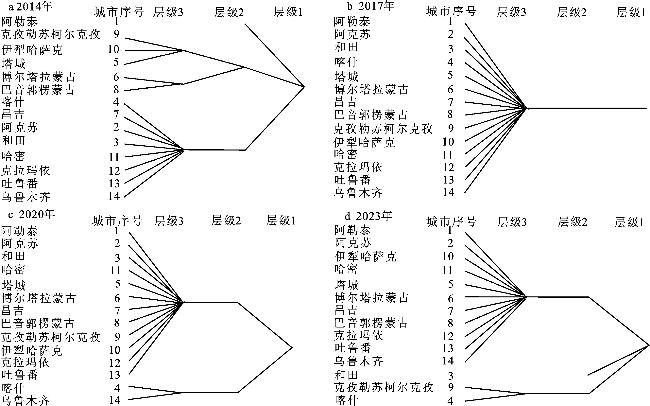
图2 新疆旅游信息流网络凝聚子群分析Fig. 2 Analysis on cohesive subgroups of tourism information network in Xinjiang |
表1 新疆旅游信息流网络凝聚子群密度矩阵Table 1 Density matrix of cohesive subgroups of Xinjiang tourism information network |
| 年份 | 密度矩阵 | ||||
| 注:空白项为无矩阵。 | |||||
| 2014年 | 子群 | 1 | 2 | 3 | 4 |
| 1 | 1 | 0 | 1 | ||
| 2 | 1 | 0 | 0 | 1 | |
| 3 | 0 | 0 | 0 | 1 | |
| 4 | 1 | 1 | 1 | 1 | |
| 2017年 | 子群 | 1 | |||
| 1 | 0.143 | ||||
| 2020年 | 子群 | 1 | 2 | ||
| 1 | 1 | 0 | |||
| 2 | 0 | 0 | |||
| 2023年 | 子群 | 1 | 2 | 3 | |
| 1 | 1 | 1 | 1 | ||
| 2 | 1 | 0 | |||
| 3 | 1 | 0 | 1 | ||
表2 新疆旅游信息网络节点中心度Table 2 Centrality of tourism information network nodes in Xinjiang |
| 地州市 | 2014年 | 2017年 | 2020年 | 2023年 | |||||||||||
| DC | CC | BC | DC | CC | BC | DC | CC | BC | DC | CC | BC | ||||
| 注:DC 为程度中心度;CC 为接近中心度;BC为中介中心度。 | |||||||||||||||
| 阿勒泰地区 | 11.00 | 0.87 | 0.33 | 1.00 | 0.35 | 0 | 0 | 0 | 0 | 13.00 | 1.00 | 0.18 | |||
| 阿克苏地区 | 13.00 | 0.10 | 1.46 | 1.00 | 0.35 | 0 | 0 | 0 | 0 | 13.00 | 1.00 | 0.18 | |||
| 和田地区 | 13.00 | 0.10 | 1.46 | 1.00 | 0.35 | 0 | 0 | 0 | 0 | 11.00 | 0.87 | 0 | |||
| 喀什地区 | 13.00 | 0.10 | 1.46 | 1.00 | 0.35 | 0 | 1.00 | 0.08 | 0 | 12.00 | 0.93 | 0 | |||
| 塔城地区 | 9.00 | 0.77 | 0 | 1.00 | 0.35 | 0 | 0 | 0 | 0 | 13.00 | 1.00 | 0.18 | |||
| 博尔塔拉蒙古 | 8.00 | 0.72 | 0 | 1.00 | 0.35 | 0 | 0 | 0 | 0 | 13.00 | 1.00 | 0.18 | |||
| 昌吉回族自治州 | 13.00 | 0.10 | 1.46 | 1.00 | 0.35 | 0 | 0 | 0 | 0 | 13.00 | 1.00 | 0.18 | |||
| 巴音郭楞蒙古 | 8.00 | 0.72 | 0 | 1.00 | 0.35 | 0 | 0 | 0 | 0 | 13.00 | 1.00 | 0.18 | |||
| 克孜勒苏柯尔 | 9.00 | 0.77 | 0 | 1.00 | 0.35 | 0 | 0 | 0 | 0 | 12.00 | 0.93 | 0 | |||
| 伊犁哈萨克自治州 | 9.00 | 0.77 | 0 | 1.00 | 0.35 | 0 | 0 | 0 | 0 | 13.00 | 1.00 | 0.18 | |||
| 哈密市 | 13.00 | 0.10 | 1.46 | 1.00 | 0.35 | 0 | 0 | 0 | 0 | 13.00 | 1.00 | 0.18 | |||
| 克拉玛依市 | 13.00 | 0.10 | 1.46 | 1.00 | 0.35 | 0 | 0 | 0 | 0 | 13.00 | 1.00 | 0.18 | |||
| 吐鲁番市 | 13.00 | 0.10 | 1.46 | 1.00 | 0.35 | 0 | 0 | 0 | 0 | 13.00 | 1.00 | 0.18 | |||
| 乌鲁木齐市 | 13.00 | 0.10 | 1.46 | 13.00 | 0.50 | 78.00 | 1.00 | 0.08 | 0 | 13.00 | 1.00 | 0.18 | |||
| 均值 | 11.29 | 0.39 | 0.86 | 1.86 | 0.36 | 5.57 | 0.14 | 0.01 | 0 | 12.71 | 0.98 | 0.14 | |||
| [1] |
苏海洋, 刘人怀, 文彤. 粤港澳大湾区城市旅游信息网络结构[J]. 热带地理, 2022, 42 (2): 220-235.
Su Haiyang, Liu Renhuai, Wen Tong. The structure of urban tourism information network in the Guangdong-Hong Kong-Macao Greater Bay Area. Tropical Geography, 2022, 42 (2): 220-235.
|
| [2] |
Derudder B, Taylor P. The cliquishness of world cities[J]. Global Networks, 2005, 5 (1): 71-91.
|
| [3] |
陈伟, 刘卫东, 柯文前, 等. 基于公路客流的中国城市网络结构与空间组织模式[J]. 地理学报, 2017, 72 (2): 224-241.
Chen Wei, Liu Weidong, Ke Wenqian et al. The spatial structures and organization patterns of China's city networks based on the highway passenger flows. Acta Geographica Sinica, 2017, 72 (2): 224-241.
|
| [4] |
李磊, 陆林, 孙小龙, 等. 高铁沿线旅游流网络结构及其互动关系研究——以合福高铁沿线地区为例[J]. 人文地理, 2020, 35 (1): 132-140.
Li Lei, Lu Lin, Sun Xiaolong et al. Study on the network structure and interactive relationship of tourism flow along high-speed railway: An example of Hefei-Fuzhou high-speed railway area. Human Geography, 2020, 35 (1): 132-140.
|
| [5] |
熊瑶, 黄丽. 粤港澳大湾区城市网络的时空演化——基于企业组织关系视角[J]. 世界地理研究, 2019, 28 (5): 83-94.
Xiong Yao, Huang Li. Spatio-temporal evolution of urban network in the Guangdong-Hong Kong-Macao Greater Bay Area—Based on listed company organization relation. World Regional Studies, 2019, 28 (5): 83-94.
|
| [6] |
Avgerou C. The informational city: Information technology, economic restructuring and the urban regional process[J]. European Journal of Information Systems, 1991, 1 (1): 76-77.
|
| [7] |
邱坚坚, 刘毅华, 陈浩然, 等. 流空间视角下的粤港澳大湾区空间网络格局——基于信息流与交通流的对比分析[J]. 经济地理, 2019, 39 (6): 7-15.
Qiu Jianjian, Liu Yihua, Chen Haoran et al. Urban network structure of Guangdong-Hong Kong-Macau Greater Bay Area with the view of space of flows: A comparison between information. Economic Geography, 2019, 39 (6): 7-15.
|
| [8] |
Derudder B. Mapping global urban networks: A decade of empirical world cities research[J]. Geography Compass, 2008, 2 (2): 559-574.
|
| [9] |
李艳, 孙阳, 陈雯. 反身性视角下信息流空间建构与网络韧性分析: 以长三角百度用户热点搜索为例[J]. 中国科学院大学学报, 2021, 38 (1): 62-72.
Li Yan, Sun Yang, Chen Wen. Construction of space of information flows and assessment of network resilience from reflexive perspective: A case study of Baidu index in Yangtze River Delta. Journal of University of Chinese Academy of Sciences, 2021, 38 (1): 62-72.
|
| [10] |
窦群. 以信息化助推京津冀区域旅游一体化[J]. 旅游学刊, 2014, 29 (10): 19
Dou Qun. Promoting the integration of Beijing-Tianjin-Hebei regional tourism with information technology. Tourism Tribune, 2014, 29 (10): 19
|
| [11] |
Mou N X, Zheng Y H, Makkonen T et al. Tourists' digital footprint: The spatial patterns of tourist flows in Qingdao, China[J]. Tourism Management, 2020, 81: 104151
|
| [12] |
张广海, 袁洪英. 中国城市旅游信息流空间网络格局及其复杂性[J]. 经济地理, 2023, 43 (1): 197-205.
Zhang Guanghai, Yuan Hongying. Spatial network pattern and complexity of urban tourism information flow in China. Economic Geography, 2023, 43 (1): 197-205.
|
| [13] |
Wang Z Z, He S Y, Leung Y. Applying mobile phone data to travel behaviour research: A literature review[J]. Travel Behaviour and Society, 2018, 11: 141-155.
|
| [14] |
Marrocu E, Paci R. They arrive with new information. Tourism flows and production efficiency in the European regions[J]. Tourism Management, 2011, 32 (4): 750-758.
|
| [15] |
史庆斌, 谢永顺, 韩增林, 等. 东北城市间旅游经济联系的空间结构及发展模式[J]. 经济地理, 2018, 38 (11): 211-219.
Shi Qingbin, Xie Yongshun, Han Zenglin et al. Spatial structure and spatial development patterns of urban tourism economic connections in northeast China. Economic Geography, 2018, 38 (11): 211-219.
|
| [16] |
吴志才, 张凌媛, 黄诗卉. 粤港澳大湾区旅游经济联系的空间结构及协同合作模式[J]. 地理研究, 2020, 39 (6): 1370-1385.
Wu Zhicai, Zhang Lingyuan, Huang Shihui. Spatial structure and characteristics of tourism economic connections in Guangdong-Hong Kong-Macao Greater Bay Area. Geographical Research, 2020, 39 (6): 1370-1385.
|
| [17] |
Taylor P J. Urban economics in thrall to Christaller: A misguided search for city hierarchies in external urban relations[J]. Environment and Planning A: Economy and Space, 2009, 41 (11): 2550-2555.
|
| [18] |
Wall R S, van der Knaap G A. Sectoral differentiation and network structure within contemporary worldwide corporate networks[J]. Economic Geography, 2011, 87 (3): 267-308.
|
| [19] |
Zhang W J, Thill J C. Mesoscale structures in world city networks[J]. Annals of the American Association of Geographers, 2019, 109 (3): 887-908.
|
| [20] |
张烈琴, 陆亦农, 龙震, 等. 新疆文化旅游空间分布格局[J]. 干旱区地理, 2023, 46 (5): 823-833.
Zhang Lieqin, Lu Yinong, Long Zhen et al. Spatial distribution pattern of cultural tourism in Xinjiang. Arid Land Geography, 2023, 46 (5): 823-833.
|
| [21] |
曹开军, 龙顺发. 新疆县市旅游产业集聚演变及其影响因素[J]. 经济地理, 2022, 42 (12): 205-213.
Cao Kaijun, Long Shunfa. Evolution of tourism industry agglomeration and its influencing factors based on counties in Xinjiang Uygurautonomous Region. Economic Geography, 2022, 42 (12): 205-213.
|
| [22] |
宋英杰, 曹开军, 丁凯红, 等. 新疆旅游资源时空演变特征研究[J]. 特区经济, 2023, 409 (2): 148-151.
Song Yingjie, Cao Kaijun, Ding Kaihong et al. Study on temporal and spatial evolution characteristics of tourism resources in Xinjiang. Special Zone Economy, 2023, 409 (2): 148-151.
|
| [23] |
王松茂, 方良彦, 邓峰. 新疆旅游经济的时空差异演变分析[J]. 商业研究, 2013(6) 195-199.
Wang Songmao, Fang Liangyan, Deng Feng. Analysis of spatiotemporal difference evolution of Xinjiang tourism economy. Commercial Research, 2013(6) 195-199.
|
| [24] |
阎顺. 新疆旅游资源及其开发利用[J]. 干旱区地理, 2001, 24 (4): 297-304.
Yan Shun. Xinjiang tourism resources and their development and utilization. Arid Land Geography, 2001, 24 (4): 297-304.
|
| [25] |
高非凡, 刘逸, 李志刚. 中国城市居民心理压力程度时空格局及与休闲设施供给的关系[J]. 地球信息科学学报, 2023: 1-12
Gao Feifan, Liu Yi, Li Zhigang. Spatial-temporal pattern of residents' psychological distress degree and its relationship with leisure facilities in China. Journal of Geo-information Science, 2023: 1-12.
|
| [26] |
杨杨, 刘秀霜. 长江中下游水环境跨域治理的社会网络分析[J]. 海洋湖沼通报, 2024, 46 (3): 200-206.
Yang Yang, Liu Xiushuang. Social network analysis of transboundary water environment governance in the middle and lower reaches of the Yangtze River. Transactions of Oceanology and Limnology, 2024, 46 (3): 200-206.
|
| [27] |
孙宇, 彭树远. 长三角城市创新网络凝聚子群发育机制研究——基于多值ERGM[J]. 经济地理, 2021, 41 (9): 22-30.
Sun Yu, Peng Shuyuan. Development mechanism of cohesive subgroups' urban innovation networks in the Yangtze River Delta: Based on the valued ERGM. Economic Geography, 2021, 41 (9): 22-30.
|
| [28] |
黄冬春, 王兆峰. 长江中游城市群旅游生态效率空间网络结构演变及其效应[J]. 长江流域资源与环境, 2023, 32(11): 1-11
Huang Dongchun, Wang Zhaofeng. Evolution of spatial network structure of tourism eco-efficiency and its effect of urban agglomeration in middle reaches of Yangtze River. Resources and Environment in the Yangtze Basin, 2023, 32(11): 1-11.
|
| [29] |
刘勤, 曹开军, 程咏春, 等. 新疆县市旅游城镇化响应的空间格局演变及影响因素[J]. 生态经济, 2024, 40 (2): 150-155.
Liu Qin, Cao Kaijun, Cheng Yongchun et al. Spatial pattern evolution and influencing factors of tourism urbanization response in cities and counties of Xinjiang. Ecological Economy, 2024, 40 (2): 150-155.
|
| [30] |
谢霞, 赵冬莹, 梁增贤, 等. 对口援疆政策对新疆旅游经济增长的效应评估[J]. 旅游学刊, 2023, 38(9): 32-47
Xie Xia, Zhao Dongying, Liang Zengxian et al. Evaluation of the policy of pairing-assistance to Xinjiang for tourism-related economic growth.Tourism Tribune, 2023, 38(9): 32-47.
|
| [31] |
Thomas W. Valente. Social networks and health: Models, methods, and applications[M]. New York: Oxford University Press, 2010.
|
| [32] |
沈丽珍, 顾朝林. 区域流动空间整合与全球城市网络构建[J]. 地理科学, 2009, 29 (6): 787-793.
Shen Lizhen, Gu Chaolin. Integration of regional space of flows and construction of global urban network. Scientia Geographica Sinica, 2009, 29 (6): 787-793.
|
| [33] |
王佳红, 袁媛, 杨洪波, 等, 城——郊生态旅游流网络结构特征与集聚联动模式研究——以北京市为例[J]. 地理科学进展, 2024, 43(10): 2052-2066
Wang Jiahong, Yuan Yuan, Yang Hongbo et al. Network structure characteristics and agglomeration-linkage patterns of ecotourist flow from urban to suburban areas: A case study of Beijing. Progress in Geography, 2024, 43(10): 2052-2066.
|
| [34] |
张宇丹, 李偲, 陈燕, 等. 新疆旅游流网络社团组织模式和层级性[J]. 地理科学, 2023, 43 (9): 1619-1628.
Zhang Yudang, Li Cai, Chen Yan et al. The community organization pattern and hierarchical structure of Xinjiang tourism flow network. Scientia Geographica Sinica, 2023, 43 (9): 1619-1628.
|
| [35] |
陈静, 吕雁琴, 潘云峰. 新疆旅游产业集群的测度及其驱动因子研究[J]. 地域研究与开发, 2021, 40 (5): 107-112.
Chen Jing, Lyu Yanqin, Pan Yunfeng. Research on measurement and driving factors of tourism industry cluster in Xinjiang. Areal Research and Development, 2021, 40 (5): 107-112.
|
| [36] |
康雷, 杨兆萍, 韩芳, 等. 多维视角下新疆非物质文化遗产资源旅游利用潜力评估[J]. 资源开发与市场, 2023, 39 (10): 1364-1372.
Kang Lei, Yang Zhaoping, Han Fang et al. Evaluation of tourism utilization potential of intangible cultural heritage resources in Xinjiang from a multi-dimensional perspective. Resource Development & Market, 2023, 39 (10): 1364-1372.
|
| [37] |
张捷, 顾朝林, 都金康, 等. 计算机网络信息空间(Cyberspace)的人文地理学研究进展与展望[J]. 地理科学, 2000, 20 (4): 368-374.
Zhang Jie, Gu Chaolin, Du Jinkang et al. Geographical approach to cyberspace review and prospect. Scientia Geographica Sinica, 2000, 20 (4): 368-374.
|
/
| 〈 |
|
〉 |