



中国粮食产量、供需关系时空格局及影响因素
|
金万富(1985—),男,江西彭泽人,副教授,博士,主要从事区域发展与城乡规划。E-mail: jinwanfu0927@163.com |
收稿日期: 2024-09-22
修回日期: 2025-04-10
网络出版日期: 2025-12-15
基金资助
国家自然科学基金项目(42171188)
广东省哲学社会科学规划项目(GD23XYJ16)
广东财经大学科研项目(2024GLPY10)
版权
Spatio-temporal patterns and influencing factors of grain output and supply-demand relationships in China
Received date: 2024-09-22
Revised date: 2025-04-10
Online published: 2025-12-15
Supported by
National Natural Science Foundation of China(42171188)
Guangdong planning Office of philosophy and Social Science(GD23XYJ16)
Research Project of Guangdong University of Finance and Economics(2024GLPY10)
Copyright
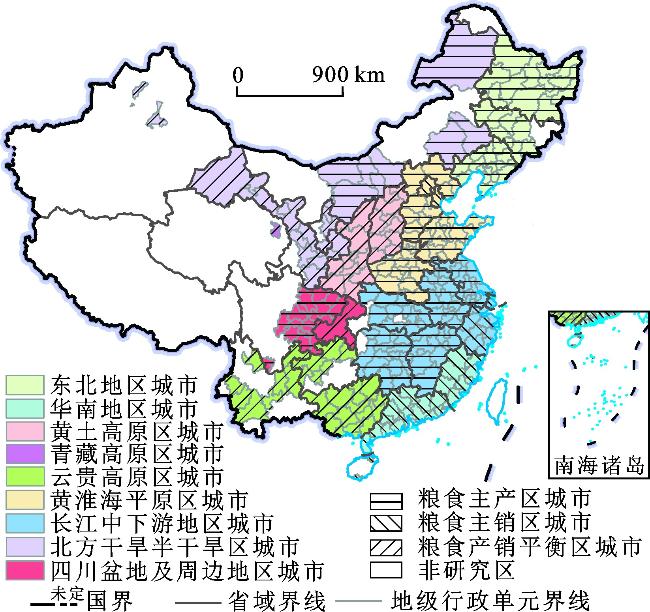
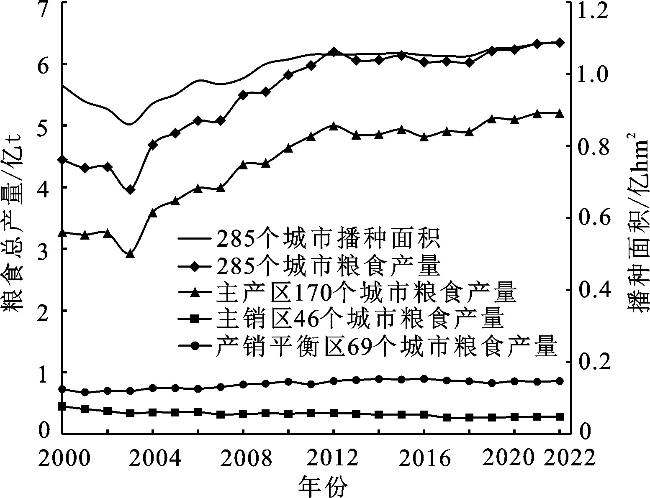
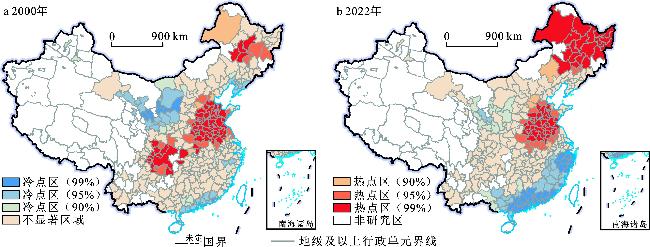
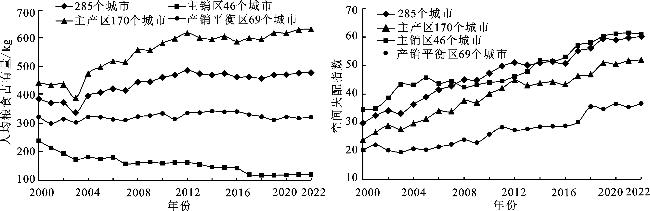
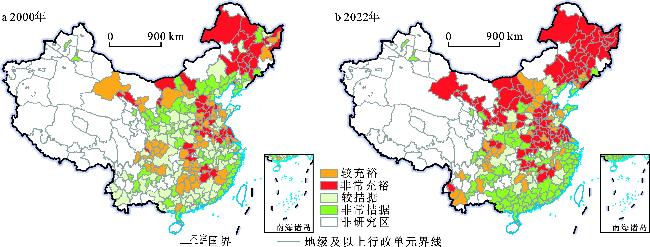
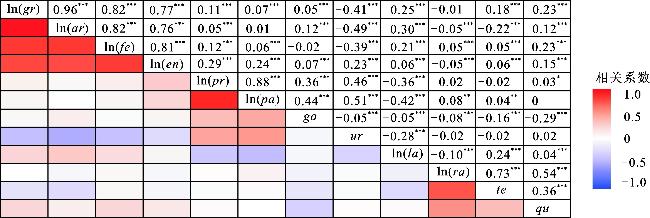
根据2000—2022年285个城市粮食产量和年末人口规模等面板数据,本文采用空间分析、粮食产需空间失配指数和双向固定效应模型等方法探讨了中国粮食产量、供需关系时空格局演变及影响因素。研究发现:①粮食产量增长速度放缓,3大粮食产销分区(主产区、产销平衡区和主销区)中主销区粮食产量下降;粮食产量空间集聚程度增加,高值集聚区向东北地区和黄淮海地区集中,低值集聚区向华南地区和长江中下游地区集中。②人均粮食占有量由高于温饱水平增长至高于粮食安全线,粮食生产和需求的空间不匹配加剧;主产区人均粮食占有量增加明显,粮食供给非常充裕;产销平衡区人均粮食占有量略有下降,粮食供给较拮据;主销区人均粮食占有量下降明显,粮食供给非常拮据;粮食供给非常充裕的城市向北方集中,供给非常拮据城市向南方集聚,供给较充裕和较拮据城市零散分布;主产区和产销平衡区粮食供需关系改善的城市数量较多,主销区粮食供需关系恶化的城市较多。③播种面积是影响粮食产量的关键积极因素,城镇化则是关键的消极因素。可为调整中国粮食产销分区、缓解粮食供需矛盾格局和促进粮食生产提供参考。
金万富 , 张国俊 , 高军波 . 中国粮食产量、供需关系时空格局及影响因素[J]. 地理科学, 2025 , 45(12) : 2650 -2661 . DOI: 10.13249/j.cnki.sgs.20241002
Based on panel data of grain output and year-end population size from 285 cities during 2000—2022, this study employs spatial analysis, the spatial mismatch index of grain supply and demand, and a two-way fixed effects model to explore the spatiotemporal evolution and influencing factors of China’s grain output and supply-demand relationships. The results show that: 1) The growth rate of grain output has slowed, with a decline in grain output in major sales areas among the three primary grain output and sales zones. The spatial clustering of grain output has intensified, with high-value clusters concentrating in the northeast and Huang-Huai-Hai regions, while low-value clusters are shifting to South China and the middle and lower reaches of the Yangtze River. The spatial distribution center of grain output has shifted northeastward. 2) The per capita grain availability has increased from above the subsistence level to exceeding the food security threshold, while the spatial mismatch between grain output and demand has intensified. Per capita grain availability in major production areas has increased significantly, with an abundant grain supply. In production-consumption balance areas, per capita grain availability has slightly declined, resulting in a relatively tight supply. In major sales areas, per capita grain availability has decreased markedly, leading to a very constrained supply. Cities with abundant grain supply are concentrated in the northern regions, while cities with very limited grain supply are clustered in the southern regions. Cities with relatively abundant or relatively scarce supply are scattered across various areas. Many cities in major production areas and production-consumption balance areas have seen improvements in the grain supply-demand relationship, while many cities in major sales areas have experienced a deterioration in this relationship. 3) There is a significant positive relationship between grain output and factors such as sown area, technological progress, government intervention, climate, and farmland quality. Among these, sown area is the key factor driving grain output growth. In contrast, grain prices, urbanization, and agricultural labor force have a significant negative impact on grain output, with urbanization having the most pronounced negative effect. The findings of this study can provide references for adjusting China’s grain production-consumption divisions, alleviating the grain supply-demand imbalance, and promoting grain production.
表1 2000—2022年城市粮食供给类型变化Table 1 Changes in regional grain supply types from 2000 to 2022 |
| 区域类型 | 变化趋势 | 变化类型(城市个数) | 主要分布地区 |
| 注:—为没有这种类型城市; 不含港澳台数据。 | |||
| 主产区 | 改善 | 较充裕→非常充裕(25) | 黄淮海平原区、长江中下游地区 |
| 较拮据→较充裕(8)、非常拮据→较拮据(4)、非常拮据→较充裕(5) | 均零散分布 | ||
| 较拮据→非常充裕(12)、非常拮据→非常充裕(5) | 均集中东北地区 | ||
| 恶化 | 较充裕→较拮据(7)、较充裕→非常拮据(3)、非常充裕→较充裕(3)、非常充裕→非常拮据(2)、较拮据→非常拮据(7) | 均较散 | |
| 未变 | 维持较充裕(15)、较拮据(16) | 四川盆地及周边地区、长江中下游地区 | |
| 保持非常充裕(43) | 东北地区、黄淮海平原区、长江中下游地区 | ||
| 保持非常拮据(15) | 长江中下游、东北地区 | ||
| 产销平 衡区 | 改善 | 较充裕→非常充裕(4)、较拮据→较充裕(6) | 甘肃省、云贵高原区 |
| 较拮据→非常充裕(5)、非常拮据→非常充裕(6) | 黄土高原区、北方干旱半干旱区 | ||
| 非常拮据→较充裕(3)、非常拮据→较拮据(2) | 分布均较散 | ||
| 恶化 | 较充裕→较拮据(1)、非常充裕→较拮据(1) | 广西壮族自治区、宁夏回族自治区 | |
| 较充裕→非常拮据(2) | 贵州省 | ||
| 较拮据→非常拮据(16) | 广西壮族自治区、云贵高原区 | ||
| 未变 | 保持非常充裕(2)、较拮据(6)、非常拮据(15) | 均较散 | |
| 主销区 | 改善 | 无改善城市 | — |
| 恶化 | 较充裕→较拮据(2)、较充裕→非常拮据(1)、较拮据→非常拮据(14) | 浙江省、福建省、华南地区 | |
| 未变 | 保持非常拮据(29) | 华南地区、浙江省 | |
表2 粮食生产影响因素估计结果Table 2 Estimated results of factors affecting grain production |
| 变量 | 估计系数 | 标准误差 | t | P>|t| |
| 注:ar为粮食播种面积; pr为粮食出售价格;pa为技术进步;go为政府干预;ur为城镇化率;la为农业劳动力;ra为年降水量;te为年均温度;qu为耕地质量等级;不含港澳台数据。 | ||||
| ln (ar) | | | 80.29 | 0.000 |
| ln (pr) | − | | −2.55 | 0.011 |
| ln(pa) | | | 5.99 | 0.000 |
| go | | | 7.48 | 0.000 |
| ur | − | | −2.85 | 0.004 |
| ln (la) | − | | −4.17 | 0.000 |
| ln (ra) | | | 6.24 | 0.000 |
| te | | | 3.55 | 0.000 |
| qu:中 | | | 1.41 | 0.158 |
| qu:高 | | | 4.14 | 0.000 |
| 个体效益 | 是 | |||
| 时间效应 | 是 | |||
| R 2 | | |||
| F | 579.50 | |||
| 观测数 | | |||
| [1] |
Erenstein O, Jaleta M, Sonder K et al. Global maize production, consumption and trade: Trends and R&D implications[J]. Food Security, 2022, 14(5): 1295-1319.
|
| [2] |
Lin F Q, Li X C, Jia N Y et al. The impact of Russia-Ukraine conflict on global food security[J]. Global Food Security, 2023, 36: 100661
|
| [3] |
刘继斌, 伊梦晗, 杜雪, 等. 面向农业农村现代化的中国乡村聚落空间重构[J]. 地理科学, 2025, 45(2): 326-338.
Liu Jibin, Yi Menghan, Du Xue et al. Spatial reconstruction of rural settlements oriented towards agricultural and rural modernization in China. Geographical Science, 2025, 45(2): 326-338.
|
| [4] |
杜蓉, 柳思维, 蔡荣. 中国粮食空间生产格局演变特征及其驱动机制[J]. 经济问题, 2023(8): 92-102.
Du Rong, Liu Siwei, Cai Rong. The characteristics and driving mechanism of China’s grain spatial production pattern evolution. On Economic Problems, 2023(8): 92-102.
|
| [5] |
谢坤, 丁明军, 辛良杰, 等. 中国县域粮食产量的时空格局及其与经济发展的空间关系[J]. 经济地理, 2021, 41(11): 167-175.
Xie Kun, Ding Mingjun, Xin Liangjie et al. Spatial-temporal patterns of grain output and its spatial relationship with economic development at the county level in China. Economic Geography, 2021, 41(11): 167-175.
|
| [6] |
张世统, 李二玲, 孙浩航, 等. 中国县域人均粮食占有量时空变化格局探究[J]. 河南大学学报(自然科学版), 2024, 54(6): 689-698.
Zhang Shitong, Li Erling, Sun Haohang et al. Temporal and spatial changes in per capita grain possession in counties in China. Journal of Henan University (Natural Science), 2024, 54(6): 689-698.
|
| [7] |
杨浩, 卢新海. 长江中游粮食生产力与植被初级生产力的动态演进及协同关系[J]. 经济地理, 2022, 42(3): 103-112.
Yang Hao, Lu Xinhai. Dynamic evolution and synergistic relationship between grain productivity capacity and vegetation primary productivity in the middle reaches of the Yangtze River. Economic Geography, 2022, 42(3): 103-112.
|
| [8] |
关浩杰, 司喜梅. 黄淮海平原粮食生产空间格局演化及其影响因素[J]. 中国农业资源与区划, 2024, 45(8): 31-43.
Guan Haojie, Si Ximei. Evolution of spatial pattern of grain production and its influencing factors in Huang-Huai-Hai Plain. Chinese Journal of Agricultural Resources and Regional Planning, 2024, 45(8): 31-43.
|
| [9] |
王志鹏, 乔家君, 张二申, 等. 1990—2020年黄河流域粮食产量时空演变及影响因素分析[J]. 河南大学学报(自然科学版), 2023, 53(5): 505-515,574.
Wang Zhipeng, Qiao Jiajun, Zhang Ershen et al. Spatial-temporal evolution and influencing factors of grain production in the Yellow River Basin from 1990 to 2020. Journal of Henan University (Natural Science), 2023, 53(5): 505-515,574.
|
| [10] |
高军波, 刘彦随, 张永显. 1990—2012年淮河流域粮食生产的时空演进及驱动机制[J]. 水土保持通报, 2016, 36(3): 179-185,192.
Gao Junbo, Liu Yansui, Zhang Yongxian. Evolution of temporal-spatial pattern of grain production and its driving mechanism in Huaihe River Basin during 1990—2012. Bulletin of Soil and Water Conservation, 2016, 36(3): 179-185,192.
|
| [11] |
陈玉洁, 张平宇, 刘世薇, 等. 东北西部粮食生产时空格局变化及优化布局研究[J]. 地理科学, 2016, 36(9): 1397-1407.
Chen Yujie, Zhang Pingyu, Liu Shiwei et al. The spatio-temporal pattern change and optimum layout of grain production in the west of northeast China. Scientia Geographica Sinica, 2016, 36(9): 1397-1407.
|
| [12] |
马泉来, 吕敏敏, 杨延伟, 等. 河南省耕地粮食生产时空演变及功能分区[J]. 地域研究与开发, 2024, 43(2): 161-167.
Ma Quanlai, Lv Minmin, Yang Yanwei et al. Spatial-temporal evolution of cultivated grain production capacity and functional zoning in Henan Province. Areal Research and Development, 2024, 43(2): 161-167.
|
| [13] |
高军波, 谢文全, 韩勇, 等. 1990—2013年河南省县域人口、经济和粮食生产重心的迁移轨迹与耦合特征——兼议与社会剥夺的关系[J]. 地理科学, 2018, 38(6): 919-926.
Gao Junbo, Xie Wenquan, Han Yong et al. The evolutionary trend and the coupling relation of gravity center moving of county-level population distribution, economical development and grain production during 1990—2013 in Henan Province. Scientia Geographica Sinica, 2018, 38(6): 919-926.
|
| [14] |
仇方道, 钱进, 佟连军, 等. 江苏省粮食生产时空格局演变及影响因素[J]. 农业现代化研究, 2009, 30(1): 11-15.
Qiu Fangdao, Qian Jin, Tong Lianjun et al. Influence factors and temperal-spatial structure of grain production in Jiangsu Province. Research of Agricultural Modernization, 2009, 30(1): 11-15.
|
| [15] |
李亚婷, 潘少奇, 苗长虹. 中国县域人均粮食占有量的时空格局: 基于户籍人口和常住人口的对比分析[J]. 地理学报, 2014, 69(12): 1753-1766.
Li Yating, Pan Shaoqi, Miao Changhong. The spatial-temporal patterns of per capita share of grain at the county level in China: A comparation between registered population and resident population. Acta Geographica Sinica, 2014, 69(12): 1753-1766.
|
| [16] |
殷培红, 方修琦, 马玉玲, 等. 21世纪初中国粮食短缺地区的空间格局和区域差异[J]. 地理科学, 2007, 27(4): 463-472.
Yin Peihong, Fang Xiuqi, Ma Yuling et al. Distribution and regional difference of food shortage in China in 21st century. Scientia Geographica Sinica, 2007, 27(4): 463-472.
|
| [17] |
韩建军, 侯纪伟, 侯婧祎. 我国省域粮食产需失配的时空演变及要素分析[J]. 地域研究与开发, 2021, 40(5): 13-17,43.
Han Jianjun, Hou Jiwei, Hou Jingyi. Spatial and temporal evolution and factor analysis of the mismatch of grain production and demand in China. Areal Research and Development, 2021, 40(5): 13-17,43.
|
| [18] |
刘正佳, 钟会民, 李裕瑞, 等. 近20年中国粮食生产变化特征及其对区域粮食供需格局的影响[J]. 自然资源学报, 2021, 36(6): 1413-1425.
Liu Zhengjia, Zhong Huimin, Li Yurui et al. Change in grain production in China and its impacts on spatial supply and demand distributions in recent two decades. Journal of Natural Resources, 2021, 36(6): 1413-1425.
|
| [19] |
胡甜, 鞠正山, 周伟. 中国粮食供需的区域格局研究[J]. 地理学报, 2016, 71(8): 1372-1383.
Hu Tian, Ju Zhengshan, Zhou Wei. Regional pattern of grain supply and demand in China. Acta Geographica Sinica, 2016, 71(8): 1372-1383.
|
| [20] |
王介勇, 刘彦随. 1990年至2005年中国粮食产量重心演进格局及其驱动机制[J]. 资源科学, 2009, 31(7): 1188-1194.
Wang Jieyong, Liu Yansui. The changes of grain output center of gravity and its driving forces in China since 1990. Resources Science, 2009, 31(7): 1188-1194.
|
| [21] |
王晨, 张文博, 王济民. 我国粮食供给时空变迁及产能提升路径分析[J]. 中国农业资源与区划, 2024, 45(9): 29-41.
Wang Chen, Zhang Wenbo, Wang Jimin. The path analysis of spatial-temporal changes and productivity improvement of grain supply in China. Chinese Journal of Agricultural Resources and Regional Planning, 2024, 45(9): 29-41.
|
| [22] |
金万富, 杜德胜, 刘松, 等. 广州城市产业用地供应规模和结构时空特征及机制[J]. 人文地理, 2022, 37(6): 150-160.
Jin Wanfu, Du Desheng, Liu Song et al. Spatial-temporal characteristics and mechanism of scale and structure of urban industrial land supply in Guangzhou. Human Geography, 2022, 37(6): 150-160.
|
| [23] |
陈强. 高级计量经济学及Stata应用[M]. 2版. 北京: 高等教育出版社, 2014
Chen Qiang. Advanced econometrics and stata application. 2nd ed. Beijing: Higher Education Press, 2014.
|
| [24] |
许尔琪. 中国农业资源环境分区数据集[J]. 全球变化数据学报(中英文), 2021, 5(1): 19-26,132-139.
Xu Erqi. Dataset of agricultural resource and environment zoning of China. Journal of Global Change Data & Discovery, 2021, 5(1): 19-26,132-139.
|
| [25] |
国家统计局. 中国统计年鉴[M]. 2001—2023. 北京: 中国统计出版社, 2001—2023
National Bureau of Statistics. China statistical yearbook. 2001—2023. Beijing: China Statistics Press, 2001—2023.
|
| [26] |
全国农业区划委员会《中国综合农业区划》编写组. 中国综合农业区划[M]. 北京: 农业出版社, 1981
National Agricultural Regionalization Committee, China Comprehensive Agricultural Regionalization Compilation Group. China comprehensive agricultural regionalization. Beijing: Agricultura Press, 1981.
|
| [27] |
邵喜武, 周杨, 吴佩蓉. 基于空间溢出效应的粮食主产区粮食增产与农业生态污染关系研究[J]. 地理科学, 2022, 42(5): 831-840.
Shao Xiwu, Zhou Yang, Wu Peirong. Relation of grain increase and agricultural ecological pollution based on spatial spillover effects in major grain producing areas. Scientia Geographica Sinica, 2022, 42(5): 831-840.
|
| [28] |
蔡晓梅, 吴泳琪, 邹小丹. 社会生态系统视角下替代性农业生产的韧性网络形成机制——广州案例[J]. 地理科学, 2024, 44(9): 1524-1533.
Cai Xiaomei, Wu Yongqi, Zou Xiaodan. Resilience network formation mechanism of alternative agricultural production from the perspective of socio-ecological system: A case of Guangzhou. Scientia Geographica Sinica, 2024, 44(9): 1524-1533.
|
| [29] |
向慧, 彭保发, 伍铁牛, 等. 湖南武陵民族地区种植业生态效率的时空分异及驱动机理研究[J]. 地理科学, 2025, 45(2): 349-363.
Xiang Hui, Peng Baofa, Wu Tieniu et al. Spatio-temporal pattern and driving mechanism of agricultural ecological efficiency for planting industry in the Wuling ethnic area of Hunan. Geographical Science, 2025, 45(2): 349-363.
|
| [30] |
吕开宇, 俞冰心, 邢鹂. 新阶段的粮农生产决策行为分析——粮价上涨对非贫困和贫困种植户的影响[J]. 中国农村经济, 2013(9): 31-43.
Lv Kaiyu, Yu Bingxin, Xing Li. Analysis on the decision-making behavior of food and agriculture in the new stage—The impact of rising food prices on non-poor and poor growers. Chinese Rural Economy, 2013(9): 31-43.
|
| [31] |
孙佳歆, 齐鹏, 章光新, 等. 基于生态足迹法的农业水土资源承载力分析——以三江平原友谊农场为例[J]. 地理科学, 2024, 44(6): 1060-1068.
Sun Jiaxin, Qi Peng, Zhang Guangxin et al. Agricultural water and land resources carrying capacity based on ecological footprint method: A case of Youyi Farm in Sanjiang Plain. Scientia Geographica Sinica, 2024, 44(6): 1060-1068.
|
| [32] |
梁爱珍, 张延, 陈学文, 等. 东北黑土区保护性耕作的发展现状与成效研究[J]. 地理科学, 2022, 42(8): 1325-1335.
Liang Aizhen, Zhang Yan, Chen Xuewen et al. Development and effects of conservation tillage in the black soil region of northeast China. Scientia Geographica Sinica, 2022, 42(8): 1325-1335.
|
| [33] |
孙中叶, 杨传宇. 技术进步偏向视角下中国粮食产能提升的新路径——以五大粮食净调出省为例[J]. 科技导报, 2024, 42(16): 40-46.
Sun Zhongye, Yang Chuanyu. A new path for China’s grain production capacity improvement from the perspective of technological progress bias—A case study of the five major provinces with net grain transfer. Science & Technology Review, 2024, 42(16): 40-46.
|
| [34] |
辛良杰. 粮食安全概念、评价体系与地理学优先研究主题[J]. 地理科学, 2024, 44(3): 451-462.
Xin Liangjie. Concepts, measurement indicators of food security and research directions of Geography. Scientia Geographica Sinica, 2024, 44(3): 451-462.
|
| [35] |
魏后凯. 应重新划分粮食产销区并完善相关政策[J]. 中国经济报告, 2024(2): 39-40.
Wei Houkai. Food production and marketing zones should be redrawn and related policies improved. China Policy Review, 2024(2): 39-40.
|
/
| 〈 |
|
〉 |