



中国旅游业数字化水平测度及空间非均衡性研究
|
陈勤昌(1992—),男,湖北通山人,助理研究员,主要从事数字文旅研究。E-mail: chenqc7777@163.com |
收稿日期: 2024-08-29
修回日期: 2025-03-07
网络出版日期: 2025-12-16
基金资助
国家自然科学基金项目(41771162)
国家自然科学基金项目(41971188)
版权
Measurement of digitalization level and spatial disequilibrium of tourism industry in China
Received date: 2024-08-29
Revised date: 2025-03-07
Online published: 2025-12-16
Supported by
National Natural Science Foundation of China(41771162)
National Natural Science Foundation of China(41971188)
Copyright
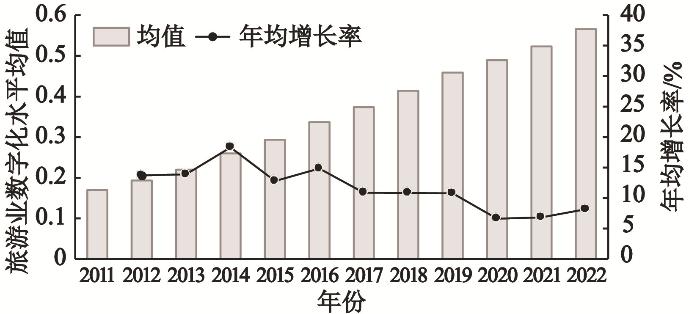
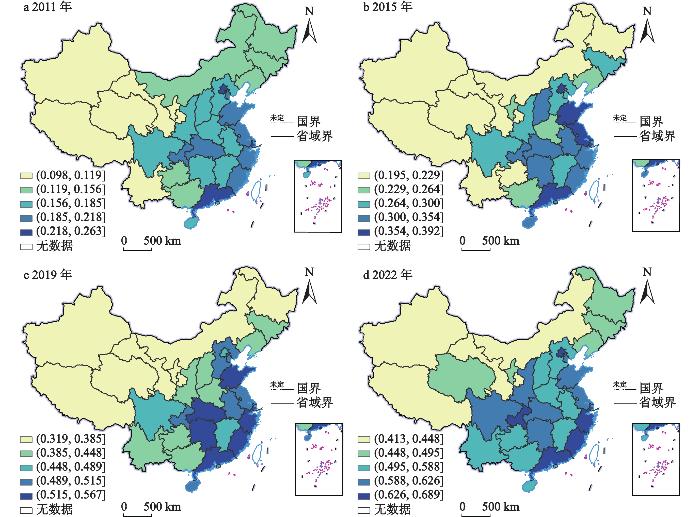
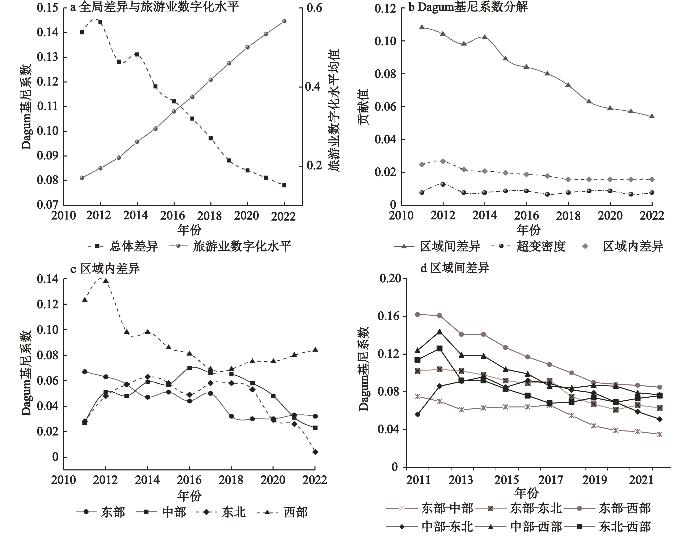
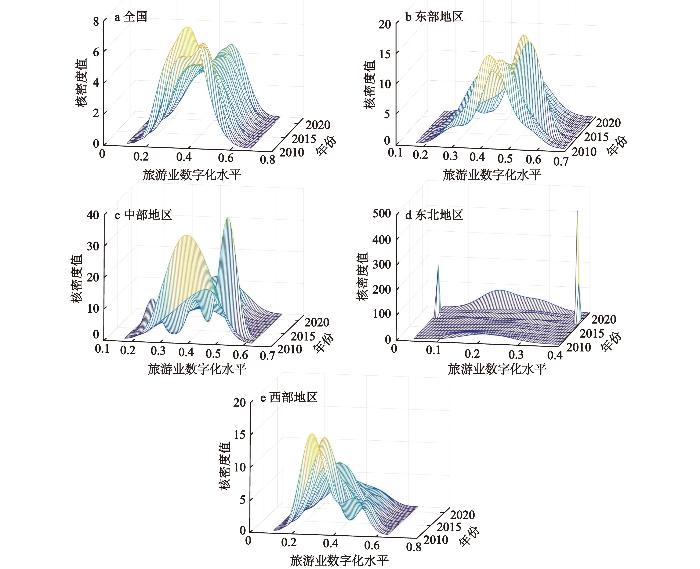
辨识旅游业数字化发展的空间非均衡性特征,可为弥合旅游产业“数字鸿沟”、优化旅游业新质生产力空间布局提供科学依据。基于旅游业数字化的内涵特征构建综合评价指标体系,采用熵权TOPSIS法、Dagum基尼系数、Kernel密度估计和Markov链分析法探究了2011—2022年中国旅游业数字化水平的空间非均衡性特征及其动态演化趋势。结果表明:①中国旅游业数字化水平呈稳步增长态势,存在“东高西低、南高北低”的空间分异特征。②中国旅游业数字化水平总体差异呈波动下降状态,区域内呈“东北>东部>西部>中部”的差序格局,省际间差距是旅游业“数字鸿沟”扩大的主要来源。③条件概率密度曲线沿45°对角线两侧分布,旅游业数字化水平的分布动态相对稳定;在纳入地理空间因素后,中国旅游业数字化水平表现出敛缩态势。④不考虑地理空间效应,中国旅游业数字化水平长期存在“马太效应”和“俱乐部趋同现象”,随着相邻省份空间滞后类型水平的提升,旅游业数字化水平受相邻省份的空间溢出效应影响显著。
陈勤昌 , 王兆峰 , 邱梦真 . 中国旅游业数字化水平测度及空间非均衡性研究[J]. 地理科学, 2026 , 46(1) : 191 -204 . DOI: 10.13249/j.cnki.sgs.20240965
Identifying the spatial non-equilibrium characteristics of digitalization development in the tourism industry can provide scientific basis for bridging the “digital divide” in the tourism industry and optimizing the spatial layout of new quality productivity in the tourism industry. Based on the connotation characteristics of digitalization in the tourism industry, a comprehensive evaluation system was constructed, and the entropy weight TOPSIS method, Dagum Gini coefficient, Kernel density estimation, and Markov chain analysis were used to explore the spatial non-equilibrium characteristics and dynamic evolution trends of tourism digitalization level from 2011 to 2022 in China. The findings indicate that: 1) According to the entropy weight TOPSIS method, it can be concluded that the digitalization level of tourism industry has maintained a steady upward trend from 2011 to 2022 in China, with eastern provinces and cities such as Shanghai, Beijing, and Guangdong leading the way. The spatial differentiation characteristics of the digitalization level of tourism industry in China were gradually emerging, roughly showing a gradient distribution state of “high in the east and low in the west” and “high in the south and low in the north”. The spatial imbalance phenomenon of the digitalization level of tourism industry among provinces in China was significant. 2) In terms of regional differences and decomposition, the overall difference in the digitalization level of the tourism industry shows a fluctuating downward trend, and the imbalance between regions shows a shrinking trend. The overall regional differences were in a state of “northeast>east>west>central”, but inter provincial differences have become the main source of the “digital divide” in the tourism industry, and narrowing regional differences has become a key direction to bridge the digital level gap of the tourism industry in China. 3) According to the Kernel density estimation method, it can be concluded that the conditional probability density curve was distributed along a 45° diagonal, and the dynamic distribution of digitalization level in the tourism industry was relatively stable. After taking into account geographical spatial factors, the digitalization level of tourism industry in China showed a shrinking trend during the research period. 4) According to the Markov chain method, it can be inferred that if geographical spatial effects are not taken into account, the digitalization level of tourism industry in China shows the phenomenon of “Matthew effect” and “club convergence”; After incorporating geographic spatial effects, as the level of spatial lag in neighboring provinces increases, the digitalization level of local tourism industry was significantly affected by the spatial spillover effects of neighboring provinces.
表1 旅游业数字化水平综合评价体系及权重Table 1 Comprehensive evaluation system and weights of digitalization level of tourism industry |
| 维度层 | 准则层 | 指标层 | 单位 | 权重值 |
| 注:–为无量纲数据。 | ||||
| 旅游数字化基础设施 | 供给端技术支撑 | 移动电话基站密度 | 万个/万km2 | |
| 光缆覆盖度 | km/km2 | | ||
| 每百家企业拥有网站数 | 个 | | ||
| 软件业收入金额 | 亿元 | | ||
| 需求端技术支撑 | 每百人拥有移动电话 | 部 | | |
| 互联网宽带接入端口数 | 万户 | | ||
| 互联网普及率 | % | | ||
| 人均邮电业务量 | 元/人 | | ||
| 旅游数字化产业环境 | 旅游产业基础 | 4A级及以上旅游景区(点)数 | 家 | |
| 星级酒店数 | 家 | | ||
| 旅行社数 | 家 | | ||
| 旅游总人次 | 万人次 | | ||
| 旅游总收入占GDP比重 | % | | ||
| 数字经济环境 | 智慧城市试点数量 | 个 | | |
| 数字普惠金融指数 | – | | ||
| 网络移动支付水平 | – | | ||
| 技术市场发育水平 | – | | ||
| 区域信息化发展指数 | – | | ||
| 旅游数字化要素投入 | 资本要素投入 | 旅游业固定资产投资额 | 亿元 | |
| 文化和旅游事业经费占财政支出比重 | % | | ||
| 劳动力要素投入 | 旅游业从业人数 | 万人 | | |
| 旅游高等院校在校学生数 | 人 | | ||
| 创新要素投入 | 旅游类科研机构数量 | 个 | | |
| 旅游R&D经费投入 | 亿元 | | ||
| 旅游数字化效用效益 | 数字化应用 | 智慧旅游门户网站数 | 个 | |
| 发表数字旅游相关论文数 | 篇 | | ||
| 万人旅游业专利授权数 | 个 | | ||
| 数字化效益 | 旅游企业数字化程度 | – | | |
| 在线旅游市场交易金额 | 亿元 | | ||
| 旅游电子商务销售额 | 亿元 | | ||
表2 无滞后类型传统马尔可夫转移概率矩阵Table 2 Transition probability matrix of non-lag type traditional Markov |
| 类型 | I | Ⅱ | Ⅲ | Ⅳ |
| 注:港澳台数据暂缺。 | ||||
| I | | | | |
| Ⅱ | | | | |
| Ⅲ | | | | |
| Ⅳ | | | | |
表3 空间马尔科夫转移矩阵Table 3 Spatial Markov transition matrix |
| 滞后类型 | 类型 | I | II | III | IV |
| 注:港澳台数据暂缺。 | |||||
| I | I | | | | |
| II | | | | | |
| III | | | | | |
| IV | | | | | |
| II | I | | | | |
| II | | | | | |
| III | | | | | |
| IV | | | | | |
| III | I | | | | |
| II | | | | | |
| III | | | | | |
| IV | | | | | |
| IV | I | | | | |
| II | | | | | |
| III | | | | | |
| IV | | | | | |
| [1] |
Luke O, Usman K, Moreno E L G. Do the size of the tourism sector and level of digitalization affect COVID-19 economic policy response? Evidence from developed and developing countries[J]. Current Issues in Tourism, 2023, 26(18): 3040-3063.
|
| [2] |
陈勤昌, 王兆峰, 邱梦真, 等. 旅游业数字化的内涵特征、研究综述及展望[J]. 经济地理, 2025, 45(4): 198-209.
Chen Qinchang, Wang Zhaofeng, Qiu Mengzhen et al. The connotation, characteristics, research review, and prospects of digitalization in the tourism industry. Economic Geography, 2025, 45(4): 198-209.
|
| [3] |
杨晓琰, 宋瑞. 数字经济对旅游产业发展的影响机理[J]. 地理科学进展, 2024, 43(10): 1943-1955.
Yang Xiaoyan, Song Rui. Mechanism of influence of the digital economy on tourism industry development. Progress in Geography, 2024, 43(10): 1943-1955.
|
| [4] |
杨勇, 邬雪. 从数字经济到数字鸿沟: 旅游业发展的新逻辑与新问题[J]. 旅游学刊, 2022, 37(4): 3-5.
Yang Yong, Wu Xue. From digital economy to digital divide: New logic and issues in the development of tourism industry. Tourism Tribune, 2022, 37(4): 3-5.
|
| [5] |
Saad A S, Gharaibeh B. E-tourism adoption in travel agencies: New qualitative insights from a developing country[J]. International Journal of Tourism Policy, 2023, 13(3): 248-261.
|
| [6] |
唐健雄, 孙婧瑶, 孙桥, 等. 酒店数字化转型动态能力: 内涵、结构及测量[J]. 旅游科学, 2023, 37(6): 1-23.
Tang Jianxiong, Sun Jingyao, Sun Qiao et al. The digital transformation dynamic capability of hotels: Connotation, structure and measurement. Tourism Science, 2023, 37(6): 1-23.
|
| [7] |
Sabine K, Andreas K, Sascha K. Visiting museums via augmented reality: An experience fast-tracking the digital transformation of the tourism industry[J]. European Journal of Innovation Management, 2024, 27(6): 20842100.
|
| [8] |
银元. 乡村旅游数字化发展: 动力机制、逻辑维度与矛盾纾解[J]. 西安财经大学学报, 2023, 36(1): 29-40.
Yin Yuan. Rural tourism digital development: Dynamic mechanism, logical dimension and contradiction Relief. Journal of Xi’an University of Finance and Economics, 2023, 36(1): 29-40.
|
| [9] |
夏江涛, 王石峰, 黎镇鹏. 我国体育旅游产业数字化转型: 动力机制、现实困境与实践路径[J]. 体育学研究, 2023, 37(3): 65-75.
Xia Jiangtao, Wang Shifeng, Li Zhenpeng. Digital transformation of China’s sports tourism industry: Driving mechanism, realistic dilemma and practical pathways. Journal of Sports Research, 2023, 37(3): 65-75.
|
| [10] |
张贝尔, 王红, 李元. 康养旅游产业数字化水平调查与提升策略[J]. 经济纵横, 2022(12): 112-117.
Zhang Beier, Wang Hong, Li Yuan. Investigation and optimization strategy in digitalization level of healthy recuperation tourism industry. Economic Review Journal, 2022(12): 112-117.
|
| [11] |
黄蕊, 李雪威. 数字技术提升中国旅游产业效率的机理与路径[J]. 当代经济研究, 2021(2): 75-84.
Huang Rui, Li Xuewei. The mechanism and path for digital technology to improve the efficiency of China’s tourism industry. Contemporary Economic Research, 2021(2): 75-84.
|
| [12] |
王俐, 周向红. 数字化赋能旅游经济发展的机理与路径: “流量”还是“质量”?[J]. 浙江社会科学, 2023(6): 26-37,156-157
Wang Li, Zhou Xianghong. Research on the mechanism and path of digitally empowered development of tourism economy: Quantity or quality? Zhejiang Social Sciences, 2023(6): 26-37,156-157.
|
| [13] |
孙盼盼, 林志斌. 数字科技驱动旅游创新发展和居民幸福感提升[J]. 旅游学刊, 2023, 38(6): 6-7.
Sun Panpan, Lin Zhibin. Digital technology drives innovative tourism development and enhances residents’ sense of happiness. Tourism Tribune, 2023, 38(6): 6-7.
|
| [14] |
杨勇. 数字经济如何重塑区域旅游经济地理空间格局[J]. 旅游科学, 2022, 36(6): 1-19.
Yang Yong. How the digital economy reshapes the geographic spatial pattern of regional tourism economy. Tourism Science, 2022, 36(6): 1-19.
|
| [15] |
王金伟, 王启翔, 冯凌. 中国数字经济与旅游业高质量发展的协调格局及驱动机制[J]. 地理科学, 2024, 44(1): 130-139.
Wang Jinwei, Wang Qixiang, Feng Ling. Coordination pattern and driving mechanism of digital economy and high quality tourism development in China. Scientia Geographica Sinica, 2024, 44(1): 130-139.
|
| [16] |
马斌斌, 豆媛媛, 贺舒琪, 等. 中国数字经济与旅游产业融合发展的时空特征及驱动机制[J]. 经济地理, 2023, 43(6): 192-201.
Ma Binbin, Dou Yuanyuan, He Shuqi et al. Spatiotemporal characteristics and driving mechanisms of the integration development of digital economy and tourism industry in China. Economic Geography, 2023, 43(6): 192-201.
|
| [17] |
黄震方, 张子昂, 李涛, 等. 数字赋能文旅深度融合的理论逻辑与研究框架[J]. 旅游科学, 2024, 38(1): 1-16.
Huang Zhenfang, Zhang Zhiang, Li Tao et al. Digital empowerment for the deep integration of culture and tourism: Theoretical logic and research framework. Tourism Science, 2024, 38(1): 1-16.
|
| [18] |
陈雪钧, 张春苗. 旅游产业数字化创新的水平测度和影响因素分析[J]. 攀枝花学院学报, 2024, 41(1): 49-58..
Chen Xuejun, Zhang Chunmiao. Measurement of the level of digital innovation in the tourism industry and analysis of influencing factors. Journal of Panzhihua University, 2024, 41(1): 49-58..
|
| [19] |
石彩霞, 贺小荣. 中国旅游产业数字化水平的时空交互、动态演进及收敛性分析[J]. 统计与决策, 2024, 40(16): 122-127.
Shi Caixia, He Xiaorong. Spatio-temporal interaction, dynamic evolution and convergence analysis of the digitization level of China’s tourism industry. Statistics & Decision, 2024, 40(16): 122-127.
|
| [20] |
Hu M, Li H, Song H et al. Tourism demand forecasting using tourist-generated online review data[J]. Tourism Management, 2022, 90: 104490.
|
| [21] |
夏杰长, 贺少军, 徐金海. 数字化: 文旅产业融合发展的新方向[J]. 黑龙江社会科学, 2020(2): 51-55.
Xia Jiechang, He Shaojun, Xu Jinhai. Digitization: A new direction for the integrated development of cultural and tourism industries. Social Sciences in Heilongjiang Province, 2020(2): 51-55.
|
| [22] |
Ye X L, Wang J, Sun R H. The coupling and coordination relationship of the digital economy and tourism industry from the perspective of industrial integration[J]. European Journal of Innovation Management, 2024, 27(4): 1182-1205.
|
| [23] |
杨文溥. 中国产业数字化转型测度及区域收敛性研究[J]. 经济体制改革, 2022, 232(1): 111-118.
Yang Wenpu. Research on statistical measurement and regional convergence of China’s industrial digital transformation. Reform of Economic System, 2022, 232(1): 111-118.
|
| [24] |
孔晓瑞, 向书坚, 罗胜. 中国经济数字化转型的量化评估、区域差异及动态演进[J]. 经济问题探索, 2023(4): 25-37.
Kong Xiaorui, Xiang Shujian, Luo Sheng. Quantitative assessment, regional differences, and spatio-temporal dynamic evolution of China’s economic digital transformation. Inquiry into Economic Issues, 2023(4): 25-37.
|
| [25] |
毛雁冰, 赵露. 中国式现代化进程中产业数字化的就业效应研究[J]. 北京工商大学学报(社会科学版), 2024, 39(1): 30-40.
Mao Yanbing, Zhao Lu. Employment effects of industrial digitalization in Chinese path to modernization. Journal of Beijing Technology and Business University (Social Sciences), 2024, 39(1): 30-40.
|
| [26] |
马丽君, 敖烨. 数字经济对旅游业高质量发展的影响及空间溢出效应[J]. 地理科学进展, 2023, 42(12): 2296-2308.
Ma Lijun, Ao Ye. Influence and spatial spillover effects of the digital economy on the high quality development of the tourism industry. Progress in Geography, 2023, 42(12): 2296-2308.
|
| [27] |
张春荣, 刘春芳, 张志英, 等. “流空间”视角下省际边缘区城乡要素空间流动特征与优化——以庆阳市为例[J]. 软科学, 2021, 35(8): 113-120.
Zhang Chunrong, Liu Chuanfang, Zhang Zhiying et al. The spatial flow characteristics and optimization of urban and rural elements in provincial fringe areas from the perspective of “Flow Space”: A case study of Qingyang. Soft Science, 2021, 35(8): 113-120.
|
| [28] |
王毅, 陈娱, 陆玉麒, 等. 中国旅游产业科技创新能力的时空动态和驱动因素分析[J]. 地球信息科学学报, 2017, 19(5): 613-624.
Wang Yi, Chen Yu, Lu Yuqi et al. Analysis of the space-time dynamics and influencing factors of scientificand technological innovation ability of tourism industry in China. Journal of Geo-information Science, 2017, 19(5): 613-624.
|
| [29] |
王兆峰, 林鲁雄, 陈勤昌. 中国旅游业数字化与绿色化时空耦合特征及互动响应关系[J]. 地理与地理信息科学, 2025, 41(4): 129-141, 151
Wang Zhaofeng, Lin Luxiong, Chen Qinchang. Spatio-temporal coupling characteristics and interactive response relationship between tourism digitalization andgreening in China. Geography and Geo-Information Science, 2025, 41(4): 129-141, 151.
|
| [30] |
魏敏, 李书昊. 新时代中国经济高质量发展水平的测度研究[J]. 数量经济技术经济研究, 2018, 35(11): 3-20.
Wei Min, Li Shuhao. Study on the measurement of economic high-quality development level in China in the new era. Journal of Quantitative & Technological Economics, 2018, 35(11): 3-20.
|
| [31] |
徐维祥, 周建平, 周梦瑶, 等. 数字经济空间联系演化与赋能城镇化高质量发展[J]. 经济问题探索, 2021(10): 141-151.
Xu Weixiang, Zhou Jianping, Zhou Mengyao et al. The evolution of spatial connection of digital economy and its impact on the high-quality development of urbanization. Inquiry into Economic Issues, 2021(10): 141-151.
|
| [32] |
吕承超, 何加豪. 中国金融科技发展的区域差异、分布动态及收敛特征[J]. 财经问题研究, 2023(4): 43-57.
Lv Chengchao, He Jiahao. Regional differences, distribution dynamics and convergence characteristics of Fin Tech development in China. Research on Financial and Economic Issues, 2023(4): 43-57.
|
| [33] |
刘庆芳, 谢佳亮, 张先甜, 等. 青藏高原县域尺度PM2.5浓度时空动态演进特征[J]. 地理学报, 2024, 79(3): 654-671
Liu Qingfang, Xie Jialiang, Zhang Xiantian et al. Spatio-temporal dynamic evolution of PM2.5 concentrations in the Qinghai-Tibet Plateau based on county scale. Acta Geographica Sinica, 2024, 79(3): 654-671.
|
| [34] |
孙未未, 李占风. 我国数字经济发展新特征: 非均衡性与趋势演进[J]. 经济问题探索, 2023(12): 21-36.
Sun Weiwei, Li Zhanfeng. New characteristics of China’s digital economy development: Non-equilibrium and trend evolution. Inquiry into Economic Issues, 2023(12): 21-36.
|
| [35] |
国家统计局. 中国统计年鉴[M]. 2012—2023. 北京: 中国统计出版社, 2012—2023
National Bureau of Statistics. China statistical yearbook. 2012—2023. Beijing: China Statistics Press, 2012—2023.
|
| [36] |
国家统计局. 中国科技统计年鉴[M]. 2012—2023. 北京: 中国统计出版社, 2012—2023
National Bureau of Statistics. China statistical yearbook on science and technology. 2012—2023. Beijing: China Statistics Press, 2012—2023.
|
| [37] |
中国文化和旅游部. 中国旅游统计年鉴[M]. 2012—2023. 北京: 中国旅游出版社, 2012—2023
Ministry of Culture and Tourism of China. The yearbook of China tourism statistics. 2012—2023. Beijing: China Travel & Tourism Press, 2012—2023.
|
| [38] |
吴非, 胡慧芷, 林慧妍, 等. 企业数字化转型与资本市场表现: 来自股票流动性的经验证据[J]. 管理世界, 2021, 37(7): 130-144,10.
Wu Fei, Hu Huizhi, Lin Huiyan et al. Enterprise digital transformation and capital market performance: Empirical evidence from stock liquidity. Journal of Management World, 2021, 37(7): 130-144,10.
|
/
| 〈 |
|
〉 |