



生计韧性研究:概念内涵、分析框架与研究展望
|
赵宏波(1985—),男,河南长垣人,教授,博导,主要从事城市韧性与区域发展研究。E-mail: zhaohbhhwm@163.com |
收稿日期: 2025-07-09
修回日期: 2025-10-07
网络出版日期: 2025-12-16
基金资助
国家自然科学基金项目(42371217)
国家自然科学基金项目(42071159)
河南省自然科学基金项目(232300421101)
浙江省习近平新时代中国特色社会主义思想研究中心常规项目(25CCG32)
浙江省教育厅科研项目(Y202559032)
版权
A systematic review on concept connotation and analytical framework of livelihood resilience
Received date: 2025-07-09
Revised date: 2025-10-07
Online published: 2025-12-16
Supported by
National Natural Science Foundation of China(42371217)
National Natural Science Foundation of China(42071159)
Natural Science Foundation of Henan Province(232300421101)
Regular Research Projects of Zhejiang Provincial Research Center for Xi Jinping Thought on Socialism with Chinese Characteristics for a New Era(25CCG32)
Scientific Research Fund of Zhejiang Provincial Department of Education(Y202559032)
Copyright
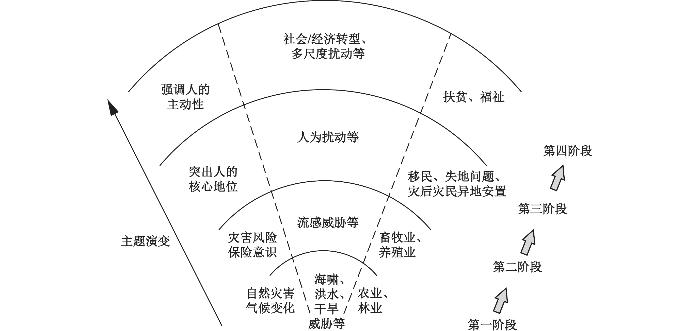
韧性研究是可持续性科学研究的热点领域,生计韧性分析是解决地区或个体家庭生计影响的有效分析工具。基于国内外生计韧性研究文献的系统回顾,本文梳理了生计韧性的概念内涵、分析框架和评估方法。研究发现:①生计韧性是以人及其能动性为核心,在应对生计系统冲击时能够抵御扰动、完成恢复并实现可持续发展的关键支撑力,其概念内涵可基于过程、能力、策略和转型4个视角进行划分。②生计韧性研究主题呈现“融合递进式”发展,从外界气候变化转向对于自然灾害的应对意识,再转向人为扰动因素并强调人的主观能动性;尺度呈现出全局化、多尺度的趋势,指标体系构建更趋于主客观统一,但仍存在概念泛化、忽略生计策略转变与生计长期变化等局限。③根据主导干扰因素与研究主题演变,可将生计韧性的分析框架与评估方法分为“气候变化型”“自然灾害型”和“人为扰动型”3种:气候变化型生计韧性衔接气候适应与生计保障,服务长期气候适应政策;自然灾害型聚焦突发性灾害应急响应与短期恢复能力的量化评估;人为扰动型关注人本能动性与社会结构的交互,资源利用、知识学习等细分维度更贴合社会经济场景。未来应逐步构建系统类别式生计韧性分析框架,强化研究对象的对比分析和多案例应用研究,关注生计韧性评估的多尺度权衡及时空动态性,探索生计策略的长期动态变化特征。
赵宏波 , 莫潇杭 , 苏飞 , 吴宝锐 , 殷朵朵 , 陈秀碧 . 生计韧性研究:概念内涵、分析框架与研究展望[J]. 地理科学, 2026 , 46(1) : 68 -78 . DOI: 10.13249/j.cnki.sgs.20250874
At present, resilience research is a hot area of sustainability science research, and livelihood resilience analysis is an effective analytical tool to solve the impact of regional or individual household livelihoods. Based on the systematic review of the research literature on livelihood resilience at home and abroad, this study combs the concept connotation, analysis framework and evaluation method of livelihood resilience. The study found that: 1) Livelihood resilience is a key support for people and their initiative to resist disturbances and achieve recovery and sustainable development when dealing with the impact of livelihood systems. Its conceptual connotation can be divided based on 4 perspectives: process, capability, strategy and transformation. 2) The theme of livelihood resilience research presents a ‘progressive’ development, from external climate change to the awareness of natural disaster response, and then to human disturbance factors and emphasizing human subjective initiative; the scale shows a global and multi-scale trend, and the construction of the index system of research content tends to be more subjective and objective. However, there are still limitations such as conceptual generalization, ignoring the transformation of livelihood strategies and long-term changes in livelihoods. 3) According to the dominant interference factors and the evolution of research topics, the analytical framework and evaluation models in the field of livelihood resilience research can be divided into 3 types: ‘climate change type’ ‘natural disaster type’ and ‘human disturbance type’. Climate change type livelihood resilience connects climate adaptation and livelihood security, and serves long-term climate adaptation policies; quantitative assessment of emergency response and short-term recovery capability of natural disaster-type focus on sudden disasters; the human disturbance type focuses on the interaction between human initiative and social structure, and the subdivision dimensions such as resource utilization and knowledge learning are more suitable for the social and economic scene. In the future, we should gradually build a systematic category-based livelihood resilience analysis framework, strengthen the comparative analysis of research objects and multi-case application research, pay attention to the multi-scale trade-off and spatio-temporal dynamics of livelihood resilience assessment, and explore the long-term dynamic characteristics of livelihood and livelihood strategies.
表1 生计韧性概念分类Table 1 Conceptual classification of livelihood resilience in different fields |
| 视角 | 特点 | 内涵界定 |
| 过程[4,12-13] | 认为系统的恢复包含4个核心过程阶段:①预测外界干扰和生计挑战;②减少过去和现在的脆弱性影响;③从过去和现在的脆弱性影响中恢复;④在艰难的生计环境中培养新知识,学习适应并蓬勃发展 | 指家庭和社区响应、恢复及从变化和扰动中学习并改变其生计模式以适应变化和挑战的多个连续作用的阶段性过程 |
| 能力[14-17] | 强调“韧性像素”,应对压力源的能力、解决潜在脆弱性结构的能力、风险感知差异的能力、采取预期行动的应急能力、利用外部可获得资源的能力、创新和学习能力、更新重组和发展能力 | 指一个家庭和社区通过从干扰中恢复自我、保持或改善其关键资本(如收入、保险、食物等)、从变化中学习和重组来应对和适应社会经济和环境变化的能力 |
| 策略[11,18] | 认为家庭或社区的生计策略与生计韧性具有紧密联系,强调通过改变生计策略应对扰动与冲击 | 家庭和社区采取多样化的生计策略和活动来应对和管理冲击,适应不断变化的条件,维持和改善其生计机会和福祉 |
| 转型[19] | 批判生计韧性研究过度关注系统冲击后是否能恢复,认为应将研究重心转向不同研究区域动态应对和适应社会转型的现实战略研究;关注特定区域如何通过社会转型来长期保证家庭或社区生活条件(包括生计模式、生计结构和生计状态)安全 | 在环境、经济、社会和政治动荡的情况下,各代人维持和改善生计机会和福祉的能力 |
表2 生计韧性的研究维度和指标因子Table 2 Research dimensions and index factors of livelihood resilience |
| 研究视角 | 特点 | 研究维度 | 主要指标因子 |
| 生计资本[20-21] | 强调获取资本是建立生计韧性的关键,重视人力资源、权利关系及资本的获取和累积过程 | 自然资本 社会资本 物质资本 人力资本 金融资本 | 耕地面积、森林面积、水资源等 亲属与邻里互助网络/社区组织参与/信任与互助频率等 住房、生产性设备、交通可达性等 受教育年限、技能培训情况、健康状况等 收入、储蓄、信贷可得性等 |
| 生计适应[22] | 提出了一种在5个维度建立生计适应能力的研究视角。关注研究主体的潜力,并注重社区网络的力量 | 资产 灵活性 社会组织 学习 能动性 | 可获取财务,技术和服务 培训和战略改变 社区信任、社会凝聚力、社区活动 学习机会和教育水平 自我决定和自我效能 |
| 生计能力[15] | 包容度更广,结合可持续生计中的生计资本维度,更加强调人的主动能力 | 缓冲能力 自组织能力 学习能力 | 生计资本 政策扶持,社会网络,邻里信任度等 信息获取渠道、技能培训情况、新技术的采用等 |
表3 生计韧性分析框架Table 3 Livelihood resilience analysis framework |
| 框架类型 | 名称 | 研究主题阶段/干扰因素/ 研究对象 | 研究侧重点与不足 |
| 气候变化型 | RCCR分析框架[19] | 第一阶段+第二阶段/潮汐洪水/渔业、养殖业沿海社区(家庭) | ①侧重点:通过将当地感知的生计韧性需求作为能力建设,管理和干预气候行动计划的目标,提高农村沿海社区的生计韧性 ②不足:未考虑赋予农户更多参与,只关注集体行动,忽视地方依恋 |
| LIHR评估方法[25] | 第一阶段+第二阶段/流感、社会保险 /牲畜或农作物养殖农户家庭 | ①侧重点:有助于决策者、管理者和保险公司寻求具有成本效益的保险政策,以建立农户家庭对气候变化的适应能力 ②不足:缺少对保险行业的其他利益相关者进行分析 | |
| HLRA评估方法[8] | 第一阶段/干旱/农林业农户家庭 | ①侧重点:提供衡量生计韧性的理论框架、实用方法及适用工具,包含“主观”生计韧性指标,强调探索农林业在建设农户/家庭生计状况对适应能力的提升起着重要作用 ②不足:未考虑生计韧性的动态性和时空多尺度;部分重要生计韧性指标捕捉缺失;忽视受访者参与主观指标的权重衡量 | |
| 自然灾害型 | CRM分析框架[31] | 第二阶段/致病性禽流感/农户家庭 | ①侧重点:关注外部环境机遇,分析社会经济单元如何应对冲击和风险,有助于在危机期间维持家庭或个体的应对和适应能力 ②不足:专注改变风险管理策略提高适应性,缺少对策略成本进行有效解释 |
| PDLR评估方法[32] | 第二阶段+第三阶段/易地搬迁/沿海社区 | ①侧重点:衡量受到不同外界自然灾害影响,不同地区中不同搬迁性质、搬迁类型和社区规模的研究对象在灾后异地安置中生计韧性的改善情况 ②不足:生计韧性指标仅采用受访者亲身经历感知和重要性排序方法进行主观性衡量具有局限性;该分析框架对所有迁移社区的普适性有待验证 | |
| QPPS评估方法[33] | 第二阶段/自然灾害压力/农村居民 | ①侧重点:从生计质量(质量)、生计促进(阻尼)、生计供给(刚度)和灾害压力(压力)4个维度建立定量评估模型,捕捉不同的系统状态和生计韧性的变化趋势和驱动变量 ②不足:其指标体系偏向宏观,难以衡量个体或家庭的生计情况 | |
| 人为扰动型 | SLM分析框架[35] | 第三阶段/移民/农户 | ①侧重点:农户为适应社会-生态系统要素影响进行移民决策来改善生计韧性,强调赋予最边缘化群体(个体)权力,并更加关注性别,种族,文化年龄方面的多样性和差异性 ②不足:研究跨地流动性下生计韧性的出发点是实现家庭长期非移民,但文章结论并未进一步提出未来非移民长期生计策略 |
| PR分析框架[40] | 第四阶段/贫困/农户 家庭 | ①侧重点:属于“BSC”衍生框架,侧重研究生计韧性形成机制 ②不足:缺少对外部机构如扶贫组织干预的行为进行评价 | |
| SAL分析框架[43] | 第四阶段/外部投资/旅游业社区 | ①侧重点:重点捕捉生计动态性、系统性的转变,关注人类能动性和社会结构在建立生计韧性时的重要性 ②不足:对研究案例的筛选要求较高,选取不当会影响研究结果的可信度 | |
| LSC评估方法[42] | 第四阶段/社会转型/ 社区 | ①侧重点:研究不同社会转型外力作用下对(旅游依赖型和资源依赖型)社区韧性影响及社区长短期内的响应效果 ②不足:模型影响因素众多,需要进一步合理优化参数的选择 | |
| BSC评估方法[15] | 第四阶段/贫困/农户 家庭 | ①侧重点:“三维度”(缓冲-学习-自组织)评价体系研究生计战略的长期变化、社会发展干预对生计韧性影响、福祉长期变化和未来生计途径选择 ②不足:评估方法提出时尚未进行公认的系统性测试 |
| [1] |
Martin R. Regional economic resilience, hysteresis and recessionary shocks[J]. Journal of Economic Geography, 2012, 12(1): 1-32.
|
| [2] |
LaRochelle S, Berkes F. Traditional ecological knowledge and practice for edible wild plants: Biodiversity use by the rarámuri, in the Sirerra Tarahumara, Mexico[J]. International Journal of Sustainable Development & World Ecology, 2003, 10(4): 361-375.
|
| [3] |
Liu X M, Song Z, Xu J et al. Impact of linking livelihood resilience of smallholder households and the risk management strategies: The case of China from socioeconomic perspectives[J]. Agriculture, 2024, 14(9): 1599.
|
| [4] |
赵旭, 郑思雨, 戴同庆. 长江不同水域的退捕渔民生计韧性差异及扶持政策组合优化——以湖北为例[J]. 地理科学, 2025, 45(7): 1420-1430.
Zhao Xu, Zheng Siyu, Dai Tongqing. Difference in livelihood resilience and optimization of support policy combination for fishermen returning from fishing in different waters of the Yangtze River: A case study of Hubei Province. Geographical Science, 2025, 45(7): 1420-1430.
|
| [5] |
Wang P J, Wang J, Li Y et al. Coupling coordination between livelihood resilience and ecological livability for farming households relocated from mining-under villages in Eastern China[J]. Land, 2025, 14(6): 1233.
|
| [6] |
Goulden M C, Adger W N, Allison E H et al. Limits to resilience from livelihood diversification and social capital in lake social-ecological systems[J]. Annals of the Association of American Geographers, 2013, 103(4): 906-924.
|
| [7] |
Young H, Ismail M A. Complexity, continuity and change: Livelihood resilience in the Darfur region of Sudan[J]. Disasters, 2019, 43(S3): S318-S344.
|
| [8] |
Quandt A. Measuring livelihood resilience: The household livelihood resilience approach (HLRA)[J]. World Development, 2018, 107: 253-263.
|
| [9] |
Mavhura E. Applying a systems-thinking approach to community resilience analysis using rural livelihoods: The case of Muzarabani district, Zimbabwe[J]. International Journal of Disaster Risk Reduction, 2017, 25: 248-258.
|
| [10] |
汪辉, 徐蕴雪, 卢思琪, 等. 恢复力、弹性或韧性?——社会-生态系统及其相关研究领域中“Resilience”一词翻译之辨析[J]. 国际城市规划, 2017, 32(4): 29-39.
Wang Hui, Xu Yunxue, Lu Siqi et al. A comparative study of Chinese translation of resilience terminology in socio-ecological system and its related research fields. Urban Planning International, 2017, 32(4): 29-39.
|
| [11] |
Marschke M J, Berkes F. Exploring strategies that build livelihood resilience: A case from Cambodia[J]. Ecology and Society, 2006, 11(1): 42.
|
| [12] |
Chambers R, Conway G R. Sustainable rural livelihoods: Practical concepts for the 21st Century (IDS Discussion Paper 296)[R]. Brighton, UK: Institute of Development Studies, 1992.
|
| [13] |
Sallu S M, Twyman C, Stringer L C. Resilient or vulnerable livelihoods? Assessing livelihood dynamics and trajectories in rural Botswana[J]. Ecology and Society, 2010, 15(4): 3.
|
| [14] |
Chitongo L. Rural livelihood resilience strategies in the face of harsh climatic conditions. The case of ward 11 Gwanda, South, Zimbabwe[J]. Cogent Social Sciences, 2019, 5(1): 1617090.
|
| [15] |
Speranza C I, Wiesmann U, Rist S. An indicator framework for assessing livelihood resilience in the context of social-Ecological dynamics[J]. Global Environmental Change, 2014, 28: 109-119.
|
| [16] |
Thulstrup A W. Livelihood resilience and adaptive capacity: Tracing changes in household access to capital in central Vietnam[J]. World Development, 2015, 74: 352-362.
|
| [17] |
Jones L, Tanner T. ‘Subjective resilience’: Using perceptions to quantify household resilience to climate extremes and disasters[J]. Regional Environmental Change, 2017, 17(1): 229-243.
|
| [18] |
Abrams J, Pischke E C, Mesa-Jurado M A et al. Between environmental change and neoliberalism: The effects of oil palm production on livelihood resilience[J]. Society & Natural Resources, 2019, 32(5): 548-565.
|
| [19] |
Tanner T, Lewis D, Wrathall D et al. Livelihood resilience in the face of climate change[J]. Nature Climate Change, 2015, 5(1): 23-26.
|
| [20] |
Jurjonas M, Seekamp E. Rural coastal community resilience: Assessing a framework in eastern North Carolina[J]. Ocean & Coastal Management, 2018, 162: 137-150.
|
| [21] |
Lancelotti C, Zurro D, Whitehouse N J et al. Resilience of small-scale societies’ livelihoods: A framework for studying the transition from food gathering to food production[J]. Ecology and Society, 2016, 21(4).
|
| [22] |
Cinner J E, Adger W N, Allison E H et al. Building adaptive capacity to climate change in tropical coastal communities[J]. Nature Climate Change, 2018, 8(2): 117-123.
|
| [23] |
Leite M, Ross H, Berkes F. Interactions between individual, household, and fishing community resilience in southeast Brazil[J]. Ecology and Society, 2019, 24(3): 2.
|
| [24] |
White C S. Social resilience, place and identity in the small-scale North Norfolk“Cromer Crab”fishery, UK[D]. Norwich: University of East Anglia, 2015.
|
| [25] |
Biglari T, Maleksaeidi H, Eskandari F et al. Livestock insurance as a mechanism for household resilience of livestock herders to climate change: Evidence from Iran[J]. Land Use Policy, 2019, 87: 104043.
|
| [26] |
Pratiwi N, Karuniasa M, Suroso D. Self-organization and crop insurance to enhance livelihood resilience: A case of rice farmers in Cirebon Regency, Indonesia[J]. ASEAN Journal of Community Engagement, 2018, 2(1).
|
| [27] |
Campbell D. Environmental change and the livelihood resilience of coffee farmers in Jamaica: A case study of the Cedar Valley farming region[J]. Journal of Rural Studies, 2021, 81: 220-234.
|
| [28] |
Quandt A, Neufeldt H, McCabe J T. Building livelihood resilience: What role does agroforestry play?[J]. Climate and Development, 2019, 11(6): 485-500.
|
| [29] |
Robbins P. Political Ecology: A critical introduction[M]. Malden: J. Wiley and Sons, 2012.
|
| [30] |
Msimanga L, Mukwada G. Themes in climate change and variability within the context of rural livelihoods:. A systematic literature review[J]. Research in Globalization, 2022, 5: 100101.
|
| [31] |
Oparinde A, Birol E. Farm households’ preferences for cash-based compensation versus livelihood-enhancing programmes: A choice experiment to inform avian flu (HPAI H5N1) compensation policy in Nigeria[J]. Journal of African Economies, 2012, 21(4): 637-668.
|
| [32] |
Sina D, Chang-Richards A Y, Wilkinson S et al. A conceptual framework for measuring livelihood resilience: Relocation experience from Aceh, Indonesia[J]. World Development, 2019, 117: 253-265.
|
| [33] |
Fang Y P, Zhu F B, Qiu X P et al. Effects of natural disasters on livelihood resilience of rural residents in Sichuan[J]. Habitat International, 2018, 76: 19-28.
|
| [34] |
Beichler S A, Hasibovic S, Davidse B J et al. The role played by social-ecological resilience as a method of integration in interdisciplinary research[J]. Ecology and Society, 2014, 19(3): 4.
|
| [35] |
Mallick B. The nexus between socio-ecological system, livelihood resilience, and migration decisions: Empirical evidence from Bangladesh[J]. Sustainability 2019, 11(12), 3332
|
| [36] |
Sobczak-Szelc K, Fekih N. Migration as one of several adaptation strategies for environmental limitations in Tunisia: Evidence from El Faouar[J]. Comparative Migration Studies, 2020, 8(1): 1-20.
|
| [37] |
Barnett J, Adger W N. Mobile worlds: Choice at the intersection of demographic and environmental change[J]. Annual Review of Environment and Resources, 2018, 43: 245-265.
|
| [38] |
Thakur S, Jayaram D. Resilience in the Anthropocene: Discourses of development, climate change, and security in South Asia[J]. Current Opinion in Environmental Sustainability, 2024, 67: 101425.
|
| [39] |
Tebboth M G L, Conway D, Adger W N. Mobility endowment and entitlements mediate resilience in rural livelihood systems[J]. Global Environmental Change, 2019, 54: 172-183.
|
| [40] |
Li E L, Deng Q Q, Zhou Y. Livelihood resilience and the generative mechanism of rural households out of poverty: An empirical analysis from Lankao County, Henan Province, China[J]. Journal of Rural Studies, 2022, 93: 210-222.
|
| [41] |
Zhou Y, Guo Y Z, Liu Y S et al. Targeted poverty alleviation and land policy innovation: Some practice and policy implications from China[J]. Land Use Policy, 2018, 74: 53-65.
|
| [42] |
Bec A R. Harnessing resilience for tourism and resource-based communities [D]. Gold Coast: Southern Cross University, 2016.
|
| [43] |
Chen F F, Xu H G, Lew A A. Livelihood resilience in tourism communities: The role of human agency[J]. Journal of Sustainable Tourism, 2020, 28(4): 606-624.
|
| [44] |
Qian C, Sasaki N, Jourdain D et al. Local livelihood under different governances of tourism development in China—A case study of Huangshan mountain area[J]. Tourism Management, 2017, 61: 221-233.
|
| [45] |
Scoones I. Livelihoods perspectives and rural development[J]. The Journal of Peasant Studies, 2009, 36(1): 171-196.
|
/
| 〈 |
|
〉 |