



尺度理论视角下的“一带一路”战略解读
作者简介:王丰龙(1988-),男,内蒙古赤峰人,讲师,主要研究方向为行为地理学和政治地理学。E-mail: flwang@iud.ecnu.edu.cn
收稿日期: 2015-05-23
要求修回日期: 2015-10-20
网络出版日期: 2016-07-21
基金资助
国家自然科学基金项目(4070104151208444)、教育部人文社会科学研究基金项目(12YJAGJW00711YJCZH058)、中央高校基本科研业务费(20720140519)资助
Rescaling and Scalar Politics in the ‘One Belt, One Road’ Strategy
Received date: 2015-05-23
Request revised date: 2015-10-20
Online published: 2016-07-21
Supported by
National Natural Science Foundation of China (4070104151208444), Research Programme Fund of Humanities and Social Sciences (12YJAGJW00711YJCZH058), Fundamental Research Funds for the Central Universities Project (20720140519)
Copyright
目前,“一带一路”已成为中国的核心发展战略之一。借鉴尺度重构和尺度政治理论,分析“一带一路”战略的内涵、影响和风险。研究发现“一带一路”战略重构了现有的国家角色和地域形式,催生了以跨国基础设施为基础、以资本和经贸合作为支撑的新尺度。该尺度一方面被国际和国内的资本和权力关系不断重构,另一方面也在重构着现有的权力关系和资本积累过程。还从尺度政治视角出发探讨了“一带一路”战略中的风险因素。在国际层面,中国既面临着基于多边国际关系和地方抵抗的尺度上推力量,也面临着基于旧有边界和尺度化表达的尺度下推因素。在国内,“一带一路”战略既面临着地方政府基于政策争夺和地方保护主义产生的重复建设问题,也存在疆独势力等通过国际联系复杂化地方趋势的风险。为了更好地推行“一带一路”战略,中国必须积极应对这些尺度政治的挑战,深入研究尺度政治的机制和破解之道,努力化解海外投资、国际合作和地方治理中的风险。
王丰龙 , 张衔春 , 杨林川 , 洪世键 . 尺度理论视角下的“一带一路”战略解读[J]. 地理科学, 2016 , 36(4) : 502 -511 . DOI: 10.13249/j.cnki.sgs.2016.04.003
‘One Belt, One Road’ (OBOR) was proposed by President Xi Jinping in 2013 when he visited Kazakhstan and Indonesia. It is now the core regional development strategy in China. A series of studies (mainly in Chinese) have been conducted to provide the contextual knowledge or suggestion for this strategy. However, a theoretical examination of OBOR remains at the very superficial level among existing scholarship. This study aims to analyze the nature and impacts of OBOR from the perspective of rescaling and scalar politics, with a balanced consideration on the political geographical mechanisms and potential risks for promoting OBOR. It is argued that OBOR reshapes the roles and territoriality of Chinese state and produces a number of new geographical scales based on construction of international infrastructure, capital flows and trade cooperation. Specifically, the state power is re-territoralized through forming new international organizations and investing in the international infrastructure; the importance of some large cities are also highlighted as the nodes of OBOR. In other words, the inter-national processes are embedded in sub-national regions or new state spaces, confirming the previous theories on ‘localization’. The rescaling strategies enable China to gain more influence on Eurasian geo-political and economic processes and more space to accelerate its capital accumulation. This echoes Lefebvre's arguments that the spatial fix of urban growth is based on scalar fixes. Therefore, it is interesting to note that the scale and power relations are mutually constructed. On the one hand, scale is produced and reconstructed by both international and domestic political powers and capitals; on the other hand, the rescaling processes have great impacts on the existing power relations and capital accumulation. The perspective of scalar politics suggests that there are some potential hindrance and risks behind this new initiative. At the international level, China is not only facing complex up-scaling forces related to the multilateral and international relations and local unrests, but also confronting the down-scaling forces based on the existing boundary and scalar discourses. At the domestic level, OBOR may lead to excessive competition, over accumulation and repeated construction due to local protectionism determined by the political promotion system in China. Some potential risks may also be caused by Xinjiang separatists, who can get supports easier than with the further opening of China to the rest of the world in the OBOR strategy. China must cope with these scalar politics actively in order to promote "one belt one road" strategy. This research has much policy implication for Chinese government to smooth the mechanisms of scalar politics on internationalization and reduce the potential risks of oversea investment, inter-national cooperation and regional governance. This aticle also furthers the understanding of scale in human geography by integrating discussions of rescaling and scalar politics from different sub-disciplines.
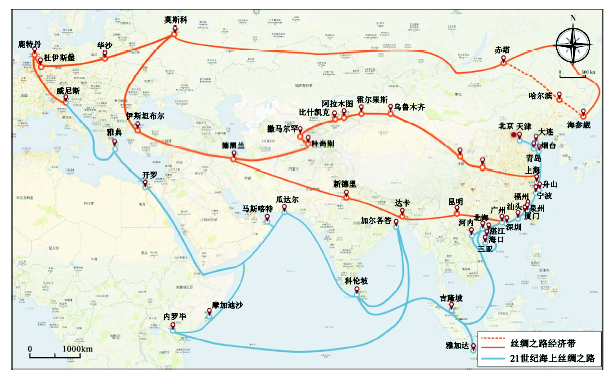
Fig. 1 Key lines and nodes in ‘One belt One Road’图1 “一带一路”主体线路及节点示意图 |
Table 1 The positioning proposed by Chinese provinces based on the ‘One Belt, One Road’ strategy表1 全国各省份根据“一带一路”战略提出的发展定位[37] |
| 省份 | 发展定位 | 节点城市 |
|---|---|---|
| 新疆 | 丝绸之路经济带上重要的交通枢纽、商贸物流和文化科技中心和丝绸之路经济带核心区 | 乌鲁木齐、喀什 |
| 青海 | 丝绸之路经济带的战略通道、重要支点和人文交流中心 | 西宁、海东、格尔木 |
| 甘肃 | “丝绸之路经济带”黄金段,向西开放的重要门户和次区域合作战略基地 | 兰州、白银、酒泉、嘉峪关、敦煌 |
| 陕西 | 丝绸之路经济带重要支点,中国向西开放的重要枢纽 | 西安 |
| 宁夏 | 丝绸之路经济带战略支点 | - |
| 重庆 | 西部中心枢纽和内陆开放高地 | - |
| 四川 | “一带一路”战略的重要交通枢纽和经济腹地 | - |
| 云南 | “一带一路”的战略支点和面向南亚、东南亚的辐射中心 | - |
| 广西 | “一带一路”有机衔接的重要门户,西南中南开放发展新的战略支点 | - |
| 江苏 | “一带一路”交汇节点 | 徐州、连云港 |
| 浙江 | “一带一路”战略的经贸合作先行区、“网上丝绸之路”试验区、贸易物流枢纽区 | 杭州、宁波、温州 |
| 福建 | “一带一路”互联互通的重要枢纽、海上丝绸之路经贸合作的前沿平台和人文交流的重要带 | 厦门、漳州、泉州、福州 |
| 广东 | 21世纪海上丝绸之路的桥头堡 | 广州 |
| 海南 | 南海资源开发服务保障基地和海上救援基地,海上丝绸之路的门户支点 | 海口、三亚 |
| 山东 | “一带一路”海上战略支点和新亚欧大陆桥经济走廊的重要沿线地区 | 日照、青岛 |
| 黑龙江 | 东部沿海以及日、韩等地陆海联运跨境运输枢纽 | - |
| 河南 | 亚欧大宗商品商贸物流中心、丝绸之路文化交流中心、能源储运交易中心,“一带一路”核心腹地 | - |
| 湖北 | “武汉-东盟”航运通道节点 | |
| 辽宁 | 中蒙俄经济走廊的重要一环,“一带一路”战略的重要平台 | - |
Table 2 Rescaling in the ‘One Belt, One Road’ strategy表2 “一带一路”战略中的尺度重构 |
| 重构主体 | 尺度上推 | 尺度下移 |
|---|---|---|
| 国家 (全球地方化) | 构建亚投行、丝路基金等超国家组织; 透过跨国基础设施投资、园区建设和国家间合作 压缩时空,以点带线拓展增长空间 | 通过国家行政管理权下放和资源集聚,强化一系列枢纽、门户、港口和口岸城市/区域作为主体参与全球化竞争 |
| 城市/区域 (节点/门户城市的发展) | 城市的全球与区域定位的变化: 融入全球竞争; 东西联动、促进区域经济合作与融合 | 内部城市空间重组; 强调原真性和地域边界 |
Table 3 Politics of scale and related risks in the ‘One Belt, One Road’ strategy表3 “一带一路”战略中的尺度政治及相关风险 |
| 主体 | 尺度上推 | 尺度下移 |
|---|---|---|
| 中国 | 促进与欧盟国家的合作,减少国际阻力; 强调开放性,防止国际将“一带一路”解读为中国试图主导亚洲 | 凸显亚洲成员、南海的主权;强调互补性而非替代性 |
| 城市/区域 | 通过提高自身定位争夺资源和优惠政策; 与国外疆独势力等联合 | 强调自身利益,造成重复建设和产能过剩 |
| 其他国家 | 引入新的大国相竞争 | 维持地方性基础设施规格和旧有公约;维持地方特色风俗和文化;凸显大国霸权的言论 |
The authors have declared that no competing interests exist.
| [1] |
[
|
| [2] |
[
|
| [3] |
[
|
| [4] |
[
|
| [5] |
[
|
| [6] |
[
|
| [7] |
[
|
| [8] |
[
|
| [9] |
[
|
| [10] |
[
|
| [11] |
[
|
| [12] |
[
|
| [13] |
刘诚. 香港:一带一路经济节点[J]. 开放导报, 2015, (2): 60-62.
[
|
| [14] |
[
|
| [15] |
[
|
| [16] |
[
|
| [17] |
[
|
| [18] |
[
|
| [19] |
|
| [20] |
[
|
| [21] |
[
|
| [22] |
[
|
| [23] |
|
| [24] |
|
| [25] |
|
| [26] |
|
| [27] |
|
| [28] |
|
| [29] |
[
|
| [30] |
[
|
| [31] |
|
| [32] |
|
| [33] |
[
|
| [34] |
[
|
| [35] |
[
|
| [36] |
郭晓萍. 2015. 欧晓理:各省区都要编制推进一带一路建设实施方案[EB/OL]. 中国证券网, 2015-04-10. .
|
| [37] |
梁敏.20省份全面布局"一带一路" 今年进入实质操作阶段[EB/OL]. 新华网. 2015-01-28. .
|
| [38] |
|
| [39] |
|
| [40] |
[
|
/
| 〈 |
|
〉 |