



多尺度视角下长株潭城市群工业旅游空间布局及联动模式
|
唐健雄(1967−),男,湖南长沙人,教授,博导,主要从事旅游地理研究。E-mail: 293430686@qq.com |
收稿日期: 2020-08-30
网络出版日期: 2021-10-11
基金资助
国家自然科学基金项目(41771162)、湖南省双一流学科建设项目(地理学−5010002)资助
版权
Spatial Layout and Linkage Mode of Industrial Tourism in Changsha-Zhuzhou-Xiangtan Urban Agglomeration from a Multi-scale Perspective
Received date: 2020-08-30
Online published: 2021-10-11
Supported by
National Natural Science Foundation of China (41771162),Double First-Class Discipline Construction of Hunan Province (Geography-5010002)
Copyright
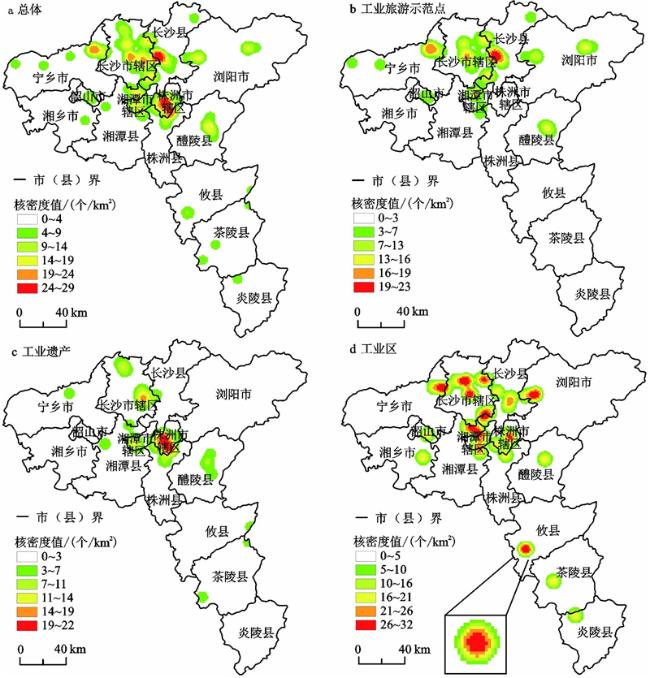
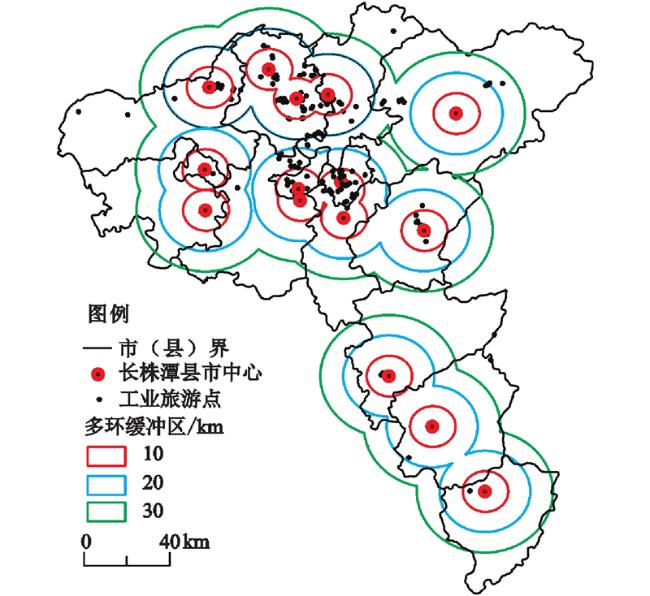
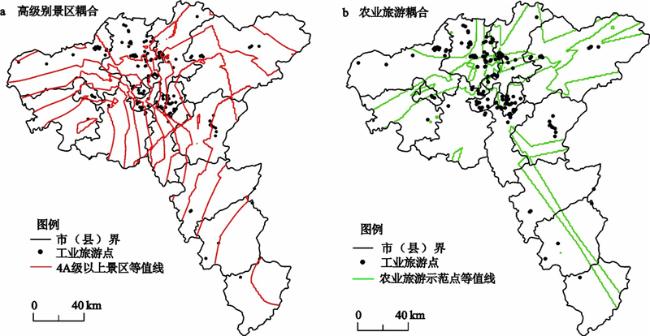
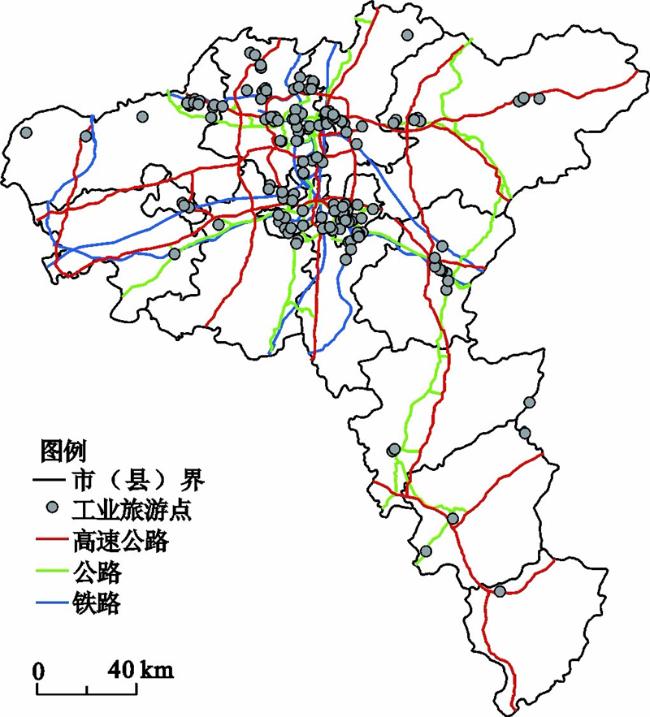
采用最邻近指数、泰森多边形、核密度估计、缓冲区分析等方法,基于城市群、县(市)、地区等多尺度对长株潭城市群不同类型工业旅游的空间布局特征及联动模式进行系统研究。结果表明:① 长株潭城市群工业旅游可划分为工业旅游示范点、工业遗产和工业区等3种类型,空间分布上均呈现为集聚态势,且总体集聚程度较强,具体表现为:工业旅游示范点>工业遗产>工业区。② 工业旅游形成“中心集聚−外围分散”的空间布局,分布密度由城市群中部向周边递减,中心城市向县、县级市递减。③ 从多尺度视角来看,工业旅游空间布局在城市群尺度上呈“团状”,县市尺度上呈“孤岛状”,地区尺度呈“块斑状”。基于以上结论,提出工业旅游的点−轴联动、集聚联动和一体化联动模式。
唐健雄 , 马梦瑶 . 多尺度视角下长株潭城市群工业旅游空间布局及联动模式[J]. 地理科学, 2021 , 41(8) : 1428 -1436 . DOI: 10.13249/j.cnki.sgs.2021.08.014
The rational layout of industrial tourism space has important practical significance for the transformation and upgrading of resource-based cities, old industrial areas, and industrial enterprises, improving quality and efficiency, and innovating and developing. Using the nearest neighbor index, thiessen polygons, kernel density estimation, buffer analysis and other methods, the spatial layout characteristics and linkage mode of different types of industrial tourism in Changsha-Zhuzhou-Xiangtan Urban Agglomeration are systematically based on multi-scale urban agglomeration, county (city), region the study. The results show that: 1) Industrial tourism in the Changsha-Zhuzhou-Xiangtan Urban Agglomeration can be divided into three types: industrial tourism demonstration sites, industrial heritage and industrial zones. The spatial distribution types all show agglomeration, and the overall degree of agglomeration is relatively strong, specifically as follows: Industrial Tourism Demonstration Site> Industrial Heritage> Industrial Zone. 2) Industrial tourism has formed a ‘central agglomeration-peripheral dispersion’ spatial layout. The distribution density decreases from the center of the urban agglomeration to the periphery, and the central city decreases to the county and county-level cities. 3) From a multi-scale perspective, the distribution of industrial tourism on the scale of urban agglomeration is distributed in the form of “clusters”, on the scale of counties and cities it is distributed in the form of “isolated islands”, and the degree of agglomeration on the regional scale is the highest, forming a “patchy” clustered area. Based on the above conclusions, combined with the source market, tourism resources, traffic conditions, etc. of the Changsha-Zhuzhou-Xiangtan Urban Agglomeration, point-axis linkage, agglomeration linkage and integrated linkage modes of industrial tourism are proposed.
表 1 2019年长株潭城市群最邻近指数(R)及空间布局类型Table 1 The adjacent index and spatial structure of Changsha-Zhuzhou-Xiangtan Urban Agglomeration in 2019 |
| 类型 | P-value | Z-score | R | 空间布局类型 |
| 总体 | 0.00 | −18.45 | 0.31 | 集聚 |
| 工业旅游示范点 | 0.00 | −12.13 | 0.32 | 集聚 |
| 工业遗产 | 0.00 | −8.03 | 0.51 | 集聚 |
| 工业区 | 0.00 | −3.71 | 0.68 | 集聚 |
表 2 2019年长株潭城市群工业旅游变异系数(CV)Table 2 Variation coefficient for the industrial tourism of Changsha-Zhuzhou-Xiangtan Urban Agglomeration in 2019 |
| 类型 | 标准差/m2 | 平均值/m2 | CV | 分布类型 |
| 总体 | 41430.22 | 36437.64 | 1.13 | 集聚 |
| 工业旅游示范点 | 76867.19 | 58451.51 | 1.31 | 集聚 |
| 工业遗产 | 81597.58 | 61569.42 | 1.33 | 集聚 |
| 工业区 | 82914.10 | 12092.84 | 0.69 | 集聚 |
| [1] |
王国华. 论推进工业旅游产业发展的理念、路径与措施[J]. 北京联合大学学报(人文社会科学版), 2019, 17 (1): 47- 54.
Wang Guohua. A brief view of the concepts, paths and measurements of industrial tourism industry[J]. Journal of Beijing Union University (Humanities and Social Sciences), 2019, 17 (1): 47- 54.
|
| [2] |
Lee T H. Influence analysis of community resident support for sustainable tourism development[J]. Tourism Management, 2013, 34 (13): 37- 46.
|
| [3] |
Castellani V, Sala S. Sustainable performance index for tourism policy development[J]. Tourism Management, 2010, 31 (7): 871- 880.
|
| [4] |
Hacklin F, Marxt C, Fahrni F. An evolutionary perspective on convergence: Inducing a stage model of inter-industry innovation[J]. International Journal of Technology Management, 2010, 49 (1): 220- 249.
|
| [5] |
Curran C S, Leker J. Anticipating converging industries using publicly available data[J]. Technological Forecasting & Social Change, 2010, 77 (3): 385- 395.
|
| [6] |
谢红彬, 高玲. 国外工业遗产再利用对福州马尾区工业旅游开发的启示[J]. 人文地理, 2005, 20 (6): 52- 55.
Xie Hongbin, Gao Ling. Enlightenment of reusing of international industrial heritage to development of industrial tourism development in Mawei District of Fuzhou[J]. Human Geography, 2005, 20 (6): 52- 55.
|
| [7] |
董锁成, 郭鹏. 国内外工业旅游研究进展[J]. 山西大学学报(哲学社会科学版), 2015, 38 (2): 137- 144.
Dong Suocheng, Guo Peng. The progress of industrial tourism research at home and abroad[J]. Journal of Shanxi University (Philosophy & Social Science), 2015, 38 (2): 137- 144.
|
| [8] |
Edwards J A, Joan C Llurdés I Coit. Mines and quarries industrial heritage tourism[J]. Annals of Tourism Research, 1996, (2): 341- 363.
|
| [9] |
虞虎, 李亚娟, 陆林, 等. 大都市传统工业区休闲旅游转型发展研究综述[J]. 自然资源学报, 2016, 31 (3): 526- 542.
Yu Hu, Li Yajuan, Lu Lin et al. The transformation development of recreation and tourism from traditional industrial zones in metropolis[J]. Journal of Natural Resources, 2016, 31 (3): 526- 542.
|
| [10] |
于秋阳, 刘青. 创意转化下的都市工业旅游模式创新与标准优化[J]. 上海经济, 2018, (5): 33- 41.
Yu Qiuyang, Liu Qing. Study on of model innovation and standards optimization of metropolitan industrial tourism based on creative transformation[J]. Shanghai Economy, 2018, (5): 33- 41.
|
| [11] |
金雨. 东北老工业衰退背景下旅游联合体城市旅游发展评价研究——以资源型城市为例[J]. 国土与自然资源研究, 2018, (3): 76- 81.
Jin Yu. Evaluation on tourism development of tourism federation under the background of the decline of the Northeast old industrial base—Taking resource-based cities as an example[J]. Territory & Natural Resources Study, 2018, (3): 76- 81.
|
| [12] |
李蕾蕾, Dietrich Soyez. 中国工业旅游发展评析: 从西方的视角看中国[J]. 人文地理, 2003, 18 (6): 20- 25.
Li Leilei, Dietrich Soyez. Evaluation of China’s industrial tourism development: From a western perspective[J]. Human Geography, 2003, 18 (6): 20- 25.
|
| [13] |
顾小光, 汪德根. 我国工业旅游的空间布局特征——以全国工业旅游资源为分析对象[J]. 经济管理, 2006, (19): 69- 73.
Gu Xiaoguang, Wang Degen. The spatial structure characteristics of industrial tourism in China—Analysis of national industrial tourism demonstration sites[J]. Economic Management, 2006, (19): 69- 73.
|
| [14] |
唐健雄, 黄江媚, 刘炼鑫, 等. 集聚视角下湖南省工业旅游空间联动多尺度研究[J]. 经济地理, 2017, 37 (8): 197- 206.
Tang Jianxiong, Huang Jiangmei, Liu Lianxin et al. A multi-scale research on spatial linkage of industrial tourism in Hunan Province from an agglomeration perspective[J]. Economic Geography, 2017, 37 (8): 197- 206.
|
| [15] |
吴杨, 倪欣欣, 马仁锋, 等. 上海工业旅游资源的空间分布与联动特征[J]. 资源科学, 2015, 37 (12): 2362- 2370.
Wu Yang, Ni Xinxin, Ma Renfeng et al. Space distribution and linkage of urban industrial tourism resources in Shanghai[J]. Resources Science, 2015, 37 (12): 2362- 2370.
|
| [16] |
宫一路, 黄磊昌. 城市工业景观系统规划初探——以大连市为例[J]. 生态经济, 2017, 33 (1): 190- 193.
Gong Yilu, Huang Leichang. The primary research of urban industrial landscape system— A case study of Dalian[J]. Ecological Economy, 2017, 33 (1): 190- 193.
|
| [17] |
湖南省统计局. 湖南统计年鉴[M]. 北京: 中国统计出版社, 2017-2019.
Hunan Statistical Bureau. Hunan statistical yearbook. Beijing: China Statistics Press, 2017-2019.
|
| [18] |
向雁, 陈印军, 侯艳林, 等. 河北省休闲农业的空间分布及影响机制[J]. 地理科学, 2019, 39 (11): 1806- 1813.
Xiang Yan, Chen Yinjun, Hou Yanlin et al. Spatial distribution and influencing factors of leisure agriculture: A case from Hebei Province[J]. Scientia Geographica Sinica, 2019, 39 (11): 1806- 1813.
|
| [19] |
杨丽婷, 刘大均, 赵越, 等. 长江中游城市群森林公园空间分布格局及可达性评价[J]. 长江流域资源与环境, 2016, 25 (8): 1228- 1237.
Yang Liting, Liu Dajun, Zhao Yue et al. Spatial pattern and accessibility of the forest parks in urban agglomeration in the middle reaches of the Yangtze River[J]. Resources and Environment in the Yangtze Basin, 2016, 25 (8): 1228- 1237.
|
| [20] |
薛冰, 肖骁, 李京忠, 等. 基于兴趣点(POI)大数据的东北城市空间结构分析[J]. 地理科学, 2020, 40 (5): 691- 700.
Xue Bing, Xiao Xiao, Li Jingzhong et al. Analysis of spatial economic structure of Northeast China cities based on Points of Interest big data[J]. Scientia Geographica Sinica, 2020, 40 (5): 691- 700.
|
| [21] |
凌德泉, 毕硕本, 左颖, 等. 缓冲区分析综合模型构建研究[J]. 测绘科学, 2019, 44 (9): 47- 53.
Ling Dequan, Bi Shuoben, Zuo Ying et al. Research on comprehensive model construction of buffer analysis[J]. Science of Surveying and Mapping, 2019, 44 (9): 47- 53.
|
| [22] |
Duyckaerts C, Godefroy G. Voronoi tessellation to study the numerical density and thespatial distribution of neurons[J]. Journal of Chemical Neuroanatomy, 2000, 20, 83- 92.
|
| [23] |
钟业喜, 郭卫东. 中国高铁网络结构特征及其组织模式[J]. 地理科学, 2020, 40 (1): 79- 88.
Zhong Yexi, Guo Weidong. High-speed rail network spatial structure and organization model in China[J]. Scientia Geographica Sinica, 2020, 40 (1): 79- 88.
|
| [24] |
史庆斌, 谢永顺, 韩增林, 等. 东北城市间旅游经济联系的空间布局及发展模式[J]. 经济地理, 2018, 38 (11): 211- 219.
Shi Qingbin, Xie Yongshun, Han Zenglin et al. Spatial structure and spatial development patterns of urban tourism economic connections in Northeast China[J]. Economic Geography, 2018, 38 (11): 211- 219.
|
| [25] |
贾妍, 于楠楠. 我国生态城市建设的时空演化路径及其发展模式[J]. 哈尔滨工程大学学报, 2017, 38 (2): 324- 330.
Jia Yan, Yu Nannan. The spatial-temporal evolution path and development patterns of eco-city construction in China[J]. Journal of Harbin Engineering University, 2017, 38 (2): 324- 330.
|
| [26] |
段德忠, 谌颖, 杜德斌. 技术转移视角下中国三大城市群区域一体化发展研究[J]. 地理科学, 2019, 39 (10): 1581- 1591.
Duan Dezhong, Chen Ying, Du Debin. Regional integration process of China’s three major urban agglomerations from the perspective of technology transfer[J]. Scientia Geographica Sinica, 2019, 39 (10): 1581- 1591.
|
| [27] |
李鹏, 虞虎, 王英杰. 中国3A级以上旅游景区空间集聚特征研究[J]. 地理科学, 2018, 38 (11): 1883- 1891.
Li Peng, Yu Hu, Wang Yingjie. Spatial agglomeration characteristics of from 3A-class to 5A-class scenic spots in China[J]. Scientia Geographica Sinica, 2018, 38 (11): 1883- 1891.
|
/
| 〈 |
|
〉 |