



基于街景数据的建成环境与街道活力时空分析——以深圳福田区为例
|
司睿(1992-),女,新疆乌鲁木齐人,博士研究生,主要从事时空行为与城市规划方面的研究。E-mail: issirui@foxmail.com |
收稿日期: 2020-06-27
修回日期: 2020-12-09
网络出版日期: 2021-11-17
基金资助
国家自然科学基金(41571145)
哈尔滨工业大学科研创新基金(HIT.NSRIF.2020073)
深圳市基础研究(JCYJ20190806144618382)
版权
Spatio-temporal Analysis of Built Environment and Street Vitality Relationship Based on Street-level Imagery: A Case Study of Futian District, Shenzhen
Received date: 2020-06-27
Revised date: 2020-12-09
Online published: 2021-11-17
Supported by
National Natural Science Foundation of China(41571145)
Research and Innovation Fund of Harbin Institute of Technology(HIT.NSRIF.2020073)
Shenzhen Basic Research Fund(JCYJ20190806144618382)
Copyright
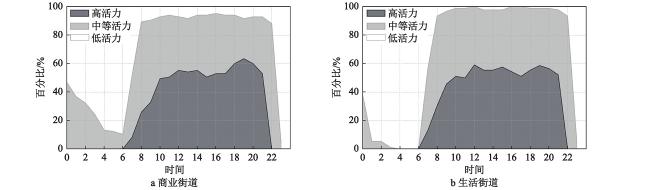
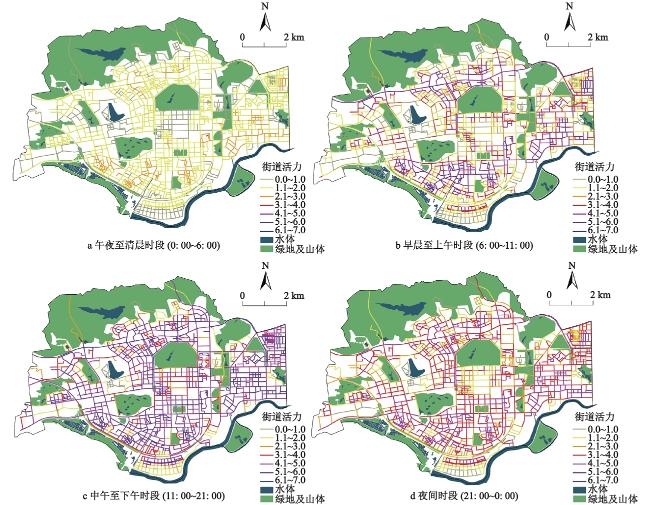
建成环境对街道活力的影响是国内外城市研究的热点议题。然而,对于建成环境要素的测度与评估多偏重于二维建成环境指标,尚未充分挖掘三维建成环境指标。以深圳市福田区为例,采用街景数据、路网数据、POI数据及移动互联网位置服务数据,建立周末分时段模型,探讨商业街道和生活街道活力的时空间分布特征及建成环境对其产生的影响。结果表明:① 商业街道上居民全天活动的峰值时段为18:00~20:00,生活街道上居民全天活动的峰值时段为11:00~13:00。② 深圳市福田区街道活力总体呈现多中心结构,随时间变化显现出明显的空间差异。③ 不同的建成环境指标对街道活力的作用时段与影响程度存在差异。提高功能混合度有利于提升商业街道凌晨、上午和夜间的活力及生活街道午后和傍晚的活力;过宽的相对步行宽度对生活街道活力提升有抑制作用,更安全的步行环境对商业和生活街道夜间活力提升有促进作用;界面连续程度高的商业街道午后及夜间的活力更强,界面多样性丰富的生活街道白天活力更强。
司睿 , 林姚宇 , 肖作鹏 , 叶宇 . 基于街景数据的建成环境与街道活力时空分析——以深圳福田区为例[J]. 地理科学, 2021 , 41(9) : 1536 -1545 . DOI: 10.13249/j.cnki.sgs.2021.09.005
The last decades have witnessed a steady increase in studying urban vitality. However, the information that could depict 3D space has not been included in studies. This research attempts to incorporate street view imagery data to elaborate the spatiotemporal variability of vibrancy in Futian District, Shenzhen. As for the street-level physical environment, attributes are extracted from street view images by deep machine-learning algorithms SegNet. 2D built environment indicators of streets were extracts from the Open Street Map and POI points. A multivariate econometric are framed to examine the association between urban environment and the vitality at the street level of commercial streets and residential streets. The results showed that: 1) The peak hours of activity on commercial streets are 18:00 to 20:00, and the peak hours of activity on living streets are 11:00 to 13:00. 2) Futian District Street Vitality Shows Polycentric Structure, whose distribution had shown obvious spatial differences with time. 3) Variations in the temporal and degree effects of different built environment indicators on street vitality. Increasing the mix of facilities contributes to the morning and nighttime vibrancy of commercial streets, as well as the afternoon vibrancy of living streets. More compact streets have a positive impact on commercial streets’ vitality, and safer pedestrian environments have a positive impact on both living and commercial streets’ vitality. Improving the building continuity will promote the vitality of commercial streets. Higher interface richness increases the vitality of living streets in afternoon and evening. An increase in the richness of the interface will promote the daytime vitality of the residential street.
表1 深圳市福田区街道建成环境变量描述性统计Table 1 Descriptive statistics of streets’ built environment variables in Futian district, Shenzhen |
| 变量类型 | 变量 | 商业街道 | 生活街道 | 说明 | |||
| 均值 | 标准差 | 均值 | 标准差 | ||||
| 便利性 | 设施数量/(个/100 m) | 9.53 | 10.14 | 10.12 | 5.31 | 单元内每100 m的设施点数量,反映设施分布 | |
| 功能混合度 | 0.46 | 0.31 | 0.52 | 0.25 | 单元内POI混合状态,反映土地利用多样性 | ||
| 最近娱乐休闲设施距离/m | 192.40 | 134.85 | 186.56 | 173.40 | 街道质心至最近娱乐休闲设施的实际距离,反映到达目的地的便捷程度 | ||
| 最近商业设施距离/m | 95.29 | 148.28 | 147.49 | 112.41 | 街道质心到最近商业设施的实际距离,反映到达目的地的便捷程度 | ||
| 可达性 | 最近公共交通站点距离/m | 230.71 | 161.73 | 259.98 | 179.40 | 街道质心至最近公交站或地铁站的实际距离,反映公共交通站点的邻近性 | |
| 接近度 | 0.26 | 0.08 | 0.25 | 0.09 | 对半径内的每个网络链路,计算网络数量并除以到达该网络的距离,然后对半径内的该项求和,反映街道中心性和拓扑整合力 | ||
| 可步行性 | 相对步行宽度 | 0.41 | 0.23 | 0.43 | 0.33 | 单元内步行道占比/马路占比的均值,反映步行空间尺度 | |
| 交通安全设施占比 | 0.03 | 0.02 | 0.02 | 0.03 | 单元内栏杆和柱占比总和的均值,反映交通安全程度 | ||
| 舒适性 | 天空开敞度 | 0.09 | 0.05 | 0.11 | 0.08 | 单元内天空占比的均值,反映视觉开敞程度 | |
| 建筑连续程度 | 0.14 | 0.08 | 0.11 | 0.07 | 单元内建筑占比的标准差,反映街道建筑界面的连续性 | ||
| 街道高宽比 | 2.36 | 2.17 | 1.90 | 2.24 | 单元内建筑占比/(道路占比+人行道占比)的均值,反映空间的紧凑程度 | ||
| 界面多样性 | 0.03 | 0.01 | 0.03 | 0.01 | 单元内可视空间元素种类/道路长度,反映界面丰富性 | ||
表2 建成环境对深圳市福田区商业街道活力强度的影响Table 2 Impact of the built environment on the vitality intensity of commercial street in Futian District, Shenzhen |
| 变量类型 | 变量 | 全天 | 分时段模型 | |||
| 0:00~6:00 | 6:00~11:00 | 11:00~21:00 | 21:00~00:00 | |||
| 注:数值为回归系数;***、**、* 分别表示在0.01、0.05、0.1的显著性水平下通过检验。 | ||||||
| 便利性 | 设施数量 | 0.028 | 0.058 | 0.120 | -0.023 | 0.030 |
| 功能混合度 | 0.212** | 0.205** | 0.258** | 0.176 | 0.192* | |
| 最近娱乐休闲设施距离 | 0.043 | -0.111 | 0.072 | 0.085 | 0.008 | |
| 最近商业设施距离 | -0.141 | -0.095 | -0.036 | -0.184. | -0.130 | |
| 可达性 | 最近公共交通站点距离 | -0.294*** | -0.166* | -0.258** | -0.323*** | -0.274*** |
| 接近度 | 0.216** | 0.172* | 0.228** | 0.202* | 0.225** | |
| 可步行性 | 相对步行宽度 | -0.033 | -0.214** | -0.057 | 0.047 | -0.069 |
| 交通安全设施占比 | 0.170* | 0.197** | 0.180* | 0.133 | 0.235** | |
| 舒适性 | 天空开敞度 | -0.206* | -0.230** | -0.198* | -0.180 | -0.199* |
| 建筑连续程度 | 0.184* | 0.113 | 0.117 | 0.213* | 0.203* | |
| 界面多样性 | -0.011 | -0.029 | 0.016 | -0.020 | 0.055 | |
| 街道高宽比 | 0.276** | 0.468*** | 0.348*** | 0.159 | 0.202* | |
| 截距项 | 2.855*** | 1.424*** | 2.534*** | 3.957*** | 2.449*** | |
| 样本量 | 85 | 85 | 85 | 85 | 85 | |
| 调整后的R2 | 0.650 | 0.699 | 0.597 | 0.556 | 0.607 | |
表3 建成环境对深圳市福田区生活街道活力强度的影响Table 3 Impact of the built environment on the vitality intensity of living streets in Futian District, Shenzhen |
| 变量类型 | 变量 | 全天 | 分时段模型 | |||
| 0:00~6:00 | 6:00~11:00 | 11:00~21:00 | 21:00~00:00 | |||
| 注:***、**、* 分别表示在0.01、0.05、0.1的显著性水平下通过检验。 | ||||||
| 便利性 | 设施数量 | 0.068 | 0.170 | 0.113 | 0.001 | -0.004 |
| 功能混合度 | 0.156* | 0.082 | 0.140 | 0.175* | 0.130 | |
| 最近娱乐休闲设施距离 | -0.193* | -0.039 | -0.104 | -0.248** | -0.340*** | |
| 最近商业设施距离 | -0.378*** | -0.392*** | -0.279* | -0.351*** | -0.361*** | |
| 可达性 | 最近公共交通站点距离 | 0.143 | 0.165 | 0.118 | 0.121 | 0.115 |
| 接近度 | 0.185* | 0.226** | 0.074 | 0.187* | 0.157* | |
| 可步行性 | 相对步行宽度 | -0.207** | -0.087 | -0.185* | -0.231** | -0.255*** |
| 交通安全设施占比 | 0.064 | 0.020 | 0.133 | 0.028 | 0.215** | |
| 舒适性 | 天空开敞度 | 0.111 | -0.018 | 0.195* | 0.115 | 0.104 |
| 建筑连续程度 | 0.004 | -0.166 | -0.136 | 0.140 | -0.070 | |
| 界面多样性 | 0.213* | 0.074 | 0.253* | 0.231* | 0.106 | |
| 街道高宽比 | 0.346** | 0.574*** | 0.398** | 0.176 | 0.304** | |
| 截距项 | 2.560*** | 0.892* | 2.663*** | 3.581*** | 2.672*** | |
| 样本量 | 91 | 91 | 91 | 91 | 91 | |
| 调整后的R2 | 0.593 | 0.518 | 0.419 | 0.559 | 0.619 | |
| [1] |
Jacobs J. The death and life of American cities[M]. New York: Random House, 1961.
|
| [2] |
杨·盖尔. 交往与空间(第四版)[M]. 何人可译. 北京: 中国建筑工业出版社, 2009.
Jan Gehl. Communication and space (4nd ed). Translated by He Renke. Beijing: China Building Industry Press, 2009.
|
| [3] |
Mehta V. Lively Streets: Determining environmental characteristics to support social behavior[J]. Journal of Planning Education and Research, 2007, 27(2): 165-187.
|
| [4] |
Montgomery J. Making a city: Urbanity, vitality and urban design[J]. Journal of Urban Design, 1998, 3(1): 93-116.
|
| [5] |
蒋涤非. 城市形态活力论[M]. 南京: 东南大学出版社, 2007
Jiang Difei. The theory of city form vitality. Nanjing: Southeast University Press, 2007.
|
| [6] |
陈品, 马水静. 关于城市街道活力的思考[J]. 建筑学报, 2009(S2): 121-126.
Chen Pin, Ma Shuijing. Research on the vitality of urban streets. Architectural Journal, 2009(S2): 121-126.
|
| [7] |
龙瀛, 周垠. 街道活力的量化评价及影响因素分析——以成都为例[J]. 新建筑, 2016(1): 52-57.
Long Ying, Zhou Yin. Quantitative evaluation on street vibrancy and its impact factors: A case study of Chengdu. New Architecture, 2016(1): 52-57.
|
| [8] |
姜蕾. 城市街道活力的定量评估与塑造策略[D]. 大连: 大连理工大学, 2013.
Jiang Lei. Quantitative assessment and shaping strategy of vitality of urban streets. Dalian: Dalian University of Technology, 2013.
|
| [9] |
方永华. 基于多源大数据的城市街道活力测度与影响机制研究[D]. 南京: 东南大学, 2018
Fang Yonghua. The measurement and influence mechanism of city street vitality. Nanjing: Southeast University, 2018.
|
| [10] |
黄丹, 戴冬晖. 生活性街道构成要素对活力的影响——以深圳典型街道为例[J]. 中国园林, 2019, 35(9): 89-94.
Huang Dan, Dai Donghui. Effect of living street’s elements on vitality taking typical streets in Shenzhen as an example. Chinese Landscape Architecture, 2019, 35(9): 89-94.
|
| [11] |
钮心毅, 吴莞姝, 李萌. 基于LBS定位数据的建成环境对街道活力的影响及其时空特征研究[J]. 国际城市规划, 2019, 34(1): 28-37.
Niu Xinyi, Wu Wanshu, Li Meng. Influence of built environment on street vitality and its spatiotemporal characteristics based on LBS positioning data. Urban Planning International, 2019, 34(1): 28-37.
|
| [12] |
Ye Y, Van Nes A. Quantitative tools in urban morphology: Combining space syntax, spacematrix and mixed-use index in a GIS framework[J]. Urban Morphology, 2014, 18(2): 97-118.
|
| [13] |
吴志强, 叶锺楠. 基于百度地图热力图的城市空间结构研究——以上海中心城区为例[J]. 城市规划, 2016, 40(4): 33-40.
Wu Zhiqiang, Ye Zhongnan. Research on urban spatial structure based on Baidu heat map: A case study on the central city cf Shanghai. City Planning Review, 2016, 40(4): 33-40.
|
| [14] |
闵忠荣, 丁帆. 基于百度热力图的街道活力时空分布特征分析——以江西省南昌市历史城区为例[J]. 城市发展研究, 2020, 27(2): 31-36.
Min Zhongrong, Ding Fan. Analysis of temporal and spatial distribution characteristics of street vitality based on Baidu thermal diagram: The case of the historical city of Nanchang City, Jiangxi Province. Urban Development Studies, 2020, 27(2): 31-36.
|
| [15] |
苟爱萍, 王江波. 基于SD法的街道空间活力评价研究[J]. 规划师, 2011, 27(10): 102-106.
Gou Aiping, Wang Jiangbo. SD method based street space vitality evaluation. Planners, 2011, 27(10): 102-106.
|
| [16] |
叶宇, 张昭希, 张啸虎, 等. 人本尺度的街道空间品质测度——结合街景数据和新分析技术的大规模、高精度评价框架[J]. 国际城市规划, 2019, 34(1): 18-27.
Ye Yu, Zhang Zhaoxi, Zhang Xiaohu et al. Human-scale quality on streets: A large-scale and efficient analytical approach based on street view images and new urban analytical tools. Urban Planning International, 2019, 34(1): 18-27.
|
| [17] |
Zhang F, Zhou B, Liu L et al. Measuring human perceptions of a large-scale urban region using machine learning[J]. Landscape and Urban Planning, 2018, 180: 148-160.
|
| [18] |
Tang J, Long Y. Measuring visual quality of street space and its temporal variation: Methodology and its application in the hutong area in Beijing[J]. Landscape and Urban Planning, 2019, 191: 103436
|
| [19] |
Richards D R, Edwards P J. Quantifying street tree regulating ecosystem services using Google Street View[J]. Ecological Indicators, 2017, 77: 31-40.
|
| [20] |
Wang R, Helbich M, Yao Y et al. Urban greenery and mental wellbeing in adults: Cross-sectional mediation analyses on multiple pathways across different greenery measures[J]. Environmental Research, 2019, 176: 108535
|
| [21] |
深圳市统计局, 国家统计局深圳调查队. 深圳统计年鉴2020[M]. 北京: 中国统计出版社, 2021.
Statistics Bureau of Shenzhen Municipality, Survey Office of the National Bureau of Statistics in Shenzhen. Shenzhen statistical yearbook 2020. Beijing: China Statistics Press, 2021.
|
| [22] |
刘志林, 柴彦威. 深圳市民周末休闲活动的空间结构[J]. 经济地理, 2001, 21(4): 504-508.
Liu Zhilin, Chai Yanwei. The leisure spatial structure of Shenzhen citizens on weekends. Economic Geography, 2001, 21(4): 504-508.
|
| [23] |
中华人民共和国建设部. 城市道路交通规划设计规范[S]. 北京: 中国计划出版社,1995.
Ministry of Construction of the People’s Republic of China. Code for transport planning and urban road. Beijing: China Planning Publishing House,1995.
|
| [24] |
上海市规划和国土资源管理局, 上海市交通委员会, 上海市城市规划设计研究院. 上海市街道设计导则[M]. 上海: 同济大学出版社, 2016.
Shanghai Municipal Planning and Land Resources Administration, Shanghai Municipal Transportation Commission, Shanghai Urban Planning and Design Institute. Shanghai street design guidelines. Shanghai: Tongji University Press, 2016.
|
| [25] |
Song Y, Merlin L, Rodriguez D. Comparing measures of urban land use mix[J]. Computers, Environment and Urban Systems, 2013, 42: 1-13.
|
| [26] |
Karimi K. A configurational approach to analytical urban design: ‘Space syntax’ methodology[J]. Urban Design International, 2012, 17(4): 297-318.
|
| [27] |
古恒宇, 沈体雁, 周麟, 等. 基于GWR和sDNA模型的广州市路网形态对住宅价格影响的时空分析[J]. 经济地理, 2018, 38(3): 82-91.
Gu Hengyu, Shen Tiyan, Zhou Lin et al. Measuring stree layout’s spatio-temporal effects on housing price based on GWR and sDNA model: The case study of Guangzhou. Economic Geography, 2018, 38(3): 82-91.
|
| [28] |
张文佳, 鲁大铭. 影响时空行为的建成环境测度与实证研究综述[J]. 城市发展研究, 2019, 26(12): 9-16+26.
Zhang Wenjia, Lu Daming. Measuring built environment for spatiotemporal behavior studies: A review. Urban Development Studies, 2019, 26(12): 9-16+26.
|
| [29] |
齐兰兰, 周素红. 邻里建成环境对居民外出型休闲活动时空差异的影响——以广州市为例[J]. 地理科学, 2018, 38(1): 31-40.
Qi Lanlan, Zhou Suhong. The influence of neighborhood built environments on the spatial-temporal characteristics of residents’ daily leisure activities: A case study of Guangzhou. Scientia Geographica Sinica, 2018, 38(1): 31-40.
|
| [30] |
杨俊宴, 吴浩, 郑屹. 基于多源大数据的城市街道可步行性空间特征及优化策略研究——以南京市中心城区为例[J]. 国际城市规划, 2019, 34(5): 33-42.
Yang Junyan, Wu Hao, Zheng Yi. Research on characteristics and interactive mechanism of street walkability through multi-source big data: Nanjing central district as a case study. Urban Planning International, 2019, 34(5): 33-42.
|
| [31] |
塔娜, 曾屿恬, 朱秋宇, 等. 基于大数据的上海中心城区建成环境与城市活力关系分析[J]. 地理科学, 2020, 40(1): 60-68.
Ta Na, Zeng Yutian, Zhu Qiuyu et al. Relationship between built environment and urban vitality in Shanghai downtown area based on big data. Scientia Geographica Sinica, 2020, 40(1): 60-68.
|
| [32] |
柴彦威, 沈洁, 翁桂兰. 上海居民购物行为的时空间特征及其影响因素[J]. 经济地理, 2008, 28(2): 221-227.
Chai Yanwei, Shen Jie, Weng Guilan. A study on activity space of shopping of shanghai residents: Temporal and spatial characteristics and relative influencing factors. Economic Geography, 2008, 28(2): 221-227.
|
| [33] |
Chen L, Ng E, An X et al. Sky view factor analysis of street canyons and its implications for daytime intra-urban air temperature differentials in high-rise, high-density urban areas of Hong Kong: A GIS-based simulation approach[J]. International Journal of Climatology, 2012, 32(1): 121-136.
|
| [34] |
Yin L, Wang Z. Measuring visual enclosure for street walkability: Using machine learning algorithms and Google Street View imagery[J]. Applied Geography, 2016, 76: 147-153.
|
| [35] |
Millward H, Spinney J, Scott D. Active-transport walking behavior: Destinations, durations, distances[J]. Journal of Transport Geography, 2013, 28: 101-110.
|
| [36] |
肖作鹏, 柴彦威, 张艳. 国内外生活圈规划研究与规划实践进展述评[J]. 规划师, 2014, 30(10): 89-95.
Xiao Zuopeng, Chai Yanwei, Zhang Yan. Overseas life circle planning and practice. Planners, 2014, 30(10): 89-95.
|
/
| 〈 |
|
〉 |