



基于多源数据的新疆人居环境质量评价
|
庞瑞秋,女,(1974−),内蒙古开鲁县人,教授,主要从事城乡规划与设计、城市社会空间研究。E-mail: pangruiqiu@mail.neu.edu.cn |
收稿日期: 2021-01-01
修回日期: 2021-04-06
网络出版日期: 2022-02-17
基金资助
国家自然科学基金项目(41971202)
版权
Evaluation of Quality for Human Settlement in Xinjiang Based on Multi-source Data
Received date: 2021-01-01
Revised date: 2021-04-06
Online published: 2022-02-17
Supported by
National Natural Science Foundation of China(41971202)
Copyright
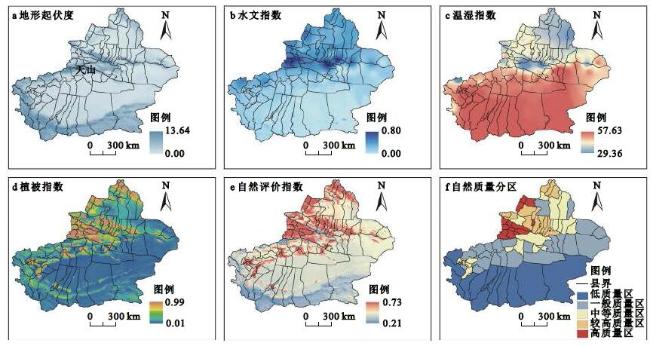
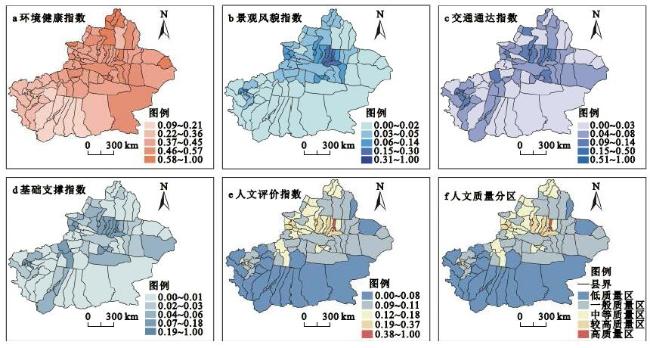
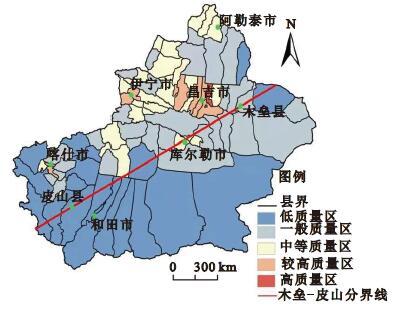
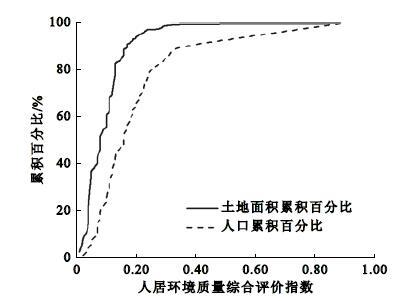
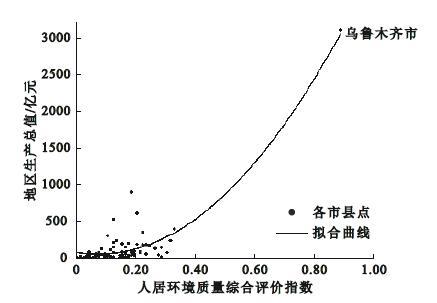
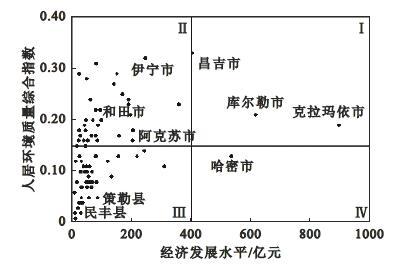
针对区域人居环境质量缺乏从自然和人文因子组合综合评价分析的现状,利用遥感影像、站点监测、交通网络等多源数据,获取与人居环境质量密切相关的自然和人文因素共17个影响因子。应用熵权法、GIS空间分析及现代大数据等方法,定量研究新疆人居环境质量综合评价指数的空间分异及其与经济、人口分布的协调性关系。结果表明:① 新疆自然环境本底受水资源及植被覆盖情况影响较大,自然环境本底评价指数高值区域的空间分布特征与绿洲分散分布的特点具有极大的相似性,县域尺度的高质量区聚集分布在天山北坡的伊犁河谷等地,低质量区和一般质量区大面积集中连片地分布在新疆南部和东部。② 人文环境受交通通达程度及基础支撑完善度影响较大,地级市、县级市优于其他县级地区,人文环境质量基本呈现以各地级市、县级市为中心向外辐射递减的空间分异规律。③ 人居环境质量综合评价指数空间分异显著,呈现出以乌鲁木齐、昌吉市等点为中心的局部圈层式递减的空间分异规律。木垒−皮山分界线东南部与西北部人居环境质量的平均水平相差悬殊。④ 整体人居环境质量水平较低,人口分布与人居环境质量综合评价指数空间分布的匹配度不足,一般质量区和低质量区的县域土地面积占比高达84.90%,分布了47.74%的人口,低质量区仍有较大的提升潜力。⑤ GDP水平与人居环境质量保持较高的匹配性,环境经济协调型县市数量较少,环境经济滞后型县市数量最多,经济发展与人居环境相互掣肘,制约着新疆的可持续性发展。
庞瑞秋 , 胡宁 , 魏冶 . 基于多源数据的新疆人居环境质量评价[J]. 地理科学, 2021 , 41(12) : 2127 -2137 . DOI: 10.13249/j.cnki.sgs.2021.12.006
In view of the lack of comprehensive evaluation and analysis of the quality of regional human settlements from the combination of natural and human multi-dimensional factors, this paper uses remote sensing images, site monitoring, transportation network data and other multi-source data to obtain a total of 17 natural and human factors closely related to the quality of human settlements. Apply entropy method, GIS spatial analysis methods and big data processing methods to quantitatively study the spatial differentiation of Xinjiang’s human settlements quality composite index and its coordinated relationship with economic and population distribution. The results show that: 1) The quality of natural environment in Xinjiang is greatly affected by water resources and vegetation coverage. The spatial distribution characteristics of high-value areas at the regional scale are very similar to the scattered distribution of oases, and high-quality areas are concentrated in the Ili River Valley on the northern slope of the Tianshan Mountains, and the low quality areas and the average quality areas at county scale are concentrated in the southern and eastern parts of Xinjiang. 2) The quality of human environment is greatly affected by convenient transportation and basic support. The scores of prefecture-level cities and county-level cities are higher than other county-level areas. And it basically presents a spatial differentiation law with the prefecture-level cities and county-level cities as the center and radiating outward. 3) The human settlements quality composite indexpresents a spatial differentiation law with local circle layer decreasing centering on Urumqi and Changji. There is a great difference in the average level of human settlement quality between the northwest and southeast of the Mulei-Pishan boundary. 4) The overall quality of human settlement is low, and the matching degree between population distribution and the distribution of human settlements quality composite indexis insufficient. The land area of the general quality and the low quality is as high as 84.9%, distributed 47.74% of the population. The low quality areas still have great potential to improve their quality. 5) The GDP level and the quality of human settlements maintain a high similarity. The number of counties and cities with coordinated environment and economy is relatively small, while the number of counties and cities with lagged environment and economy is the largest.Economic development and human settlement environment restrict each other, which restricts the sustainable development of Xinjiang.
表1 新疆人居环境评价指标体系及其权重Table 1 Index system and weights of human settlement environmental quality evaluation of Xinjiang |
| 目标层 | 标准化准则层权重 | 标准化因素层权重 | 标准化指标层权重 |
| 人居环境 质量综合 评价指数 | 自然环境评价指数(0.165) | 自然环境本底指数 | 地形起伏度(0.181)、水文指数(0.270)、 植被指数(0.459)、温湿指数(0.090) |
| 人文环境评价指数(0.835) | 景观风貌指数(0.130) | 风景名胜核密度(0.129)、省级以上 旅游景点临近度(0.001) | |
| 环境健康指数(0.057) | 年均空气质量指数(0.013)、人均公园绿地面积(0.019)、建成区绿化 覆盖率(0.008)、绿地与广场用地占城市建设用地比例(0.017) | ||
| 交通通达指数(0.330) | 路网1 h覆盖面积(0.027)、路网1h覆盖人口(0.157)、 路网密度(0.146) | ||
| 基础支撑指数(0.483) | 医疗保健核密度(0.118)、科教文化核密度(0.120)、 餐饮服务核密度(0.139)、购物服务核密度(0.106) |
表2 新疆人居环境评价的数据来源及描述Table 2 Data sources and descriptions of human settlement environmental quality evaluation of Xinjiang |
| 数据名称 | 年份 | 数据描述 | 数据来源 |
| DEM | 2018 | 30 m空间分辨率的数字高程模型 | http://www.gscloud.cn/ |
| MODIS数据 | 2009―2018 | 500 m/16 d,归一化植被指数逐月累年均值数据 | http://www.resdc.cn/ |
| 土地利用数据 | 2018 | 1 km空间分辨率的遥感监测解译数据[27] | http://www.resdc.cn/ |
| 气象站点数据 | 1989―2018 | 66 个站点累年均值数据,包含降水、温度、湿度等数据 | http://data.cma.cn/ |
| 环境监测站点数据 | 2013—2018 | 41个空气质量监测国控点获取的年均空气质量指数数据 | http://www.cnemc.cn/ |
| 行政区划数据 | 2018 | 用于提取研究区边界 | http://www.geodata.cn/ |
| 县级行政中心数据 | 2018 | 用于提取交通1 h圈 | http://www.ngcc.cn/ |
| 交通路网数据 | 2018 | 用于提取交通通达指数 | BIGEMAP平台采集 |
| POI数据 | 2018 | 包含餐饮、购物、科教、医疗保健、风景名胜等类 | 高德地图采集 |
| 统计年鉴数据 | 2018 | 包含人口、土地、经济等统计数据 | 2019年《新疆统计年鉴》[28] |
表3 新疆人居环境自然环境本底评价指标计算方法Table 3 Calculation method of natural single factor index in the human settlement environmental quality evaluation of Xinjiang |
| 指标 | 计算公式 | 变量含义 |
| 地形起伏度 | | RDLS为地形起伏度,ALT为以某一栅格为中心的10 km×10 km窗口大小内的平均海拔高度,max(H)和min(H)分别为窗口内的最高与最低海拔,A为窗口总面积即100 km2,500 m作为中国基准山体的高度,P(A)为窗口内的平地面积,本文将坡度小于5°区域定义为平地[12] |
| 水文指数 | | WRI为水文指数,P为归一化降水量,Wa为归一化水域面积比重,α和β分别为P和Wa的权重,本文α和β分别取0.2和0.8[26] |
| 植被指数 | | NDVI为归一化植被指数,NIR为近红外波段反射值,R为红光波段反射值[ 12] |
| 温湿指数 | | THI是温湿指数,T为月平均华氏温度,t为月平均气温,f为相对湿度[13] |
表4 2018年新疆人居环境质量分区与人口、土地累积百分比Table 4 Quality zoning of human settlements with land and population cumulative percentage in Xinjiang in 2018 |
| 人居环境质量分区 | 土地面积百分比/% | 人口百分比/% |
| 高质量区 | 0.30 | 9.88 |
| 较高质量区 | 3.08 | 15.01 |
| 中等质量区 | 11.72 | 27.37 |
| 一般质量区 | 32.84 | 26.81 |
| 低质量区 | 52.06 | 20.93 |
| [1] |
吴良镛. 人居环境科学导论[M]. 北京: 中国建筑工业出版社, 2001.
Wu Liangyong. Introduction to sciences of human settlements. Beijing: China Architecture and Building Press, 2001.
|
| [2] |
Doxiadis C A. Action for human settlements[M]. Athens: Athens Publishing Center, 1975.
|
| [3] |
张文忠, 何炬, 谌丽. 面向高质量发展的中国城市体检方法体系探讨[J]. 地理科学, 2021, 41(1): 1-12.
Zhang Wenzhong, He Ju, Chen Li. Method system of urban physical examination for high quality development in China. Scientia Geographica Sinica, 2021, 41(1): 1-12.
|
| [4] |
陈婷, 武文斌, 何建军, 等. 多源空间数据融合的城市人居环境监测模型与应用研究[J]. 生态学报, 2019, 39(4): 1300-1308.
Chen Ting, Wu Wenbin, He Jianjun et al. Urban human settlements monitoring model and its application based on multi-source spatial data fusion. Acta Ecologica Sinica, 2019, 39(4): 1300-1308.
|
| [5] |
祁新华, 程煜, 陈烈, 等. 国外人居环境研究回顾与展望[J]. 世界地理研究, 2007, 16(2): 17-24.
Qi Xinhua, Cheng Yu, Chen Lie et al. Review of literatures on human settlements. World Regional Studies, 2007, 16(2): 17-24.
|
| [6] |
张文忠, 谌丽, 杨翌朝. 人居环境演变研究进展[J]. 地理科学进展, 2013, 32(5): 710-721.
Zhang Wenzhong, Chen Li, Yang Yizhao. Research progress on human settlement evolution. Progress in Geography, 2013, 32(5): 710-721.
|
| [7] |
Geddes P. Cities in evolution: An introduction to the town planning movement and the study of civicism[M]. New York: Howard Ferug, 1915.
|
| [8] |
Mumford L. The city in history: Its origin, its transformation, and its prospects[M]. New York: Haccourt, Brace & World, Inc, 1961.
|
| [9] |
Tsinda A, Abbott P, Chenoweth J. Sanitation markets in urban informal settlements of East Africa[J]. Habitat International, 2015, 40: 21-29.
|
| [10] |
Reeves D. Putting women and gender in the frame: A consideration of gender in the global report on human settlement planning sustainable cities 2009[J]. Habitat International, 2014, 43: 293-298.
|
| [11] |
Castro C P, Ibarra I, Lukas M. Disaster risk construction in the progressive consolidation of informal settlements: Iquique and Puerto Montt, Chile case studies[J]. International Journal of Disaster Risk Reduction, 2015, 13: 109-127.
|
| [12] |
封志明, 唐焰, 杨艳昭, 等. 基于GIS的中国人居环境指数模型的建立与应用[J]. 地理学报, 2008, 63(12): 1327-1336.
Feng Zhiming, Tang Yan, Yang Yanzhao et al. Establishment and application of human settlements environment index model (HEI) based on GIS. Acta Geographica Sinica, 2008, 63(12): 1327-1336.
|
| [13] |
郝慧梅, 任志远. 基于栅格数据的陕西省人居环境自然适宜性测评[J]. 地理学报, 2009, 64(4): 498-506.
Hao Huimei, Ren Zhiyuan. Evaluation of nature suitability for human settlement in Shanxi Province based on grid data. Acta Geographica Sinica, 2009, 64(4): 498-506.
|
| [14] |
游珍, 封志明, 杨艳昭, 等. 栅格尺度的西藏自治区人居环境自然适宜性综合评价[J]. 资源科学, 2020, 42(2): 394-406.
You Zhen, Feng Zhiming, Yang Yanzhao et al. Evaluation of human settlement environmental suitability in Tibet based on gridded data. Resources Science, 2020, 42(2): 394-406.
|
| [15] |
李雪铭, 晋培育. 中国城市人居环境质量特征与时空差异分析[J]. 地理科学, 2012, 32(5): 521-529.
Li Xueming, Jin Peiyu. Characteristics and spatial-temporal differences of characteristics and spatial-temporal differences of urban human settlement environment in China. Scientia Geographica Sinica, 2012, 32(5): 521-529.
|
| [16] |
张春梅, 李雪铭. 辽宁省老年宜居社区人居环境评价[J]. 地理科学, 2021, 41(1): 92-99.
Zhang Chunmei, Li Xueming. The evaluation index system of human settlements on livable community for the elderly in Liaoning Province. Scientia Geographica Sinica, 2021, 41(1): 92-99.
|
| [17] |
李威, 赵卫权, 苏维词. 基于GIS技术的黔中地区人居环境自然适宜性评价[J]. 长江流域资源与环境, 2018, 27(5): 1082-1091.
Li Wei, Zhao Weiquan, Su Weici. Nature suitability evaluation of human settlement environment based on GIS technique in central Guizhou Province. Resources and Environment in the Yangtze Basin, 2018, 27(5): 1082-1091.
|
| [18] |
娄胜霞. 基于GIS技术的人居环境自然适宜性评价研究——以遵义市为例[J]. 经济地理, 2011(8): 128-133.
Lou Shengxia. Evaluation of nature suitability for human settlement of Zunyi region based on GIS. Economic Geography, 2011(8): 128-133.
|
| [19] |
李帅, 魏虹, 倪细炉, 等. 基于层次分析法和熵权法的宁夏城市人居环境质量评价[J]. 应用生态学报, 2014, 25(9): 2700-2708.
Li Shuai, Wei Hong, Ni Xilu et al. Evaluation of urban human settlement quality in Ningxia based on AHP and the entropy method. Chinese Journal of Applied Ecology, 2014, 25(9): 2700-2708.
|
| [20] |
秦永东, 欧向军, 甄峰. 基于熵值法的人居环境质量评价研究——以徐州市为例[J]. 城市问题, 2008(10): 19-24.
Qin Yongdong, Ou Xiangjun, Zhen Feng. The assessment of urban human settlements: A case study of Xuzhou. Urban Problems, 2008(10): 19-24.
|
| [21] |
杨雪, 张文忠. 基于栅格的区域人居自然和人文环境质量综合评价——以京津冀地区为例[J]. 地理学报, 2016, 71(12): 2141-2154.
Yang Xue, Zhang Wenzhong. Combining natural and human elements to evaluate regional human settlements quality based on raster data: A case study in Beijing-Tianjin-Hebei region. Acta Geographica Sinica, 2016, 71(12): 2141-2154.
|
| [22] |
李雪铭, 田深圳. 中国人居环境的地理尺度研究[J]. 地理科学, 2015, 35(12): 1495-1501.
Li Xueming, Tian Shenzhen. The geographic scale of human settlements in China. Scientia Geographica Sinica, 2015, 35(12): 1495-1501.
|
| [23] |
陈亚宁, 徐长春, 杨余辉, 等. 新疆水文水资源变化及对区域气候变化的响应[J]. 地理学报, 2009, 64(11): 1331-1341.
Chen Yaning, Xu Changchun, Yang Yuhui et al. Hydrology and water resources variation and its responses to regional climate change in Xinjiang. Acta Geographica Sinica, 2009, 64(11): 1331-1341.
|
| [24] |
王坤鹏. 城市人居环境宜居度评价——来自我国四大直辖市的对比与分析[J]. 经济地理, 2010, 30(12): 1992-1997.
Wang Kunpeng. Evaluation of urban human settlements livability——A case of comparison and analysis on China’s four municipalities. Economic Geography, 2010, 30(12): 1992-1997.
|
| [25] |
阿依努尔·买买提, 玉米提·哈力克, 娜斯曼·那斯尔丁. 基于3S技术的开孔河流域人居环境适宜性评价[J]. 农业工程学报, 2017, 33(9): 268-275.
AynurMamat, UmutHalik, NasimaNasirdin. Suitability evaluation of living environment in Kai-Kong River Basin based on 3S. Transactions of the Chinese Society of Agricultural Engineering, 2017, 33(9): 268-275.
|
| [26] |
程淑杰, 朱志玲, 白林波. 基于GIS的人居环境生态适宜性评价——以宁夏中部干旱带为例[J]. 干旱区研究, 2015, 32(1): 176-183.
Cheng Shujie, Zhu Zhiling, Bai Linbo. GIS-based assessment on ecological suitability for human settlement—A case study in the central arid zone in Ningxia. Arid Zone Research, 2015, 32(1): 176-183.
|
| [27] |
徐新良, 刘纪远, 张树文, 等. 中国多时期土地利用土地覆被遥感监测数据集(CNLUCC) [EB/OL]. 中国科学院资源环境科学数据中心数据注册与出版系统(http://www.resdc.cn/DOI), 2018.
Xu Xinliang, Liu Jiyuan, Zhang Shuwen et al. China’s multi-period land use land cover remote sensing monitoring dataset (CNLUCC). Data Registration and Publishing System of the Resource and Environmental Science Data Center of the Chinese Academy of Sciences (http://www.resdc.cn/DOI),2018.
|
| [28] |
新疆维吾尔自治区统计局. 新疆统计年鉴(2019)[M]. 北京: 中国统计出版社, 2019.
Statistics Bureau of Xinjiang Uygur Autonomous Region. Xin Jiang Statistical Yearbook (2019). Beijing: China Statistics Press, 2019.
|
| [29] |
马晓蕾, 马延吉. 基于GIS的中国地级及以上城市交通可达性与经济发展水平关系分析[J]. 干旱区资源与环境, 2016, 30(4): 8-13.
Ma Xiaolei, Ma Yanji. The transportation accessibility and comprehensive economic levels of Chinese cities at prefecture level or above based on GIS. Journal of Arid Land Resourcesand Environment, 2016, 30(4): 8-13.
|
| [30] |
杨振, 雷军, 段祖亮, 等. 新疆人口的空间分布特征[J]. 地理研究, 2016, 35(12): 2333-2346.
Yang Zhen, Lei Jun, Duan Zuliang et al. Spatial distribution of population in Xinjiang. Geographical Research, 2016, 35(12): 2333-2346.
|
| [31] |
熊鹰, 曾光明, 董力三, 等. 城市人居环境与经济协调发展不确定性定量评价——以长沙市为例[J]. 地理学报, 2007(4): 397-406.
Xiong Ying, Zeng Guanagming, Dong Lisan et al. Quantitative evaluation of the uncertainties in the coordinated development of urban human settlement environment and economy: Taking Changsha City as an example. Acta Geographica Sinica, 2007(4): 397-406.
|
| [32] |
李大伟, 黄薇薇, 沈非, 等. 基于栅格的安徽省人居环境人文适宜性评价[J]. 地球信息科学学报, 2021, 23(6): 1017-1027.
Li Dawei, Huang Weiwei, Shen Fei et al. Evaluation of human suitability of human settlement environment in Anhui Province based on grid. Journal of Geo-information Science, 2021, 23(6): 1017-1027.
|
| [33] |
夏小园, 陈颢明, 郜晴, 等. 基于地理探测器的江苏省城市人居环境适宜性时空变化研究[J]. 水土保持通报, 2020, 40(3): 289-296
Xia Xiaoyuan, Chen Haoming, Gao Qing et al. Bulletin of Soil and Water Conservation, 2020, 40(3): 289-296.
|
| [34] |
陈呈奕, 张文忠, 湛东升, 等. 环渤海地区城市人居环境质量评估及影响因素[J]. 地理科学进展, 2017, 36(12): 1562-1570.
Chen Chengyi, Zhang Wenzhong, Zhan Dongsheng et al. Quantitative evaluation of human settlement environment and influencing factors in the Bohai Rim area. Progress in Geography, 2017, 36(12): 1562-1570.
|
| [35] |
朱媛媛, 杨晴青, 曾菊新, 等. 长江中游城市群人居文化环境建设的评价与优化策略[J]. 经济地理, 2017, 37(7): 56-62.
Zhu Yuanyuan, Yang Qingqing, Zeng Juxin et al. Constructive optimization from the urban human cultural settlements of the city cluster in the middle reaches of the Yangtze River. Economic Geography, 2017, 37(7): 56-62.
|
/
| 〈 |
|
〉 |