



贝叶斯方法在犯罪时空格局研究上的应用——以长春市为例
|
刘大千(1983−),男,辽宁本溪人,博士,助研,主要从事犯罪地理、城市问题研究。E-mail: liudaqian@iga.ac.cn |
收稿日期: 2021-02-13
修回日期: 2021-08-01
网络出版日期: 2022-05-20
基金资助
国家自然科学基金项目资助(41771161)
国家自然科学基金项目资助(41871162)
国家自然科学基金项目资助(42171236)
版权
Bayesian Modeling for Analyzing Spatial and Temporal Pattern of Crimes: A Case Study in Changchun, China
Received date: 2021-02-13
Revised date: 2021-08-01
Online published: 2022-05-20
Supported by
National Natural Science Foundation of China(41771161)
National Natural Science Foundation of China(41871162)
National Natural Science Foundation of China(42171236)
Copyright
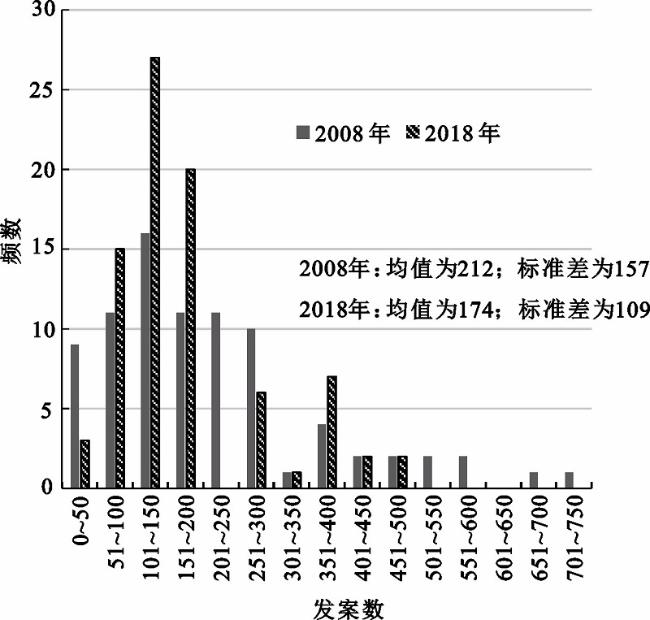
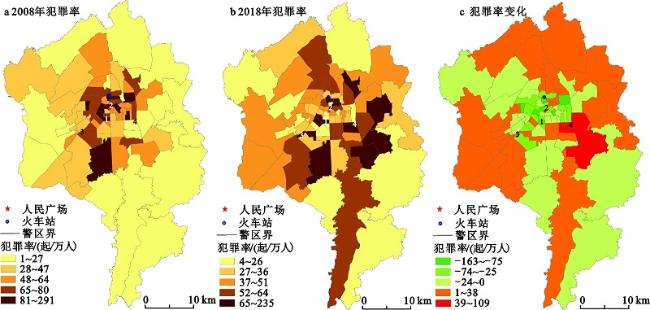
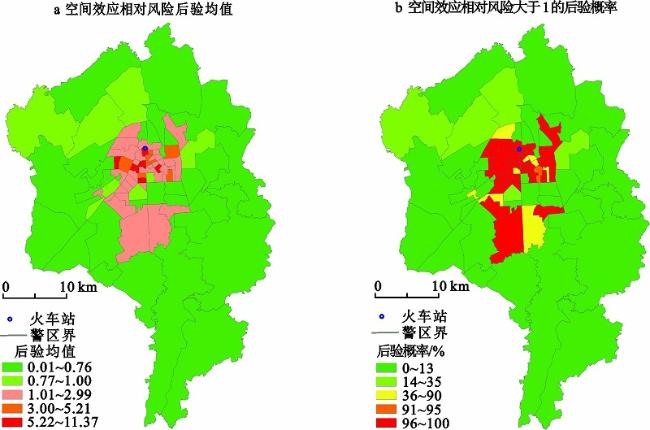
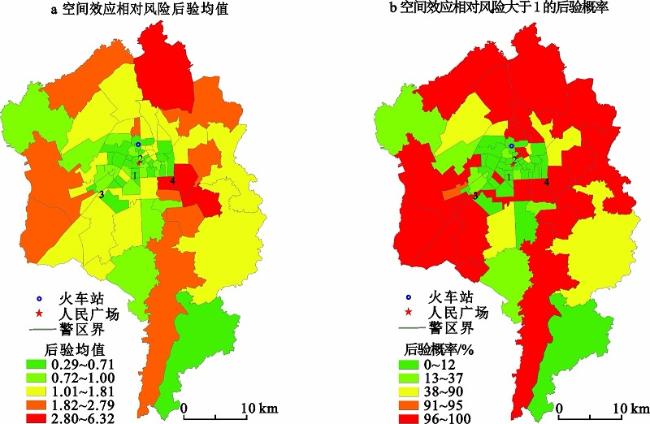
对比分析了2008年和2018年长春市犯罪空间格局的变化特征,进而构建了贝叶斯时空分析模型,整合了犯罪时空格局演化中的固定效应、空间随机效应和时间随机效应,基于R环境中的INLA程序包对模型的各个参数进行了拟合,结合GIS制图,识别出异于总体趋势的犯罪相对风险高值区,并进一步解析了犯罪格局形成和演化的过程和规律。研究发现,犯罪总量在10 a间显著下降,犯罪数量较高的警区数量明显减少。长春市周边地区犯罪率有所提高,而城市中心区域的多数警区则明显下降。贝叶斯时空模型表明,虽然城市犯罪相对风险的平均水平较低,但其总体上却呈现出显著的增加趋势。空间效应的高值区主要集中在城市中心核心区域,特别是传统的商业网点或经济活动较为集中的警区。时间效应的高值区主要集中在城市外围地区,尤其是国家级开发区所在的警区。综合空间效应和时间效应,城市中心区域存在既是空间效应的高值区也是时间效应高值区的时空共同高风险区。贝叶斯方法在数据整合、区域异质性识别以及灵活性方面具有明显的优势,对于犯罪时空格局形成和演化规律的理解和把握上均有所助益。
刘大千 , 宋伟 , 修春亮 . 贝叶斯方法在犯罪时空格局研究上的应用——以长春市为例[J]. 地理科学, 2022 , 42(5) : 820 -830 . DOI: 10.13249/j.cnki.sgs.2022.05.008
This study firstly compares and analyzes the changes in terms of the spatial and temporal patterns of crimes in Changchun between 2008 and 2018. A Bayesian spatio-temporal model integrating the fixed effects, the spatial random effects and the temporal random effects is built and fitted using the R-INLA package in R program. Combining with the maps of different effects of the model which are made used the software of ArcGIS 10.5, we identify the areas with higher relative risks of crime different from the general level or trend and further analyze the process and spatio-temporal patterns of crimes in Changchun. The study shows that the total amount of crimes displayed an obvious decreasing trend and the numbers of police precincts with higher crimes declined apparently. The crime rates showed an obvious increasing trend in the peripheral areas of the city while it went down dramatically in the inner city during the two years. The results of the Bayesian spatio-temporal model shows that the average trend of relative risk of crimes shows a significant increase in spite of the lower basic average relative risk of crimes. The police precincts with higher spatial effects were predominantly concentrated in the core area of the inner city. Especially, the highest spatial effects were mostly located in the precincts with those major traditional commercial area or the intensive economic activities. The higher differential time effects were mainly located in the peripheral areas. Particularly, those precincts where the three major national development zones located possess the higher relative risks represented by the differential time effects. After integrating the spatial and differential time effects, several higher relative risks regions are identified through both spatial and temporal effects within the inner city, deserving more attentions in the work of crime control and countermeasures in the future. Bayesian method show obvious advantages on data integration, area-specific heterogeneity identification and degree of flexibility and can provide more insights into the formation and evolution of the crime pattern.
Key words: crime; Bayesian models; INLA; Changchun
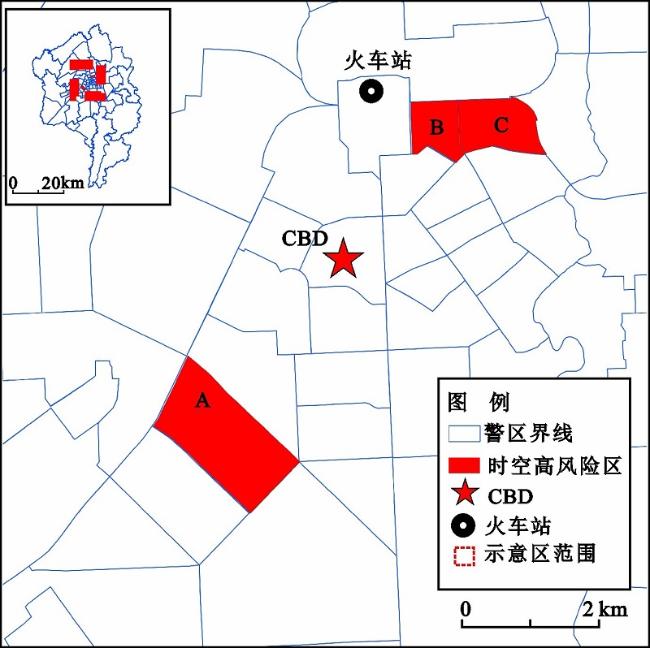
表1 时空共同高风险区参数统计Table 1 Parameters for the regions with higher spatio-temporal relative risks |
| 时空共同高风险区 | 空间效应相对风险 | 时间效应相对风险 | |||||
| 后验均值 | 95%可信区间 | 大于1后验概率 | 后验均值 | 95%可信区间 | 大于1后验概率 | ||
| 注:A、B、C参见图5。 | |||||||
| A | 1.23 | (0.98,1.52) | 95.98% | 1.26 | (1.10,1.45) | 99.95% | |
| B | 3.55 | (2.88,4.30) | 100% | 1.23 | (1.09,1.41) | 99.94% | |
| C | 1.50 | (0.97,2.19) | 96.53% | 1.28 | (0.98,1.64) | 96.24% | |
| [1] |
Chainey S, Tompson L, Uhlig S. The utility of hotspot mapping for predicting spatial patterns of crime[J]. Security Journal, 2008, 21(1): 4-28.
|
| [2] |
徐冲, 柳林, 周素红. 基于临近相似性考虑的犯罪热点密度图预测准确性比较——以DP半岛街头抢劫犯罪为例[J]. 地理科学, 2016, 36(1): 55-62.
Xu Chong, Liu Lin, Zhou Suhong. The comparison of predictive accuracy of crime hotspot density maps with the consideration of the near similarity: A case study of robberies at DP Peninsula. Scientia Geographica Sinica, 2016, 36(1): 55-62.
|
| [3] |
柳林, 纪佳楷, 宋广文, 等. 基于犯罪空间分异和建成环境的公共场所侵财犯罪热点预测[J]. 地球信息科学学报, 2019, 21(11): 1655-1668.
Liu Lin, Ji Jiakai, Song Guangwen et al. Hotspot prediction of public property crime based on spatial differentiation of crime and built environment. Journal of Geo-information Science, 2019, 21(11): 1655-1668.
|
| [4] |
宋广文, 肖露子, 周素红, 等. 居民日常活动对扒窃警情时空格局的影响[J]. 地理学报, 2017, 72(2): 356-367.
Song Guangwen, Xiao Luzi, Zhou Suhong et al. Impact of residents’ routine activities on the spatial-temporal pattern of theft from person. Acta Geographica Sinica, 2017, 72(2): 356-367.
|
| [5] |
陈鹏, 李欣, 胡啸峰, 等. 北京市长安街沿线的扒窃案件高发区分析及防控对策[J]. 地理科学进展, 2015, 34(10): 1250-1258.
Chen Peng, Li Xin, Hu Xiaofeng et al. Clustering pattern analysis and prevention strategies to pickpocketing offence along the Chang’an Street in Beijing. Progress in Geography, 2015, 34(10): 1250-1258.
|
| [6] |
冯健, 黄琳珊, 董颖, 等. 城市犯罪时空特征与机制——以北京城八区财产类犯罪为例[J]. 地理学报, 2012, 67(12): 1645-56.
Feng Jian, Huang Linshan, Dong Ying et al. Research on the spatial-temporal characteristics and mechanism of urban crime: A case study of property crime in Beijing. Acta Geographica Sinica, 2012, 67(12): 1645-56.
|
| [7] |
李钢, 谭然, 王会娟, 等. 中国拐卖儿童犯罪时空格局演变及其影响因素[J]. 人文地理, 2018, 33(2): 26-34.
Li Gang, Tan Ran, Wang Huijuan et al. Spatio-temporal change and influencing factors of trafficking in children in China. Human Geography, 2018, 33(2): 26-34.
|
| [8] |
龙冬平, 柳林, 冯嘉欣, 等. 社区环境对入室盗窃和室外盗窃影响的对比分析——以ZG市ZH半岛为例[J]. 地理学报, 2017, 72(2): 341-355.
Long Dongping, Liu Lin, Feng Jiaxin et al. Comparisons of the community environment effects on burglary and outdoor-theft: A case study of ZH peninsula in ZG City. Acta Geographica Sinica, 2017, 72(2): 341-355.
|
| [9] |
王增利, 刘学军, 陆娟. 入室盗窃多尺度地理因子分析[J]. 地理学报, 2017, 72(2): 329-334.
Wang Zengli, Liu Xuejun, Lu Juan. Multiscale geographic analysis of burglary. Acta Geographica Sinica, 2017, 72(2): 329-334.
|
| [10] |
张延吉, 朱春武, 秦波. 犯罪数量与危害的空间分布及建成环境影响——基于北京市刑事案件的纵向研究[J]. 地理科学进展, 2019, 38(12): 1876-1889.
Zhang Yanji, Zhu Chunwu, Qin Bo. Spatial distribution of crime number and harm and the influence of the built environment: A longitudinal research on criminal cases in Beijing. Progress in Geography, 2019, 38(12): 1876-1889.
|
| [11] |
Newton A, Felson M. Editorial: crime patterns in time and space: The dynamics of crime opportunities in urban areas[J]. Crime Science, 2015, 4(1): 11.
|
| [12] |
Ratcliffe J H. Aoristic signatures and the spatio-temporal analysis of high volume crime patterns[J]. Journal of Quantitative Criminology, 2002, 18(1): 23-43.
|
| [13] |
Ceccato V, Uittenbogaard A C. Space-time dynamics of crime in transport nodes[J]. Annals of the Association of American Geographers, 2014, 104(1): 131-150.
|
| [14] |
Andresen M A, Malleson N. Intra-week spatial-temporal patterns of crime[J]. Crime Science, 2015, 4(1): 12.
|
| [15] |
Baller R D, Anselin L, Messner S F et al. Structural covariates of US county homicide rates: Incorporating spatial effects[J]. Criminology, 2001, 39(3): 561-588.
|
| [16] |
Linning S J. Crime seasonality and the micro-spatial patterns of property crime in Vancouver, BC and Ottawa, ON[J]. Journal of Criminal Justice, 2015, 43(6): 544-555.
|
| [17] |
Valente R. Spatial and temporal patterns of violent crime in a Brazilian state capital: A quantitative analysis focusing on micro places and small units of time[J]. Applied Geography, 2019, 103: 90-97.
|
| [18] |
Haberman C P, Ratcliffe J H. Testing for temporally differentiated relationships among potentially criminogenic places and census block street robbery counts[J]. Criminology, 2015, 53(3): 457-483.
|
| [19] |
Weisburd D, Bushway S, Lum C et al. Trajectories of crime at places: A longitudinal study of street segments in the city of Seattle[J]. Criminology, 2004, 42(2): 283-322.
|
| [20] |
Weisburd D, Morris N A, Groff E R. Hot Spots of Juvenile Crime: A longitudinal study of arrest incidents at street segments in Seattle, Washington[J]. Journal of Quantitative Criminology, 2009, 25(4): 443-467.
|
| [21] |
Andresen M A, Malleson N. Testing the stability of crime patterns: Implications for theory and policy[J]. Journal of Research in Crime and Delinquency, 2011, 48(1): 58-82.
|
| [22] |
Curman A S N, Andresen M A, Brantingham P J. Crime and place: A longitudinal examination of street segment patterns in Vancouver, BC[J]. Journal of Quantitative Criminology, 2015, 31(1): 127-147.
|
| [23] |
Hodgkinson T, Andresen M A, Farrell G. The decline and locational shift of automotive theft: A local level analysis[J]. Journal of Criminal Justice, 2016, 44: 49-57.
|
| [24] |
Groff E R, Weisburd D, Yang S-M. Is it important to examine crime trends at a local “micro” level? A longitudinal analysis of street to street variability in Crime trajectories[J]. Journal of Quantitative Criminology, 2010, 26(1): 7-32.
|
| [25] |
Law J, Quick M, Chan P W. Analyzing hotspots of crime using a Bayesian spatiotemporal modeling approach: A case study of violent crime in the Greater Toronto Area[J]. Geographical Analysis, 2015, 47(1): 1-19.
|
| [26] |
Andresen M A. Testing for similarity in area-based spatial patterns: A nonparametric Monte Carlo approach[J]. Applied Geography, 2009, 29(3): 333-345.
|
| [27] |
Weisburd D. The law of crime concentration and the criminology of place[J]. Criminology, 2015, 53(2): 133-157.
|
| [28] |
Cohen L E, Felson M. Social change and crime rate trends: A routine activity approach[J]. American Sociological Review, 1979, 44(4): 588-608.
|
| [29] |
Johnson S D. A brief history of the analysis of crime concentration[J]. European Journal of Applied Mathematics, 2010, 21(4-5): 349-370.
|
| [30] |
Quick M. Multiscale spatiotemporal patterns of crime: A Bayesian cross-classified multilevel modelling approach[J]. Journal of Geographical Systems, 2019, 21(3): 339-365.
|
| [31] |
Matthews S A, Yang T-C, Hayslett-McCall K L et al. Built environment and property crime in Seattle, 1998-2000: A Bayesian analysis[J]. Environment & Planning A, 2010, 42(6): 1403-1420.
|
| [32] |
Hu T, Zhu X, Duan L et al. Urban crime prediction based on spatio-temporal Bayesian model[J]. PLoS One, 2018, 13(10): e0206215.
|
| [33] |
刘洪强. 基于层次贝叶斯模型的入室盗窃时空模式研究[D]. 武汉: 武汉大学, 2017.
Liu Hongqiang. Research on spatio-temporal patterns of burglaries based on hierarchical Bayesian models—Taking Jianghan district, Wuhan as an example. Wuhan: Wuhan University, 2017.
|
| [34] |
Law J, Quick M, Chan P. Bayesian spatio-temporal modeling for analysing local patterns of crime over time at the small-area level[J]. Journal of Quantitative Criminology, 2014, 30(1): 57-78.
|
| [35] |
浩飞龙. 多中心视角下的长春市城市功能空间结构研究[D]. 长春: 东北师范大学, 2017.
Hao Feilong. Spatial structure of urban functions of Changchun in the perspective of polycentricity. Changchun: Northeast Normal University, 2017.
|
| [36] |
张婧, 李诚固, 周国磊, 等. 长春市公共服务设施用地演变格局与机制[J]. 地理学报, 2015, 70(12): 1939-1952.
Zhang Jing, Li Chenggu, Zhou Guolei et al. The evolution pattern and mechanism of public service facilities lands in Changchun. Acta Geographica Sinica, 2015, 70(12): 1939-1952.
|
| [37] |
Lawson A B. Baysian disease mapping: Hierarchical modeling in spatial epidemiology (3rd ed.) [M]. Boca Raton: FL CSC Press, 2018.
|
| [38] |
Blangiardo M, Cameletti M. Spatial and spatio-temporal Bayesian models with R-INLA [M]. Chichester: John Wiley & Sons, Ltd, 2015.
|
| [39] |
Besag J, York J, Mollié A. Bayesian image restoration, with two applications in spatial statistics[J]. Annals of the Institute of Statistical Mathematics, 1991, 43(1): 1-20.
|
| [40] |
Blangiardo M, Cameletti M, Baio G et al. Spatial and spatio-temporal models with R-INLA[J]. Spatial and Spatio-temporal Epidemiology, 2013, 7: 39-55.
|
| [41] |
Bakka H, Rue H, Fuglstad G-A et al. Spatial modeling with R-INLA: A review[J]. WIREs Computational Statistics, 2018, 10(6): e1443
|
| [42] |
Spiegelhalter D J, Best N G, Carlin B P et al. Bayesian measures of model complexity and fit[J]. Journal of the Royal Statistical Society: Series B (Statistical Methodology), 2002, 64(4): 583-639.
|
| [43] |
王劲峰, 廖一兰, 刘鑫. 空间数据分析教程(第二版)[M]. 北京: 科学出版社, 2019.
Wang Jinfeng, Liao Yilan, Liu Xin. Course on spatial data analysis (2nd edition). Beijing: Science Press, 2019.
|
/
| 〈 |
|
〉 |