



上海市后郊区化空间发育过程及其驱动机制研究
|
王绍博(1990—),男,山东东营人,博士,讲师,研究方向为城市与区域发展。E-mail: wshb@lzu.edu.cn |
收稿日期: 2021-08-25
修回日期: 2021-12-16
网络出版日期: 2023-02-20
基金资助
国家自然科学基金项目(42101160)
甘肃省青年科技基金计划项目(21JR7RA523)
版权
Spatial development process and dynamic mechanism of post-suburbanization in Shanghai
Received date: 2021-08-25
Revised date: 2021-12-16
Online published: 2023-02-20
Supported by
National Natural Science Foudation of China(42101160)
Science-Technology Foundation for Young Scientist of Gansu Province(21JR7RA523)
Copyright
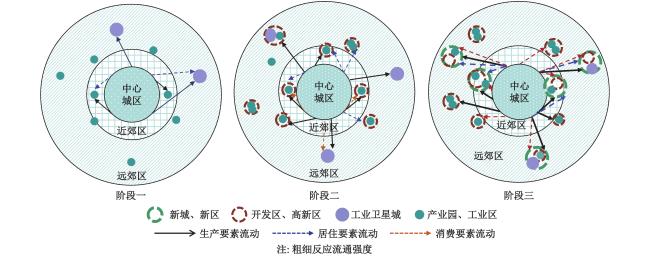
伴随着城市经济向都市区经济的转变,城市空间加速向郊区扩张,远郊区域由此得到快速发展,郊区发展进入新的阶段——后郊区化。研究将上海郊区置于后郊区化图景,用后郊区化的理论审视上海郊区空间增长。研究发现:① 后郊区化是郊区化进程中的一个重要阶段,是多元要素离心分散发展后呈现的新的空间聚落形态。与传统郊区化相比,后郊区化在空间分布、空间利用、空间关系、空间治理模式等方面存在明显的不同表现。② 上海郊区已经进入后郊区化时代,远郊功能空间更加复杂多元,郊区空间更加独立,类城市体形态凸显。③ 后郊区化空间的形成大致经历了3个阶段:1949年后服务工业生产的工业卫星城镇;改革开放后先行先试的开发区;2000年后综合功能空间营造的新城。不同空间载体重塑着郊区景观格局,推动着新空间聚落形态的形成。④ 开发导向下的后郊区化空间建设,是地方政府新一轮郊区大规模开发建设保持自身增长的资本积累策略,其形成是地方政府主导下增长联盟共同推动的结果。政府企业化行为;资本的空间修补;居民的空间生产参与,均对中国后郊区化空间的形成产生明显的推动作用。
王绍博 , 罗小龙 , 陆建城 , 徐坤瑶 , 毛锦凰 . 上海市后郊区化空间发育过程及其驱动机制研究[J]. 地理科学, 2023 , 43(2) : 219 -229 . DOI: 10.13249/j.cnki.sgs.2023.02.004
With the transformation of urban economy to metropolitan economy, urban space is accelerating to expand to suburbs, and the fringe areas have developed rapidly. The development of suburbs presents a new stage characteristic—post-suburbanization. This article puts Shanghai’s suburbs in the post-suburbanization landscape, and uses the post-suburbanization theory to examine the spatial growth of Shanghai's suburbs. Results found: 1) Post-suburbanization is an important stage in the process of suburbanization, which is a new spatial settlement form after the centrifugal and decentralized development of multiple elements. Compared with traditional suburbanization, post-suburbanization space is obviously different in spatial distribution, spatial utilization, spatial relationship, spatial governance mode, etc. 2) The suburbs of Shanghai have entered a new era of post-suburbanization, with more complex and diversified functional spaces in the outer suburbs, more independent suburban spaces, and present urban-like forms. 3) The development of post-suburbanization space has gone through three stages: industrial satellite towns serving industrial production after the founding of the People's Republic of China; development zones for reforming experimental fields after the opening up; and new towns created by comprehensive functional spaces after 2000. Different spatial carriers reshape the elements of suburban landscape and promote the formation of new spatial settlement form. 4) The development-oriented post-suburbanization construction is a new round of large-scale suburban development and construction of local governments to maintain their own growth accumulation strategy, and its formation is the result of the growth alliance under the leadership of the local government.Government's entrepreneurial behaviors; space repair of capital; The participation of residents in space production has obviously promoted the formation of post-suburbanization in China.
表1 郊区化与后郊区化的对比Table 1 Comparison of suburbanization and post-suburbanization |
| 维度 | 郊区化 | 后郊区化 |
| 空间利用 | 生产、居住空间简单拼合的卧城 | 出现空间混合利用度更高甚至不和谐的空间利用模式,功能空间更加复合 |
| 空间变化 | 集中于中心城区的外围区域或者近郊区 | 远郊区空间;城市边缘地带 |
| 空间结构 | 中心城区与郊区呈现简单的城乡二元结构;“核心−边缘”空间结构 | 多中心−多轴−网络化空间结构;郊区和中心城区相互补充的复杂系统关系 |
| 空间治理 | 行政区划治理模式 | 没有直接的行政管辖主体;影子政府影响 |
| 其它方面 | 传统经济;居民构成相对简单 | 新经济特点;社区居民更加复杂,混住性特点 |
表2 中西后郊区化的不同特点Table 2 Different characteristics of post-suburbanization between China and west countries |
| 维度 | 中国 | 西方部分国家 |
| 空间利用 | 生产功能属性依然稳固 | 已经经历去工业化下服务行业的兴起 |
| 社会空间 | 当地居民、外来务工群体、外商等多元混住 | 中产阶级为主 |
| 与中心城区关系 | 合并式空间增长 | 背离式空间增长 |
| 空间治理 | 政府主导下多方力量形成的增长联盟 | 市场、社会作用相对较大 |
| [1] |
Wu F, Phelps N A. (Post) Suburban development and state entrepreneurialism in Beijing's outer suburbs[J]. Environment and Planning A, 2011, 43(2): 410-430.
|
| [2] |
沈洁. 中国城市郊区的增长[M]. 北京: 商务印书馆, 2016.
Shen Jie. Growth in the suburbs of Chinese cities. Beijing: The Commercial Press, 2016.
|
| [3] |
Teaford J C. Post-suburbia: Government and politics in the edge cities[M]. Baltimore: Johns Hopkins University Press, 1997.
|
| [4] |
Lang R, Edgeless cities: Exploring the elusive metropolis[M]. Washington D C: Brookings Institution Press, 2003.
|
| [5] |
Charmes E, Keil R. The politics of post-suburban densiflcation in Canada and France[J]. International Journal of Urban and Regional Research, 2015, 39(3): 581-602.
|
| [6] |
Peter H. The bootstrap and edgeworth expansion[M]. New York: Springer-Verlag, 1992.
|
| [7] |
黄亚平. 城市空间理论与空间分析
M]. 南京: 东南大学出版社, 2002. [Huang Yaping. Urban space theory and spatial analysis. Nanjing: Southeast University Press, 2002.
|
| [8] |
陈顺清. 城市增长与土地增值[M]. 北京: 科学出版社, 2000.
Chen Shunqing. Urban growth and land appreciation. Beijing: Science Press, 2000.
|
| [9] |
Nick P, Wu F L. International perspectives on suburbanization: A post-suburban world[M]. UK, Basingstroke: Palgrave Macmillan, 2011.
|
| [10] |
吴缚龙, 沈洁. 中国城市的郊区开发和治理[J]. 国际城市规划, 2015, 30(6): 27-33.
Wu Fulong, Shen Jie. Suburban development and governance in China. Urban Planning International, 2015, 30(6): 27-33.
|
| [11] |
Carr C, Mcdonough E. Intergrative planning of post-suburban growth in the Glatt Valley (Switzerland)[J]. Raumforschungund Raumodnung-Spatial Research and Planning, 2016, 76(2): 1-14.
|
| [12] |
曹玉红, 宋艳卿, 朱胜清, 等. 基于点状数据的上海都市型工业空间格局研究[J]. 地理研究, 2015, 34(9): 1708-1720.
Cao Yuhong, Song Yanqing, Zhu Shengqing et al. The spatial pattern of Shanghai urban industry based on point data. Geographical Research, 2015, 34(9): 1708-1720.
|
| [13] |
Phelps N A, Wood A M. The new post-suburban Politics?[J]. Urban Studies, 2011, 48(12): 2591-2610.
|
| [14] |
冯健, 周一星. 转型期北京社会空间分异重构[J]. 地理学报, 2008, 63(8): 829-844.
Feng Jian, Zhou Yixing. Restructuring of socio-spatial differentiation in Beijing in the transition period. Acta Geographica Sinica, 2008, 63(8): 829-844.
|
| [15] |
胡秀媚, 李志刚, 冯建. 后郊区化?——政府视角下广州萝岗的空间生产与转型[J]. 现代城市研究, 2016(5): 72-79.
Hu Xiumei, Li Zhigang, Feng Jian. Post-suburbanization?—The production and transformation of space of Luogang, Guangzhou: A government perspective. Modern Urban Research, 2016(5): 72-79.
|
| [16] |
Guo X. Land expropriation and rural conflicts in China[J]. China Quarterly, 2001, 166: 422-439.
|
| [17] |
朱琳, 黎磊, 刘素, 等. 大城市郊区村域土地利用功能演变及其对乡村振兴的启示——以成都市江家堰村为例[J]. 地理研究, 2019, 38(3): 535-549.
Zhu Lin, Li Lei, Liu Su et al. The evolution of village land-use function in the metropolitan suburbs and its inspiration to rural revitalization: A case study of Jiangjiayan Village in Chengdu City. Geographical Research, 2019, 38(3): 535-549.
|
| [18] |
邹晖, 罗小龙, 唐蜜, 等. 从住房建设透视巨型城市多中心发展——以北京为例[J]. 经济地理, 2019, 39(9): 65-70.
Zou Hui, Luo Xiaolong, Tang Mi et al. Revealing polycentric development of mega-city from housing construction: A case study of Beijing. Economic Geography, 2019, 39(9): 65-70.
|
| [19] |
Hall M, Lee B. How diverse are suburbs?[J]. Urban Studies, 2010, 47(1): 3-28.
|
| [20] |
周之聪. 中国城市后郊区化特征与地方政府作用研究——以南京市为例[J]. 西部人居环境学刊, 2015, 30(3): 61-66.
Zhou Zhicong. The features of post-suburbanization in China and the role of local government— Taking Nanjing for example. Journal of Human Settlements in West China, 2015, 30(3): 61-66.
|
| [21] |
He S, Wu F. China's emerging neoliberal urbanism: Perspectives from urban development[J]. Antipode, 2009, 41(2): 282-304.
|
| [22] |
Hsing Y. The great urban transformation: Politics of land and poverty in China[M]. New York: Oxford University Press, 2010.
|
| [23] |
Cox K. Scales of dependence, spaces of engagement and the politics of scale, or looking for local politics[J]. Political Geography, 1998, 17(1): 1-23.
|
| [24] |
Wang Shaobo, Luo Xiaolong. The evolution of government behaviors and urban expansion in Shanghai[J]. Land Use Policy,2022, 114: 105973.
|
| [25] |
Jenny M. Auckland: Rescaled governance and post-suburban politics[J]. Cities, 2017, 64(4): 79-87.
|
| [26] |
Delik H, Tommy F. Beyond property: Industrial estates and post-suburban transformation in Jakarta metropolitan region[J]. Cities, 2012, 29(1): 40-48.
|
| [27] |
Kiran A F, Thomas I E, Bikash B et al. Prevalence of emergency department patients presenting with heroin or prescription opioid abuse residing in urban, suburban, and rural Jefferson county[J]. The Journal of Emergency Medicine, 2018, 55(5): 605-611.
|
| [28] |
Wang S B, Luo X L. The industrial composition of edge cities and downtowns: the new urban reality[J]. Land Use Policy, 2022, 114: 105973.
|
| [29] |
Stefano M, Luca M. Unnatural sprawl: Reconsidering public responsibility for suburban development in Italy, and the desirability and possibility of changing the rules of the game[J]. Land Use Policy, 2019, 86: 104-112.
|
| [30] |
孙彪, 杨山. 长三角地区城市创新投入要素的经济溢出效应及趋同格局[J]. 地理科学进展, 2021, 40(1): 147-160.
Sun Biao, Yang Shan. Economic spillover effects and convergence patterns of urban innovation input features in the Yangtze River Delta region. Progress in Geography, 2021, 40(1): 147-160.
|
| [31] |
佟伟铭, 张平宇, 何欢. 基于社区理论大城市郊区化过程中失地农民社区的城镇化问题分析——以长春市兴华园社区为例[J]. 地理科学, 2019, 39(10): 1537-1545.
Tong Weiming, Zhang Pingyu, He Huan. Urbanization issues of landless farmers' community in the suburban of metropolis based on community theory: A case study of Xinghuayuan community in Changchun. Scientia Geographica Sinica, 2019, 39(10): 1537-1545.
|
| [32] |
谢夏成. 上海地区快递物流节点的空间格局分析[D]. 上海: 上海师范大学, 2015.
Xie Xiacheng. Analysis of the spatial pattern of express logistics nodes in Shanghai. Shanghai: Shanghai Normal University, 2015.
|
| [33] |
高向东, 吴文钰. 20世纪90年代上海市人口分布变动及模拟[J]. 地理学报, 2005, 62(4): 637-644.
Gao Xiangdong, Wu Wenyu. Population redistribution and modelling of Shanghai city in the 1990s. Acta Geographica Sinica, 2005, 62(4): 637-644.
|
| [34] |
苏夏, 罗小龙, 王绍博. 郊区化进程中城市功能空间演变——以上海为例[J]. 中国名城, 2021, 35(5): 8-13.
Su Xia, Luo Xiaolong, Wang Shaobo. Evolution of urban functional space in the process of suburbanization: A case study of Shanghai. China Ancient City, 2021, 35(5): 8-13.
|
/
| 〈 |
|
〉 |