



湘西地区交通可达性对旅游环境系统韧性的影响及空间溢出效应
|
麻学锋(1970—),男,苗族,湖南凤凰人,博士,教授,硕导,主要从事旅游经济研究。E-mail: maxuefeng90@163.com |
收稿日期: 2022-04-01
修回日期: 2022-07-06
录用日期: 2022-11-28
网络出版日期: 2023-02-20
基金资助
国家自然科学基金项目(42171235)
国家自然科学基金项目(41771164)
湖南省自然科学基金项目(2019JJ40143)
湖南省教育厅科学研究重点项目(21A0378)
版权
Impact of traffic accessibility on the resilience of tourism environment system and spatial spillover effects in Xiangxi Area
Received date: 2022-04-01
Revised date: 2022-07-06
Accepted date: 2022-11-28
Online published: 2023-02-20
Supported by
National Natural Science Foundation of China(42171235)
National Natural Science Foundation of China(41771164)
Natural Science Foundation of Hunan Province(2019JJ40143)
Key Scientific Research Projects of Hunan Education Department(21A0378)
Copyright
运用集对分析、加权平均旅行时间和综合评价分析等方法,研究湘西地区2000—2020年旅游环境系统韧性和交通可达性演化特征,并利用空间杜宾模型揭示交通可达性对旅游环境系统韧性的空间溢出效应。结果表明:① 旅游环境系统韧性均值随着时间的推移呈现显著上升的态势,空间分布上南部变化相对稳定,而中部和北部变动明显;基于旅游环境子系统韧性的测算结果,将各区县划分为高高高、高低低、高低高、低高高、低低高、低低低6种类型。② 交通可达性呈现显著的“核心−边缘”空间分布结构,形成吉首−凤凰−鹤城−芷江−洪江−中方为可达性高值区的相对优势带。③ 交通可达性提升通过直接作用旅游经济和社会环境系统韧性,并对旅游经济环境系统韧性产生正向空间溢出,进而促进整体旅游环境系统韧性提升。
麻学锋 , 谭佳欣 . 湘西地区交通可达性对旅游环境系统韧性的影响及空间溢出效应[J]. 地理科学, 2023 , 43(2) : 291 -300 . DOI: 10.13249/j.cnki.sgs.2023.02.011
This study firstly constructs a conceptual model of tourism environmental system resilience and a theoretical framework of the influence of traffic accessibility on tourism environmental system resilience. Then, we take 24 county-level units in Xiangxi Area as the study area, introduce set-pair analysis method, weighted average travel time and comprehensive evaluation analysis to research tourism environmental system resilience (TESR). In addition, this research adopts spatial panel Durbin model to examine the spatial spillover effect of traffic accessibility on the resilience of tourism environment system. It is revealed by the results that: 1) The mean value of TESR in Xiangxi Area has increased from 0.407 in 2000 to 0.624 in 2020, and the spatial distribution was relatively stable in the south, while the central and northern parts changed significantly. Based on the results of TESR subsystem measurement in Xiangxi Area, the districts and counties were classified into six types: high-high, high-low, high-low, low-high, low-low, low-low, and low-low; 2) The traffic accessibility shows the characteristic of decreasing from the central part to the surrounding area, forming the relative advantageous zone of Jishou-Fenghuang-Hecheng-Zhijiang-Hongjiang as the high value area of accessibility, and the development trend of regional traffic integration is prominent; 3) The traffic accessibility improves the tourism economic system resilience and tourism social system resilience, which in turn promotes the improvement of TESR.
表1 旅游环境系统韧性评价指标及权重Table 1 Evaluation index and weight of tourism environment system resilience |
| 目标层 | 指标层 | 指标描述 | 指标性质 | 权重 |
| 旅游经济子系统 | 旅游收入占GDP比重X1 | 反映区域经济对旅游业的依赖性 | + | 0.063 |
| 旅游经济增长弹性系数X2 | 反映旅游业发展对经济增长的弹性 | + | 0.069 | |
| 人均GDP增长率X3 | 反映旅游地经济增长情况 | + | 0.050 | |
| 旅游人次增长率X4 | 反映旅游地市场规模扩张情况 | + | 0.055 | |
| A级旅游景区数量X5 | 反映旅游地发展潜力 | + | 0.069 | |
| 旅游生态子系统 | 森林覆盖率X6 | 反映旅游地生态平衡状况 | + | 0.044 |
| 人均公园绿地面积X7 | 反映旅游地人居环境情况 | + | 0.046 | |
| 建成区绿化覆盖率X8 | 反映旅游地生态绿化情况 | + | 0.046 | |
| 自然保护区个数X9 | 反映旅游地生态保护状况 | + | 0.047 | |
| 空气质量达标率X10 | 反映旅游地生态质量 | + | 0.050 | |
| 城镇生活污水处理率X11 | 反映旅游地污水处理情况 | + | 0.045 | |
| 旅游社会子系统 | 人口密度X12 | 反映人口活动强度 | + | 0.045 |
| 城镇化率X13 | 反映旅游地综合发展情况 | + | 0.047 | |
| 每1000人口医院、卫生院床位数量X14 | 反映旅游地医疗发展水平 | + | 0.045 | |
| 每1万人口社会福利院床位数X15 | 反映旅游地社会福利水平 | + | 0.049 | |
| 每10万人口义务在校学生增长率X16 | 反映旅游地教育覆盖率增长情况 | + | 0.049 | |
| 城乡可支配收入比增长率X17 | 反映城乡差距缩小情况 | − | 0.045 | |
| 城镇居民医疗保险覆盖率增长率X18 | 反映民生保障情况 | + | 0.045 | |
| 财政支出增长率X19 | 反映政府对社会发展的支持力度 | + | 0.044 | |
| 贫困发生率X20 | 反映旅游地扶贫情况 | − | 0.047 |
表2 空间地物时间成本Table 2 Time cost of different types of transportation modes and land use |
| 年份 | 空间对象 | 公路 | 铁路 | 默认值 | |||||||
| 高速公路 | 国道 | 省道 | 县道 | 乡道 | 高速铁路 | 普通铁路 | 非道路区域 | ||||
| 注:—表示该年份无此类交通道路。 | |||||||||||
| 2000 | 速度/(km/h) | — | 80 | 60 | 40 | 20 | — | 60 | 5 | ||
| 时间成本/min | — | 0.75 | 1.00 | 1.50 | 3.00 | — | 1.00 | 12 | |||
| 2010 | 速度/(km/h) | 100 | 80 | 60 | 40 | 30 | — | 100 | 5 | ||
| 时间成本/min | 0.60 | 0.75 | 1.00 | 1.50 | 2.00 | — | 0.60 | 12 | |||
| 2020 | 速度/(km/h) | 100 | 80 | 60 | 40 | 30 | 300 | 120 | 5 | ||
| 时间成本/min | 0.60 | 0.75 | 1.00 | 1.50 | 2.00 | 0.20 | 0.50 | 12 | |||
表3 对外交通设施影响度赋值Table 3 Weighted value of the impact of main transport infrastructure |
| 大类 | 赋值标准 | 赋值 | 大类 | 赋值标准 | 赋值 | |
| 注:La为行政中心与铁路客运站的距离;Lb为行政中心与高速出口的距离;Lc为行政中心与机场的距离。 | ||||||
| 铁路 | 有铁路客运站 | 1.5 | 公路 | 有国道 | 1.0 | |
| La<30 km | 1.0 | 其他 | 0 | |||
| 30 km≤La≤60 km | 0.5 | 机场 | 有机场 | 1.5 | ||
| La>60 km | 0 | Lc<30 km | 1.0 | |||
| 高速公路 | 有高速出口 | 1.5 | 30 km≤Lc≤60 km | 0.5 | ||
| Lb<10 km | 1.0 | Lc>60 km | 0 | |||
| 10 km≤Lb≤30 km | 0.5 | |||||
| Lb>30 km | 0 | |||||
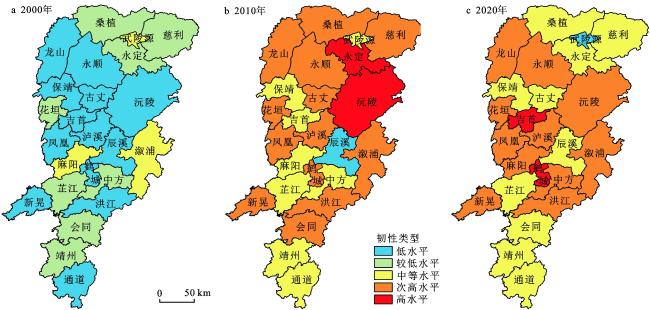
图2 2000—2020年湘西地区旅游环境系统韧性空间分布湘西土家族苗族自治州(龙山、永顺、保靖、花垣、凤凰、泸溪、古丈分别为龙山县、永顺县、保靖县、花垣县、凤凰县、泸溪县、古丈县;吉首为吉首市);张家界市(永定为永定区;武陵源为武陵源区;慈利为慈利县;桑植为桑植县);怀化市(鹤城为鹤城区;中方、沅陵、辰溪、溆浦、 会同、麻阳、新晃、芷江、靖州、通道分别为中方县、沅陵县、辰溪县、溆浦县、会同县、麻阳苗族自治县、新晃侗族自治县、 芷江侗族自治县、靖州苗族侗族自治县、通道侗族自治县;洪江为洪江市) Fig. 2 Spatial distribution of the resilience of tourism environment system in Xiangxi Area from 2000 to 2020 |
表4 空间计量模型检验Table 4 Spatial econometric model test |
| 统计量 | TESR | TNSR | TLSR | TSSR |
| 注:***、**、*分别表示0.01、0.05、0.1显著性水平;TESR为旅游环境系统韧性;TNSR为旅游经济环境系统韧性;TLSR为旅游生态环境系统韧性;TSSR为旅游社会环境系统韧性。 | ||||
| LM-lag | 12.248** | 16.402** | 16.149*** | 15.517** |
| LM-error | 21.115** | 24.279** | 21.176*** | 19.166** |
| Robust LM-lag | 27.248** | 32.967* | 28.149* | 27.131** |
| Robust LM-error | 27.359** | 28.844* | 24.176* | 33.781** |
| Hausman | 57.10*** | 29.06*** | 51.29*** | 127.07*** |
| Wald-lag | 78.02** | 78.61* | 75.71*** | 76.01*** |
| Wald-error | 69.51*** | 78.03* | 65.74*** | 72.37*** |
| LR-error | 85.94** | 88.76* | 92.44*** | 85.48** |
| LR-lag | 65.33*** | 78.89* | 63.26*** | 76.76** |
表5 空间面板杜宾模型估计结果Table 5 Estimation results of SPDM |
| 空间权重矩阵 | 变量 | 回归系数 | 空间滞后项系数 | Log-likehood | R2 |
| 注:***、**、*分别表示0.01、0.05、0.1显著性水平;W1为地理距离空间权重矩阵;W3为地理与经济距离的嵌套权重矩阵;变量解释见表4。 | |||||
| W1 | TESR | 0.198** | 0.484** | 77.207 | 0.378 |
| TNSR | 0.686** | 1.387** | 138.710 | 0.328 | |
| TLSR | −0.402*** | 0.592** | 131.459 | 0.522 | |
| TSSR | 0.189 | 0.484 | 139.672 | 0.664 | |
| W3 | TESR | 0.286*** | 2.425*** | 132.415 | 0.628 |
| TNSR | 0.872*** | 4.233** | 133.698 | 0.453 | |
| TLSR | −0.278* | 2.573** | 135.832 | 0.522 | |
| TSSR | 0.202 | 0.587 | 137.659 | 0.576 | |
表6 空间面板杜宾效应偏微分估计结果Table 6 Results of spatial spillover partial differential estimation |
| 变量 | W1 | W3 | |||||
| 直接效应 | 间接效应 | 总效应 | 直接效应 | 间接效应 | 总效应 | ||
| 注:***、**、*分别表示0.01、0.05、0.1显著性水平;W1为地理距离空间权重矩阵;W3为地理与经济距离的嵌套权重矩阵;变量解释见表4。 | |||||||
| TESR | 0.141* | 0.385* | 0.526* | 0.172** | 1.369* | 1.541* | |
| TNSR | 0.368* | 0.244** | 0.612* | 0.360* | 1.075* | 1.435* | |
| TLSR | 0.002 | 2.466 | 2.468 | 0.004 | −0.149 | −0.145 | |
| TSSR | 0.021* | 0.306 | 0.327* | 0.131*** | 0.072 | 0.203** | |
| [1] |
United Nations. Transforming our world: The 2030 agenda for sustainable development[R]. New York: United Nations, 2014: 1-41.
|
| [2] |
李一曼, 修春亮, 孔翔. 浙江陆路交通对区域旅游空间结构及发展的影响研究[J]. 地理科学, 2018, 38(12): 2066-2073.
Li Yiman, Xiu Chunliang, Kong Xiang. Influence of land transportation network evolution on spatial structure and development of regional tourism in Zhejiang Province. Scientia Geographica Sinica, 2018, 38(12): 2066-2073.
|
| [3] |
杨秀平, 贾云婷, 翁钢民, 等. 城市旅游环境系统韧性的系统动力学研究——以兰州市为例[J]. 旅游科学, 2020, 34(2): 23-40.
Yang Xiuping, Jia Yunting, Weng Gangmin et al. A study on system dynamics of the resilience of urban tourism environment system: A case study of Lanzhou City. Tourism Science, 2020, 34(2): 23-40.
|
| [4] |
Vincent M. Tourism, environment and development: Values, sustainability and stewardship[J]. Tourism Management, 1991, 12(2): 112-118.
|
| [5] |
朱媛媛, 汪紫薇, 顾江, 等. 基于“乡土−生态”系统韧性的红色旅游资源利用空间格局优化研究——以大别山革命老区为例[J]. 自然资源学报, 2021, 36(7): 1700-1717.
Zhu Yuanyuan, Wang Ziwei, Gu Jiang et al. The spatial optimization of red tourism resources utilization based on the resilience of "ruralism-ecology" system: A case study of Dabie Mountains Old Revolutionary Base Area. Journal of Natural Resources, 2021, 36(7): 1700-1717.
|
| [6] |
杨秀平, 贾云婷, 张大成, 等. 旅游环境系统研究进展与展望[J]. 生态科学, 2020, 39(3): 221-230.
Yang Xiuping, Jia Yunting, Zhang Dacheng et al. Research progress and prospect of tourism environment system. Ecological Science, 2020, 39(3): 221-230.
|
| [7] |
Romao Joao. Tourism, smart specialisation, growth, and resilience[J]. Annals of Tourism Research, 2020, 84: 102995.
|
| [8] |
Yang P, Zhang D, Liu L et al. Development trajectory for the temporal and spatial evolution of the resilience of regional tourism environmental systems in 14 cities of Gansu Province, China[J]. Environmental Science and Pollution Research, 2021, 28(46): 65094-65115.
|
| [9] |
郭向阳, 穆学青, 丁正山, 等. “交旅”融合下旅游效率与高速交通协调格局研究——以长三角41市为例[J]. 地理研究, 2021, 40(4): 1042-1063.
Guo Xiangyang, Mu Xueqing, Ding Zhengshan et al. The coordination pattern of tourism efficiency and high-speed transportation: A case study of 41 cities in the Yangtze River Delta. Geographical Research, 2021, 40(4): 1042-1063.
|
| [10] |
吴磊, 焦华富, 叶雷. 皖南国际文化旅游示范区旅游经济与交通耦合协调发展的时空特征[J]. 地理科学, 2019, 39(11): 1822-1829.
Wu Lei, Jiao Huafu, Ye Lei. Spatio-temporal characteristics of coordinated development between tourism economy and transportation: A case of international culture and tourism demonstration area in South Anhui Province. Scientia Geographica Sinica, 2019, 39(11): 1822-1829.
|
| [11] |
王兆峰, 李丹. 基于交通网络的区域旅游空间合作效率评价与差异变化分析——以湘西地区为例[J]. 地理科学, 2016, 36(11): 1697-1705.
Wang Zhaofeng, Li Dan. Regional tourism space cooperation efficiency evaluation and difference change based on traffic network: A case of the Western Hunan, China. Scientia Geographica Sinica, 2016, 36(11): 1697-1705.
|
| [12] |
Ibanescu B C, Eva M, Gheorghiu A. Questioning the role of tourism as an engine for resilience: The role of accessibility and economic performance[J]. Sustainability, 2020, 21(14): 5527.
|
| [13] |
Cui W J, Chen J, Xue T et al. The economic resilience cycle evolution and spatial-temporal difference of tourism industry in Guangdong-Hong Kong-Macao Greater Bay Area from 2000 to 2019[J]. Sustainability, 2021, 13(21): 12092.
|
| [14] |
Dorta P, Díaz J, López A et al. Tourism, transport and climate change: The carbon footprint of international air traffic on Islands[J]. Sustainability, 2021, 13(4): 1795.
|
| [15] |
吕天宇, 曾晨. 交通网络空间互动视角下生态足迹驱动机制[J]. 生态学报, 2022, 42(4): 1340-1353.
Lyu Tianyu, Zeng Chen. Driving mechanism of ecological footprint from the perspective of spatial interaction of transportation network. Acta Ecologica Sinica, 2022, 42(4): 1340-1353.
|
| [16] |
国家统计局. 中国县域统计年鉴 (2001—2020)[M]. 北京: 中国统计出版社: 2001—2020.
National Bureau of Statistics. China county statistical yearbook (2001-2020). Beijing: China Statistics Press, 2001-2020.
|
| [17] |
Holling S. Resilience and stability of ecological systems[J]. Annual Review of Ecology and Systematics, 1973, 4(1): 1-23.
|
| [18] |
Wang T, Yang P, Chen D et al. Bibliometric analysis and literature review of tourism destination resilience research[J]. International Journal of Environment Research and Public Health, 2922, 19(9): 1-19.
|
| [19] |
麻学锋, 谭佳欣, 黄俊. 区域旅游产业集聚过程及其影响因素研究——以湘西地区为例[J]. 旅游学刊, 2021, 36(9): 13-27.
Ma Xuefeng, Tan Jiaxin, Huang Jun. Study on the agglomeration process and influencing factors of regional tourism industry: A case of the Western Hunan. Tourism Tribune, 2021, 36(9): 13-27.
|
| [20] |
田雅娟, 刘强. 中国旅游业发展对农村贫困减缓的效应及其影响因素[J]. 旅游学刊, 2020, 35(6): 40-49.
Tian Yajuan, Liu Qiang. Effect of China's tourism industry development and influencing factors on reducing rural poverty. Tourism Tribune, 2020, 35(6): 40-49.
|
| [21] |
葛林芳, 吴云勇. 城镇化阻断贫困代际传递了吗?——来自CFPS2018的证据[J]. 北京社会科学, 2020(11): 12-25.
Ge Linfang, Wu Yunyong. Has urbanization blocked the intergenerational transmission of poverty?. Social Sciences of Beijing, 2020(11): 12-25.
|
| [22] |
麻学锋, 谭佳欣. 旅游城镇化与社会治理协同发展时空格局及趋势预测——以张家界为例[J]. 吉首大学学报(社会科学版), 2022, 43(2): 96-106.
Ma Xuefeng, Tan Jiaxin. Spatio-temporal pattern and trend prediction of coordinated development of tourism urbanization and social governance: A case study of Zhangjiajie. Journal of Jishou University (Social Sciences), 2022, 43(2): 96-106.
|
| [23] |
董丽晶, 苏飞, 温玉卿, 等. 阜新市收缩城市经济系统弹性演变趋势与障碍因素分析[J]. 地理科学, 2020, 40(7): 1142-1149.
Dong Lijing, Su Fei, Wen Yuqing et al. Obstacle factors and evolution of urban economic resilience of Fuxin shrinking city and its obstacle factors. Scientia Geographica Sinica, 2020, 40(7): 1142-1149.
|
| [24] |
Gutiérrez J. Location, economic potential and daily accessibility: An analysis of the accessibility impact of the high-speed line Madrid-Barcelona-French Border[J]. Journal of Transport Geography, 2001, 9(1): 229-242.
|
| [25] |
孙宏日, 刘艳军, 周国磊. 东北地区交通优势度演变格局及影响机制[J]. 地理学报, 2021, 76(2): 444-458.
Sun Hongri, Liu Yanjun, Zhou Guolei. The spatiotemporal differentiation and mechanisms of traffic dominance in Northeast China. Acta Geographica Sinica, 2021, 76(2): 444-458.
|
| [26] |
焦胜, 张冰洁, 韩宗伟. 近70年湘西地区陆路可达性及经济联系时空演变[J]. 经济地理, 2020, 40(6): 137-146.
Jiao Sheng, Zhang Bingjie, Han Zongwei. Spatial-temporal evolution of land transportation accessibility and economic contact in Xiangxi Area in recent 70 years. Economic Geography, 2020, 40(6): 137-146.
|
| [27] |
邵帅, 李欣, 曹建华, 等. 中国雾霾污染治理的经济政策选择——基于空间溢出效应的视角[J]. 经济研究, 2016, 51(9): 73-88.
Shao Shuai, Li Xin, Cao Jianhua et al. China's economic policy choices for governing smog pollution based on spatial spillover effects. Economic Research Journal, 2016, 51(9): 73-88.
|
| [28] |
童昀, 刘海猛, 马勇, 等. 中国旅游经济对城市绿色发展的影响及空间溢出效应[J]. 地理学报, 2021, 76(10): 2504-2521.
Tong Yun, Liu Haimeng, Ma Yong et al. The influence and spatial spillover effects of tourism economy on urban green development in China. Acta Geographica Sinica, 2021, 76(10): 2504-2521.
|
| [29] |
张家界统计局. 张家界统计年鉴[M]. 北京: 中国统计出版社, 2020.
Zhangjiajie Statistical Bureau. Zhangjiajie statistical yearbook. Beijing: China Statistics Press, 2020.
|
| [30] |
贾文通, 黄震方, 刘俊, 等. 高铁对区域旅游“时空压缩”效应的测度与分析——以长江经济带为例[J]. 地理研究, 2021, 40(6): 1785-1802.
Jia Wentong, Huang Zhenfang, Liu Jun et al. Measuring and analyzing the time-space compression of high-speed rail on regional tourism: A case study of Yangtze River Economic Belt, China. Geographical Research, 2021, 40(6): 1785-1802.
|
| [31] |
Lesage P, Pace K. Introduce to spatial econometrics[M]. Boca Raton: Taylor & Francis, 2009.
|
| [32] |
方叶林, 苏雪晴, 黄震方, 等. 城市韧性对旅游经济的空间溢出效应研究——以长三角城市群为例[J]. 地理科学进展, 2022, 41(2): 214-223.
Fang Yelin, Su Xueqing, Huang Zhenfang et al. Spatial spillover effect of urban resilience on tourism economy: A case study of the Yangtze River Delta Urban Agglomeration. Progress in Geography, 2022, 41(2): 214-223.
|
/
| 〈 |
|
〉 |