



北京市北部空气花粉类型及浓度变化特征研究
|
孙爱芝(1979—),女,山东济南人,博士,副教授,主要从事孢粉学与环境变化研究。E-mail: aizhisun@ucas.ac.cn |
收稿日期: 2022-01-05
修回日期: 2022-05-12
网络出版日期: 2023-04-20
基金资助
北京市自然科学基金项目(8212038)
科技部科技基础资源调查专项(2022FY100103)
高校基本科研业务费专项资金资助
版权
Characteristics of airborne pollen types and concentrations in the north of Beijing, China
Received date: 2022-01-05
Revised date: 2022-05-12
Online published: 2023-04-20
Supported by
Beijing Natural Science Foundation(8212038)
Science & Technology Fundamental Resources Investigation Program(2022FY100103)
Fundamental Research Funds for the Central Universities
Copyright
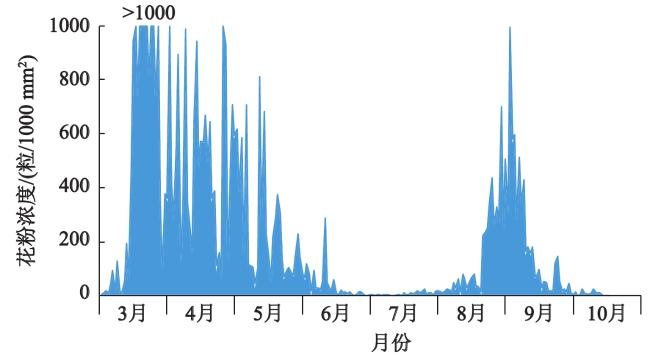
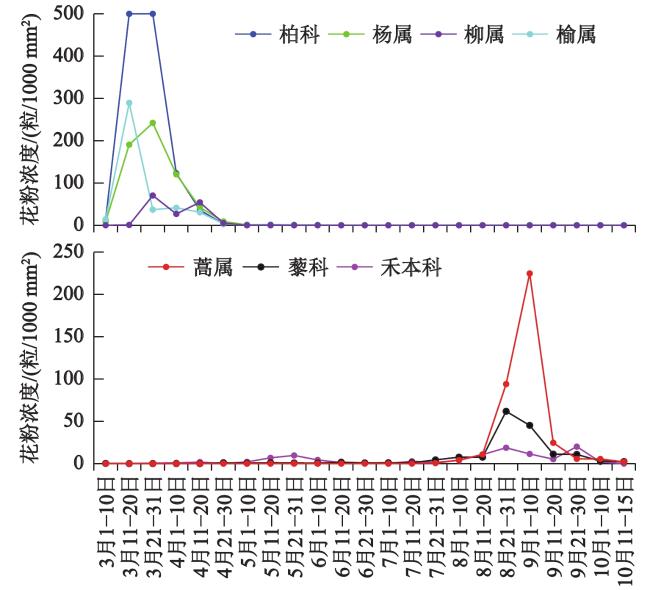
空气花粉被认为是空气污染物之一,可引起人群过敏反应,导致一系列过敏性疾病的发生或加重。但由于不同地区气候条件、植被和植物种类的差异,空气中的植物花粉种类和数量亦有所不同,所以空气花粉研究需要不同区域进行研究。通过对北京市北部2020年3月1日至10月15日的空气花粉监测,分析了空气花粉种类和浓度变化特征。结果显示,① 2020年北京市北部的花粉季从3月15日至9月5日,共172 d,占全年总天数的47.0%。② 不同植物花粉传播峰值有差异。③ 花粉总浓度变化呈双峰型,即3—5月为第一高峰,主要是树木花粉(如柏科、杨属、柳属、榆属);8—9月为第二高峰,主要是草本花粉(如蒿属、藜/苋科、禾本科)。④ 春季花粉数量显著高于秋季花粉数量,峰值出现在3月中下旬。
孙爱芝 , 张海红 , 李雪银 , 叶彩华 . 北京市北部空气花粉类型及浓度变化特征研究[J]. 地理科学, 2023 , 43(4) : 737 -744 . DOI: 10.13249/j.cnki.sgs.2023.04.017
Airborne pollen is considered to be one of the air pollutants that can cause allergic reactions in humans, then leading to the occurrence or aggravation of a series of allergic diseases. The latest study showed that the positive rate of pollen allergens in allergic rhinitis patients in urban areas of Beijing is as high as 84.3%. However, due to the differences in climatic conditions, vegetation types and plant species in different regions, the types and amount of airborne pollen are also different. Therefore, research on airborne pollen needs to be conducted in different regions. In this study, we analyzed the characteristics of airborne pollen types and concentration variations by monitoring in the north of Beijing from 1 March to 15 October 2020. The results show that: 1) The pollen season in the north of Beijing in 2020 started from 15 March (2.5% of the total annual amount) to 5 September (97.5% of the total annual amount), covering 172 days, accounting for 47.0% of the total days of the year. Among them, the days with pollen concentrations higher than 25 grains/1 000 mm2, 50 grains/1 000 mm2, 100 grains/1 000 mm2, 200 grains/1 000 mm2, 500 grains/1 000 mm2, and 1 000 grains/1 000 mm2 were 142 d, 124 d, 97 d, 73 d, 38 d, and 10 d, respectively. 2) A total of 20 pollen types were observed, among which the percentage of Cupressaceae pollen is the highest at 57.3%, followed by Moraceae (7.8%), Populus (6.6%), Pinus (6.1%), Ulmus (4.3%), Artemisia (3.9%), Rosaceae (3.6%), Betula (2.9%), Chenopodiaceae (1.7%). This is mainly because the plant species distributed in this study area are mainly trees and shrubs, especially the Cupressaceae, Salicaceae and Pinaceae, which have more higher pollen production. 3) The total concentration of airborne pollen changes significantly and exhibits a bimodal pattern, that is, March to May is the first peak (mainly tree pollen, such as Cupressaceae, Populus, Salix and Ulmus); August to September is the second peak (mainly herbaceous pollen, such as Artemisia, Chenopodiaceae and Poaceae). Pollen concentration from June to July is the lowest, all below 50 grains/1 000 mm2. The study of airborne pollen types, concentration changes and seasonal variation in the north of Beijing provides first-hand scientific data for guiding the prevention of pollinosis patients and building a healthy urban environment.
表1 2020年北京市北部空气花粉种类及分布Table 1 Airborne pollen types and distribution in the north of Beijing in 2020 |
| 花粉类型 | 3月 | 4月 | 5月 | 6月 | 7月 | 8月 | 9月 | 10月 |
| 注:+代表出现该科属植物花粉。 | ||||||||
| 柏科 | + | + | + | + | ||||
| 杨属 | + | + | + | |||||
| 柳属 | + | + | ||||||
| 榆属 | + | + | + | |||||
| 白蜡树属 | + | + | ||||||
| 木犀科 | + | + | ||||||
| 桦属 | + | + | + | + | ||||
| 胡桃科 | + | + | + | |||||
| 蔷薇科 | + | + | + | |||||
| 桑科 | + | + | + | + | + | + | + | |
| 松属 | + | + | + | + | + | |||
| 壳斗科 | + | + | ||||||
| 豆科 | + | + | + | + | + | |||
| 禾本科 | + | + | + | + | + | + | + | |
| 藜科 | + | + | + | + | + | + | + | |
| 蒿属 | + | + | + | |||||
| 香蒲科 | + | + | ||||||
| 菊科 | + | + | + | + | + | |||
| 蓼科 | + | + | ||||||
| 莎草科 | + | |||||||
| [1] |
Beggs P J. Impact of climate change on aeroallergens: Past and future[J]. Clinical Experimental Allergy, 2004, 34(10): 1507-1513.
|
| [2] |
谢立锋, 朱丽, 张丰珍, 等. 风媒花木本植物盛花期与变应性鼻炎就诊率的关系分析[J]. 临床耳鼻咽喉头颈外科杂志, 2016, 30(15): 1206-1209.
Xie Lifeng, Zhu Li, Zhang Fengzhen et al. Relationship between full flowering stages of anemophilous and ligeneous plants and consultation rate of allergic rhinitis. Journal of Clinical Otorhinolaryngology Head and Neck Surgery, 2016, 30(15): 1206-1209.
|
| [3] |
孙洁. 真菌、花粉、尘螨致敏急性支气管哮喘患者临床特征分析[J]. 川北医学院学报, 2018, 33(1): 37-39.
Sun Jie. Analysis of clinical characteristics of patients with acute bronchial asthma caused by fungus, pollen and dust mites. Journal of North Sichuan Medical College, 2018, 33(1): 37-39.
|
| [4] |
王晓艳, 郭淼颖, 王洪田, 等. 我国北方地区儿童与青少年季节性变应性鼻炎致敏花粉的特征分析[J]. 临床耳鼻咽喉头颈外科杂志, 2020, 34(11): 1005-1010.
Wang Xiaoyan, Guo Miaoying, Wang Hongtian et al. Pollen allergen sensitization feature of seasonal allergic rhinitis in children and adolescents in northern China. Journal of Clinical Otorhinolaryngology Head and Neck Surgery, 2020, 34(11): 1005-1010.
|
| [5] |
叶世泰, 张金谈, 乔秉善, 等. 中国气传和致敏花粉[M]. 北京: 科学出版社, 1988.
Ye Shitai, Zhang Jintan, Qiao Bingshan et al. Air transport and sensitized pollen in China. Beijing: Science Press, 1988.
|
| [6] |
温志华, 尹佳. 蒿属、葎草花粉空气浓度与夏秋季花粉症患者哮喘症状严重程度的相关性[J]. 中华临床免疫和变态反应杂志, 2012, 6: 10-17.
Wen Zhihua, Yin Jia. Correlation of the artemisia and humulus scandens pollen count in the air and the severity of asthma symptoms in patinets with autumnal pollinosis. Chinese Journal of Allergy and Clinical Immunology, 2012, 6: 10-17.
|
| [7] |
D'amato G, Spieksma F Th M, Liccardi G et al. Pollen-related allergy in Europe[J]. Allergy, 1998, 53(6): 567-578.
|
| [8] |
Wang Xueyan, Ma Tingting, Wang Xiaoyan et al. Prevalence of pollen-induced allergic rhinitis with high pollen exposure in grasslands of northern China[J]. Allergy, 2018, 73(6): 1232-1243.
|
| [9] |
杨琼梁, 欧阳婷, 颜红, 等. 花粉过敏的研究进展[J]. 中国农学通报, 2015, 31(24): 163-167.
Yang Qiongliang, Ouyang Ting, Yan Hong et al. Research progress of pollen allergy. Chinese Agricultural Science Bulletin, 2015, 31(24): 163-167.
|
| [10] |
汤蕊, 王良录, 尹佳, 等. 花粉症的中国历程[J]. 中国科学: 生命科学, 2021, 51(8): 901-907.
Tang Rui, Wang Lianglu, Yin Jia et al. History of hay fever in China. Scientia Sinica (Vitae), 2021, 51(8): 901-907.
|
| [11] |
马婷婷, 王洪田, 陈艳蕾, 等. 北京地区门诊患者常见吸入过敏原致敏谱[J]. 中华临床免疫和变态反应杂志, 2021, 15(1): 136-143.
Ma Tingting, Wang Hongtian, Chen Yanlei et al. Sensitization spectrum of inhaled allergens in outpatients in Beijing area. Chinese Journal of Allergy and Clinical Immunology, 2021, 15(1): 136-143.
|
| [12] |
王涛, 刘林菁, 黄澜, 等. 佛山地区春季气传致敏花粉特点的研究[J]. 现代医学, 2018, 46(7): 802-804.
Wang Tao, Liu Linjing, Huang Lan et al. Study on the characteristics of airborne sensitized pollen in spring in Foshan. Modern Medical Journal, 2018, 46(7): 802-804.
|
| [13] |
李文静, 黄南, 张书辰, 等. 2017至2018年武汉城区花粉播散特征及其与变应性鼻炎患者就诊人次数的相关性研究[J]. 中华预防医学杂志, 2021, 55(5): 620-626.
Li Wenjing, Huang Nan, Zhang Shuchen et al. Airborne pollens in Wuhan urban area and its correlation with hospital visits of allergic rhinitis patients from 2017 to 2018. Chinese Journal of Preventive Medicine, 2021, 55(5): 620-626.
|
| [14] |
王晓艳, 田宗梅, 宁慧宇, 等. 北京城区气传花粉分布与过敏性疾病就诊关系分析[J]. 临床耳鼻咽喉头颈外科杂志, 2017, 31(10): 757-761.
Wang Xiaoyan, Tian Zongmei, Ning Huiyu et al. Association between airborne pollen distribution and allergic diseases in Beijing urban area. Journal of Clinical Otorhinolaryngology Head and Neck Surgery, 2017, 31(10): 757-761.
|
| [15] |
云文强, 云文丽. 呼和浩特城区花粉致敏植物调查[J]. 安徽农业科学, 2009, 37(35): 17467-17468,17475.
Yun Wenqiang, Yun Wenli. Survey on pollen allergenic plants in Huhhot urban area. Journal of Anhui Agricultural Sciences, 2009, 37(35): 17467-17468,17475.
|
| [16] |
宋岚, 赵方新, 张静, 等. 内蒙古乌海市夏秋季空气中花粉飘散状况与临床分析[J]. 现代预防医学, 2014, 41(18): 3304-3306,3309.
Song Lan, Zhao Fangxin, Zhang Jing, et al. Pollen dispersion in summer and autumn in Wuhai city of Inner Mongolia and its clinical analysis. Modern Preventive Medicine, 2014, 41(18): 3304-3306,3309.
|
| [17] |
何海娟, 王良录, 张宏誉. 北京城区空气中花粉分析[J]. 中华临床免疫和变态反应杂志, 2008, 2(3): 179-183.
He Haijuan, Wang Lianglu, Zhang Hongyu. Air pollen analysis in Beijing. Chinese Journal of Allergy and Clinical Immunology, 2008, 2(3): 179-183.
|
| [18] |
孟龄, 王效科, 欧阳志云, 等. 北京城区气传花粉季节分布特征[J]. 生态学报, 2013, 33(8): 2381-2387.
Meng Ling, Wang Xiaoke, Ouyang Zhiyun et al. Seasonal dynamics of airborne pollen in Beijing urban area. Acta Ecologica Sinical, 2013, 33(8): 2381-2387.
|
| [19] |
孟龄, 王效科, 欧阳志云, 等. 北京城区气传花粉季节特征及与气象条件关系[J]. 环境科学, 2016, 37(2): 452-458.
Meng Ling, Wang Xiaoke, Ouyang Zhiyun et al. Seasonal dynamics of airborne pollens and its relationship with meteorological factors in Beijing urban area. Environmental Science, 2016, 37(2): 452-458.
|
| [20] |
张新时. 中国植被及其地理格局: 中华人民共和国植被图(1∶1 000 000)说明书[M]. 北京: 地质出版社, 2007.
Zhang Xinshi. Vegetation map of China and its geographic pattern: Vegetation map of China (1∶1000000). Beijing: Geological Publishing House, 2007.
|
| [21] |
王伏雄, 钱南芬, 张玉龙, 等. 中国植物花粉形态(第二版)[M]. 北京: 科学出版社, 1995.
Wang Fuxiong, Qian Nanfen, Zhang Yulong et al. Pollen morphology in China (The second edition). Beijing: Science Press, 1995.
|
| [22] |
乔秉善. 中国气传花粉和植物彩色图谱[M]. 北京: 中国协和医科大学出版社, 2005.
Qiao Bingshan. Color atlas of air-borne pollens and plants of the Chinese. Beijing: Peking Union Medical College Press, 2005.
|
| [23] |
王学艳, 张罗. 中国北方植物花粉调研——花粉形态及花粉过敏疑难病例[M]. 北京: 北京科学技术出版社, 2018.
Wang Xueyan, Zhang Luo. Mapping the vegetation and pollen distribution in Northern China—Pollen characterizations, clinical manifestations and complications of pollen allergies. Beijing: Beijing Science and Technology Press, 2018.
|
| [24] |
辛嘉楠. 北京城区花粉致敏植物分布及花粉浓度动态研究[D]. 北京: 中国科学院生态环境研究中心, 2008.
Xin Jianan. Allergenic pollen distribution and concentration dynamic of allergenic pollen in Beijing urban area. Beijing: Research Center for Eco-environmental Sciences, Chinese Academy of Sciences, 2008.
|
| [25] |
姚丽娜, 张宏誉. 北京气传柏树花粉监测分析[J]. 中国公共卫生, 2009, 25(6): 749-751.
Yao Lina, Zhang Hongyu. Analysis on the division and monitoring of asthmatic cypress in Beijing. Chinese Journal of Public Health, 2009, 25(6): 749-751.
|
| [26] |
李挚, 何海娟, 孙国强, 等. 北京市区与过敏相关的气传花粉[J]. 基础医学与临床, 2015, 35(6): 734-738.
Li Zhi, He Haijuan, Sun Guoqiang et al. Allergy-related airborne pollen in urban area of Beijing. Basic & Clinical Medicine, 2015, 35(6): 734-738.
|
| [27] |
欧阳志云, 辛嘉楠, 郑华, 等. 北京城区花粉致敏植物种类、分布及物候特征[J]. 应用生态学报, 2007, 18(9): 1953-1958.
Ouyang Zhiyun, Xin Jianan, Zheng Hua et al. Species composition distribution and phenological characters of pollen allergenic plants in Beijing urban area. Chinese Journal of Applied Ecology, 2007, 18(9): 1953-1958.
|
| [28] |
张雨辰, 马春梅, 方伊曼. 大气花粉监测与传播研究进展[J]. 微体古生物学报, 2018, 35(2): 200-210.
Zhang Yuchen, Ma Chunmei, Fang Yiman. Advance in the study on the monitoring and spread of airborne pollen. Acta Micropalaeontologica Sinica, 2018, 35(2): 200-210.
|
| [29] |
汪佩芳, 夏玉梅, 杨青. 三江平原沼泽区的现代花粉雨[J]. 地理科学, 2000, 20(2): 121-126.
Wang Peifang, Xia Yumei, Yang Qing. Modern pollen rain of mire region in Sanjian Plain. Scientia Geographica Sinica, 2000, 20(2): 121-126.
|
| [30] |
江伟明, 潘睿聪, 罗传秀, 等. 城市空气花粉的研究进展[J]. 生态科学, 2018, 37(6): 199-208.
Jiang Weiming, Pan Ruicong, Luo Chuanxiu et al. Advances in urban airborne pollen. Ecological Science, 2018, 37(6): 199-208.
|
| [31] |
邬清芝, 丁小珍, 汪春英. 湖北省荆州市城区气传花粉调查研究[J]. 长江大学学报(自科版), 2005, 2(6): 189-190.
Wu Qingzhi, Ding Xiaozhen, Wang Chunying. Investigation on airborne pollen in Jingzhou City, Hubei Province. Journal of Yangtze University (Nat Sci Edit), 2005, 2(6): 189-190.
|
| [32] |
熊汉忠, 高国胜, 皮压平, 等. 湖北省鄂州市城区气传花粉调查研究[J]. 华中医学杂志, 2006, 30(4): 283-285.
Xiong Hanzhong, Gao Guosheng, Pi Yaping et al. An investigation of airborne pollen grains in Ezhou City, Hubei Province, China. Central China Medical Journal, 2006, 30(4): 283-285.
|
| [33] |
彭清臻, 钟敏华, 谢志斌, 等. 湖北省孝感市城区气传花粉调查与研究[J]. 华中医学杂志, 2006, 30(4): 292-294.
Peng Qingzhen, Zhong Minhua, Xie Zhibin et al. Investigation on airborne pollens in urban districts of Xiaogan in Hubei Province. Central China Medical Journal, 30(4): 292-294.
|
| [34] |
何丽娟, 张德山, 乔秉善. 北京城区空气中花粉含量与气象要素的关系初探[J]. 中华微生物学和免疫学杂志, 2001(S2): 36-38.
He Lijuan, Zhang Deshan, Qiao Bingshan. Preliminary study on the relationship between pollen content and meteorological elements in Beijing. Chinese Journal of Microbiology and Immunology, 2001(S2): 36-38.
|
| [35] |
全国绿化委员会办公室. 2016年中国国土绿化状况公报[EB/OL]. http://www.gov.cn/xinwen/2017-03/13/content_5177009.htm#1, 2017-03-13.
National Greening Commission Office. China's land greening status bulletin in 2016. http://www.gov.cn/xinwen/2017-03/13/content_5177009.htm#1,2017-03-13.
|
| [36] |
李玉梅, 杨振京, 张芸, 等. 新疆博尔塔拉河表土孢粉组合与植被关系研究[J]. 地理科学, 2014, 34(12): 1518-1525.
Li Yumei, Yang Zhenjing, Zhang Yun, et al. Surface pollen assemblages and vegetation relationships in the Bortala River Basin of Xinjiang, China. Scientia Geographica Sinica, 2014, 34(12): 1518-1525.
|
| [37] |
魏建苏, 刘梅, 顾亚进, 等. 南京市花粉浓度变化规律及预报方法研究[J]. 安徽农业科学, 2008, 36(22): 9368-9371.
Wei Jiangsu, Liu Mei, Gu Yajin et al. Study on pollen concentration change rule and forecast method in Nanjing City. Journal of Anhui Agricultural Sciences, 2008, 36(22): 9368-9371.
|
| [38] |
李英, 李月丛, 吕素青, 等. 石家庄空气花粉散布规律及与气候因子的关系[J]. 生态学报, 2014, 34(6): 1575-1586.
Li Ying, Li Yuecong, Lyu Suqing, et al. The dispersion of airborne pollen and its relationship with major climatic parameters in Shijiazhuang. Acta Ecologica Sinica, 2014, 34(6): 1575-1586.
|
| [39] |
李月丛, 许清海, 葛亚汶, 等. 黄土高原中东部沙尘与非沙尘天气花粉组成及来源范围[J]. 地理研究, 2014, 33(12): 2361-2381.
Li Yuecong, Xu Qinghai, Ge Yawen et al. Airborne pollen assemblages and maximum source area in dust and non-dust weather in the central and eastern Loess Plateau. Geographical Research, 2014, 33(12): 2361-2381.
|
| [40] |
Pashley C H, Satchwell J, Edwards R E. Ragweed pollen: Is climate change creating a new aeroallergen problem in the UK?[J]. Clinical & Experimental Allergy, 2015, 45(7): 1262-1265.
|
| [41] |
Fang Yiman, Ma Chunmei, Jane Bunting M et al. Airborne pollen concentration in Nanjing, Eastern China, and its relationship with meteorological factors[J]. Journal of Geophysical Research: Atmospheres, 2018, 123(19): 10842-10856.
|
| [42] |
Qin Xiaoxin, Li Yiyin. Influence of environmental factors on spatial and temporal variability of allergenic Artemisia pollen in Beijing, China[J]. Agricultural and Forest Meteorology, 2022, 313: 108690
|
| [43] |
Chen Lixin, Zhang Yun, Kong Zhaochen. Airborne pollen patterns and their relationship with meteorological factors in the Betula microphylla—Dominated wetland of Ebinur Lake, Xinjiang, China[J]. Science China Earth Sciences, 2021, 64(10): 1746-1760.
|
/
| 〈 |
|
〉 |