



全球城市顶尖人才流动网络的空间格局与结构特征
|
陈鹏鑫(1997—),男,河南宁陵人,博士研究生,主要从事人才流动与区域创新发展研究。E-mail: chenpx476743@qq.com |
收稿日期: 2022-12-02
修回日期: 2023-02-24
录用日期: 2023-08-31
网络出版日期: 2024-01-12
基金资助
国家自然科学基金项目(42130510)
国家自然科学基金项目(42171214)
版权
Spatial patterns and structural characteristics of the global intercity elite mobility network: Based on the data of AI elite growth mobility trajectories
Received date: 2022-12-02
Revised date: 2023-02-24
Accepted date: 2023-08-31
Online published: 2024-01-12
Supported by
National Natural Science Foundation of China(42130510)
National Natural Science Foundation of China(42171214)
Copyright
借助空间分析与网络分析方法,深入剖析全球顶尖人才教育和工作流动网络的空间格局、结构特征及其影响因素。研究发现:① 全球AI顶尖人才流动主要集中在北美洲、欧洲和亚洲,教育阶段流动空间范围相较于工作阶段更为广泛。② 全球AI顶尖人才教育和工作流动网络均具等级层次性和社团结构,教育流动网络中社团以单中心组织模式为主,工作流动网络中社团以多中心组织模式为主。③ 国家(地区)边界与AI顶尖人才教育和工作流动均显著正相关;区域性国际组织仅与AI顶尖人才工作流动显著正相关;地理邻近性与AI顶尖人才教育和工作流动均不显著相关,这表明国际顶尖人才流动几乎不受地理距离的限制。
陈鹏鑫 , 何金廖 , 曾刚 , 李炜 , 杨阳 . 全球城市顶尖人才流动网络的空间格局与结构特征[J]. 地理科学, 2023 , 43(12) : 2069 -2079 . DOI: 10.13249/j.cnki.sgs.2023.12.001
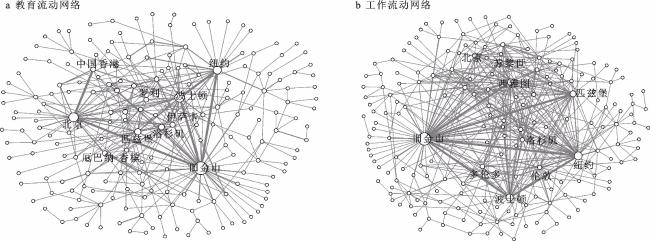
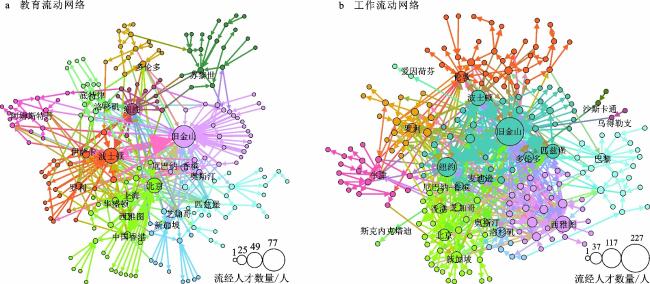
Global/world city network research is gradually focusing on the phenomenon of science and technology globalization. The existing studies have been analyzed it based on the paper co-authorship or patent cooperation data, there is a paucity of analysis of the world city system from the perspective of talent flows. Based on the education and career mobility data of the world's top 500 AI scientists, this paper analyzed the spatial patterns, structural characteristics and influencing factors of the global elite education and career mobility network using spatial analysis and network analysis methods. The results are as follows. Firstly, the global mobility of AI elites is highly concentrated in the ''global triangle'' of North America, Europe and Asia. The scope of the global AI elite mobility at the education stage is broader than that at the career stage, which is related to the differences in the locational characteristics of education and market resources. Secondly, both the global AI elite education mobility network and the global AI elite career mobility network have a hierarchical structure. However, the disassortativity of the former is more significant than the latter. The top cities in both networks are mostly from the ''global north'', with a significant ''North-South gap''. The ''North-South gap'' in the global AI elite career mobility network is greater than that in the global AI elite education mobility network. Many US cities such as San Francisco, Boston and New York appear in the top 30 cities of both networks, while only Beijing and Hong Kong in China appear in the list of both networks. Third, the global intercity AI elite education mobility network community feature is characteristic with globalization and regionalization, and most communities are monocentric. The global intercity career mobility network community feature is characteristic with globalization, and most communities are polycentric. Finally, Spearman correlation analysis results show that national border is significantly and positively correlated with the global AI elite education and career mobility, regional international organization are only significantly and positively correlated with the global AI elite career mobility, and geographical proximity is not significantly correlated with both the global AI elite education and career mobility, which suggests that the mobility of top talent is almost not limited by geographical distance. The paper calls for future research on the global urban system from the perspective of talent mobility.
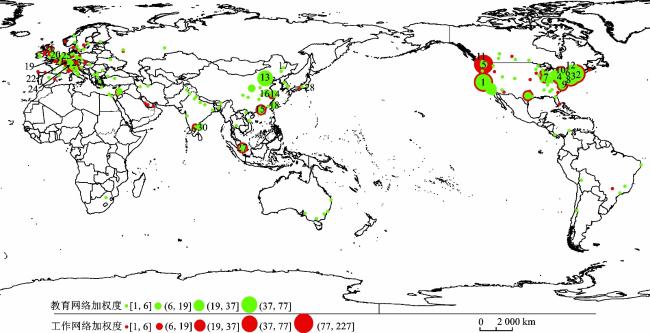
图1 全球AI顶尖人才教育流动网络和工作流动网络节点加权度的空间格局1. 旧金山;2. 波士顿;3. 纽约;4. 匹兹堡;5. 西雅图;6. 伊萨卡;7. 厄巴纳–香槟;8. 费城;9. 华盛顿;10. 多伦多;11. 温哥华;12. 蒙特利尔;13. 北京;14. 上海;15. 香港;16. 合肥;17. 哈尔滨;18. 中国台北;19. 伦敦;20. 剑桥(英);21. 巴黎;22. 南锡;23. 慕尼黑;24. 苏黎世;25. 阿姆斯特丹;26. 爱丁堡;27. 新加坡;28. 东京;29. 班加罗尔;30. 金奈;基于审图号GS:2016(2666)(自然资源部监制),底图无修改 Fig. 1 Geographic distribution of node weight degrees of global intercity AI elite education and career mobility network |
表1 全球AI顶尖人才教育流动网络和工作流动网络中联系强度排名前15的城市对Table 1 The top 15 city pairs of global intercity AI elite mobility network at the higher education and career stages |
| 排序 | 教育流动网络 | 工作流动网络 | |||||
| 流出地 | 流入地 | 流动频次 | 流出地 | 流入地 | 流动频次 | ||
| 1 | 波士顿 | 旧金山 | 8 | 波士顿 | 旧金山 | 19 | |
| 2 | 北京 | 旧金山 | 4 | 旧金山 | 纽约 | 16 | |
| 3 | 北京 | 中国香港 | 4 | 纽约 | 旧金山 | 15 | |
| 4 | 纽约 | 旧金山 | 4 | 匹兹堡 | 旧金山 | 10 | |
| 5 | 哈尔滨 | 北京 | 3 | 旧金山 | 匹兹堡 | 9 | |
| 6 | 合肥 | 北京 | 3 | 西雅图 | 旧金山 | 8 | |
| 7 | 金奈 | 波士顿 | 3 | 纽约 | 波士顿 | 7 | |
| 8 | 纽约 | 波士顿 | 3 | 波士顿 | 匹兹堡 | 6 | |
| 9 | 中国台北 | 厄巴纳-香槟 | 3 | 波士顿 | 西雅图 | 6 | |
| 10 | 伊萨卡 | 波士顿 | 3 | 波士顿 | 纽约 | 6 | |
| 11 | 长春 | 北京 | 3 | 旧金山 | 西雅图 | 6 | |
| 12 | 北京 | 厄巴纳-香槟 | 2 | 纽约 | 匹兹堡 | 6 | |
| 13 | 北京 | 费城 | 2 | 中国香港 | 南锡 | 6 | |
| 14 | 北京 | 华盛顿 | 2 | 伊萨卡 | 旧金山 | 6 | |
| 15 | 北京 | 纽约 | 2 | 北京 | 旧金山 | 5 | |
表2 全球AI顶尖人才教育流动网络和工作流动网络中加权度排名前30的城市Table 2 The 30 most connected cities of global intercity AI elite mobility network at the higher education and career stages |
| 排序 | 教育流动网络 | 工作流动网络 | |||||||
| 城市 | Dw | Dwi | Dwi – Dwo | 城市 | Dw | Dwi | Dwi – Dwo | ||
| 注:Dw表示加权度中心性;Dwi表示加权入度中心性;Dwi – Dwo表示加权入度中心性与加权出度中心性的差值。 | |||||||||
| 1 | 旧金山 | 77 | 65 | 53 | 旧金山 | 227 | 129 | 31 | |
| 2 | 波士顿 | 49 | 36 | 23 | 纽约 | 117 | 60 | 3 | |
| 3 | 北京 | 47 | 14 | -19 | 波士顿 | 100 | 40 | -20 | |
| 4 | 纽约 | 38 | 25 | 12 | 西雅图 | 79 | 53 | 27 | |
| 5 | 匹兹堡 | 25 | 20 | 15 | 匹兹堡 | 73 | 41 | 9 | |
| 6 | 洛杉矶 | 20 | 11 | 2 | 北京 | 37 | 17 | -3 | |
| 7 | 伊萨卡 | 16 | 11 | 6 | 多伦多 | 36 | 18 | 0 | |
| 8 | 厄巴纳-香槟 | 14 | 11 | 8 | 伦敦 | 31 | 20 | 9 | |
| 9 | 中国香港 | 13 | 9 | 5 | 洛杉矶 | 31 | 14 | -3 | |
| 10 | 罗利 | 13 | 6 | -1 | 苏黎世 | 30 | 14 | -2 | |
| 11 | 上海 | 13 | 0 | -13 | 中国香港 | 29 | 14 | -1 | |
| 12 | 华盛顿 | 12 | 10 | 8 | 新加坡 | 28 | 16 | 4 | |
| 13 | 新加坡 | 12 | 8 | 4 | 伊萨卡 | 25 | 9 | -7 | |
| 14 | 西雅图 | 12 | 8 | 4 | 华盛顿 | 23 | 9 | -5 | |
| 15 | 多伦多 | 11 | 7 | 3 | 厄巴纳-香槟 | 22 | 8 | -6 | |
| 16 | 芝加哥 | 11 | 5 | -1 | 奥斯汀 | 21 | 10 | -1 | |
| 17 | 苏黎世 | 10 | 8 | 6 | 罗利 | 20 | 10 | 0 | |
| 18 | 底特律 | 10 | 8 | 6 | 芝加哥 | 19 | 10 | 1 | |
| 19 | 金奈 | 10 | 0 | -10 | 麦迪逊 | 17 | 8 | -1 | |
| 20 | 奥斯汀 | 9 | 7 | 5 | 底特律 | 16 | 8 | 0 | |
| 21 | 费城 | 9 | 5 | 1 | 爱丁堡 | 15 | 8 | 1 | |
| 22 | 圣迭戈 | 8 | 5 | 2 | 温哥华 | 15 | 6 | -3 | |
| 23 | 蒙特利尔 | 8 | 5 | 2 | 特拉维夫 | 13 | 7 | 1 | |
| 24 | 剑桥(英) | 8 | 2 | -4 | 牛津 | 13 | 7 | 1 | |
| 25 | 西安 | 8 | 0 | -8 | 剑桥(英) | 13 | 5 | -3 | |
| 26 | 合肥 | 8 | 0 | -8 | 慕尼黑 | 13 | 5 | -3 | |
| 27 | 布卢明顿 | 7 | 5 | 3 | 巴黎 | 13 | 5 | -3 | |
| 28 | 阿姆斯特丹 | 7 | 3 | -1 | 圣迭戈 | 12 | 6 | 0 | |
| 29 | 中国台北 | 7 | 0 | -7 | 费城 | 11 | 4 | -3 | |
| 30 | 麦迪逊 | 6 | 6 | 6 | 波恩 | 11 | 4 | -3 | |
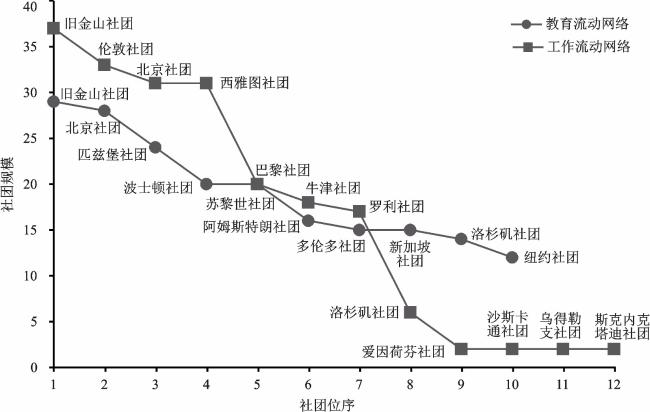
图3 全球AI顶尖人才教育流动网络和工作流动网络的社团位序-规模分布Fig. 3 Rank-size distributions of the community in the global intercity AI elite mobility network |
| [1] |
|
| [2] |
|
| [3] |
|
| [4] |
|
| [5] |
|
| [6] |
|
| [7] |
李恩康, 陆玉麒, 杨星, 等. 全球城市网络联系强度的时空演化研究——基于2014—2018年航空客运数据[J]. 地理科学, 2020, 40(1): 32-39.
|
| [8] |
|
| [9] |
|
| [10] |
司月芳, 曾刚, 曹贤忠, 等. 基于全球–地方视角的创新网络研究进展[J]. 地理科学进展, 2016, 35(5): 600-609.
|
| [11] |
郝均, 曾刚, 胡森林, 等. 长三角地区本地、区内和区外合作创新对城市经济增长的影响研究[J]. 长江流域资源与环境, 2022, 31(3): 515-525.
|
| [12] |
|
| [13] |
桂钦昌, 杜德斌, 刘承良, 等. 全球城市知识流动网络的结构特征与影响因素[J]. 地理研究, 2021, 40(5): 1320-1337.
|
| [14] |
曹湛, 戴靓, 吴康, 等. 全球城市知识合作网络演化的结构特征与驱动因素[J]. 地理研究, 2022, 41(4): 1072-1091.
|
| [15] |
焦美琪, 杜德斌, 桂钦昌, 等. 全球城市技术合作网络的拓扑结构特征与空间格局[J]. 地理科学, 2019, 39(10): 1546-1552.
|
| [16] |
马海涛. 知识流动空间的城市关系建构与创新网络模拟[J]. 地理学报, 2020, 75(4): 708-721.
|
| [17] |
马海涛. 基于人才流动的城市网络关系构建[J]. 地理研究, 2017, 36(1): 161-170.
|
| [18] |
|
| [19] |
|
| [20] |
|
| [21] |
|
| [22] |
姜炎鹏, 王鑫静, 马仁锋. 创新人才集聚的理论探索——全球人才流动的城市选择视角[J]. 地理科学, 2021, 41(10): 1802-1811.
|
| [23] |
孙康, 司月芳. 创新型人才流动的空间结构与影响因素——基于高被引华人科学家履历分析[J]. 地理学报, 2022, 77(8): 2113-2130.
|
| [24] |
|
| [25] |
|
| [26] |
|
| [27] |
|
| [28] |
|
| [29] |
侯纯光, 杜德斌, 刘承良, 等. 全球留学生留学网络时空演化及其影响因素[J]. 地理学报, 2020, 75(4): 681-694.
|
| [30] |
|
| [31] |
|
| [32] |
|
| [33] |
宋丽敏, 田佳蔚. 东北地区人口流动决策的影响因素研究——基于个体特征与经济因素的交互分析[J]. 人口学刊, 2021, 43(4): 63-73.
|
| [34] |
古恒宇, 沈体雁. 中国省际高技能人才迁移的时空演化机制[J]. 地理学报, 2022, 77(10): 2457-2473.
|
/
| 〈 |
|
〉 |