



国际大都市碳中和行动对北京的启示
|
杨晓燕(1982—),女,内蒙古包头人,副研究员,研究方向为城市应对气候变化和环境地球化学等。E-mail: yxy8412@foxmail.com |
收稿日期: 2022-08-10
修回日期: 2023-01-15
网络出版日期: 2024-01-20
基金资助
国家重点研发计划(2017YFF0211805)
北京市科技计划课题(Z221100005222027)
版权
Inspiration from the international metropolis’ zero emission action plan to the carbon neutrality of Beijing
Received date: 2022-08-10
Revised date: 2023-01-15
Online published: 2024-01-20
Supported by
National Key Research and Development Program of China(2017YFF0211805)
Beijing Science and Technology Plan Project(Z221100005222027)
Copyright
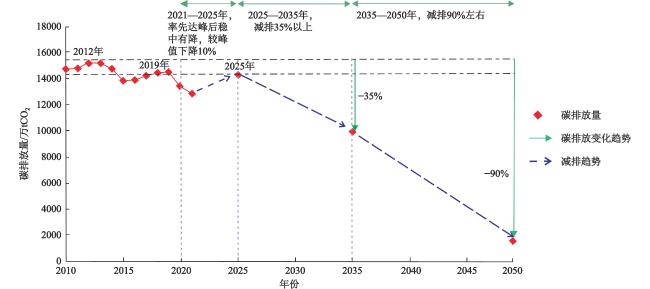
中国的“3060”目标对城市发展提出了更为严格的要求。为科学制定北京市碳中和目标并探索实现路径,文中系统梳理了伦敦、纽约、东京、巴黎4个国际大都市的碳中和目标、实现路径及具体措施。对比分析了北京能源消费及碳排放情况与这4个城市的差异,统筹考量北京目前的经济发展阶段、碳排放特点和未来城市定位等,结合LEAP模型测算结果,研究提出北京市碳中和路径。为支撑国家双碳目标,北京实现碳中和目标应在2055年或2050年。按近远期目标结合分步骤实现,2025年实现碳排放达峰后稳中有降,2035年实现较基准年减排35%,2055年/2050年达到较基准年减排85%。根据北京市主要碳排放源,实现碳中和主要集中在能源转型、建筑和交通低碳化发展、民众广泛参与以及技术创新等方向率先开展行动。
杨晓燕 , 胡永锋 , 贾秋淼 , 高晶 , 祁圻 . 国际大都市碳中和行动对北京的启示[J]. 地理科学, 2024 , 44(1) : 109 -120 . DOI: 10.13249/j.cnki.sgs.20220373
Climate change is a significant global challenge that humanity faces today. As the world’s largest emitter, China’s “3060” target reflects its responsible attitude as a major country and demonstrates strict requirements for local development. Compared to globally recognized world cities such as New York, London, Tokyo and Paris, Beijing has a certain space for development in addressing climate change, economic growth, urban construction, and other aspects. To scientifically explore the carbon neutrality target and the roadmap of Beijing, this article systematically sorted out the proposed carbon neutrality goals, realization paths and specific measures of the 4 international metropolises and compared the differences in energy consumption and carbon emission between Beijing and these 4 international metropolises. After considering Beijing’s current economic development stage, carbon emission characteristics and future urban positioning, and combined with the LEAP model results, the roadmap and timetable of Beijing’s carbon neutrality are proposed. Beijing should be achieve carbon neutrality by 2055 or 2050 to support the country’s dual carbon goals. According to the principle of combining short-term and long-term goals with step by step, carbon emission will be reduced steadily after reaching the peak by 2025 and by 2035 it will be reduced by 35% compared with the base year. In the neutralizing year of 2055/2050, carbon emission would be reduced by 85%. According to carbon dioxide emission source characteristics, the main measures to achieve carbon neutrality for Beijing should focus on energy transformation, low-carbon buildings, green transportation, extensive public participation, and technological innovation.
表1 四大城市温室气体排放计算方法及边界情况Table 1 The inventory method and boundary of the greenhouse gas emission for Tokyo, New York, London and Paris |
| 城市 | 人口/万人 | 面积/km2 | 人均GDP/(美元/a)1) | 温室气体排放计算方法 | 计算范围2) | 计算领域 |
| 注:1)人均GDP数据来源于2014年《巴黎,2050年迈向碳中和的变革之风》报告(http://paris2050.elioth.com/en/);2)指GPC方法所列出的范围内容。 | ||||||
| 东京 | 1374 | 2 194 | 69 524 | build-up method[17] | 1、2、3 | 工业、商业、居民、交通、其他 |
| 纽约 | 855 | 789 | 69 915 | GPC[18] | 1、2、3 | 固定能源、交通、固体废弃物 |
| 伦敦 | 889 | 1 572 | 53 157 | LEGGI[19] | 1、2 | 居民、商业-工业、交通 |
| 巴黎 | 224 | 105 | 57 241 | Bilan Carbone[20] | 1、2、3 | 工业、第三产业、居民、交通、废弃物、食物 |
表2 四大国际城市碳中和目标及主要政策措施Table 2 The summary of carbon neutrality goals and major policies for Tokyo, New York, London and Paris |
| 序号 | 城市 | 基准年/温室 气体排放量 | 实现路径 | 政策措施 |
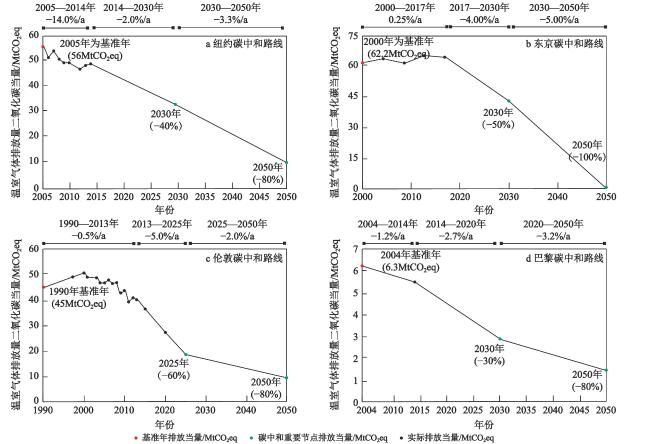
| 1 | 东京 | 2000年/ 62.2Mt | ① 2019—2030年,为实现30%的温室气体排放量的下降目标,进行加速推进行动,通过能耗提升和可再生能源的利用,能耗总量较2000年下降38%;② 2030—2050年,实现碳中和,100%实现脱碳能源,形成新的社会发展体系和新技术体系,通过森林吸收和技术变革降到最低碳排放,最后通过抵消实现碳中和 | ① 能源领域:最大比例的使用可再生能源、氢能,提高能源管理效率;②基础设施领域:100%零排放住宅和建筑改造,交通100%使用零排放车辆;③ 资源利用\工业领域:实现塑料和其他资源的可持续利用,将生产、运输和消费环节的环境负荷最小化,杜绝食物浪费,实现HFCs零排放;④ 适应气候变化:将气候变化的危害最小化,气候变化预测高精细化;⑤ 全民行动与保障:加强与社会各界、国际间城市、其他地方市政府的合作;加强绿色金融市场建设 |
| 2 | 纽约 | 2005年/ 64.85Mt | ① 2020年后实行必要的可衡量的短期行动,通过提升建筑标准、100%可再生能源的城市电力供应、充电设施建设等降低可测量的温室气体排放;②实行可衡量的短期行动的同时,实行必要的短期增速行动,主要通过碳定价、财政项目、提升的气候变化社交等加速实现;③2040年后进入加速路径,通过不懈的努力和不断的评估进展和战略来实现长远气候行动目标;④最终实现碳中和,从技术上抵消剩余的排放实现可行的城市减排 | ① 制定法规,改建电力设施,扩建分布式能源;② 倡导使用公共交通、自行车及步行,支持汽车电动化,实行交通拥堵费;建立情节、安全和可负担性的高能效交通网络和遍布全城的电动汽车充电网络;③ 提高能效水平,用可再生能源或高效的电力系统取代建筑物中许多以化石燃料为基础的供暖和热水系统,向以可再生能源为基础的电网过渡;④ 对市政建筑节能、可再生能源、电动汽车和固体废物管理进行投资;实现零垃圾填埋、零废弃物,实现城市循环经济;⑤ 最大限度的发挥公民的作用,鼓励全民参与 |
| 3 | 伦敦 | 1990年/ 45.36Mt | ① 近期路径(2018—2023年),通过发展清洁电力、提高能效和开发低碳技术实现减排;②中期路径(至2040年),在2040年建成零排放公交体系;③远期路径(至2050年),建成清洁能源体系,交通全面电动化 | ① 开展全市建筑能效改造;② 电网、气网的低碳化改造;减少天然气用量,发展清洁电力;③ 控制新增能耗,规定所有新增用能需求必须通过能耗提升或者智能技术来抵消;④ 制定2025年的低碳供热路径;推广地热、海洋能和空气源供热技术进行居民供热,开展建筑余热捕捉;⑤ 2040年前市民绿色出行比例80%,2050年道路交通领域将实现全面电动化,能源全面清洁化 |
| 4 | 巴黎 | 2004年/ 28.3Mt | ① 2020年是加速发展阶段,迫切的能源变革需求;②有效行动阶段(2020—2030年),开发雄心勃勃的可实施的行动计划;③ 愿景(2030—2050年),将巴黎打造成韧性、包容、碳中和城市,实现100%可再生能源 | ① 能源领域:建立能源新政策;发展太阳能、风力和生物质发电;开发地下能源存储系统;2050年能源消费降低50%,可再生能源占比100%;2030年前所有能源系统完成智能改造,节能50%以上;② 交通领域:2020年建成骑行友好城市,2025年淘汰柴油车;2040年淘汰汽油车,支持建设远程办公中心;③ 建筑领域:修改现行法规,对既有建筑进行能源改造,推广新节能标准和规范;2050年,完成100万户生态改造,所有新建建筑均为低碳、主动能源建筑;④ 城市规划:调整规划以适应气候变化,城市规划和土地利用规划中推广碳中和示范项目,改善城市生态空间和人居环境;⑤ 废弃物处置:2020年将回收站数量增加到20座,堆肥站增至1000座;⑥ 食品行动:到2030年将食品相关的温室气体排放降低40% |
表3 北京与纽约、伦敦、东京、巴黎基本情况对比Table 3 Basic situation of Beijing, New York, London, Tokyo and Paris |
| 城市 | 人口/万人 | 人均GDP/万美元 | 市域面积/km2 | 人口密度/(人/km2) |
| 注:表中的北京数据根据《北京市统计年鉴》[10]获得,纽约、伦敦、巴黎为2014年GDP计算得到,东京的数据来自于2016年公开统计数据(https://www.toukei.metro.tokyo.lg.jp/tnenkan/2016/tn16q3e001.htm)。 | ||||
| 北京 | 2189 | 2.4 | 16410 | 1312 |
| 纽约 | 855 | 6.9 | 789 | 10800 |
| 伦敦 | 854 | 5.4 | 1572 | 5400 |
| 东京 | 1392 | 6.6 | 2155 | 15481 |
| 巴黎 | 224 | 5.7 | 105 | 21200 |
| [1] |
UNFCCC. The Paris Agreement[EB/OL]. 2015 [2020-08-20]. https://unfccc.int/process-and-meetings/the-paris-agreement/the-paris-agreement.
|
| [2] |
IPCC. Global warming of 1.5℃[R/OL]. 2018. https://www.ipcc.ch/sr15/.
|
| [3] |
张雅欣, 罗荟霖, 王灿. 碳中和行动的国际趋势分析[J/OL]. 气候变化研究进展, 2020. https://kns.cnki.net/kcms/detail/11.5368.P.20201225.1606.004.html.
Zhang Yaxin, Luo Huilin, Wang Can. Progress and trends of global carbon neutrality pledges. Climate Change Research, 2020. https://kns.cnki.net/kcms/detail/11.5368.P.20201225.1606.004.html.
|
| [4] |
秦大河. 中国极端天气气候事件和灾害风险管理与适应国家评估报告[M]. 北京: 科学出版社, 2015.
Qin Dahe. China national assessment report on risk management and adaptation of climate extremes and disasters. Beijing: Science Press, 2015.
|
| [5] |
葛全胜. 中国历朝气候变化[M]. 北京: 科学出版社, 2011.
Ge Quansheng. Climate change in China in the past. Beijing: China Science Press, 2011.
|
| [6] |
张德二, Dearee G. 1743年华北夏季极端高温: 相对温暖气候背景下的历史炎夏事件研究[J]. 科学通报, 2004, 49(21): 2204-2210.
Zhang Deer, Dearee G. Extreme summer high hemperature in North China in 1743: A study of historical hot summer events in a relatively warm climate. Chinese Science Bulletin, 2004, 49(21): 2204-2210.
|
| [7] |
杜吴鹏, 曹经福, 刘咪咪, 等. 华北区域气候变化评估报告: 2020决策者摘要[R]. 北京: 气象出版社, 2021.
Du Wupeng, Cao Jingfu, Liu Mimi et al. Regional climate change cssessment ceport for North China: Summary for policy makers 2020. Beijing: China Meteorological Press, 2021.
|
| [8] |
IPCC. Climate change 2013: The physical pcience pasis. Contribution of Working Group I to the fifth assessment report of the pntergovernmental panel on climate change[M]. Cambridge and New York: Cambridge University Press, 2013: 1535.
|
| [9] |
刘学之, 刘成, 马婧. 伦敦能源战略对北京建设世界城市的启示[J].环境保护, 2012(7): 79-82.
Liu Xuezhi, Liu Cheng, Ma Jing. Inspiration of London’s energy strategy to Beijing’s construction of a world city. Environmental Protection, 2012(7): 79-82
|
| [10] |
北京市统计局. 北京统计年鉴: 2020[M]. 北京: 中国统计出版社, 2021.
Beijing Statistical Bureau. Beijing statistical yearbook 2020. Beijing: China Statistics Press, 2021.
|
| [11] |
陈飞燕, 陆萍. 国际大都市中心城区的发展及其对上海的启示[J]. 城市道桥与防洪, 2009(9): 198-201.
Chen Feiyan, Lu Ping. The development of central city of international metropolis and its enlightenment to Shanghai. Urban Roads Bridges & Flood Control, 2009(9): 198-201.
|
| [12] |
孙尧光. 中国50个城市2000—2015年CO2排放特征研究[D]. 南京: 南京大学, 2019.
Sun Yaoguang. Characteristics and driving forces of carbon emissions of 50 Chinese cities during 2000—2015. Nanjing: Nanjing University, 2019.
|
| [13] |
胡鞍钢. 中国实现2030年前碳达峰目标及主要途径[J/OL]. 北京工业大学学报(社会科学版), 2021. https://kns.cnki.net/kcms/detail/11.4558.G.20210125.0947.002.html.
Hu Angang. China’s goal of achieving carbon peak by 2030 and its main approaches. Journal of Beijing University of Technology (Social Sciences Edition). 2021. https://kns.cnki.net/kcms/detail/11.4558.G.20210125.0947.002.htm.
|
| [14] |
Holtz-Eakin D, Selden T M. Stoking the fires? CO2 emissions and economic growth [J]. Journal of Public Economics, 1995,57(1): 85-101.
|
| [15] |
王楠, 谢文萱. 面向碳中和的京津冀城市群发展路径[J]. 企业经济, 2021, 40(8): 44-52.
Wang Nan, Xie Wenxuan. A carbon-neutral development path for the Beijing-Tianjin-Hebei city cluster. Enterprise Economy, 2021, 40(8): 44-52.
|
| [16] |
United Nations, Department of Economic and Social Affairs, Population Division. World urbanization prospects: The 2018 Revision (ST/ESA/SER. A/420)[R]. New York: United Nations, 2019.
|
| [17] |
李燕, 顾朝林. 日本城市碳排放清单计算方法——以横滨市为例[J]. 城市环境与城市生态, 2012, 25(12): 38-42.
Li Yan, Gu Chaolin. Method of estimating CO2 emissions on city-level in Japan. Urban Environment & Urban Ecology, 2012, 25(12): 38-42.
|
| [18] |
Mayor of New York City. Inventory of New York City greenhouse gas emissions in 2016 [R/OL]. 2016.[2020-09-20]. https://www.sallan.org/pdf-docs/NYC_greenhousegas_2010.pdf
|
| [19] |
Mayor of London. London energy and Greenhouse Gas Inventory (LEGGI) [R/OL]. 2019.[2020-09-20]. https://data.london.gov.uk/dataset/leggi
|
| [20] |
Mayor of Paris. 2004—2014 assessment of Paris climate and energy [R/OL]. 2014. [2020-09-20]. https://cdn.paris.fr/paris/2022/06/14/94cc71963334fdeb17dc64da8756aae8.pdf
|
| [21] |
王乾. 京津冀能源消费、碳排放与经济增长关系研究[D]. 北京: 北京理工大学, 2016.
Wang Qian. Research on the relationship of energy consumption, carbon emissions and economic growth in Beijing-Tianjin-Hebei Region. Beijing: Beijing Institute of Technology, 2016.
|
| [22] |
李惠民, 张西, 张哲瑜, 等. 北京市碳排放达峰路径及政策启示[J]. 环境保护, 2020, 48(5): 24-31.
Li Huimin, Zhang Xi, Zhang Zheyu et al. The pathway and policy implication of reaching peak of carbon emission in Beijing. Environmental Protection, 2020, 48(5): 24-31.
|
| [23] |
北京市节能环保中心. 2020年北京能源发展报告[R]. 北京: 环境能源出版社, 2020.
Beijing Energy Conservation and Environmental Protection Center. Beijing energy development report. Beijing: Environmental Energy Press, 2020.
|
| [24] |
Bureau of Environment Tokyo Metropolitan Government. Final energy consumption and greenhouse gas emission in Tokyo [R]. 2020.[2020-09-20]. https://www.kankyo.metro.tokyo.lg.jp/en/climate/index.files/Tokyo_GHG_2019.pdf
|
| [25] |
卢笛声. 中国低碳治理的制约因素和相应对策[J]. 地理科学, 2014, 34(3): 265-271.
Lu Disheng. Low carbon governance in China: Barriers and solutions. Scientia Geographica Sinica, 2014, 34(3): 265-271.
|
| [26] |
刘华军, 邵明吉, 吉元梦. 中国碳排放的空间格局及分布动态演进——基于县碳排放数据的实证研究[J]. 地理科学, 2021, 41(11): 1917-1924.
Liu Huajun, Shao Mingji, Ji Yuanmeng. The spatial pattern and distribution dynamic evolution of carbon emissions in China: Empirical study based on county carbon emission data. Scientia Geographica Sinica, 2021, 41(11): 1917-1924.
|
| [27] |
中国长期低碳发展战略与转型路径研究课题组, 清华大学气候变化与可持续发展研究院著. 读懂碳中和: 中国2020—2050年低碳发展行动路线图[M]. 北京: 中信出版社, 2022.
China’s Long-term Low-carbon Development Strategy and Transition Path Research Group, Institute of Climate Change and Sustainable Development, Tsinghua University. Read carbon neutral: China’s low-carbon development roadmap for 2020—2050. Beijing: CITIC Press, 2022.
|
| [28] |
王深, 吕连宏, 张保留, 等. 基于多目标模型的中国低成本碳达峰、碳中和路径[J]. 环境科学研究, 2021, 34(9): 344-355.
Wang Shen, Lyu Lianhong, Zhang Baoliu et al. Multi objicetive programming model of low-cost path for China’s peaking carbon dioxide emissions and carbon neutrality. Research of Environmental Sciences, 2021, 34(9): 344-355.
|
| [29] |
赵明轩, 吕连宏, 王深, 等. 中国碳达峰路径的Meta回归分析[J]. 环境科学研究, 2021, 34(9): 2056-2064.
Zhao Mingxuan, Lyu Lianhong, Wang Shen, et al. Meta regression analysis of pathway of peak carbon emission in China. Research of Environmental Sciences, 2021, 34(9): 2056-2064.
|
| [30] |
刘贤赵, 高长春, 张勇, 等. 中国省域碳强度空间依赖格局及其影响因素的空间异质性研究[J]. 地理科学, 2018, 38(5): 681-690.
Liu Xianzhao, Gao Changchun, Zhang Yong et al. Spatial dependence pattern of carbon emission intensity in China’s provinces and spatial heterogeneity of its influencing factors. Scientia Geographica Sinica, 2018, 38(5): 681-690.
|
| [31] |
赵玉焕, 李浩, 刘娅, 等. 京津冀CO2排放的时空差异及影响因素研究[J]. 资源科学, 2018, 40(1): 207-215.
Zhao Yuhuan, Li Hao, Liu Ya et al. Identifying driving forces of CO2 emissions in Beijing-Tian-Hebei region from temporal and spatial angles. Reseources Science, 2018, 40(1): 207-215.
|
| [32] |
王仲瑀. 京津冀地区能源消费、碳排放与经济增长关系实证研究[J]. 工业技术经济, 2017, 36(1): 82-92.
Wang Zhongyu. The empirical study on the relationship between energy consumption, carbon emissions and economic growth in Beijing-Tianjin-Hebei. Journal of Industrial Technological Economics, 2017, 36(1): 82-92.
|
| [33] |
钟良, 王红梅. 北京市碳排放达峰规律研究[J]. 气候变化, 2019, 41(4): 38-47.
Zhong Liang, Wang Hongmei. Study on peaking carbon emission in Beijing. Climate Change, 2019, 41(4): 38-47.
|
| [34] |
Zhang D Y, Liu G Y, Chen C C et al. Medium-to-long-term coupled strategies for energy efficiency and greenhouse gas emissions reduction in Beijing (China)[J]. Energy Policy, 2019, 127: 350-360.
|
| [35] |
Liu G Y, Hu J M, Chen C C et al. Leap-weap analysis of urban energy-water dynamic nexus in Beijing (China)[J]. Renewable and Sustainable Energy Reviews, 2021, 136: 110369.
|
| [36] |
姚仁福, 边文燕, 范宏琳, 等. 中国省域森林碳汇效率演进分析[J]. 林业经济问题, 2021, 41(1): 51-59.
Yao Renfu, Bian Wenyan, Fan Honglin, et al. Analysis on the evolution of provincial forest carbon sequestration efficiency in China. Issues of Forestry Economics, 2021, 41(1): 51-59.
|
| [37] |
王丽娟, 张剑, 王雪松, 等. 中国电力行业二氧化碳排放达峰路径研究[J]. 环境科学研究, 2022, 35(2): 329-338.
Wang Lijuan, Zhang Jian, Wang Xuesong et al. Pathway of carbon emission peak in China’s electric power industry. Research of Environmental Sciences, 2022, 35(2): 329-338.
|
| [38] |
钟良, 王红梅, 刘之琳. 北京碳排放尽早达峰及未来路径研究[J]. 气候变化, 2019, 41(11): 42-47.
Zhong Liang, Wang Hongmei, Liu Zhilin. Study on peaking of carbon emission in Beijing as soon as possible and future path. Climate Change, 2019, 41(11): 42-47.
|
| [39] |
袁闪闪, 陈潇君, 杜艳春, 等. 中国建筑领域CO2排放达峰路径研究[J]. 环境科学研究, 2022, 35(2): 394-404.
Yuan Shanshan, Chen Xiaojun, Du Yanchun, et al. Pathway of carbon emission peak of China’s building sector. Research of Environmental Sciences, 2022, 35(2): 394-404.
|
| [40] |
黄志辉, 纪亮, 尹洁, 等. 中国道路交通二氧化碳排放达峰路径研究[J]. 环境科学研究, 2022, 35(2): 385-393.
Huang Zhihui, Ji Liang, Yin Jie, et al. Peak pathway of China’s road traffic carbon emissions. Research of Environmental Sciences, 2022, 35(2): 385-393.
|
| [41] |
施南德. 2060碳中和: 中国如何发挥城市的作用实现这一目标[J]. 中国发展高层论坛专题, 2021, 13: 21-30.
Shi Nande. 2060 Carbon neutral: How can China play its cities to achieve the goal[J]. China Development Forum, 2021, 13: 21-30.
|
/
| 〈 |
|
〉 |