



全球数字贸易网络结构演化及影响因素分析
|
马菁(1999—),女,湖北孝感人,硕士,主要从事贸易网络、创新网络研究。E-mail: 51203902032@stu.ecnu.edu.cn |
收稿日期: 2023-01-18
修回日期: 2023-04-27
网络出版日期: 2024-04-08
基金资助
国家自然科学基金项目资助(42130510)
版权
Spatial evolution characteristics and influencing factors of global digital trade network
Received date: 2023-01-18
Revised date: 2023-04-27
Online published: 2024-04-08
Supported by
National Natural Science Foundation of China(42130510)
Copyright
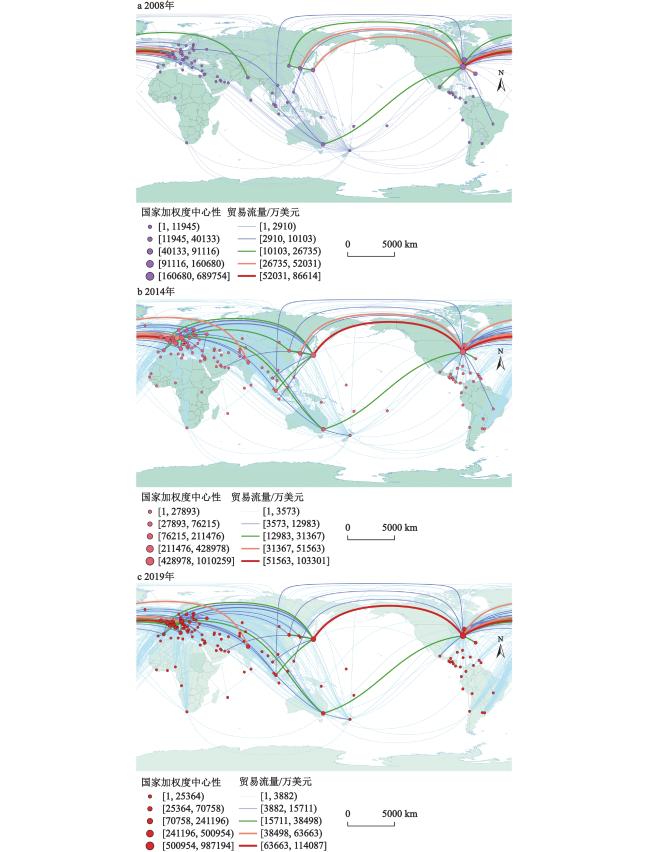
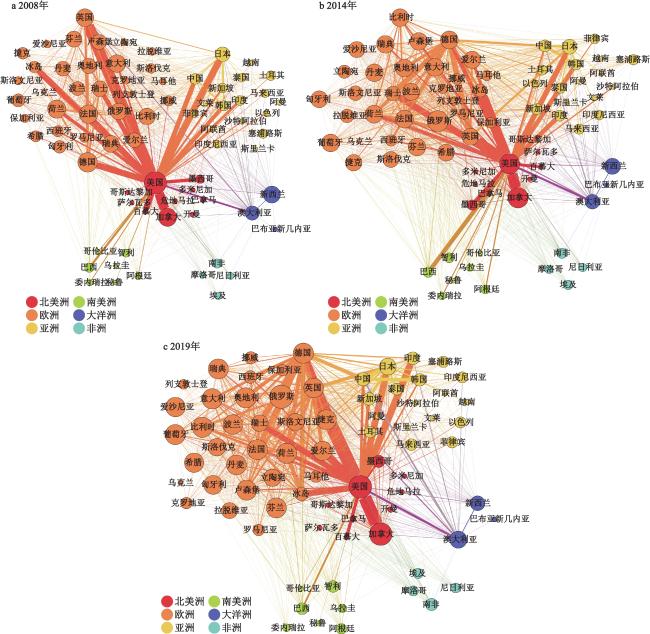
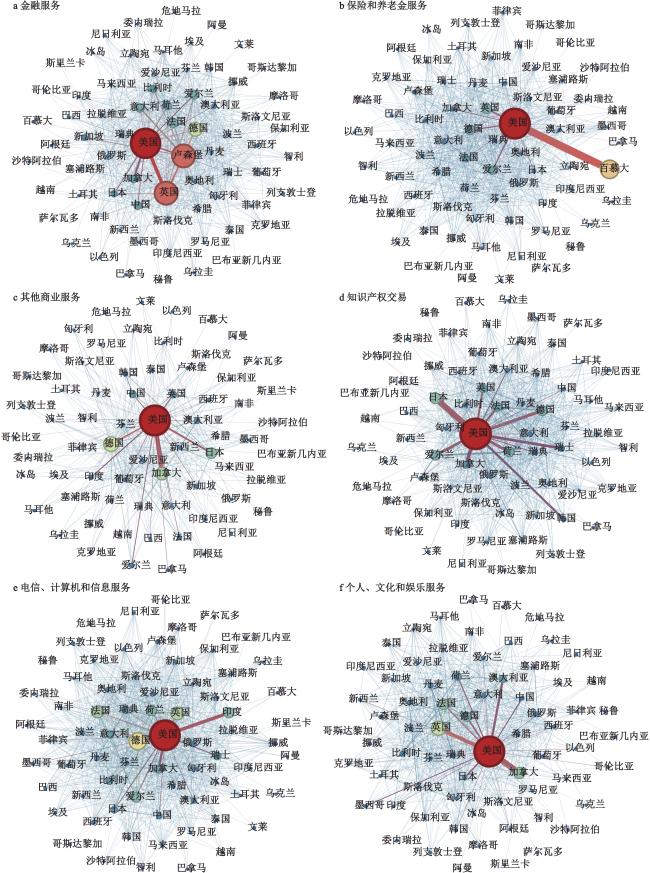
世界经济正处在新旧动能的转换期,数字贸易成为当前经济结构转型的典型特征。本文利用OECD数据库中2008—2019年的贸易数据,筛选出6类数字化程度高的行业,从网络结构和影响因素两方面探究了全球数字贸易结构的演化态势。研究发现:① 全球数字贸易格局空间分布不均衡,主要的贸易节点和贸易联系都分布在西半球和北半球,“美日欧”作为全球数字经济与数字贸易的引领者,在全球数字贸易网络中占据着重要的地位;② 不同行业数字贸易网络的结构和紧密程度有一定差异,但除金融服务的贸易网络为多中心结构外,其他行业的贸易网络均呈现以美国为核心的单中心结构,中国在6类行业的数字贸易网络中均处于外围位置。③ 信息通信技术、对外开放水平、互联网普及程度、相同收入水平、共同货币、共同语言及区域贸易协定均对促进双边贸易流量的提升有积极作用,接壤关系仅在早期有利于贸易流量的提升,宗教文化对数字贸易并无显著影响,而地理距离对开展数字贸易仍具有显著的抑制作用,打破了“距离已死”的说法。本研究旨在探讨全球数字贸易发展的空间分布及演化,以期增强中国在全球数字贸易网络的辐射能力,寻求竞争优势。
马菁 , 曾刚 , 孙康 . 全球数字贸易网络结构演化及影响因素分析[J]. 地理科学, 2024 , 44(3) : 439 -450 . DOI: 10.13249/j.cnki.sgs.20211451
The global economy is undergoing a transition between old and new drivers, with digital trade being a typical characteristic of the current economic structural transformation. In the process of the vigorous development of the digital economy, the field of digital trade has shown strong competitiveness. Compared with traditional trade, it has stronger resilience and can withstand the downward pressure of the global economy. This study utilizes trade data from the OECD database spanning 2008 to 2019, selecting 6 highly digitized industries, to explore the evolution of the global digital trade from both network structure and influencing factors perspectives. The study found that: 1) The spatial distribution of global digital trade is uneven, with major trade nodes and connections concentrated in the Western and Northern Hemispheres. “USA, Japan, and Europe” as leaders in the global digital economy and digital trade play crucial roles in the global digital trade network. 2) Different industries exhibit varying structure and density in digital trade networks. Except for the financial services trade network, which is a polycentric structure, trade networks of other industries are all single-center structures with the United States as the core. China occupies a peripheral position in the digital trade networks of the 6 industries. 3) Information and communication technology, openness level, internet penetration, income levels, currency, language, and regional trade agreements all contribute to the enhancement of bilateral trade flows. Bordering relationship is favorable for boosting trade flows only in the early stages, and religious culture has no significant impact on digital trade. Geographical distance still significantly inhibits digital trade, challenging the notion that “distance is dead”. This study aims to explore the spatial distribution and evolution of global digital trade, in order to enhance China’s radiative capacity in the global digital trade network and seek competitive advantages.
表1 自变量含义、预期效应与理论说明Table 1 Meaning of independent variable, expected effect and theoretical explanation |
| 变量名 | 含义 | 预期符号 | 理论说明 |
| GDPi(j) | 进口(出口)国国内生产总值 | + | 反映了一国的进口需求(出口供给)能力,经济规模总量越大,潜在的进口(出口)能力越大,进而双边的贸易流量也越大 |
| Distij | 进口国和出口国的地理距离 | 不确定 | 数字贸易不受运输成本的限制,但也有研究表明地理距离也会通过影响两国之间的社会文化距离对贸易产生影响[14-16] |
| ECOij | 虚拟变量,表示进口国和出口国是否处于同一收入水平 | 不确定 | 需求相似偏好理论认为,收入水平越接近消费偏好越相似,贸易潜力越大[23],但数字贸易并非传统的有形商品贸易,互补性的需求而非相似需求通常也可能对贸易流量产生影响 |
| Contingij | 虚拟变量,表示进口国和出口国是否接壤 | 不确定 | 当贸易双方接壤时,可以节约交易成本,从而促进货物贸易流量的提升,但边界变量对数字贸易流量的影响尚不明确[24] |
| RTAij | 进口国和出口国t年共同参与的区域贸易协定的数量 | + | 当两国共同参与某个贸易协定时,由于优惠贸易安排,双边贸易流量将会上升[25],开放数据限制的条款、隐私保护条款及促进贸易便利化等条款的签订还能直接促进数字贸易流量的提升[26] |
| curij | 虚拟变量,表示进口国和出口国是否使用同一货币 | + | 两国之间使用共同货币,能避免浮动汇率对贸易的消极影响,促进贸易合作,也利于减少两国之间的贸易摩擦,降低贸易壁垒[27] |
| langij | 虚拟变量,表示进口国和出口国是否使用同一语言 | + | 共同官方语言的使用能降低沟通障碍,为贸易信息获取提供便利,促进双边贸易额的提升[28] |
| religij | 虚拟变量,表示进口国与出口国宗教邻近指数 | 不确定 | 宗教相同的国家其因文化差异导致的冲突较少,文化认同感强,贸易关系较容易建立,但宗教文化对数字贸易的影响尚不明确 |
| ICTi(j) | 进口(出口)国t年ICT产业专利申请数 | + | 信息通信技术可以降低市场情报的成本,如市场调查、客户概况实况调查、营销和推广以及建立分销网络等,从而促进贸易关系的建立,提升贸易流量[11] |
| Interneti(j) | 进口(出口)国t年每100名居民的互联网使用人数 | + | 互联网的使用能够有效提高沟通效率,节省交易成本,为中小企业参与国际贸易提供机会,且是一国数字贸易的基础设施水平的重要体现,互联网普及率越高,数字贸易流量越大[29] |
| FDIi(j) | 进口(出口)国t年外国直接投资存量 | + | 对外直接投资具有贸易创造效应,能通过国际劳动分工促进产业内贸易[30],且能表征一国对外开放程度,一国对外开放程度越高,对外贸易往往越发达 |
表2 贸易引力模型回归结果Table 2 Trade gravity model regression results |
| 变量 | 变量含义 | 模型1 | 模型2 | 模型3 |
| lnWij | lnWij | lnWij | ||
| 注:***、*分别为P<0.01、P<0.1;括号内为稳健标准误。 | ||||
| lnGDPi | 进口国经济规模 | 0.59*** (0.047) | 0.606*** (0.058) | 0.530*** (0.055) |
| lnGDPj | 出口国经济规模 | 0.56*** (0.047) | 0.386*** (0.057) | 0.441*** (0.054) |
| lnDistij | 地理距离 | –0.44*** (0.040) | –0.640*** (0.041) | –0.799*** (0.043) |
| ECOij | 同一收入水平 | 0.313*** (0.096) | 0.425*** (0.097) | 0.334*** (0.099) |
| Contingij | 接壤关系 | 0.001*** (0.051) | 0.421 (0.114) | 0.151 (0.150) |
| RTAij | 区域贸易协定 | 0.343 (0.05) | 0.281 (0.055) | 0.343*** (0.050) |
| curij | 共同货币 | 0.389*** (0.11) | 0.326*** (0.114) | 0.402*** (0.128) |
| langij | 共同语言 | 1.349*** (0.124) | 1.078*** (0.127) | 1.254*** (0.161) |
| religij | 宗教文化 | 0.197 (0.132) | 0.499 (0.153) | 0.290 (0.160) |
| ICTi | 进口国通信技术 | 0.016 (0.025) | 0.06* (0.036) | 0.114*** (0.034) |
| ICTj | 出口国通信技术 | 0.011 (0.025) | 0.148*** (0.037) | 0.245*** (0.035) |
| Interneti | 进口国互联网普及程度 | 0.021*** (0.002) | 0.03*** (0.003) | 0.023*** (0.003) |
| Internetj | 出口国互联网普及程度 | 0.028*** (0.002) | 0.034*** (0.003) | 0.023*** (0.003) |
| FDIi | 进口国对外开放水平 | 0.098*** (0.029) | 0.147*** (0.033) | 0.204*** (0.047) |
| FDIj | 出口国对外开放水平 | 0.19*** (0.029) | 0.279*** (0.032) | 0.129*** (0.047) |
| Constant | 常数项 | –24.248*** (1.318) | –25.86*** (1.625) | –21.794*** (1.749) |
| R2 | 拟合优度 | 0.604 | 0.635 | 0.678 |
| [1] |
黄鹏, 陈靓. 数字经济全球化下的世界经济运行机制与规则构建: 基于要素流动理论的视角[J]. 世界经济研究, 2021(3): 3-13+134.
Huang Peng, Chen Liang. World economic operating mechanism and rules building-up under the digital economic globalization: Based on the perspective of factor mobility theory. World Economy Studies, 2021(3): 3-13+134.
|
| [2] |
González J L, Jouanjean M A. Digital trade: Developing a framework for analysis[R]. Paris: OECD, 2017.
|
| [3] |
刘洪愧. 数字贸易发展的经济效应与推进方略[J]. 改革, 2020(3): 40-52.
Liu Hongkui. The economic effect and development strategy of digital trade. Reform, 2020(3): 40-52.
|
| [4] |
周念利, 李玉昊. RTAs框架下数字知识产权规则的数字贸易效应测度及异质性分析[J]. 国际经贸探索, 2021, 37(5): 35-50.
Zhou Nianli, Li Yuhao. Measurement and heterogeneity analysis of digital trade effect of digital intellectual property rules under the framework of RTAs. International Economics and Trade Research, 2021, 37(5): 35-50.
|
| [5] |
Cho J W. Innovation and competition in the digital network economy[J]. Fresenius Zeitschrift Für Analytische Chemie, 1966, 221(1): 80-85.
|
| [6] |
刘健琦. 谁有可能成为数字贸易强国——主要国家发展潜力研判及其战略研究[D]. 杭州: 浙江大学, 2021.
Liu Jianqi. Who can become powerful countries in digital trade—Research on the development potential and strategies of major countries. Hangzhou: Zhejiang University, 2021.
|
| [7] |
盛斌, 高疆. 超越传统贸易: 数字贸易的内涵、特征与影响[J]. 国外社会科学, 2020(4): 18-32.
Sheng Bin, Gao Jiang. Beyond traditional trade: The connotation, characteristics and impact of digital trade. Social Sciences Abroad, 2020(4): 18-32.
|
| [8] |
伊万·沙拉法诺夫, 白树强. WTO视角下数字产品贸易合作机制研究——基于数字贸易发展现状及壁垒研究[J]. 国际贸易问题, 2018(2): 149-163.
Ivan Sarafanov, Bai Shuqiang. A study on the cooperation mechanism on digital trade within the WTO framework—Based on an analysis on the status and barriers to digital trade. Journal of International Trade, 2018(2): 149-163.
|
| [9] |
陈维涛, 朱柿颖. 数字贸易理论与规则研究进展[J]. 经济学动态, 2019(9): 114-126.
Chen Weitao, Zhu Shiying. Research progress on digital trade theory and rules. Economic Perspectives, 2019(9): 114-126.
|
| [10] |
Gomez-Herrera E, Martens B, Turlea G. The drivers and impediments for cross-border e-commerce in the EU[J]. Information Economics and Policy, 2014, 28(1): 83-96.
|
| [11] |
Ismail N W. Digital trade facilitation and bilateral trade in selected Asian countries[J]. Studies in Economics and Finance, 2021, 38(2): 257-271.
|
| [12] |
郭四维, 张明昂, 王庆, 等. 新常态下的“外贸新引擎”: 我国跨境电子商务发展与传统外贸转型升级[J]. 经济学家, 2018(8): 42-49.
Guo Siwei, Zhang Ming’ang, Wang Qing et al. The “New Engine of Foreign Trade” under the new normal: The development of international e-commerce and the transformation and upgrading of traditional foreign trade. Economist, 2018(8): 42-49.
|
| [13] |
Anderson P, Anderson E. The new e-commerce intermediaries[J]. MIT Sloan Management Review, 2002, 43(4): 53-62.
|
| [14] |
马述忠, 房超, 张洪胜. 跨境电商能否突破地理距离的限制[J]. 财贸经济, 2019, 40(8): 116-131.
Ma Shuzhong, Fang Chao, Zhang Hongsheng. Can cross-border e-commerce declare the death of distance. Finance & Trade Economics, 2019, 40(8): 116-131.
|
| [15] |
Hummels D. Toward a geography of trade costs[Z]. GTAP Working Papers, 1999.
|
| [16] |
Frankel J A. The regionalization of the world economy[M]. Chicago: University of Chicago Press, 1998.
|
| [17] |
Ferracane M F, Kren J, van der Marel E. Do data policy restrictions impact the productivity performance of firms and industries?[J]. Review of International Economics, 2020(28): 676-722.
|
| [18] |
陈寰琦. 签订“跨境数据自由流动”能否有效促进数字贸易——基于OECD服务贸易数据的实证研究[J]. 国际经贸探索, 2020, 36(10): 4-21.
Chen Huanqi. Can the signing of “Free Flow of Cross-border Data” promote digital trade effectively: An empirical study based on OECD data on trade in services. International Economics and Trade Research, 2020, 36(10): 4-21.
|
| [19] |
陆菁, 傅诺. 全球数字贸易崛起: 发展格局与影响因素分析[J]. 社会科学战线, 2018(11): 57-66+281+2.
Lu Jing, Fu Nuo. Rise of global digital trade: Analysis of its development patterns and determinants. Social Science Front, 2018(11): 57-66+281+2.
|
| [20] |
盛斌, 廖明中. 中国的贸易流量与出口潜力: 引力模型的研究[J]. 世界经济, 2004(2): 3-12.
Sheng Bin, Liao Mingzhong. China’s trade volume and export potential: The study on gravity model. World Economy, 2004(2): 3-12.
|
| [21] |
林玲, 王炎. 贸易引力模型对中国双边贸易的实证检验和政策含义[J]. 世界经济研究, 2004(7): 54-58.
Lin Ling, Wang Yan. The empirical evidence and policy implication of the effect of gravity model on China’s bilateral trade. World Economy Studies, 2004(7): 54-58.
|
| [22] |
蒋小荣, 杨永春, 刘清, 等. 多重贸易网络的空间演化特征及其影响因素——基于货物、服务和增加值贸易的比较[J]. 地理科学, 2021, 41(8): 1419-1427.
Jiang Xiaorong, Yang Yongchun, Liu Qing et al. Spatial evolution characteristics and influencing factors of trade multidimensional network: A comparative study based on trade in goods, services and value-added. Scientia Geographica Sinica, 2021, 41(8): 1419-1427.
|
| [23] |
党军, 冯宗宪. 对华贸易摩擦与我国对外贸易地理方向调整——基于收入需求偏好相似理论的分析[J]. 人文地理, 2007, 22(5): 66-68+93.
Dang Jun, Feng Zongxian. The trade disputes towards China and the adjustment of the Chinese international trade by region: An analysis from the theory of demand preference similarity perspective. Human Geography, 2007, 22(5): 66-68+93.
|
| [24] |
邓羽佳, 秦放鸣. 欧亚区域经济一体化背景下中国出口贸易效应及潜力研究[J]. 世界经济研究, 2015(12): 55-65+125.
Deng Yujia, Qin Fangming. The proposed Eurasian regional economic integration's influences on and potentials for China export. World Economy Studies, 2015(12): 55-65+125.
|
| [25] |
赵金龙, 郭传道. 全球价值链视角下区域贸易协定对成员间贸易的促进效应[J]. 国际贸易问题, 2021(1): 111-125.
Zhao Jinlong, Guo Chuandao. Promotion effect of RTAs on members’ trade from the perspective of global value chain. Journal of International Trade, 2021(1): 111-125.
|
| [26] |
彭羽, 杨碧舟, 沈玉良. RTA数字贸易规则如何影响数字服务出口——基于协定条款异质性视角[J]. 国际贸易问题, 2021(4): 110-126.
Peng Yu, Yang Bizhou, Shen Yuliang. How do rules on digital trade in regional trade agreements make a difference to digital service exports—From the perspective of heterogeneity of RTA provisions. Journal of International Trade, 2021(4): 110-126.
|
| [27] |
Bergin P R, Lin C Y. The dynamic effects of a currency union on trade[J]. Journal of International Economics, 2012(87): 191-204.
|
| [28] |
杨文龙, 杜德斌, 马亚华, 等. “一带一路”沿线国家贸易网络空间结构与邻近性[J]. 地理研究, 2018, 37(11): 2218-2235.
Yang Wenlong, Du Debin, Ma Yahua et al. Network structure and proximity of the trade network in the Belt and Road region. Geographical Research, 2018, 37(11): 2218-2235.
|
| [29] |
Choi C. The effect of the internet on services trade[J]. Economics Letters, 2010, 109(2): 102-104.
|
| [30] |
王煌, 邵婧儿. “一带一路”建设下中国OFDI的贸易效应研究——基于GTAP 模型的分析[J]. 国际经贸探索, 2018, 34(2): 36-52.
Wang Huang, Shao Jing’er. Research on trade effects of China’s OFDI under the building of the Belt and Road: Analysis based on GTAP model. International Economics and Trade Research, 2018, 34(2): 36-52.
|
| [31] |
Lendle A, Olarreaga M, Schropp S et al. There goes gravity: eBay and the death of distance[J]. The Economic Journal, 2016, 126(591): 406-441.
|
| [32] |
Blum B S, Goldfarb A. Does the internet defy the law of gravity?[J]. Journal of International Economics, 2006, 70(2): 384-405.
|
| [33] |
Meijers H. Does the internet generate economic growth, international trade, or both?[J]. International Economics and Economic Policy, 2014, 11(1): 137-163.
|
| [34] |
余运江, 杨力, 任会明, 等. 中国城市数字经济空间格局演化与驱动因素[J]. 地理科学, 2023, 43(3): 466-475.
Yu Yunjiang, Yang Li, Ren Huiming et al. Spatial evolution and driving factors of urban digital economy development in China. Scientia Geographica Sinica, 2023, 43(3): 466-475.
|
/
| 〈 |
|
〉 |