



旅游新质生产力及其对地方的作用机制——基于视频化社交媒体场域的案例研究
|
谢晓如(1990—),女,广东揭阳人,博士后,主要从事社会文化地理研究。E-mail: xr.xie@gzhu.edu.cn |
收稿日期: 2024-06-17
修回日期: 2024-08-15
网络出版日期: 2024-11-20
基金资助
国家社科重大项目(21&ZD179)
版权
New quality productive force of tourism and its mechanism on place: A case study of the field of video-based social media
Received date: 2024-06-17
Revised date: 2024-08-15
Online published: 2024-11-20
Supported by
Major Project of the National Social Science Foundation of China(21&ZD179)
Copyright
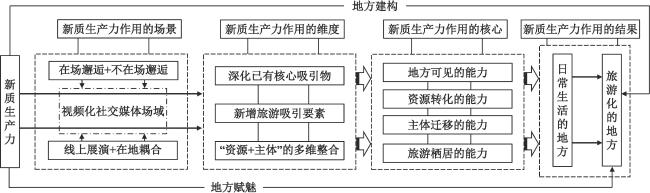
本研究旨在探索中国式现代化背景下对旅游新质生产力的理解与构建,以实现高质量发展的本质要求。研究重点关注旅游业在多元社会经济背景和特定场景中的角色,特别是在强调体验经济和创新发展的趋势下,探讨旅游新质生产力的理论构建。通过文献与案例分析,从3个维度探讨了新质生产力对地方旅游的影响:① 通过深化核心吸引物,夯实已有的旅游吸引基础;② 增加新的旅游吸引要素,重点再造旅游亮点;③ 整合资源,激发地方主体的服务意识和地方认同感,强化地方情感治理。结果表明,视频化社交媒体时代旅游“新质生产力”可以被定义为:一种使原本不受关注的地方被重新“看见”和“显现”的能力、一种促使非旅游资源向旅游资源有效转化并形成吸引的能力、一种帮助旅游者克服空间障碍助推旅游行为主体从客源地向目的地迁移流动的能力,以及一种增强驻留时间促使旅游主体诗意栖居的能力。研究结论指出,旅游新质生产力在视频化社交媒体的推动下,能够显著提升地方旅游吸引力、助推地方经济发展,并为中国式现代化中的旅游业高质量发展提供新的理论依据和实践指导。
谢晓如 , 朱竑 , 胡蕊纯 , 陈晓亮 . 旅游新质生产力及其对地方的作用机制——基于视频化社交媒体场域的案例研究[J]. 地理科学, 2025 , 45(1) : 92 -105 . DOI: 10.13249/j.cnki.sgs.20240655
In the field of tourism research, due to the distinctive nature of industry development and interdisciplinary paradigms, the study of the new quality productive force has unique characteristics. As China experiences social innovation driven by these forces, there is a pressing need for scholars to explore the theoretical construction of tourism’s new quality productive force. In the context of China’s innovative development driven by new quality productive forces, it is crucial to critically explore how the tourism sector, as a unique and integral part of these forces, should be conceptualized and theoretically constructed. Given that tourism is an interdisciplinary field involving multiple sectors, understanding new quality productive forces in tourism should be considered within diverse socio-economic contexts and specific scenarios. This study aims to understand and conceptualize these forces within the context of China’s modernization to achieve high-quality development. It focuses on the role of tourism in diverse socio-economic settings, particularly in the experience economy and innovative development. Through literature and case analysis, the study examines how the new quality productive force impacts local tourism by enhancing core attractions, introducing new elements, and integrating resources to strengthen local identity and emotional governance. It puts forward that, the new quality productive forces in tourism influence places by deepening existing core attractions and reinforcing the foundational tourist allure, while also adding new tourism elements and creating new highlights. Furthermore, they integrate resources, invigorating the service awareness and territorial characteristics of local stakeholders, and emphasizing the cultivation of place sense. In the era of video-based social media, the new quality productive forces in tourism can be defined as the capability to make previously overlooked places visible, the ability to transform non-tourism resources into attractive tourist assets, the power to overcome spatial barriers and facilitate the movement of tourists from their place of origin to the destination, and the capacity to enhance the duration of tourists’ stays, fostering a more immersive and poetic dwelling. These capabilities collectively shape the transformative potential of new quality productive forces in the tourism sector, driving sustainable and innovative development in alignment with the broader goals of high-quality growth. Ultimately, the study highlights how these forces, fueled by social media, can boost local tourism appeal and contribute to China’s modernization, offering insights for future research on how innovative technologies can enhance local sustainability.
| [1] |
方创琳, 孙彪. 新质生产力的地理学内涵及驱动城乡融合发展的重点方向[J]. 地理学报, 2024, 79(6): 1357-1370
Fang Chuanglin, Sun Biao. The connotation of new quality productive forces and research priorities for driving urban-rural integrated development from the geographical perspective[J]. Acta Geographica Sinica, 2024, 79(6): 1357-1370.
|
| [2] |
孙九霞, 李菲, 王学基. “旅游中国”: 四十年旅游发展与当代社会变迁[J]. 中国社会科学, 2023(11): 84-104+206
Sun Jiuxia, Li Fei, Wang Xueji. “Tourism China”: Forty years of tourism development and contemporary social changes[J]. Social Sciences in China, 2023(11): 84-104+206.
|
| [3] |
朱竑, 陈晓亮, 尹铎. 从“绿水青山”到“金山银山”: 欠发达地区乡村生态产品价值实现的阶段、路径与制度研究[J]. 管理世界, 2023, 39(8): 74-91
Zhu Hong, Chen Xiaoliang, Yin Duo. Transforming “green water and green mountains” into “golden mountains and silver mountains”: Research on the stage, path and system of the value realization of rural ecological products in underdeveloped areas[J]. Journal of Management World, 2023, 39(8): 74-91.
|
| [4] |
厉新建,曾博伟,张辉,等. 新质生产力与旅游业高质量发展[J]. 旅游学刊, 2024, 39(5): 15-29
Li Xinjian, Zeng Bowei, Zhang Hui et al. New quality productivity and high-quality development of tourism[J]. Tourism Tribune, 2024, 39(5): 15-29.
|
| [5] |
Ahmed Y A, Ahmad M N, Ahmad N et al. Social media for knowledge-sharing: A systematic literature review[J]. Telematics and Informatics, 2019, 37: 72-112.
|
| [6] |
Gretzel U, Yoo K. Use and impact of online travel reviews[M]//O’Connor P et al. Information and communication technologies in tourism 2008. Vienna, Austria: Springer-Verlag Wien, 2008: 35-46.
|
| [7] |
Nuenen T, Scarles C. Advancements in technology and digital media in tourism[J]. Tourist Studies, 2021, 21(1): 119-32.
|
| [8] |
Zhou Q, Sotiriadis M, Shen S. Using TikTok in tourism destination choice: A young Chinese tourists’ perspec-tive[J]. Tourism Management Perspectives, 2023, 46: 101101.
|
| [9] |
Zeng B, Gerritsen R. What do we know about social media in tourism?—A review[J]. Tourism Management Perspectives, 2014, 10: 27-36.
|
| [10] |
Wengel Y, Ma L, Ma Y et al. The TikTok effect on destination development: Famous overnight, now what?[J]. Journal of Outdoor Recreation and Tourism, 2022, 37: 100458.
|
| [11] |
Bassano C, Barile S, Piciocchi P et al Storytelling about places: Tourism marketing in the digital age[J]. Cities, 2019, 87: 10-20.
|
| [12] |
Drews W, Schemer C. E-Tourism for all? Online travel planning of disabled people[M]//Gretzel U et al. Information and communication technologies in tourism 2010. Vienna, Austria: Springer-Verlag Wien, 2010: 507-518.
|
| [13] |
Fotis J, Buhalis D, Rossides N. Social media use and impact during the holiday travel planning process[M]//Fuch M et al. Information and communication technologies in tourism. Vienna, Austria: Springer-Verlag Wien, 2012: 13-24.
|
| [14] |
Litvin S W, Goldsmith R E, Pan B. Electronic word-of-mouth in hospitality and tourism management[J]. Tourism management, 2008, 29(3): 458-468.
|
| [15] |
Zhang Z. Infrastructuralization of TikTok: Transformation, power relationships, and platformization of video entertainment in China[J]. Media, Culture, Society, 2021, 43(2): 219-236.
|
| [16] |
Rastrilla L P, Sapag P, García A R. Fast politics: Propaganda in the age of TikTok[M]. Singapore: Springer Nature, 2023.
|
| [17] |
Jordan J M. The rise of the algorithms: How YouTube and TikTok conquered the world[M]. State College: Penn State University Press, 2024.
|
| [18] |
De Souza J, Mendes-Filho L, Buhalis D. Evaluating the effectiveness of tourist advertising to improve the competitiveness of destinations[J]. Tourism Economics, 2020, 26(6): 1001-1020.
|
| [19] |
Chen H, Wu X, Zhang Y. Impact of short video marketing on tourist destination perception in the post-pandemic era[J]. Sustainability, 2023, 15(13): 10220.
|
| [20] |
Wang Y, Guo R. Tourism e-commerce marketing following live-streaming: Consumer behavior and verification psychology[J/OL]. Tourism Review, 2024. https://doi.org/10.1108/TR-10-2023-0738.
|
| [21] |
Deng Z, Benckendorff P, Wang J. Travel live streaming: An affordance perspective[J]. Information Technology, Tourism, 2021, 23(2): 189-207.
|
| [22] |
殷乐, 高慧敏. 传统媒体新闻短视频发展现状与传播态势[J]. 当代传播, 2018, 6(6): 45-50
Yin Le, Gao Huimin. The current status and dissemination trend of short news videos in traditional media[J]. Contemporary Communication, 2018, 6(6): 45-50.
|
| [23] |
Lee K, Zhou J, Koo C. From fan to become tourist: Watching online videos as seamlessly connecting travel[J]. Journal of Hospitality and Tourism Technology, 2023, 14(4): 598-629.
|
| [24] |
Li Y, Hayes S. Comparing the influences of tourism live streaming and short-form video for young Chinese: A qualitative investigation[J]. Journal of China Tourism Research, 2024, 20(1): 167-191.
|
| [25] |
Wang X, Yu Y, Zhu Z, Zheng J. Visiting intentions toward theme parks: Do short video content and tourists’ perceived playfulness on TikTok matter?[J]. Sustainability, 2022, 14(19): 12206.
|
| [26] |
Bærenholdt J O, Haldrup M, Larsen J et al. Performing tourist places[M]. London and New York: Routledge, 2004.
|
| [27] |
Yin J, Qu X, Ni Y. The marketing of destination distinctiveness: The power of tourism short videos with enjoyability and authenticity[J]. Current Issues in Tourism, 2024, 27(14): 2217-2229.
|
| [28] |
Haldrup M, Larsen J. Tourism, performance and the everyday: Consuming the orient[M]. London and New York: Routledge, 2010.
|
| [29] |
Battarbee K, Koskinen I. Co-experience: User experience as interaction[J]. CoDesign, 2005, 1(1): 5-18.
|
| [30] |
Goffman E. The presentation of self in everyday life[M]. New York: Anchor Books, 1959.
|
| [31] |
孙九霞. 作为一种“社会形式”的旅游: “地方”视角[J]. 旅游学刊, 2017, 32(12): 12-14
Sun Jiuxia. Tourism as a “social form”: A “place” perspective[J]. Tourism Tribune, 2017, 32(12): 12-14.
|
| [32] |
钱俊希. 地方性研究的理论视角及其对旅游研究的启示[J]. 旅游学刊, 2013, 28(3): 5-7
Qian Junxi. Theoretical perspectives of local studies and their implications for tourism research[J]. Tourism Tribune, 2013, 28(3): 5-7.
|
| [33] |
Fisker J K, Johansen P H, Jensen M T et al. Performing rurality in online community groups[J]. Rural Sociology, 2022, 87(3): 993-1016.
|
| [34] |
Schroeder R. The globalization of on-screen sociability: Social media and tethered togetherness[J]. International Journal of Communication, 2016, 10: 5626-43.
|
| [35] |
Wilson G. Language ideologies and identities on Facebook and TikTok: A southern Caribbean perspective[M]. Cambridge: Cambridge University Press, 2024.
|
| [36] |
Boffone T. TikTok cultures in the United States[M]. New York: Routledge, 2022.
|
| [37] |
刘慧悦, 阎敏君. 移动短视频使用对旅游者行为意愿的影响研究[J]. 旅游学刊, 2021, 36(10): 62-73
Liu Huiyue, Yan Minjun. Influence of mobile short-form video on tourist behavioural intentions[J]. Tourism Tribune, 2021, 36(10): 62-73.
|
| [38] |
Mueser D, Vlachos P. Almost like being there? A conceptualisation of live-streaming theatre[J]. International Journal of Event and Festival Management, 2018, 9(2): 183-203.
|
| [39] |
Shao T, Wang R, Hao J X. Visual destination images in user-generated short videos: An exploratory study on Douyin[C]. Shenzhen: 2019 16th International Conference on Service Systems and Service Management (ICSSSM), 2019: 1-5.
|
| [40] |
冯学钢, 梁茹. 促进我国在线新文旅市场主体建设的对策建议[J]. 旅游学刊, 2021, 36(7): 1-3
Feng Xuegang, Liang Ru. Suggestions on promoting the construction of new online cultural tourism market players in my country[J]. Tourism Tribune, 2021, 36(7): 1-3.
|
| [41] |
Tham A, Chen S H, Durbidge L. A pentadic analysis of TikTok marketing in tourism: The case of Penang, Malaysia[J]. Tourist Studies, 2024, 24(1): 75-103.
|
| [42] |
孙晶, 刘建国, 杨新军, 等. 人类世可持续发展背景下的远程耦合框架及其应用[J]. 地理学报, 2020, 75(11): 2408-2416
Sun Jing, Liu Jianguo, Yang Xinjun et al. Sustainability in the anthropocene: Telecoupling framework and its applications[J]. Acta Geographica Sinica, 2020, 75(11): 2408-2416.
|
| [43] |
Hull V, Liu J. Telecoupling: A new frontier for global sustainability[J]. Ecology and Society, 2018, 23(4): 41.
|
| [44] |
林毅夫. 新质生产力: 中国创新发展的着力点与内在逻辑[M]. 北京: 中信出版社, 2024
Lin Yifu. New quality productivity: The focus and internal logic of China’s innovative development. Beijing: CITIC Press, 2024.
|
| [45] |
杨勇. 旅游新质生产力: 供需特质、创新取向与新旧之辩[J]. 旅游导刊, 2024, 8(3): 48-57
Yang Yong. New quality productivity of tourism: Supply and demand characteristics, innovation orientation and the debate between the old and the new[J]. Tourism and Hospitality Prospects, 2024, 8(3): 48-57.
|
| [46] |
厉新建, 宋昌耀, 张安妮. 旅游业新质生产力: 难点与方向[J]. 旅游导刊, 2024, 8(3): 23-33
Li Xinjian, Song Changyao, Zhang Anni. New quality productivity of tourism: Difficulties and directions[J]. Tourism and Hospitality Prospects, 2024, 8(3): 23-33.
|
| [47] |
陈晓亮, 蔡晓梅, 朱竑. 基于“地方场域”视角的中国旅游研究反思[J]. 地理研究, 2019, 38(11): 2578-2594
Chen Xiaoliang, Cai Xiaomei, Zhu Hong. Reflection on China’s tourism study based on the perspective of field of place[J]. Geographical Research, 2019, 38(11): 2578-2594.
|
| [48] |
王金伟, 蓝浩洋, 陈嘉菲. 固守与重塑: 乡村旅游介入下传统村落居民地方身份建构——以北京爨底下村为例[J]. 旅游学刊, 2023, 38(5): 87-101
Wang Jinwei, Lan Hanyang, Chen Jiafei. Defend and remold-residents’ place identity construction in traditional villages in the rural tourism context: A case study of Cuandixia Village, Beijing[J]. Tourism Tribune, 2023, 38(5): 87-101.
|
| [49] |
牟伦超, 程励. 空间生产视域下“古”镇旅游的地方营造——以恩施土家女儿城为例[J]. 旅游学刊, 2023, 38(3): 107-124
Mou Lunchao, Cheng Li. The place making of “ancient” town tourism from the perspective of the theory of production of space production: A case from Enshi Tujia Daughter Town[J]. Tourism Tribune, 2023, 38(3): 107-124.
|
/
| 〈 |
|
〉 |