



长江江苏段滨岸陆域土地利用和植被覆盖变化特征及响应研究
|
陶正涛(1997―),男,江苏扬州人,硕士研究生,主要从事资源利用与可持续发展研究。E-mail: neuromancerlsh@163.com |
收稿日期: 2024-09-26
网络出版日期: 2025-12-15
基金资助
国家自然科学基金项目(42571348)
湖泊与流域水安全全国重点实验室项目(NKL2023-KP03)
版权
Characteristics and response of land use and vegetation coverage changes in the riparian buffer of the Yangtze River in Jiangsu Province
Received date: 2024-09-26
Online published: 2025-12-15
Supported by
National Natural Science Foundation of China(42571348)
State Key Laboratory of Lake and Watershed Science for Water Security(NKL2023-KP03)
Copyright
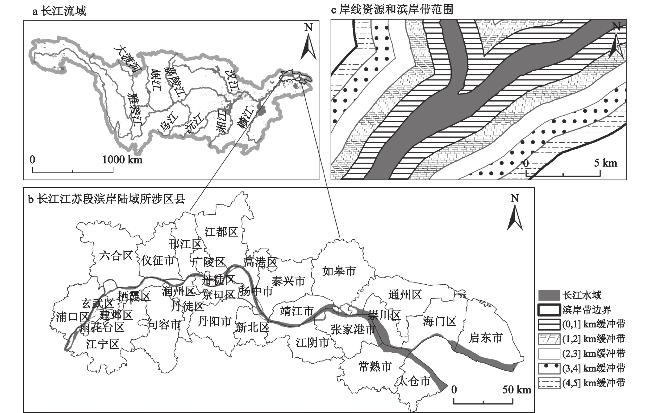
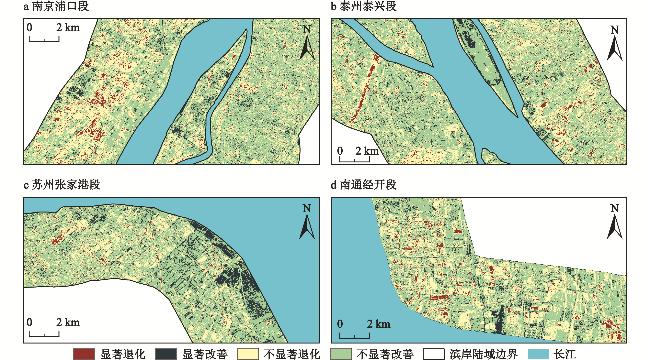
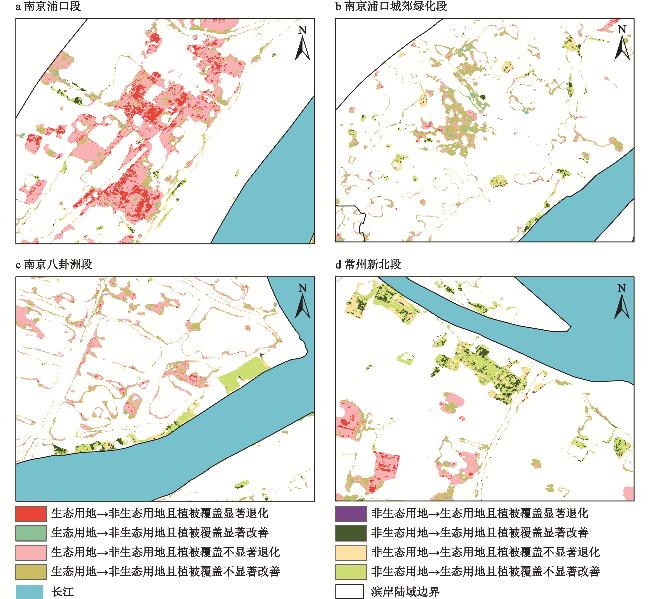
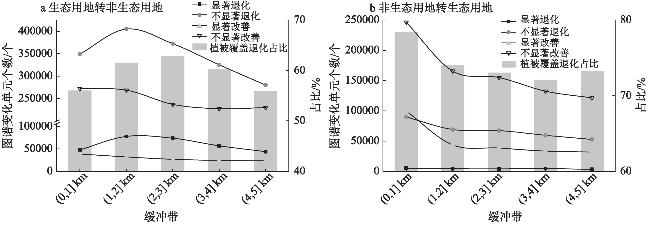
以长江江苏段滨岸陆域为例,基于2017―2021年土地利用数据与归一化植被指数,采用植被覆盖趋势分析、显著性检验和土地利用图谱等方法,从纵深缓冲带视角探究滨岸陆域土地利用、植被覆盖及其响应的时空分异特征。研究表明:①研究区非生态用地扩张,但植被覆盖改善显著,植被覆盖改善的区域占62.91%,土地利用转移中20.95%由非生态用地转化为生态用地;②植被覆盖与土地利用变化存在响应关系,植被覆盖的改善响应更为显著,非生态用地转生态用地导致植被改善的图谱比例为74.8%,而生态用地转非生态用地导致植被退化的图谱比例为59.5%;③土地利用和植被覆盖变化表现出明显的纵深空间差异性,不同纵深缓冲带离岸越近,非生态用地向生态用地转移面积越大,植被覆盖改善越明显,深刻反映出长江大保护政策的成效。
陶正涛 , 段学军 , 马腾 , 邹辉 . 长江江苏段滨岸陆域土地利用和植被覆盖变化特征及响应研究[J]. 地理科学, 2025 , 45(11) : 2386 -2396 . DOI: 10.13249/j.cnki.sgs.20230926
Taking riparian buffer of the Yangtze River in Jiangsu Province as an example, based on land use data and Normalized Difference Vegetation Index from 2017 to 2021, this study analyzed land use and vegetation coverage by means of vegetation coverage trend analysis, significance test and land use geo-spectrum. Exploring temporal and spatial difference of land use and vegetation coverage characteristics and responses in riparian buffer from the perspective of buffer zone. Results show that: 1) Non-ecological land expanded, but vegetation coverage improved significantly, vegetation coverage have improved in 62.91% of the areas, and 20.95% of land use transfer was converted from non-ecological land to ecological land; 2) There was a response relationship between vegetation coverage and land use change. The response of vegetation coverage improvement was more significant than that of degradation. Conversion of non-ecological land to ecological land led to vegetation improvement in 74.8%, while the conversion of ecological land to non-ecological land led to vegetation degradation in 59.5% in the geo-spectrum; 3) Land use and vegetation cover changes showed obvious spatial differences in depth. The closer the depth buffer zone is to the shore, the larger the transfer area of non-ecological land to ecological land, and the more obvious the improvement of vegetation coverage, which profoundly reflects the effectiveness of the Yangtze River Protection policy.
表1 长江江苏段滨岸陆域土地利用转移/km2Table 1 Land use transfer chord diagram of riparian buffer of the Yangtze River in Jiangsu Province/km2 |
| 土地利用类型 | 2021年 | ||||||||
| 水域 | 林地 | 湿地 | 耕地 | 草地 | 建成区 | 裸地 | 总计 | ||
| 2017年 | 水域 | 248.39 | 2.70 | 3.36 | 26.49 | 7.17 | 26.03 | 0.16 | 314.30 |
| 林地 | 0.95 | 68.04 | 0.56 | 7.91 | 6.66 | 9.86 | 0.07 | 94.05 | |
| 湿地 | 1.32 | 0.90 | 4.28 | 2.94 | 4.91 | 0.36 | 0.01 | 14.73 | |
| 耕地 | 30.82 | 20.32 | 3.57 | 48.06 | 270.60 | 1.16 | |||
| 草地 | 2.39 | 6.08 | 1.06 | 13.61 | 46.89 | 32.72 | 1.06 | 103.82 | |
| 建成区 | 15.24 | 4.49 | 0.39 | 103.17 | 16.89 | 1.29 | |||
| 裸地 | 0.45 | 0.04 | 0.10 | 1.93 | 1.65 | 6.27 | 1.75 | 12.20 | |
| 总计 | 299.56 | 102.58 | 13.31 | 132.22 | 5.51 | ||||
表2 土地利用和植被覆盖变化响应图谱特征Table 2 Characteristics of land use and vegetation coverage change response geo-spectrum |
| 编码 | 土地利用和植被覆盖变化类型 | 图谱变化单元个数/个 | 变化比例/% | 空间分离度 |
| 生态用地→非生态用地且植被覆盖显著退化 | 6.20 | 0.20 | ||
| 生态用地→非生态用地且植被覆盖不显著退化 | 35.73 | 0.08 | ||
| 生态用地→非生态用地且植被覆盖显著改善 | 3.02 | 0.37 | ||
| 生态用地→非生态用地且植被覆盖不显著改善 | 25.51 | 0.10 | ||
| 非生态用地→生态用地且植被覆盖显著退化 | 0.44 | 0.93 | ||
| 非生态用地→生态用地且植被覆盖不显著退化 | 7.01 | 0.19 | ||
| 非生态用地→生态用地且植被覆盖显著改善 | 5.10 | 0.29 | ||
| 非生态用地→生态用地且植被覆盖不显著改善 | 17.00 | 0.12 |
表3 不同缓冲带植被覆盖变化面积和显著趋势占比/%Table 3 Proportion of vegetation coverage change area and significant trend of different buffers/% |
| 缓冲带 | 改善和退化趋势占比 | 显著趋势的占比 | |||
| 改善 | 退化 | 改善 | 退化 | ||
| (0,1] km缓冲带 | 64.77 | 35.23 | 13.81 | 7.28 | |
| (1,2] km缓冲带 | 61.97 | 38.03 | 12.42 | 9.60 | |
| (2,3] km缓冲带 | 61.36 | 38.64 | 11.97 | 9.56 | |
| (3,4] km缓冲带 | 62.18 | 37.82 | 12.06 | 9.12 | |
| (4,5] km缓冲带 | 64.00 | 36.00 | 12.50 | 8.55 | |
| [1] |
王明铭, 俞洁, 魏俊, 等. 基于文献计量学的滨岸生态缓冲带研究综述(1999—2020)[M]//中国环境科学学会环境工程分会. 中国环境科学学会2022年科学技术年会——环境工程技术创新与应用分会场论文集(三). 北京: 《工业建筑》杂志社有限公司, 2022
Wang Mingming, Yu Jie, Wei Jun et al. A review on the riparian buffer strip by Bibliometrics (1999—2020). //Environmental engineering Branch of the Chinese Society of Environmental Sciences, 2022 Annual Conference of Science and Technology of the Chinese Society of Environmental Sciences-Environmental engineering Technology Innovation and Application Forum Collection (III). Beijing: Industrial Construction Magazine Agency Co., LTD, 2022.
|
| [2] |
Singh R, Tiwari A K et al. Managing riparian zones for river health improvement: an integrated approach[J]. Landscape and Ecological Engineering, 2021, 17(2): 195-223.
|
| [3] |
Cole L J, Stockan J, Helliwell R et al. Managing riparian buffer strips to optimise ecosystem services: A review[J]. Agriculture, Ecosystems & Environment, 2020, 296: 106891.
|
| [4] |
Naiman R J, H Decamps. The ecology of interfaces: Riparian zones[J]. Annual Review of Ecology and Systematics, 1997, 28 621-658
|
| [5] |
王佳恒, 颜蔚, 段学军, 等. 湖泊生态缓冲带识别与生态系统服务价值评估——以滇池为例[J]. 生态学报, 2023, 43(3): 1005-1015.
Wang Jiaheng, Yan Wei, Duan Xuejun et al. Lake ecological buffer zone identification and ecosystem service value evaluation: A case study of Lake Dianchi. Acta Ecologica Sinica, 2023, 43(3): 1005-1015.
|
| [6] |
Li H, Li Y, Gao Y et al. Human impact on vegetation dynamics around Lhasa, Southern Tibetan Plateau, China[J]. Sustainability, 2016, 8(11): 1146
|
| [7] |
Jin Kai, Wang Fei, Li Pengfei et al. Responses of vegetation cover to environmental change in large cities of China[J]. Sustainability, 2018, 10(1): 270
|
| [8] |
寻芳芳. 长江经济带资源环境承载力研究[D]. 北京: 中国地质大学(北京), 2019
Xun Fangfang. Research on resource and environment carrying capacity of the Yangtze River economic belt. Beijing: China University of Geosciences Beijing, 2019.
|
| [9] |
Sun J, Wang X, Chen A et al. NDVI indicated characteristics of vegetation cover change in China’s metropolises over the last three decades[J]. Environmental Monitoring and Assessment, 2011, 1791-4: 1-14.
|
| [10] |
段学军, 王磊, 邹辉, 等. 长江经济带生态环境治理成效与绿色发展态势[J]. 长江流域资源与环境, 2022, 31(8): 1677-1684.
Duan Xuejun, Wang Lei, Zou Hui et al. Achievements in ecological and environmental governance and green development in the Yangtze River Economic Belt. Resources and Environment in the Yangtze Basin, 2022, 31(8): 1677-1684.
|
| [11] |
易浪, 任志远, 张翀, 等, 黄土高原植被覆盖变化与气候和人类活动的关系[J]. 资源科学, 2014, 36(1): 166-174
Yi Lang, Ren Zhiyuan, Zhang Chong et al. Vegetation cover, climate and human activities on the Loess Plateau, Resources Science, 2014, 36(1): 166-174.
|
| [12] |
李昊, 蔡运龙, 陈睿山, 等, 基于植被遥感的西南喀斯特退耕还林工程效果评价——以贵州省毕节地区为例[J]. 生态学报, 2011, 31(12): 3255-3264
Li Hao, Cai Yunlong, Chen Ruishan et al. Effect assessment of the project of grain for green in the Karst region in Southwestern China: A case study of Bijie Prefecture. Acta Ecologica Sinica, 2011, 31(12): 3255-3264.
|
| [13] |
易浪, 孙颖, 尹少华, 等, 2000—2019年长江流域植被覆盖时空演化及其驱动因素[J]. 生态学报, 2023, 43(2): 798-811
Yi Lang, Sun Ying, Yin Shaohua et al. Spatial-temporal variations of vegetation coverage and its driving factors in the Yangtze River Basin from 2000 to 2019. Acta Ecologica Sinica, 2023, 43(2): 798-811.
|
| [14] |
王德旺, 何萍, 徐杰, 等, 长江大保护5年来流域土地利用和生态系统服务变化[J]. 环境工程技术学报, 2022, 12(2): 408-416
Wang Dewang, He Ping, Xu Jie et al. Changes of land use and ecosystem service in the Yangtze River Basin after five years’ general protection. Journal of Environmental Engineering Technology, 2022, 12(2): 408-416.
|
| [15] |
孔雪松, 陈俊励, 王静, 等. 耦合土地利用格局与过程变化的生态干扰评价——以长三角地区为例[J]. 地理科学, 2021, 41(11): 2031-2041.
Kong Xuesong, Chen Junli, Wang Jing et al. Evaluation of ecological disturbance coupling land use pattern and process change: Taking the Yangtze River Delta as an example. Scientia Geographica Sinica, 2021, 41(11): 2031-2041.
|
| [16] |
Kalnay E, M Cai. Impact of urbanization and land-use change on climate[J]. Nature, 2003, 423(6939): 528-531.
|
| [17] |
Fang Chuanglin, Liu Haimeng, Li Guangdong. International progress and evaluation on interactive coupling effects between urbanization and the eco-environment[J]. Journal of Geographical Sciences, 2016, 26(8): 1081-1116.
|
| [18] |
Gitelson A A. Novel algorithms for remote estimation of vegetation fraction[J]. Remote Sensing of Environment, 2002, 80(1): 76-87.
|
| [19] |
郭铌. 植被指数及其研究进展[J]. 干旱气象, 2003, 21(4): 71-75
Guo Ni. Vegetation index and its advances. Journal of Arid Meteorology, 2003, 21(4): 71-75.
|
| [20] |
梁尧钦, 曾辉, 李菁, 等, 深圳市大鹏半岛土地利用变化对植被覆盖动态的影响[J]. 应用生态学报, 2012.23(1): 199-205
Liang Yaoqin, Zeng Hui, Li Jing et al. Influence of land use change on vegetation cover dynamics in Dapeng Peninsula of Shenzhen, Guangdong Province of South China. Chinese Journal of Applied Ecology, 2012, 23(1): 199-205.
|
| [21] |
王宗明, 国志兴, 宋开山, 等, 2000—2005年三江平原土地利用/覆被变化对植被净初级生产力的影响研究[J]. 自然资源学报, 2009, 24(1): 136-146
Wang Zongming, Guo Zhixing, Song Kaishan et al. Effects of land use/cover change on net primary productivity of Sanjiang Plain, during 2000—2005. Journal of Natural Resources, 2009, 24(1): 136-146.
|
| [22] |
张江, 袁旻舒, 张婧, 等, 近30年来青藏高原高寒草地NDVI动态变化对自然及人为因子的响应[J]. 生态学报, 2020.40(18): 6269-6281
Zhang Jiang, Yuan Minshu, Zhang Jing et al. Responses of the NDVI of alpine grasslands on the Qinghai-Tibetan Plateau to climate change and human activities over the last 30 years. Acta Ecologica Sinica, 2020, 40(18): 6269-6281.
|
| [23] |
韩美, 孔祥伦, 李云龙, 等. 黄河三角洲“三生”用地转型的生态环境效应及其空间分异机制[J]. 地理科学, 2021, 41(6): 1009-1018.
Han Mei, Kong Xianglun, Li Yunlong et al. Eco-environmental effects and its spatial heterogeneity of ‘ecological-production-living’ land use transformation in the Yellow River Delta. Scientia Geographica Sinica, 2021, 41(6): 1009-1018.
|
| [24] |
杨清可, 段学军, 王磊, 等. 基于“三生空间”的土地利用转型与生态环境效应——以长江三角洲核心区为例[J]. 地理科学, 2018, 38(1): 97-106.
Yang Qingke, Duan Xuejun, Wang Lei et al. Land use transformation based on ecological-production-living spaces and associated eco-environment effects: A case study in the Yangtze River delta. Scientia Geographica Sinica, 2018, 38(1): 97-106.
|
| [25] |
刘晓曼, 王超, 肖如林, 等. 中国重要生态保护区域人类干扰时空变化特征分析[J]. 地理科学, 2022, 42(6): 1082-1090.
Liu Xiaoman, Wang Chao, Xiao Rulin et al. Characteristics of human disturbance and the spatio-temporal changes of important ecological protection areas in China. Scientia Geographica Sinica, 2022, 42(6): 1082-1090.
|
| [26] |
段学军, 陈雯, 朱红云, 等, 长江岸线资源利用功能区划方法研究——以南通市域长江岸线为例[J]. 长江流域资源与环境, 2006, (5): 621-626
Duan Xuejun, Chen Wen, Zhu Hongyun et al. Method to make function division of waterfront resourses along the Yangtze River—A sample on the waterfront for Nantong City. Resources and Environment in the Yangtze Basin. 2006, (5): 621-626.
|
| [27] |
段学军, 邹辉, 王晓龙, 等. 长江经济带岸线资源保护与科学利用[J]. 中国科学院院刊, 2020, 35(8): 970-976
Duan Xuejun, Zou Hui, Wang Xiaolong et al. Protection and scientific utilization of waterfront resources in the Yangtze River Economic Belt. Bulletin of the Chinese Academy of Sciences. 2020, 35(8): 970-976.
|
| [28] |
张哲, 倪贺伟, 王维, 等, 长江流域不同尺度岸带区域的土地利用及其变化[J]. 环境工程技术学报, 2017.7(4): 500-508
Zhang Zhe, Ni Hewei, Wang Wei et al. Land use and change of riparian zone at different scales in the Yangtze River Basin. Journal of Environmental Engineering Technology, 2017, 7(4): 500-508.
|
| [29] |
龙花楼, 刘永强, 李婷婷, 等, 生态用地分类初步研究[J]. 生态环境学报, 2015,24(1): 1-7
Long Hualou, Liu Yongqiang, Li Tingting et al. A primary study on ecological land use classification. Ecology and Environmental Sciences, 2015, 24(1): 1-7.
|
| [30] |
刘宪锋, 潘耀忠, 朱秀芳, 等, 2000—2014年秦巴山区植被覆盖时空变化特征及其归因[J]. 地理学报, 2015, 70(5): 705-716
Liu Xianfeng, Pan Yaozhong, Zhu Xiufang et al. Spatiotemporal variation of vegetation coverage in Qinling-Daba Mountains in relation to environmental factors. Acta Geographica Sinica, 2015, 70(5): 705-716.
|
| [31] |
李卓, 孙然好, 张继超, 等, 京津冀城市群地区植被覆盖动态变化时空分析[J]. 生态学报, 2017, 37(22): 7418-7426
Li Zhuo, Sun Ranhao, Zhang Jichao et al. Temporal-spatial analysis of vegetation coverage dynamics in Beijing-Tianjin-Hebei metropolitan regions. Acta Ecologica Sinica, 2017, 37(22): 7418-7426.
|
| [32] |
张国坤, 邓伟, 张洪岩, 等, 新开河流域土地利用格局变化图谱分析[J]. 地理学报, 2010, 65(9): 1111-1120
Zhang Guokun, Deng Wei, Zhang Hongyan et al. The TUPU analysis of land use pattern in Xinkai River basin. Acta Geographica Sinica, 2010, 65(9): 1111-1120.
|
| [33] |
常雄凯, 刘淼, 李春林, 等, 辽宁沿海土地利用变化的图谱特征[J]. 生态学杂志, 2015, 34(12): 3459-3465
Chang Xiongkai, Liu Miao, Li Chunlin et al. Geo-spectrum characteristics of land use change in Liaoning coastal areas. Chinese Journal of Ecology, 2015, 34(12): 3459-3465.
|
| [34] |
吕晓, 史洋洋, 黄贤金, 等, 江苏省土地利用变化的图谱特征[J]. 应用生态学报, 2016, 27(4): 1077-1084
Lyu Xiao, Shi Yangyang, Huang Xianjin et al. Geo-spectrum characteristics of land use change in Jiangsu Province, China. Chinese Journal of Applied Ecology, 2016, 27(4): 1077-1084.
|
| [35] |
侯利萍, 何萍, 钱金平, 等, 河岸缓冲带宽度确定方法研究综述[J]. 湿地科学, 2012, 10(4): 500-506
Hou Liping, He Ping, Qian Jinping et al. A review on determination methods for width of riparian buffer. Wetland Science, 2012, 10(4): 500-506.
|
| [36] |
魏佳豪, 温玉玲, 龚志军, 等, 近30年鄱阳湖1~2 km缓冲带土地利用变化及生态系统服务价值[J]. 生态学报, 2022, 42(22): 9261-9273
Wei Jiahao, Wen Yuling, Gong Zhijun et al. Land use changes and ecosystem service value in the buffer zone of Poyang Lake in recent 30 years. Acta Ecologica Sinica, 2022, 42(22): 9261-9273.
|
| [37] |
王思, 张路路, 林伟彪, 等. 基于MODIS-归一化植被指数的广东省植被覆盖与土地利用变化研究[J]. 生态学报, 2022, 42(6): 2149-2163.
Wang Si, Zhang Lulu, Lin Weibiao et al. Study on vegetation coverage and land-use change of Guangdong Province based on MODIS-NDVI. Acta Ecologica Sinica, 2022, 42(6): 2149-2163.
|
| [38] |
余晨渝, 肖作林, 刘睿, 等. 人类活动对西南山地植被覆盖变化的影响——以重庆市为例[J]. 生态学报, 2022, 42(17): 7177-7186
Yu Chenyu, Xiao Zuolin, Liu Rui et al. Analysis of human activities as driving forces of vegetation cover changes in mountainous areas of Southwest China from 2000 to 2020: A case study in Chongqing. Acta Ecologica Sinica, 2022, 42(17): 7177-7186.
|
| [39] |
周洪建, 王静爱, 岳耀杰, 等, 人类活动对植被退化/恢复影响的空间格局——以陕西省为例[J]. 生态学报, 2009, 29(9): 4847-4856
Zhou Hongjian, Wang Jingai, Yue Yaojie et al. Research on spatial pattern of human-induced vegetation degradation and restoration: A case study of Shaanxi Province. Acta Ecologica Sinica, 2009, 29(9): 4847-4856.
|
/
| 〈 |
|
〉 |