



北方农牧交错区乡村人地系统脆弱性演变机制与发展策略——以内蒙古达尔罕茂明安联合旗为例
|
李文龙(1986—),男,内蒙古赤峰人,博士,教授,博导,主要从事农村牧区现代化、生态经济研究。E-mail: nmgliwenlong@126.com |
收稿日期: 2024-12-01
网络出版日期: 2025-12-15
基金资助
内蒙古社会科学联合会重点项目(2025DK01)
国家重点研发计划项目(2024YFE0113800)
国家重点研发计划项目(2023YFE0111300)
内蒙古教育厅基金项目(STAQZX202322)
版权
Evolution mechanism and development of rural human-land system vulnerability in agro-pastoral ecotone of North China
Received date: 2024-12-01
Online published: 2025-12-15
Supported by
Key Project of Social Science Federation of Inner Mongolia(2025DK01)
National Key R&D Program Projects(2024YFE0113800)
National Key R&D Program Projects(2023YFE0111300)
Foundation of Education Department of Inner Mongolia(STAQZX202322)
Copyright
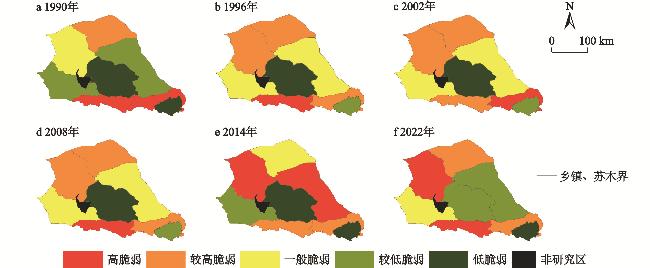
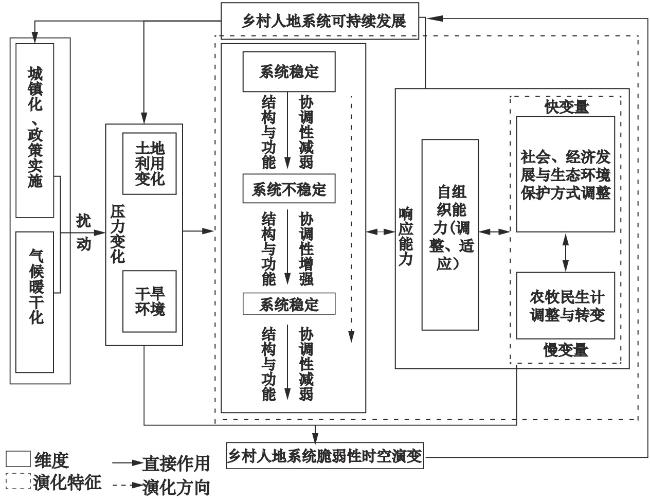
社会–生态系统脆弱性强调系统承受多重扰动冲击与通过社会经济与生态环境协调发展从而适应冲击能力的综合评估,为综合分析不确定条件下人类社会的可持续发展奠定基础。本研究将社会–生态系统脆弱性理论框架引入农牧复合型乡村人地系统多重扰动效应评估中,在明晰农牧复合型乡村人地系统脆弱性内涵的基础上,从压力程度、敏感状态和响应能力3个维度建立受多重扰动的系统评估体系,选取中国北方农牧交错区内蒙古达尔罕茂明安联合旗乡村为案例区,基于1990—2022年达茂旗乡村社会经济发展数据、气象数据、遥感影像解译数据,运用熵值法、变异系数法与障碍度模型对受多重扰动的乡村人地系统脆弱性演变过程、影响因素及作用路径进行总结。研究表明:①农牧复合型乡村人地系统对多重扰动的脆弱性出现急速下降、缓慢上升、缓慢下降的变化特征,脆弱性由高到低排序为:农业乡村、畜牧业乡村、旅游乡村、综合性乡村;②30 a来脆弱性差异度呈现小幅度增高、大幅度降低的波动式循环发展特征,农业乡村脆弱性低幅度变化,畜牧业乡村脆弱性变异幅度随纬度提高而降低,旅游与综合型乡村脆弱性高幅度变化;③脆弱性变化主要影响因素是农牧民人均收入、人均耕地面积、人均牲畜头数、年降水量,不同乡村脆弱性主要影响因素存在显著差异;④农牧复合型乡村人地系统的多重扰动源于气候暖干化与生态工程实施,系统状态深受多重扰动后其结构与功能变化的制约,系统响应变化主要受乡村社会、经济、生态发展方式与农牧户生计影响。最后从乡村经济、社会、管理、环境层面提出降低系统脆弱性的对策建议。
李文龙 , 徐芮 , 侯梦晨 , 林海英 . 北方农牧交错区乡村人地系统脆弱性演变机制与发展策略——以内蒙古达尔罕茂明安联合旗为例[J]. 地理科学, 2025 , 45(11) : 2481 -2494 . DOI: 10.13249/j.cnki.sgs.20240692
Social ecosystem vulnerability emphasizes the comprehensive evaluation of the system’s ability to withstand multiple disturbance shocks and adapt to shocks through the coordinated development of social economy and ecological environment, which lays the foundation for the comprehensive analysis of the sustainable development of human society under uncertain conditions. In this study, the theoretical framework of social ecosystem vulnerability is introduced into the evaluation of multiple disturbance effects of man land system in agricultural and animal husbandry complex rural areas. On the basis of clarifying the connotation of vulnerability of man land system in agricultural and animal husbandry complex rural areas, an evaluation system for multiple disturbance of the system is established from the 3 dimensions of pressure degree, sensitive state and response ability. Based on the rural socio-economic development data, meteorological data and remote sensing image interpretation data of Darhan Muminggan Joint Banner from 1990 to 2020, entropy method, coefficient of variation method and obstacle model are used to summarize the vulnerability evolution process, influencing factors and action path of rural human land system facing multiple disturbances. The results show that: 1) the vulnerability of agricultural and animal husbandry complex rural man-land system to multiple disturbances shows the characteristics of rapid decline, slow rise and slow decline. The order of vulnerability from high to low is: agricultural countryside, animal husbandry countryside, tourism countryside and comprehensive countryside; 2) In the past 30 years, the vulnerability difference has shown the characteristics of fluctuating circular development with small increase and large decrease. The vulnerability of agricultural and rural areas has changed in a low range, the vulnerability variation of animal husbandry and rural areas has decreased with the increase of latitude, and the vulnerability of tourism and comprehensive rural areas has changed in a high range; 3) The main influencing factors of vulnerability change are per capita income of farmers and herdsmen, per capita cultivated land area, per capita number of livestock and annual precipitation. There are significant differences in the main influencing factors of vulnerability in different villages; 4) The multiple disturbances of farming pastoral complex rural man land system come from climate warming and drying and the implementation of ecological engineering. The system state is restricted by the changes of its structure and function after multiple disturbances. The change of system response is mainly affected by rural social, economic and ecological development mode and the livelihood of farmers and herdsmen. Finally, it puts forward countermeasures and suggestions to reduce system vulnerability from the aspects of rural economy, society, management and environment.
表1 农牧交错区乡村人地关系地域系统脆弱性评价指标体系Table 1 Index of rural human-land relationship regional system in farming-pastoral ecotone |
| 准则层 | 指标因素 | 指标权重 | 指标性质 | 指标含义 |
| 压力 | 年降水量E1 | 0.100 | − | 系统受干旱扰动程度 |
| 年平均温度E2 | 0.030 | + | 系统受干旱扰动程度 | |
| 城镇用地占比E3 | 0.118 | + | 系统受城镇化活动扰动程度 | |
| 土地荒漠化指数E4 | 0.089 | + | 表征系统内部生态环境压力 | |
| 状态 | 水资源费支出S1 | 0.098 | + | 系统中社会经济敏感性状态 |
| 粮食产量S2 | 0.108 | + | 系统中农牧业敏感性状态 | |
| 出售牲畜数量S3 | 0.080 | + | 系统中农牧业敏感性状态 | |
| 植被覆盖度S4 | 0.044 | − | 系统中生态环境敏感性状态 | |
| 响应 | 有效灌溉面积A1 | 0.032 | − | 系统中农牧业适应能力 |
| 人均耕地面积A2 | 0.025 | − | 系统中农牧业适应能力 | |
| 人均牲畜头数A3 | 0.040 | − | 系统中农牧业适应能力 | |
| 农牧业人均机械总动力A4 | 0.035 | − | 系统中社会经济适应能力 | |
| 农牧民人均收入A5 | 0.108 | − | 系统中社会经济适应能力 | |
| 造林面积A6 | 0.026 | − | 系统中生态环境适应能力 | |
| 生态服务价值A7 | 0.067 | − | 系统中生态环境适应能力 |
表2 1990—2022 年内蒙古达尔罕茂明安联合旗乡镇脆弱性指数Table 2 Township vulnerability index in Darhan Muminggan Joint Banner of Inner Mongolia in 1990—2022 |
| 乡镇名称 | 1990年 | 1996年 | 2002年 | 2008年 | 2014年 | 2022年 |
| 百灵庙镇 | 0.176 | 0.084 | 0.110 | 0.181 | 0.111 | 0.121 |
| 乌克忽洞镇 | 0.257 | 0.225 | 0.176 | 0.313 | 0.198 | 0.204 |
| 石宝镇 | 0.257 | 0.170 | 0.198 | 0.263 | 0.203 | 0.103 |
| 希拉穆仁镇 | 0.172 | 0.090 | 0.119 | 0.203 | 0.122 | 0.111 |
| 达尔罕苏木 | 0.206 | 0.105 | 0.148 | 0.231 | 0.233 | 0.129 |
| 明安镇 | 0.210 | 0.100 | 0.144 | 0.210 | 0.162 | 0.141 |
| 巴音花镇 | 0.216 | 0.132 | 0.185 | 0.262 | 0.218 | 0.188 |
| 满都拉镇 | 0.236 | 0.153 | 0.186 | 0.263 | 0.165 | 0.136 |
| 平均值 | 0.216 | 0.132 | 0.158 | 0.241 | 0.177 | 0.142 |
表3 1990—2022年内蒙古达尔罕茂明安联合旗脆弱性及维度差异度Table 3 Difference in vulnerability and its dimensional indices in Darhan Muminggan Joint Banner of Inner Mongolia in 1990—2022 |
| 年份 | 压力差 异度 | 状态差 异度 | 响应差 异度 | 脆弱性 差异度 |
| 1990 | 0.770 | 0.490 | 1.807 | 0.411 |
| 1996 | 0.864 | 0.553 | 0.312 | 0.602 |
| 2002 | 1.373 | 0.364 | 1.07 | 0.284 |
| 2008 | 1.181 | 0.195 | 3.290 | 0.381 |
| 2014 | 1.560 | 0.333 | 0.870 | 0.396 |
| 2022 | 1.664 | 0.310 | 0.280 | 0.353 |
表4 1990—2022年内蒙古达尔罕茂明安联合旗乡村压力、状态、响应及脆弱性差异度Table 4 Rural pressure, state, response and vulnerability in Darhan Muminggan Joint Banner of Inner Mongolia in 1990—2022 |
| 乡镇 名称 | 压力差 异度 | 状态差 异度 | 响应差 异度 | 脆弱性 差异度 |
| 百灵庙镇 | 0.694 | 0.153 | 0.195 | 0.347 |
| 乌克忽洞镇 | 0.153 | 0.374 | 0.663 | 0.397 |
| 石宝镇 | 0.148 | 0.413 | 0.644 | 0.402 |
| 希拉穆仁镇 | 0.497 | 0.098 | 0.368 | 0.321 |
| 达尔罕苏木 | 0.418 | 0.239 | 0.371 | 0.343 |
| 明安镇 | 0.632 | 0.114 | 0.348 | 0.365 |
| 巴音花镇 | 0.321 | 0.163 | 0.376 | 0.287 |
| 满都拉镇 | 0.272 | 0.082 | 0.454 | 0.269 |
表5 1990—2022年内蒙古达尔罕茂明安联合旗乡村人地系统指标层因子贡献度指数Table 5 Contribution index of factor at indicator layer for rural human-land system in Darhan Muminggan Joint Banner of Inner Mongolia in 1990—2022 |
| 年份 | 指标层因子贡献度排序 | |||||
| 1 | 2 | 3 | 4 | 5 | 6 | |
| 1990 | 人均耕地面积 | 农牧业机械总动力 | 年降水量 | 人均牲畜头数 | 出售牲畜数量 | 农牧民人均收入 |
| 1996 | 粮食产量 | 人均牲畜头数 | 农牧民人均收入 | 年降水量 | 水资源费用支出 | 人均耕地面积 |
| 2002 | 人均牲畜头数 | 人均耕地面积 | 年降水量 | 农牧民人均收入 | 有效灌溉面积 | 水资源费用支出 |
| 2008 | 人均耕地面积 | 植被覆盖度 | 人均牲畜头数 | 农牧民人均收入 | 年降水量 | 出售牲畜数量 |
| 2014 | 人均耕地面积 | 农牧民人均收入 | 人均牲畜头数 | 出售牲畜数量 | 年降水量 | 水资源费用支出 |
| 2022 | 农牧民人均收入 | 人均牲畜头数 | 植被覆盖度 | 年降水量 | 人均耕地面积 | 粮食产量 |
表6 1990—2022 年内蒙古达尔罕茂明安联合旗各产业主导类型乡村人地系统脆弱性时空演变主导因子Table 6 Dominant factors of spatiotemporal evolution of vulnerability in rural human-land systems with different industry-dominated types in Dalian Kuomintang United Banner of Inner Mongolia in 1990—2022 |
| 乡村类型 | 指标层因子障碍度排序 | ||||
| 1 | 2 | 3 | 4 | 5 | |
| 农业型 | 粮食产量 | 年降水量 | 人均牲畜头数 | 植被覆盖度 | 农牧民人均收入 |
| 畜牧业型 | 人均牲畜头数 | 农牧民人均收入 | 农牧业机械总动力 | 水资源支出费用 | 出售牲畜数量 |
| 旅游业型 | 农牧民人均收入 | 年降水量 | 水资源费用支出 | 农牧业机械总动力 | 植被覆盖度 |
| 综合型 | 植被覆盖度 | 水资源费用支出 | 农牧业机械总动力 | 农牧民人均收入 | 有效灌溉面积 |
| [1] |
中国科学院基础科学局. 中国至2050年科技发展路线图——《创新2050: 科学技术与中国的未来》中国科学院战略研究系列报告摘登(一)[J]. 前沿科学, 2009, 3(3): 4-19.
Bureau of Basic Sciences, Chinese Academy of Sciences. The scientific and technological development road map for China to 2050—Excerpts from the strategic research series reports of the Chinese Academy of Sciences “Innovation 2050: Science and technology and China’s future” (I)[J]. Frontier Science, 2009, 3(3): 4-19.
|
| [2] |
李小云, 董强, 饶小龙, 等. 农户脆弱性分析方法及其本土化应用[J]. 中国农村经济, 2007(4): 32-39.
Li Xiaoyun, Dong Qiang, Rao Xiaolong et al. Analysis methods of farmer vulnerability and their localized application. Chinese Rural Economy, 2007(4): 32-39.
|
| [3] |
何艳冰, 乔旭宁, 王同文, 等. 传统村落文化景观脆弱性测度及类型划分——以河南省为例[J]. 旅游科学, 2021, 35(3): 24-41.
He Yanbing, Qiao Xuning, Wang Tongwen et al. On dividing the classification and assessment of the vulnerability of cultural landscape of traditional villages: A case study of Henan Province. Tourism Science, 2021, 35(3): 24-41.
|
| [4] |
黄晓军, 王博, 刘萌萌, 等. 中国城市高温特征及社会脆弱性评价[J]. 地理研究, 2020, 39(7): 1534-1547.
Huang Xiaojun, Wang Bo, Liu Mengmeng et al. Characteristics of urban extreme heat and assessment of social vulnerability in China. Geographical Research, 2020, 39(7): 1534-1547.
|
| [5] |
Ahmed N, Howlader N, Hoque M A A et al. Coastal erosion vulnerability assessment along the eastern coast of Bangladesh using geospatial techniques[J]. Ocean & Coastal Management, 2021, 199: 105408.
|
| [6] |
Melnykovych M, Nijnik M, Soloviy I et al. Social-ecological innovation in remote mountain areas: Adaptive responses of forest-dependent communities to the challenges of a changing world[J]. Science of the Total Environment, 2018, 613 894-906
|
| [7] |
Aryal S, Cockfield G, Maraseni T N. Globalisation and traditional social-ecological systems: Understanding impacts of tourism and labour migration to the transhumance systems in the Himalayas[J]. Environmental Development, 2018, 25: 73-84.
|
| [8] |
Walker B, Holling C S, Carpenter S R et al. Resilience, adaptability and transformability in social-ecological systems[J]. Ecology and Society, 2004, 9(2): 5-12.
|
| [9] |
Walker B, Salt D. Resilience thinking: Sustaining ecosystems and people in a changing world [M]. London: Island Press, 2006.
|
| [10] |
高卿, 苗毅, 宋金平. 青藏高原可持续发展研究进展[J]. 地理研究, 2021, 40(1): 1-17.
Gao Qing, Miao Yi, Song Jinping. Research progress on the sustainable development of Qinghai-Tibet Plateau. Geographical Research, 2021, 40(1): 1-17.
|
| [11] |
Maikhuri R K, Nautiyal A, Jha N K et al. Socio-ecological vulnerability: Assessment and coping strategy to environmental disaster in Kedarnath Valley, Uttarakhand, Indian Himalayan Region[J]. International Journal of Disaster Risk Reduction, 2017, 25: 111-124.
|
| [12] |
孙晶, 刘建国, 杨新军, 等. 人类世可持续发展背景下的远程耦合框架及其应用[J]. 地理学报, 2020, 75(11): 2408-2416.
Sun Jing, Liu Jianguo, Yang Xinjun et al. Sustainability in the Anthropocene: Telecoupling framework and its applications. Acta Geographica Sinica, 2020, 75(11): 2408-2416.
|
| [13] |
Zhang H, Zhao Y, Pedersen J. Capital assets framework for analysing household vulnerability during disaster[J]. Disasters, 2020, 44(4): 687-707.
|
| [14] |
Chakradhar K. People and climate change: Vulnerability, adaptation, and social justice[J]. Journal of Baccalaureate Social Work, 2020, 25(1): 253-257.
|
| [15] |
Nguyen K A, Liou Y A. Global mapping of eco-environmental vulnerability from human and nature disturbances[J]. Science of The Total Environment, 2019, 664: 995-1004.
|
| [16] |
Huang Y, Li F, Bai X et al. Comparing vulnerability of coastal communities to land use change: Analytical framework and a case study in China[J]. Environmental Science & Policy, 2012, 23 133-143
|
| [17] |
刘凯, 任建兰, 程钰, 等. 黄河三角洲地区社会脆弱性评价与影响因素[J]. 经济地理, 2016, 36(7): 45-52.
Liu Kai, Ren Jianlan, Cheng Yu et al. Yellow River Delta social vulnerability evaluation and influence factor. Economic Geography, 2016, 36(7): 45-52.
|
| [18] |
Turner B, Kasperson R E, Matson P A et al. A framework for vulnerability analysis in sustainability science[J]. Proceedings of the National Academy of Sciences, 2003, 100(14): 8074-8079.
|
| [19] |
唐红林, 刘晔, 顾君冉. 人口老龄化影响下中国城市经济系统脆弱性评估与空间分异特征[J]. 地理科学, 2025, 45(4): 835-847
Tang Honglin, Liu Ye, Gu Junran. Vulnerability assessment and spatial differentiation characteristics of China’s urban economic system under the influence of population aging. Geographical Science, 2025, 45(4): 835-847
|
| [20] |
陈佳, 杨新军, 尹莎, 等. 基于VSD框架的半干旱地区社会–生态系统脆弱性演化与模拟[J]. 地理学报, 2016, 71(7): 1172-1188.
Chen Jia, Yang Xinjun, Yin Sha et al. The vulnerability evolution and simulation of the social-ecological systems in the semi-arid based on the VSD framework. Acta Geographica Sinica, 2016, 71(7): 1172-1188.
|
| [21] |
方修琦, 殷培红. 弹性、脆弱性和适应——IHDP三个核心概念综述[J]. 地理科学进展, 2007, 17(5): 11-22.
Fang Xiuqi, Yin Peihong. Review on the three key concepts of resilience, vulnerability and adaptation in the research of global environmental change. Progress in Geography, 2007, 17(5): 11-22.
|
| [22] |
曾坚, 田健, 王倩雯, 等. 国土空间规划体系中的气候韧性及适灾承洪理论——以闽三角地区为例[J]. 中国科学: 技术科学, 2023, 53(10): 1713-1727.
Zeng Jian, Tian Jian, Wang Qianwen et al. Climate resilience and disaster resilience theory in the national spatial planning system: A case study of the Fujian Triangle. Chinese Science: Technological Sciences, 2023, 53(10): 1713-1727.
|
| [23] |
Smit B, Wandel J. Adaptation, adaptive capacity and vulnerability[J]. Global Environmental Change, 2006, 16(3): 282-292.
|
| [24] |
喻忠磊, 杨新军, 石育中. 关中地区城市干旱脆弱性评价[J]. 资源科学, 2012, 34(3): 581-588.
Yu Zhonglei, Yang Xinjun, Shi Yuzhong. Evaluation of urban vulnerability to drought in Guanzhong Area. Resources Science, 2012, 34(3): 581-588.
|
| [25] |
胡颖颖, 玉米提·哈力克, 塔依尔江·艾山, 等. 新疆2001—2010年农业气候干旱脆弱性分析[J]. 中国沙漠, 2014, 34(1): 254-259.
Hu Yingying, Umut Halik, Tayierjiang Aishan et al. Vulnerability to drought on agriculture in Xinjiang during 2001—2010. Journal of Desert Research, 2014, 34(1): 254-259.
|
| [26] |
李梦娜, 钱会, 乔亮. 关中地区农业干旱脆弱性评价[J]. 资源科学, 2016, 38(1): 166-174.
Li Mengna, Qian Hui, Qiao Liang. Evaluation of agricultural vulnerability to drought in Guanzhong Area. Resources Science, 2016, 38(1): 166-174.
|
| [27] |
周利光, 杜凤莲, 张雪峰, 等. 草原畜牧业对干旱的脆弱性评估——以内蒙古锡林郭勒草原为例[J]. 生态学杂志, 2014, 33(1): 259-268.
Zhou Liguang, Du Fenglian, Zhang Xuefeng et al. The vulnerability assessment of grassland livestock industry to drought: A case study in pasture of Xilingol, Inner Mongolia. Chinese Journal of Ecology, 2014, 33(1): 259-268.
|
| [28] |
Thomas D S K, Wilhelmi O V, Finnessey T N et al. A comprehensive framework for tourism and recreation drought vulnerability reduction[J]. Environmental Research Letters, 2013, 8(4): 575-591.
|
| [29] |
曹永强, 马静, 李香云, 等. 投影寻踪技术在大连市农业干旱脆弱性评价中的应用[J]. 资源科学, 2011, 33(6): 1106-1110.
Cao Yongqiang, Ma Jing, Li Xiangyun et al. Application of the projection pursuit technique in assessment of agricultural drought vulnerability in Dalian. Resources Science, 2011, 33(6): 1106-1110.
|
| [30] |
李文龙, 匡文慧, 吕君, 等. 北方农牧交错区人地系统演化特征与影响机理——以内蒙古达茂旗为例[J]. 地理学报, 2021, 76(2): 487-502.
Li Wenlong, Kuang Wenhui, Lyu Jun et al. Adaptive evolution mechanism of rural human-land system in farming-and-pastoral areas of northern China. Acta Geographica Sinica, 2021, 76(2): 487-502.
|
| [31] |
周升强, 赵凯. 草原生态补奖政策对农牧民牲畜养殖规模的影响——基于生计分化的调节效应分析[J]. 中国人口·资源与环境, 2020, 30(4): 157-165.
Zhou Shengqiang, Zhao Kai. The impact of grassland ecological compensation policy on the livestock breeding scale of farmers and herders: Based on the moderating role of livelihood diversification. China Population, Resources and Environment, 2020, 30(4): 157-165.
|
| [32] |
Yang Y, Wang K, Liu D et al. Effects of land-use conversions on the ecosystem services in the agro-pastoral ecotone of northern China[J]. Journal of Cleaner Production, 2020, 249: 119360.
|
| [33] |
周一敏, 张昂, 赵昕奕. 未来气候变化情景下中国北方农牧交错带脆弱性评估[J]. 北京大学学报(自然科学版), 2017, 53(6): 1099-1107.
Zhou Yimin, Zhang Ang, Zhao Xinyi. Analysis of vulnerable characteristics in Chinese northern farming-pastoral region based on coordinated regional downscaling experiment. Acta Scientiarum Naturalium Universitatis Pekinensis, 2017, 53(6): 1099-1107.
|
| [34] |
何艳冰, 黄晓军, 翟令鑫, 等. 西安快速城市化边缘区社会脆弱性评价与影响因素[J]. 地理学报, 2016, 71(8): 1315-1328.
He Yanbing, Huang Xiaojun, Zhai Lingxin et al. Assessment and influencing factors of social vulnerability to rapid urbanization in urban fringe: A case study of Xi’an. Acta Geographica Sinica, 2016, 71(8): 1315-1328.
|
| [35] |
李文龙, 匡文慧. 草原牧区旅游发展对牧户生计的影响——以内蒙古希拉穆仁草原为例[J]. 地理科学, 2019, 39(1): 131-139.
Li Wenlong, Kuang Wenhui. Impact of tourism development on the herdsmen livelihood in pastoral areas: A case study of Xila Muren pastoral area in Inner Mongolia. Sinica Geographica Sinica, 2019, 39(1): 131-139.
|
| [36] |
李文龙, 林海英, 金桩. 社会资本可利用度及其影响因素研究——来自内蒙古农牧民的经验发现[J]. 经济研究, 2019, 54(12): 134-149.
Li Wenlong, Lin Haiying, Jin Zhuang. Social capital availability: The case of farmers and herdsmen from Inner Mongolia. Economic Research Journal, 2019, 54(12): 134-149.
|
| [37] |
吴晓光, 姚云峰, 迟文峰, 等. 1990—2015年内蒙古高原土壤风蚀时空差异特征[J]. 中国农业大学学报, 2020, 25(3): 117-127.
Wu Xiaoguang, Yao Yunfeng, Chi Wenfeng et al. Spatio-temporal characteristics of soil wind erosion in Inner Mongolia Plateau from 1990 to 2015. Journal of China Agricultural University, 2020, 25(3): 117-127.
|
| [38] |
李玉恒, 王晟业, 黄惠倩. 乡村灾害脆弱性评价及影响因素——以河南省浚县为例[J]. 地理科学, 2024, 44(10): 1818-1825
Li Yuheng, Wang Shengye, Huang Huiqian. Vulnerability assessment and influencing factors of rural disasters: A case study of Jun County, Henan Province. Sinica Geographica Sinica, 2024, 44(10): 1818-1825
|
| [39] |
Huang L, Yang P, Ren S. The vulnerability assessment method for Beijing agricultural drought[J]. Ifip Advances in Information & Communication Technology, 2014, 419 269-280
|
| [40] |
鲁大铭, 石育中, 李文龙, 等. 西北地区县域脆弱性时空格局演变[J]. 地理科学进展, 2017, 36(4): 404-415.
Lu Daming, Shi Yuzhong, Li Wenlong et al. Spatiotemporal change of vulnerability in counties of northwest China. Progress in Geography, 2017, 36(4): 404-415.
|
| [41] |
范金, 万伟, 袁小慧, 等. 改革开放40年中国绿色增加值演化趋势与结构分解[J]. 中国人口·资源与环境, 2019, 29(10): 79-89.
Fan Jin, Wan Wei, Yuan Xiaohui et al. Evolution trend and structural decomposition of China’s green value-added during forty years of reform and opening-up. China Population, Resources and Environment, 2019, 29(10): 79-89.
|
/
| 〈 |
|
〉 |