



吉林省农业现代化多维演进、地域类型与协调发展
|
房艳刚(1979—),男,山东曲阜人,博士,教授,博导,主要从事人文地理学与乡村发展研究。E-mail: fangyg578@nenu.edu.cn |
收稿日期: 2024-07-18
网络出版日期: 2025-12-15
基金资助
国家自然科学基金项目(42471223)
版权
Multidimensional evolution, regional typologies and coordinated development of agricultural modernization in Jilin Province
Received date: 2024-07-18
Online published: 2025-12-15
Supported by
National Natural Science Foundation of China(42471223)
Copyright
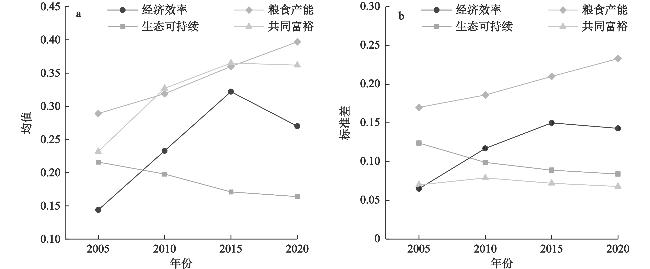
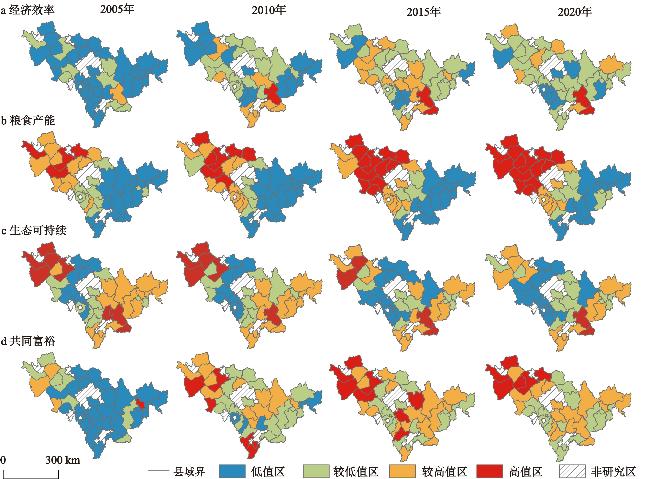
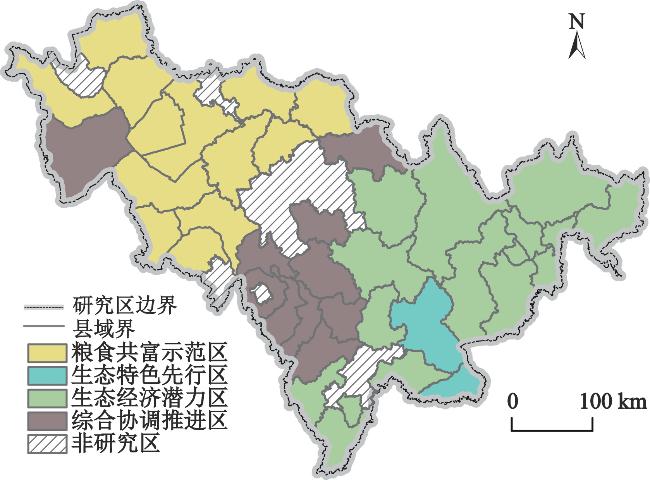
农业农村现代化是社会主义现代化重要组成部分。面向中国特色农业现代化需求,本文将农业现代化分为经济效率、粮食产能、生态可持续和共同富裕4个维度,构建农业现代化多维评价指标体系,利用熵值法、Spearman秩相关系数和聚类分析方法,分析吉林省农业现代化多维时空演变特征及各维度之间的权衡/协同,划分命名地域类型并提出协调发展的路径和策略。研究发现:①2005—2020年,吉林省粮食产能呈持续上升趋势,生态可持续逐渐下降,经济效率先升后降,共同富裕的良好趋势在2020年受到暂时性冲击。空间上,各维度发展水平具有明显的集聚特征且分布格局的差异显著,部分维度的格局与演变相逆。②2005—2020年粮食产能与生态可持续为逐渐增强的权衡关系;2005—2020年粮食产能与共同富裕整体呈逐渐增强的协同关系。③吉林省农业现代化可划分为粮食共富示范区、生态特色先行区、生态经济潜力区、综合协调推进区4种地域类型,并采取差异化的协调发展路径和策略。
房艳刚 , 齐雨施 , 刘建志 . 吉林省农业现代化多维演进、地域类型与协调发展[J]. 地理科学, 2025 , 45(11) : 2495 -2507 . DOI: 10.13249/j.cnki.sgs.20240785
Without agricultural and rural modernization, socialist modernization would be incomplete. To address the requirements of agricultural modernization with Chinese characteristics, this study evaluates agricultural modernization from 4 dimensions—economic efficiency, grain production capacity, ecological sustainability, and common prosperity—and constructs a corresponding evaluation index system. By using the entropy method, Spearman rank correlation coefficient, and cluster analysis, this research analyzes the spatiotemporal evolution and trade-offs/synergies of multidimensional agricultural modernization levels in Jilin Province, classifies regional typologies, and proposes coordinated development pathways and strategies. Key findings include: 1) From 2005 to 2020, grain production capacity showed a consistent upward trend, while ecological sustainability gradually declined. Economic efficiency initially increased but later declined, and the advancement of common prosperity experienced temporary challenges in 2020. In terms of spatial distribution, the development levels across various dimensions displayed distinct clustering characteristics with significant differentiation in their distribution patterns. Notably, some dimensions demonstrated the opposing spatial pattern and evolutionary trend. 2) Spearman rank correlation coefficients revealed dynamic interactions: During 2005—2020, grain production capacity and ecological sustainability evolved toward stronger trade-offs; grain production capacity and common prosperity generally showed strengthening synergies. 3) Agricultural modernization in Jilin Province can be classified into 4 regional typologies: Grain-Prosperity Dual Demonstrating Zones, Ecological Uniqueness Pioneering Zones, Eco-economy Up-and-coming Zones, and Comprehensive and Synergistic Promoting Zones, each requiring tailored development pathways and coordination strategies.
表1 吉林省农业现代化多维评价指标体系Table 1 Evaluation index system of multidimensional agricultural modernization in Jilin Province |
| 决策层 | 目标层 | 指标层 | 方向 | 权重 | 指标计算方法 |
| 注:1 hm2=15亩。 | |||||
| 农业 现代 化水 平 | 经济 效率 | 耕地生产率/(万元/hm2) | + | 0.557 | 农业产值/耕地面积 |
| 劳动生产率/(万元/人) | + | 0.278 | 第一产业总产值/第一产业从业人员数 | ||
| 全要素生产率 | + | 0.164 | Malmquist指数法[39] | ||
| 粮食 产能 | 粮食单产/(t/hm2) | + | 0.090 | 粮食总产量/粮食播种面积 | |
| 人均粮食盈余量/(kg/人) | + | 0.176 | 粮食总产量/区域总人口-400 kg | ||
| 粮食播种面积占比/% | + | 0.029 | 粮食播种面积/农作物总播种面积 | ||
| 垦殖指数/% | + | 0.250 | 耕地面积/行政区面积 | ||
| 机械化水平/(kW/hm2) | + | 0.307 | $\scriptsize{ \left(\mathrm{农}\mathrm{业}\mathrm{机}\mathrm{械}\mathrm{总}\mathrm{动}\mathrm{力}\times \dfrac{\text{耕地面积}}{\text{耕地面积}\text{+}\text{林地面积}}\right)/\mathrm{农}\mathrm{作}\mathrm{物}\mathrm{总}\mathrm{播}\mathrm{种}\mathrm{面}\mathrm{积}} $ | ||
| 有效灌溉面积比重/% | + | 0.149 | 有效灌溉面积/耕地面积 | ||
| 生态 可持续 | 亩均化肥使用量/(kg/亩) | - | 0.004 | 化肥施用量/耕地面积 | |
| 亩均农药使用量/(kg/亩) | - | 0.009 | 农药施用量/耕地面积 | ||
| 亩均农膜使用量/(kg/亩) | - | 0.011 | 农膜施用量/耕地面积 | ||
| 农田生态系统多样性指数 | + | 0.060 | $-\displaystyle\sum {p}_{i}\mathrm{l}\mathrm{n}\left({p}_{i}\right) $,${p}_{i} $为各农作物播种面积比重[40] | ||
| 森林覆盖率/% | + | 0.165 | 森林面积/行政区面积 | ||
| 草地面积比重/% | + | 0.515 | 草地面积/行政区面积 | ||
| 水域面积比重/% | + | 0.236 | 水域面积/行政区面积 | ||
| 共同 富裕 | 农林水事务支出比重/% | + | 0.089 | 农林水事务支出/总财政支出 | |
| 乡村人均农林牧渔业 总产值/(元/人) | + | 0.086 | 农林牧渔业总产值/乡村人口 | ||
| 乡村人均耕地面积/(hm2/人) | + | 0.135 | 耕地面积/乡村人口 | ||
| 劳均耕地面积/(hm2/人) | + | 0.099 | 耕地面积/第一产业从业人员数 | ||
| 劳均农林牧渔业总产值/(元/人) | + | 0.086 | 农林牧渔业总产值/第一产业从业人员数 | ||
| 一产产值比重/% | - | 0.048 | 第一产业产值/三次产业总产值 | ||
| 农林牧渔服务业产值比重/% | + | 0.203 | 农林牧渔服务业产值/农林牧渔业总产值 | ||
| 乡村非农就业率/% | + | 0.055 | 1–农林牧渔业从业人员数/乡村从业人员数 | ||
| 经济作物播种面积比例/% | + | 0.199 | 经济作物播种面积/农作物总播种面积 | ||
表2 吉林省农业现代化两两维度之间Spearman秩相关系数Table 2 Spearman rank correlation coefficient between agricultural modernization dimension in Jilin Province |
| 农业现代化维度 | 2005年 | 2010年 | 2015年 | 2020年 |
| 注:***、**、*分别表示在1%、5%、10%统计水平上显著,括号内数值为P值。 | ||||
| 经济效率−粮食产能 | 0.084(0.612) | −0.038(0.818) | −0.198(0.226) | 0.073(0.657) |
| 经济效率−生态可持续 | 0.000(1.000) | 0.001(0.990) | −0.014(0.931) | 0.042(0.800) |
| 经济效率−共同富裕 | 0.265(0.102) | 0.309*(0.055) | 0.170(0.301) | 0.115(0.485) |
| 粮食产能−生态可持续 | −0.385**(0.016) | −0.450***(0.004) | −0.523***(0.001) | −0.526***(0.001) |
| 粮食产能−共同富裕 | 0.279*(0.085) | 0.292*(0.071) | 0.252(0.121) | 0.379**(0.017) |
| 生态可持续−共同富裕 | 0.333**(0.038) | 0.179(0.275) | 0.216(0.187) | 0.114(0.491) |
| [1] |
Van Der Ploeg J D. From de-to repeasantization: The modernization of agriculture revisited[J]. Journal of Rural Studies, 2018, 61: 236-243.
|
| [2] |
Woods M. Rural[M]. London: Routledge, 2010.
|
| [3] |
Bjorkhaug H, Knickel K. Rethinking the links between farm modernisation, rural development and resilience[J]. Journal of Rural Studies, 2018, 59: 194-196.
|
| [4] |
习近平. 加快建设农业强国 推进农业农村现代化[J]. 求是, 2023(6): 4-17.
Xi Jinping. Building up China’s strength in agriculture accelerating the modernization of agricultural sector and rural areas. Qiushi, 2023(6): 4-17.
|
| [5] |
刘彦随, 张紫雯, 王介勇. 中国农业地域分异与现代农业区划方案[J]. 地理学报, 2018, 73(2): 203-218.
Liu Yansui, Zhang Ziwen, Wang Jieyong. Regional differentiation and comprehensive regionalization scheme of modern agriculture in China. Acta Geographica Sinica, 2018, 73(2): 203-218.
|
| [6] |
韩俊. 关于实施乡村振兴战略的八个关键性问题[J]. 中国党政干部论坛, 2018(4): 19-26.
Han Jun. Eight key issues on the implementation of rural revitalization strategy. Chinese Cadres Tribune, 2018(4): 19-26.
|
| [7] |
戈大专, 龙花楼. 中国粮食生产转型与乡村振兴[M]. 北京: 商务印书馆, 2023
Ge Dazhuan, Long Hualou. China’s grain production transformation and rural revitalization. Beijing: The Commercial Press, 2023.
|
| [8] |
辛良杰. 粮食安全概念、评价体系与地理学优先研究主题[J]. 地理科学, 2024, 44(3): 451-462.
Xin Liangjie. Concepts, measurement indicators of food security and research directions of Geography. Scientia Geographica Sinica, 2024, 44(3): 451-462.
|
| [9] |
Key N. Farm size and productivity growth in the United States Corn Belt[J]. Food Policy, 2019, 84: 186-195.
|
| [10] |
Clar E, Ayuda M I. Rural migration and agricultural modernization: An analysis of provincial Spain during its great rural exodus, 1960—1981[J]. Historia Agraria, 2023, 90 223-255
|
| [11] |
Roest K D, Ferrari P, Knickel K. Specialisation and economies of scale or diversification and economies of scope? Assessing different agricultural development pathways[J]. Journal of Rural Studies, 2018, 59: 222-231.
|
| [12] |
Davis B, Campos A P D L O, Farrae M et al. Whither the agricultural productivity-led model? Reconsidering resilient and inclusive rural transformation in the context of agrifood systems[J]. Global Food Security, 2024, 43: 100812.
|
| [13] |
中国宏观经济研究院课题组, 马晓河, 马建蕾, 等. 迈向高收入国家行列进程中农业现代化的思路与任务[J]. 宏观经济研究, 2022(6): 5-14+136.
Research Group of China Academy of Macroeconomic Research, Ma Xiaohe, Ma Jianlei et al. Thoughts and tasks of agricultural modernization in the process of moving towards the rank of high-income countries. Macroeconomics, 2022(6): 5-14+136.
|
| [14] |
陈明. 农业农村现代化的世界进程与国际比较[J]. 经济体制改革, 2022(4): 151-159.
Chen Ming. The world process and international comparison of agricultural and rural modernization. Reform of Economic System, 2022(4): 151-159.
|
| [15] |
龙冬平, 李同昇, 苗园园, 等. 中国农业现代化发展水平空间分异及类型[J]. 地理学报, 2014, 69(2): 213-226.
Long Dongping, Li Tongsheng, Miao Yuanyuan et al. The spatial distribution and types of the development level of Chinese agricultural modernization. Acta Geographica Sinica, 2014, 69(2): 213-226.
|
| [16] |
杨奇峰, 张平宇, 李静, 等. 东北地区农业现代化发展水平测度与时空演变分析[J]. 地理科学, 2022, 42(9): 1588-1599.
Yang Qifeng, Zhang Pingyu, Li Jing et al. Development level and spatio-temporal evolution of agricultural modernization in Northeast China. Scientia Geographica Sinica, 2022, 42(9): 1588-1599.
|
| [17] |
李裕瑞, 王婧, 刘彦随, 等. 中国“四化”协调发展的区域格局及其影响因素[J]. 地理学报, 2014, 69(2): 199-212.
Li Yurui, Wang Jing, Liu Yansui et al. Spatial pattern and influencing factors of the coordination development of industrialization, informatization, urbanization and agricultural modernization in China: A prefecture level exploratory spatial data analysis. Acta Geographica Sinica, 2014, 69(2): 199-212.
|
| [18] |
潘竟虎, 胡艳兴, 刘晓, 等. 中国地级及以上城市“四化”协调发展效率的时空分异测度[J]. 地理科学, 2016, 36(4): 512-520.
Pan Jinghu, Hu Yanxing, Liu Xiao et al. Spatial-temporal pattern of the coordinated development efficiency of the ‘Four Modernizations’ of prefecture level cities or above in China. Scientia Geographica Sinica, 2016, 36(4): 512-520.
|
| [19] |
李小建, 朱瑞明. 农区现代化进程中的农户地理研究[J]. 经济地理, 2023, 43(7): 1-11.
Li Xiaojian, Zhu Ruiming. Geography of rural households in the process of rural modernization. Economic Geography, 2023, 43(7): 1-11.
|
| [20] |
Liu J Z, Fang Y G, Qiao J J et al. Rural transformation and the future of China’s “granary”: A perspective on livelihood trajectories[J]. Journal of Rural Studies, 2025, 114: 103524.
|
| [21] |
丁吉萍, 黄季焜, 盛誉. 从单产和利润再看农户适度规模经营: 来自东北、华北农户粮食生产的实证分析[J]. 农林经济管理学报, 2021, 20(1): 19-28.
Ding Jiping, Huang Jikun, Sheng Yu. Farming on an optimum scale from the yield and profit prospective: Evidence from grain production in Northeast and North China. Journal of Agro-Forestry Economics and Management, 2021, 20(1): 19-28.
|
| [22] |
孙学涛, 于婷, 于法稳. 数字普惠金融对农业机械化的影响——来自中国1869个县域的证据[J]. 中国农村经济, 2022(2): 76-93.
Sun Xuetao, Yu Ting, Yu Fawen. The impact of digital finance on agricultural mechanization: Evidence from 1869 counties in China. Chinese Rural Economy, 2022(2): 76-93.
|
| [23] |
柯炳生. 我国粮食安全的新变化新思考[J]. 农村工作通讯, 2023(5): 22-24.
Ke Bingsheng. New changes and thoughts on China’s food security. Newsletter About Work in Rural Areas, 2023(5): 22-24.
|
| [24] |
罗必良. 中国农业现代化: 时代背景、目标定位与策略选择[J]. 国家现代化建设研究, 2023, 2(1): 65-78.
Luo Biliang. Agricultural modernization in China: Development context, goal setting and strategic options. Journal of Modernization Studies, 2023, 2(1): 65-78.
|
| [25] |
陈锡文. 当前农业农村的若干重要问题[J]. 中国农村经济, 2023(8): 1-17.
Chen Xiwen. Several important issues in current agriculture and rural areas. Chinese Rural Economy, 2023(8): 1-17.
|
| [26] |
邸菲, 胡志全. 我国农业现代化评价指标体系的构建与应用[J]. 中国农业资源与区划, 2020, 41(6): 46-56.
Di Fei, Hu Zhiquan. Construction and application of China’s agricultural modernization evaluation index system. Chinese Journal of Agricultural Resources and Regional Planning, 2020, 41(6): 46-56.
|
| [27] |
中国社会科学院农村发展研究所课题组, 魏后凯, 崔凯, 等. 农业农村现代化: 重点、难点与推进路径[J]. 中国农村经济, 2024(5): 2-20.
Research Group of the Institute of Rural Development, Chinese Academy of Social Sciences, Wei Houkai, Cui Kai et al. The modernization of agriculture and rural Areas: Key points, difficulties and promotion paths. Chinese Rural Economy, 2024(5): 2-20.
|
| [28] |
Rodriguez J P, Beard T D, Bennett E M et al. Trade-offs across space, time, and ecosystem services[J]. Ecology and Society, 2006, 11(1): 28
|
| [29] |
尹礼唱, 王晓峰, 张琨, 等. 国家屏障区生态系统服务权衡与协同[J]. 地理研究, 2019, 38(9): 2162-2172.
Yin Lichang, Wang Xiaofeng, Zhang Kun et al. Trade-offs and synergy of ecosystem services in National Barrier Zones. Geographical Research, 2019, 38(9): 2162-2172.
|
| [30] |
Auer A, Maceira N, Nahuelhual L. Agriculturisation and trade-offs between commodity production and cultural ecosystem services: A case study in Balcarce County[J]. Journal of Rural Studies, 2017, 53: 88-101.
|
| [31] |
Li F, Qin Z X, Liu X L et al. Grain production space reconstruction and land system function tradeoffs in China[J]. Geography and Sustainability, 2021, 2(1): 22-30.
|
| [32] |
Ma W Q, Yang H, Jiang G H et al. Exploring trade-offs between residential and industrial functions in rural areas and their ecological impacts across transitioning agricultural systems: Evidence from the metropolitan suburbs of China[J]. Journal of Environmental Management, 2024, 358: 120907.
|
| [33] |
Zhang J, Li S N, Lin N F et al. Spatial identification and trade-off analysis of land use functions improve spatial zoning management in rapid urbanized areas, China[J]. Land Use Policy, 2022, 116: 106058.
|
| [34] |
刘玉, 郜允兵, 潘瑜春, 等. 基于多源数据的乡村功能空间特征及其权衡协同关系度量[J]. 地理研究, 2021, 40(7): 2036-2050.
Liu Yu, Gao Yunbing, Pan Yuchun et al. Spatial differentiation characteristics and trade-off/synergy relationships of rural multi-functions based on multi-source data. Geographical Research, 2021, 40(7): 2036-2050.
|
| [35] |
杨忍, 刘芮彤. 珠三角城市群地区都市农业功能演变及其协同-权衡关系[J]. 地理研究, 2022, 41(7): 1995-2015.
Yang Ren, Liu Ruitong. Functional evolution and collaboration/trade-off relationship of urban agriculture in the Pearl River Delta urban agglomeration. Geographical Research, 2022, 41(7): 1995-2015.
|
| [36] |
黄季焜, 胡瑞法, 易红梅, 等. 面向2050年我国农业发展愿景与对策研究[J]. 中国工程科学, 2022, 24(1): 11-19.
Huang Jikun, Hu Ruifa, Yi Hongmei et al. Development visions and policies of China’s agriculture by 2050. Strategic Study of CAE, 2022, 24(1): 11-19.
|
| [37] |
刘守英. 实现农业现代化: 共同性与独特性[J]. 智慧中国, 2023(4): 26-29.
Liu Shouying. Achieving agricultural modernization: Commonalities and uniqueness. Wisdom China, 2023(4): 26-29.
|
| [38] |
吉林省人民政府. 关于印发《吉林省率先实现农业现代化总体规划(2019—2030年修订稿)》的通知[EB/OL]. 2019-08-09[2025-03-04]. https://www.jl.gov.cn
Jilin Provincial People’s Government. Notice on issuing the Master Plan of Pioneer in Achieving Agricultural Modernization for Jilin Province (2019—2030 Revised Edition). 2019-08-09[2025-03-04]. https://www.jl.gov.cn.]
|
| [39] |
高帆. 我国区域农业全要素生产率的演变趋势与影响因素——基于省际面板数据的实证分析[J]. 数量经济技术经济研究, 2015, 32(5): 3-19.
Gao Fan. Evolution trend and internal mechanism of regional total factor productivity in Chinese agriculture. Journal of Quantitative & Technological Economics, 2015, 32(5): 3-19.
|
| [40] |
宋小青, 吴志峰, 欧阳竹. 1949年以来中国耕地功能变化[J]. 地理学报, 2014, 69(4): 435-447.
Song Xiaoqing, Wu Zhifeng, Ouyang Zhu. Changes of cultivated land function in China since 1949. Acta Geographica Sinica, 2014, 69(4): 435-447.
|
| [41] |
房艳刚, 刘本城, 刘建志. 农业多功能的地域类型与优化策略——以吉林省为例[J]. 地理科学进展, 2019, 38(9): 1349-1360.
Fang Yangang, Liu Bencheng, Liu Jianzhi. Territorial types and optimization strategies of agriculture multifunction: A case study of Jilin Province. Progress in Geography, 2019, 38(9): 1349-1360.
|
| [42] |
刘玉洁, 吕硕, 陈洁, 等. 青藏高原农业现代化时空分异及其驱动机制[J]. 地理学报, 2022, 77(1): 214-227.
Liu Yujie, Lyu Shuo, Chen Jie et al. Spatio-temporal differentiation of agricultural modernization and its driving mechanism on the Qinghai-Tibet Plateau. Acta Geographica Sinica, 2022, 77(1): 214-227.
|
| [43] |
傅伯杰. 地理学的灵魂[M]. 北京: 商务印书馆, 2024
Fu Bojie. The soul of Geography. Beijing: The Commercial Press, 2024.
|
| [44] |
国家统计局. 中国县域统计年鉴[M]. 2006, 2011, 2016, 2021. 北京: 中国统计出版社, 2006, 2011, 2016, 2021
National Bureau of Statistics of China. 2006, 2011, 2016, 2021. China county statistical yearbook. Beijing: China Statistics Press, 2006, 2011, 2016, 2021.
|
| [45] |
吉林省统计局. 吉林统计年鉴[M]. 2006, 2011, 2016, 2021. 北京: 中国统计出版社, 2006, 2011, 2016, 2021
Jilin Statistical Bureau. Jilin statistical yearbook. 2006, 2011, 2016, 2021. Beijing: China Statistics Press, 2006, 2011, 2016, 2021.
|
| [46] |
Song W, Han Z, Deng X Z. Changes in productivity, efficiency and technology of China’s crop production under rural restructuring[J]. Journal of Rural Studies, 2016, 47: 563-576.
|
| [47] |
宋伟轩, 谭华云, 叶玲, 等. 南京绅士化乡村的类型辨识与特征刻画[J]. 地理学报, 2025, 80(3): 811-827.
Song Weixuan, Tan Huayun, Ye Ling et al. Identification and characterization of rural gentrification in Nanjing. Acta Geographica Sinica, 2025, 80(3): 811-827.
|
| [48] |
Foster J B. Marx’s theory of metabolic rift: Classical foundations for environmental sociology[J]. American Journal of Sociology, 1999, 105(2): 366-405.
|
| [49] |
房艳刚, 刘继生. 基于多功能理论的中国乡村发展多元化探讨——超越“现代化”发展范式[J]. 地理学报, 2015, 70(2): 257-270.
Fang Yangang, Liu Jisheng. Diversified agriculture and rural development in China based on multifunction theory: Beyond modernization paradigm. Acta Geographica Sinica, 2015, 70(2): 257-270.
|
/
| 〈 |
|
〉 |