



中国旅游度假区空间分布与影响机制研究
|
刘海洋(1982—),男,辽宁锦西人,博士,教授,博导,主要研究方向为海洋旅游与区域社会发展。E-mail: haiyang0796@163.com |
收稿日期: 2024-07-12
网络出版日期: 2025-12-15
基金资助
海南省自然科学基金项目(724MS045)
海南省高等学校科学研究项目(Hnkyzc2023-1)
版权
Spatial distribution and impact mechanism of Chinese tourist resort areas
Received date: 2024-07-12
Online published: 2025-12-15
Supported by
Natural Science Foundation of Hainan(724MS045)
Hainan Province Higher Education Science Research Project(Hnkyzc2023-1)
Copyright
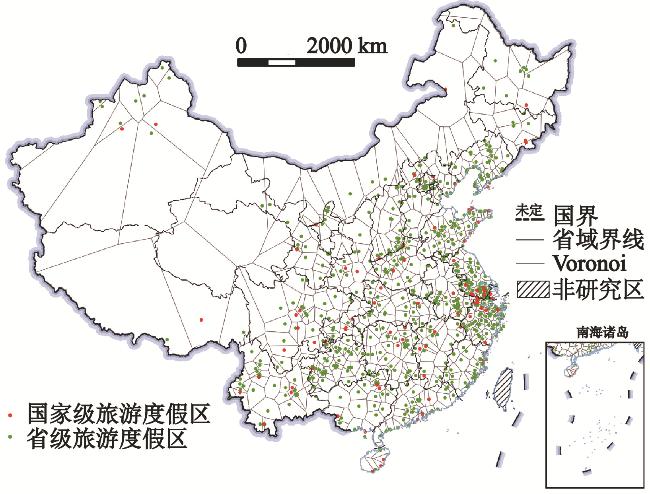
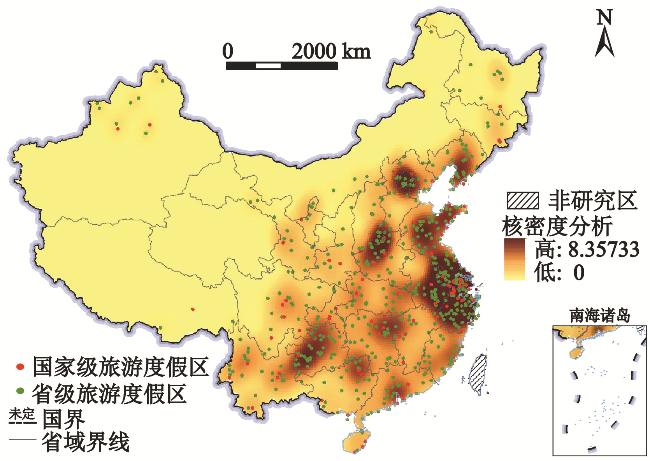
本文依据中国的668处国家级与省级旅游度假区点位数据,运用GIS空间分析法及皮尔逊相关系数探究旅游度假区空间分布特征,并从地形地貌、河流水域、天气条件、资源条件等自然因素和经济发展、市场状况、交通运输、医疗水平、政府政策等社会经济因素对空间分布特征影响因素进行探讨,探索其影响机制。结果表明:①研究区域内旅游度假区分布不均衡,呈聚集性分布,整体呈现出“东部一核、中部两带、南部三中心”的空间分布格局,具体表现出“近低地、沿缓坡、亲水域、喜温暖、临景区”的空间分布特点。②旅游度假区的空间分布受自然资源因素和社会经济因素共同作用。在自然资源因素上,与海拔、坡度、河流距离呈负相关,与旅游资源密度呈正相关,且多分布在温暖湿润地区。在社会经济因素上,旅游度假区数量与生产总值、人均GDP、旅游业收入、第三产业产值、常住人口等呈极显著正相关(P<0.01);与车站数量、水运客运量呈显著正相关(P<0.05);与接待入境人次数、星级酒店数量呈负相关;与港口数量不相关(P>0.05)。
刘海洋 , 程文博 , 杨明家 , 张志辉 . 中国旅游度假区空间分布与影响机制研究[J]. 地理科学, 2025 , 45(11) : 2519 -2530 . DOI: 10.13249/j.cnki.sgs.20241361
Based on data from 668 national and provincial tourist resorts in China, this study employs GIS spatial analysis and the Pearson correlation coefficient to explore the spatial distribution characteristics of tourist resorts. It also discusses the influencing factors of spatial distribution characteristics and explores their impact mechanisms, considering natural factors such as topography, rivers, weather conditions, and resource conditions, as well as socio-economic factors such as economic development, market conditions, transportation, medical standards, and government policies. The results indicate that: 1) The distribution of tourist resorts within the study area is uneven and aggregated, presenting an overall spatial distribution pattern of “one core in the east, two belts in the central region, and three centers in the south”. Specifically, they exhibit spatial distribution features of being “close to lowlands, along gentle slopes, near water bodies, preferring warmer climates, and adjacent to scenic areas”. 2) The spatial distribution of tourist resorts is influenced by both natural and socio-economic factors. In terms of natural resources, they are negatively correlated with altitude, slope, and distance from rivers, but positively correlated with tourism resource density, and are mostly located in warm and humid regions. In terms of socio-economic factors, the number of tourist resorts is significantly positively correlated with gross domestic product (GDP), per capita GDP, tourism revenue, output value of the tertiary industry, and permanent resident population (P<0.01); significantly positively correlated with the number of stations and water transportation passenger volume (P<0.05); negatively correlated with the number of inbound tourist arrivals and starred hotels; and uncorrelated with the number of ports (P>0.05).
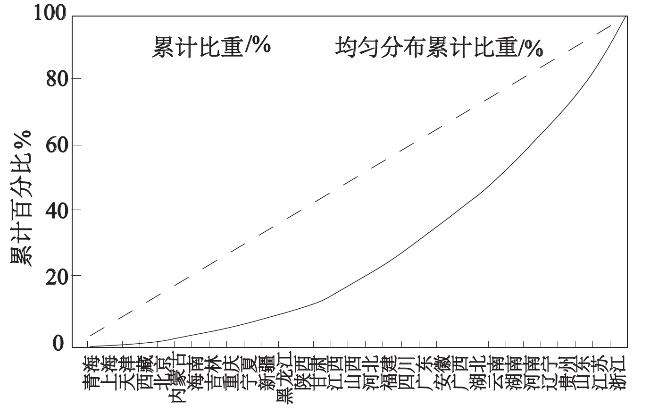
图2 中国旅游度假区空间分布洛伦兹曲线港澳台数据暂缺 Fig. 2 Tourist attraction area in China and Lorenz Curve |
表1 中国旅游度假区空间数量分布Table 1 Spatial distribution of tourist resort in China |
| 省份 | 度假区数量/家 | 占全国 比重/% | 累计 比重/% | 均匀分 布累计 比重/% | ||
| 总计 | 国家级 | 省级 | ||||
| 注:港澳台数据暂缺。 | ||||||
| 青海 | 0 | 0 | 0 | 0.00 | 0.00 | 3.23 |
| 上海 | 2 | 2 | 0 | 0.30 | 0.30 | 6.45 |
| 天津 | 2 | 0 | 2 | 0.30 | 0.60 | 9.68 |
| 西藏 | 3 | 1 | 2 | 0.45 | 1.05 | 12.90 |
| 北京 | 4 | 1 | 3 | 0.60 | 1.65 | 16.13 |
| 内蒙古 | 7 | 1 | 6 | 1.05 | 2.69 | 19.35 |
| 海南 | 7 | 3 | 4 | 1.05 | 3.74 | 22.58 |
| 吉林 | 7 | 2 | 5 | 1.05 | 4.79 | 25.81 |
| 重庆 | 8 | 3 | 5 | 1.20 | 5.99 | 29.03 |
| 宁夏 | 9 | 1 | 8 | 1.35 | 7.34 | 32.26 |
| 新疆 | 10 | 2 | 8 | 1.50 | 8.83 | 35.48 |
| 黑龙江 | 10 | 1 | 9 | 1.50 | 10.33 | 38.71 |
| 陕西 | 11 | 2 | 9 | 1.65 | 11.98 | 41.94 |
| 甘肃 | 13 | 1 | 12 | 1.95 | 13.92 | 45.16 |
| 江西 | 20 | 5 | 15 | 2.99 | 16.92 | 48.39 |
| 山西 | 21 | 1 | 20 | 3.14 | 20.06 | 51.61 |
| 河北 | 21 | 2 | 19 | 3.14 | 23.20 | 54.84 |
| 福建 | 23 | 1 | 22 | 3.44 | 26.65 | 58.06 |
| 四川 | 26 | 5 | 21 | 3.89 | 30.54 | 61.29 |
| 广东 | 27 | 3 | 24 | 4.04 | 34.58 | 64.52 |
| 安徽 | 27 | 2 | 25 | 4.04 | 38.62 | 67.74 |
| 广西 | 28 | 4 | 24 | 4.19 | 42.81 | 70.97 |
| 湖北 | 28 | 3 | 25 | 4.19 | 47.01 | 74.19 |
| 云南 | 33 | 5 | 28 | 4.94 | 51.95 | 77.42 |
| 湖南 | 35 | 4 | 31 | 5.24 | 57.19 | 80.65 |
| 河南 | 38 | 3 | 35 | 5.69 | 62.87 | 83.87 |
| 辽宁 | 38 | 1 | 37 | 5.69 | 68.56 | 87.10 |
| 贵州 | 41 | 2 | 39 | 6.14 | 74.70 | 90.32 |
| 山东 | 47 | 7 | 40 | 7.04 | 81.74 | 93.55 |
| 江苏 | 57 | 8 | 49 | 8.53 | 90.27 | 96.77 |
| 浙江 | 65 | 9 | 56 | 9.73 | 100.00 | 100.00 |
表2 不同自然资源因素下中国旅游度假区分布数量Table 2 Number of tourist resort in China under different natural resource factor |
| 国家级/家 (占比/%) | 省级/家 (占比/%) | 国家级/家 (占比/%) | 省级/家 (占比/%) | |||||
| 注:港澳台数据暂缺。 | ||||||||
| 海拔 | 0~200 m | 47(57.32) | 307(51.40) | 气温 | 20~25℃ | 8(9.41) | 70(12.01) | |
| 200~500 m | 10(10.14) | 81(14.21) | 25~30℃ | 3(3.53) | 4(0.69) | |||
| 500~1000 m | 9(11.12) | 62(10.31) | 与河流 的距离 | 0~1 km | 42(49.41) | 329(56.43) | ||
| >1000 m | 19(21.42) | 133(24.07) | 1~5 km | 41(48.24) | 244(41.85) | |||
| 坡度 | 0°~5° | 68(76.27) | 432(72.17) | 5~10 km | 2(2.35) | 10(1.72) | ||
| 5°~15° | 14(20.09) | 126(23.68) | >10 km | 0(0) | 0(0) | |||
| 15°~35° | 3(3.65) | 24(3.99) | 降水量 | 100~800 mm | 20(8.31) | 171(12.66) | ||
| >35° | 0(0) | 1(0.16) | 800~1500 mm | 50(60.86) | 327(62.52) | |||
| 气温 | <15℃ | 23(27.06) | 180(30.87) | 13(26.38) | 78(22.52) | |||
| 15~20℃ | 51(60.00) | 329(56.43) | 2000~2278 mm | 2(4.45) | 7(2.31) | |||
表3 中国省级行政区旅游度假区及其A级旅游景区分布Table 3 Tourist resort and A-level resort of regions in China |
| 省份 | 旅游度假区 数量/家 | S | 5A级景区 数量/个 | Q5A | 4A级旅游景 区数量/个 | Q4A | 省份 | 旅游度假区 数量/家 | S | 5A级景区 数量/个 | Q5A | 4A级旅游景 区量/个 | Q4A | |
| 注:港澳台数据暂缺;S为旅游度假区数量占全国旅游度假区总量的比重,单位%;Q5A、Q4A分别为5为省区内5A、4A级景区数量与全国5A、4A级景区总量的比重,单位%。 | ||||||||||||||
| 安徽 | 25 | 4 | 13 | 4 | 191 | 5 | 辽宁 | 38 | 6 | 7 | 2 | 101 | 3 | |
| 北京 | 14 | 2 | 9 | 3 | 74 | 2 | 内蒙古 | 7 | 1 | 7 | 2 | 126 | 3 | |
| 福建 | 24 | 4 | 11 | 3 | 97 | 3 | 宁夏 | 8 | 1 | 5 | 1 | 23 | 1 | |
| 甘肃 | 14 | 2 | 7 | 2 | 99 | 3 | 青海 | 0 | 0 | 4 | 1 | 25 | 1 | |
| 广东 | 29 | 4 | 15 | 4 | 183 | 5 | 山东 | 47 | 7 | 15 | 4 | 223 | 6 | |
| 广西 | 27 | 4 | 10 | 3 | 247 | 7 | 山西 | 19 | 3 | 10 | 3 | 100 | 3 | |
| 贵州 | 40 | 6 | 9 | 3 | 129 | 4 | 陕西 | 11 | 2 | 13 | 4 | 116 | 3 | |
| 海南 | 7 | 1 | 7 | 2 | 22 | 1 | 上海 | 2 | 0 | 5 | 1 | 62 | 2 | |
| 河北 | 22 | 3 | 12 | 4 | 114 | 3 | 四川 | 27 | 4 | 17 | 5 | 284 | 8 | |
| 河南 | 34 | 5 | 16 | 5 | 164 | 4 | 天津 | 2 | 0 | 2 | 1 | 31 | 1 | |
| 黑龙江 | 10 | 1 | 6 | 2 | 104 | 3 | 西藏 | 2 | 0 | 5 | 1 | 12 | 0 | |
| 湖北 | 26 | 4 | 15 | 4 | 142 | 4 | 新疆 | 10 | 1 | 17 | 5 | 91 | 2 | |
| 湖南 | 34 | 5 | 12 | 4 | 95 | 3 | 云南 | 33 | 5 | 10 | 3 | 89 | 2 | |
| 吉林 | 7 | 1 | 8 | 2 | 63 | 2 | 浙江 | 63 | 9 | 21 | 6 | 217 | 6 | |
| 江苏 | 58 | 9 | 26 | 8 | 204 | 6 | 重庆 | 8 | 1 | 12 | 4 | 85 | 2 | |
| 江西 | 20 | 3 | 14 | 4 | 146 | 4 | ||||||||
表4 中国旅游度假区空间分布影响因素Table 4 Factors affecting spatial distribution of tourist resort in China |
| 影响因素 | 一级指标 | 二级指标 | 皮尔逊相关系数 | 显著性 |
| 注:**在0.01级别(双尾)上显著相关,*在0.05水平(双尾)上显著相关,港澳台数据暂缺。 | ||||
| 社会经济发展因素 | 经济发展水平 | 生产总值/亿元 | 0.985** | 0.000 |
| 人均GDP/(元/人) | 0.987** | 0.000 | ||
| 旅游业收入/亿元 | 0.830** | 0.000 | ||
| 第三产业产值/亿元 | 0.976** | 0.000 | ||
| 旅游市场需求 | 常住人口/万人 | 0.990** | 0.000 | |
| 接待入境游客人次数/万人次 | −0.253 | 0.233 | ||
| 接待过夜游客停留天数/(人·d) | 0.962** | 0.000 | ||
| 交通运输能力 | 水运客运量/万人 | 0.437* | 0.033 | |
| 高速公路里程/万km | 0.996** | 0.000 | ||
| 公路网密度/(万km/万km2) | 0.954** | 0.000 | ||
| 机场数量/座 | 0.976** | 0.000 | ||
| 港口数量/座 | 0.379 | 0.068 | ||
| 车站数量/处 | 0.458* | 0.016 | ||
| 医疗卫生保障 | 医院卫生院数量/所 | 0.539** | 0.007 | |
| 政府支持力度 | 星级酒店数量/家 | −0.313 | 0.137 | |
| 政策数量/套 | 0.990** | 0.000 | ||
| [1] |
戴斌. 加快建设旅游强国推动旅游业高质量发展[J]. 红旗文稿, 2024(12): 25-28.
Dai Bin. Accelerating the construction of a tourism strong country and promoting high quality development of the tourism industry. Red Flag Manuscript, 2024(12): 25-28.
|
| [2] |
张凌云. 试论我国度假区的市场定位和开发方向[J]. 旅游学刊, 1996, 11(4): 5-9,62.
Zhang Lingyun. Discuss the market positioning and development direction of my country’s resort. Traveling Journal, 1996, 11(4): 5-9,62.
|
| [3] |
苟雨君, 何孝凡, 苏振宇. 国土空间规划视角下区域旅游空间结构识别与规划路径[J]. 经济地理, 2023, 43(4): 184-193.
Gou Yujun, He Xiaofan, Su Zhenyu. Under the perspective of land and space planning, regional tourism space structure identification and planning path. Economic Geography, 2023, 43(4): 184-193.
|
| [4] |
陈钢华, 张艳, 胡宪洋. 滑雪度假区属性的结构维度及其影响研究[J]. 地理研究, 2023, 42(2): 371-388.
Chen Ganghua, Zhang Yan, Hu Xianyang. The structural dimension of the attributes of the ski resort and its impact research. Geographical Research, 2023, 42(2): 371-388.
|
| [5] |
陈东田, 吴人韦. 旅游度假地规划特点及现有规划设计规程的适用性研究[J]. 旅游学刊, 2001, 16(5): 59-62.
Chen Dongtian, Wu Renwei. The planning characteristics of the planning and design regulations of the tourism resort. Tourism Journal, 2001, 16(5): 59-62.
|
| [6] |
王建国. 南京威斯汀温泉度假酒店设计[J]. 建筑学报, 2022(8): 83-85.
Wang Jianguo. Nanjing westin hot spring resort design. Journal of Architecture, 2022(8): 83-85.
|
| [7] |
王志文, 张小妮. 酒店住宿体验中的价值共创机制研究[J]. 旅游科学, 2024, 38(5): 96-111.
Wang Zhiwen, Zhang Xiaoni. The value co-creation mechanism in the hotel accommodation experience. Tourism Science, 2024, 38(5): 96-111.
|
| [8] |
杨卫东, 徐泽, 丁洪建. 大都市后发地区规划探索——五彩浅山国际休闲度假产业发展带规划[J]. 城市发展研究, 2013, 20(12): 93-98.
Yang Weidong, Xu Ze, Ding Hongjian. The metropolitan houfa area planning and exploration-the development of the development belt plan of the Colorful Shallow Mountains International Leisure and Vacation Industry. Urban Development Research, 2013, 20(12): 93-98.
|
| [9] |
桑霞. 咸宁温泉旅游产业发展现状及对策研究[J]. 湖北社会科学, 2011(4): 78-80.
Sang Xia. Xianning hot spring tourism industry development status and countermeasure research. Hubei Social Science, 2011(4): 78-80.
|
| [10] |
Salazar B N, 张扬, 撒露莎. 季节性度假旅游模式: 中国精英阶层的个案研究[J]. 中南民族大学学报(人文社会科学版), 2018, 38(1): 95-103.
Salazar B N, Zhang Yang, Sa Lusha. Seasonal vacation tourism model: Case study of Chinese elite class. Journal of Central South University for Nationalities (Humanities and Social Sciences), 2018, 38(1): 95-103.
|
| [11] |
刘强. 方式、模式与范式——评《我国度假体育发展模式研究》[J]. 中国教育学刊, 2014(1): 112.
Liu Qiang. Methods, models and paradigms—Evaluate the “Research on the development model in my country”. China Education Journal, 2014(1): 112.
|
| [12] |
覃建雄, 张培, 陈兴. 四川省旅游度假区成因分类、空间布局与开发模型研究[J]. 中国人口·资源与环境, 2013, 23(S2): 205-211.
Qin Jianxiong, Zhang Pei, Chen Xing. Sichuan tourism resort classification, space layout and development model study. China Population, Resources and Environment, 2013, 23(S2): 205-211.
|
| [13] |
国家质量监督检验检疫总局, 中国国家标准化管理委员会. 旅游度假区等级划分标准(GB/T26358-2010)[S]. 北京: 中国标准出版社, 2011
General Administration of Quality Supervision, Inspection and Quarantine, China National Standardization Management Committee. Standards for the classification of tourist resorts (GB/T 26358—2010). Beijing: China Standards Press, 2011.
|
| [14] |
国务院. 国务院关于试办国家旅游度假区有关问题的通知[EB/OL]. (1992-08-17). http://www.mofcom.gov.cn/article/b/bf/200207/20020700031390.shtml
State Council. Notice of the State Council on the establishment of national tourist resorts. (1992-08-17). http://www.mofcom.gov.cn/articleb/bf/200207/20020700031390.shtml.
|
| [15] |
Adeniyi David Adedayo, Wei Zhaoqiang, Yang Yongquan. Automated web usage data mining and recommendation system using K Nearest Neighbor classification method[J]. Applied Computing and Informatics, 2016, 12(1): 90-108.
|
| [16] |
Xu J, Yang M, Hou C et al. Distribution of rural tourism development in geographical space: A case study of 323 traditional villages in Shaanxi, China[J]. European Journal of Remote Sensing, 2021, 54(sup2): 318-333.
|
| [17] |
Liao Z, Zhang L. Spatial distribution evolution and accessibility of A-level scenic spots in Guangdong Province from the perspective of quantitative geography[J]. PLoS One, 2021, 16(11): e0257400.
|
| [18] |
Harrigan FJ. The relationship between industrial and geographical linkages: A case study of the United Kingdom[J]. Journal of Regional Science, 2010, 22(1): 19-31.
|
| [19] |
Obilor Esezi Isaac, Eric Chikweru Amadi. Test for significance of Pearson’s correlation coefficient[J]. International Journal of Innovative Mathematics, Statistics & Energy Policies, 2018, 6(1): 11-23.
|
| [20] |
黄建军, 伏苹瑜, 张慧. 江西省森林康养基地空间分布与影响因素[J]. 东华理工大学学报(社会科学版), 2024, 43(2): 140-148.
Huang Jianjun, Fu Pingyu, Zhang Hui. Spatial distribution and influencing factors of forest health bases in Jiangxi Province. Journal of East China University of Technology (Social Science), 2024, 43(2): 140-148.
|
| [21] |
刘海洋, 闫静, 范士陈. 海南热带雨林国家公园原住居民角色定位与保护性利用实践研究[J/OL]. 海南大学学报(人文社会科学版), 2025:1-9. 2025-09-29. https: //doi. org/10.15886/j. cnki. hnus. 202412.0459
Liu Haiyang, Yan Jing, Fan Shichen. Research on the role positioning and conservation utilization practice of indigenous peoples in Hainan Tropical Rainforest National Park. Journal of Hainan University (Humanities and Social Sciences Edition), 2025: 1-9. 2025-09-29. https://doi.org/10.15886/j.cnki.hnus.202412.0459.
|
| [22] |
刘大均, 胡静, 陈君子. 武汉市休闲旅游地空间结构及差异研究[J]. 经济地理, 2014, 34(3): 176-181.
Liu Dajun, Hu Jing, Chen Junzi. Study on the spatial structure and differences of leisure tourism in Wuhan. Economic Geography, 2014, 34(3): 176-181.
|
| [23] |
江维国. 我国农业供给侧结构性改革研究[J]. 现代经济探讨, 2016(4): 15-19.
Jiang Weiguo. Research on my country’s agricultural supplyside structural reform. Modern Economic Discussion, 2016(4): 15-19.
|
| [24] |
刘海洋, 付雨鑫, 殷铭徽. 东北地区唐代渤海古城遗址空间格局及影响因素分析[J]. 地理科学, 2022, 42(6): 1005-1014.
Liu Haiyang, Fu Yuxin, Yin Minghui. Spatial pattern and influencing factors of the Tang Dynasty Bohai ancient city ruins in northeast China. Scientia Geographica Sinica, 2022, 42(6): 1005-1014.
|
| [25] |
杨俊, 那楠, 席建超, 等. 滨海旅游小镇旅游用地空间格局演变微尺度分析——以大连金石滩旅游度假区为例[J]. 资源科学, 2015, 37(3): 465-474.
Yang Jun, Na Nan, Xi Jianchao et al. The evolution of the spatial pattern of tourist land in Binhai Tourism Town—Take Dalian Jinshitan Tourism Resort as an example. Resources Science, 2015, 37(3): 465-474.
|
| [26] |
吴侃侃, 金豪. 全域旅游背景下浙江旅游度假区高质量发展的思考[J]. 浙江社会科学, 2018(8): 147-150+160.
Wu Kankan, Jin Hao. Under the background of the global tourism, the high-quality development of Zhejiang Tourism Resort. Zhejiang Social Science, 2018(8): 147-150+160.
|
| [27] |
王新歌, 席建超, 陈田. 社区居民生计模式变迁与土地利用变化的耦合协调研究——以大连金石滩旅游度假区为例[J]. 旅游学刊, 2017, 32(3): 107-116.
Wang Xinge, Xi Jianchao, Chen Tian. The changes in the livelihood model of the community residents and the coupling coordination of land use changes—Take the Dalian Jinshitan Tourist Resort as an example. Tourism Journal, 2017, 32(3): 107-116.
|
| [28] |
蓝雪, 张红, 张心怡, 等. “心动”便会“行动”吗?——旅游景区网络关注市场转化度指标的构建与应用[J]. 旅游科学, 2023, 37(5): 37-60.
Lan Xue, Zhang Hong, Zhang Xinyi et al. Doe ‘heartbeat’ mean ‘actions’?—The construction and application of market conversion rate indicators forthe network attention of tourist attractions. Tourism Science, 2023, 37(5): 37-60.
|
/
| 〈 |
|
〉 |