


路幸福 , 陆林
, 陆林
LU Xing-fu, LU Lin
中图分类号: F592
文献标识码: A
文章编号: 1000-0690(2015)11-1404-08
通讯作者:
收稿日期: 2014-12-1
修回日期: 2015-06-25
网络出版日期: 2015-11-20
版权声明: 2015 《地理科学》编辑部 本文是开放获取期刊文献,在以下情况下可以自由使用:学术研究、学术交流、科研教学等,但不允许用于商业目的.
基金资助:
作者简介:
作者简介:路幸福(1980-),男,安徽寿县人,博士研究生,讲师,研究方向为旅游地理与旅游社会学。E-mail:lxf058@126.com
展开
摘要
边缘型地区旅游开发较晚,因生态环境和经济环境比较脆弱,容易受到来自现代化各种因素的影响,环境认同与边缘型地区旅游发展的支持具有相关性,并且环境认同也会影响居民对旅游影响的态度,进而影响旅游支持度。以泸沽湖为例,采用封闭式问卷调查法与结构式访谈法收集居民环境认同、旅游影响的态度和旅游支持的资料,并对数据进行回归分析。结果发现边缘型地区旅游地居民的环境认同较高,对旅游发展持相对谨慎的态度;边缘型地区居民的旅游支持还取决于居民对旅游积极影响的态度,而不是对消极影响的态度;居民对旅游的文化积极影响关注度略大于旅游经济影响。因此,边缘型地区的旅游发展要避免一些核心地区旅游发展过程中的环境破坏、过度商业化等问题,以环境保护为前提,以旅游利益共享为原则,统筹规划,实现旅游可持续发展。
关键词:
Abstract
Peripheral areas are far away from the centre of population and economy, and at a disadvantage in the development of many fields. Many of these areas are characterized by lower agricultural income, less population, shortage of local investment and so on. Because of the fragile ecological environment and economic environment, later tourism developments and also easily affected by various factors from modernization, these areas have attracted domestic and foreign tourism researchers’ much attention in resent years. The article assumes that environmental identity significantly correlates to residents’ identity of tourism development in these areas, and it will influence attitudes to tourism impacts and residents’ support. This is of great importance to fragile environment in peripheral areas, and then it would facilitate the residents’ support for tourism to be a strong development momentum the tourism sustainable development. The study takes Lugu Lake as a typical case of tourism destination of peripheral areas. The methods of closed questionnaire and structured interview are adopted to collect information of residents’ environmental identity, attitudes of tourism impact and support. Subjects were those administrative villages or natural villages around the lake with developed tourism. Multistage sampling is adopted to select households and then respondents. Semantic differential scale consisted of seven bipolar statements were used to measure environmental recognition, responses range from 1 to 5. 1 represents agreement with one bipolar statement and 5 reflected agreement with the other extreme. And attitudes to tourism impacts and support were measured by 22 items asking residents their level of attitudes and support with specific forms of tourism development on a 1-5 Likert scaling where 1 represented ‘strongly disagree’ and 5 represented ‘strongly agree’. To detect scale dimensionality, an exploratory factor analysis with principal component method was conducted for each construct. And then stepwise multiple regression analysis was used to test the proposed model and hypothesized relationships. Results indicate that there is a direct negative relationship between environmental identity and residents’ attitudes towards the positive impacts of tourism, and a positive relationship between residents’ attitudes to the positive impacts of tourism and residents’ support for tourism, and a directly negative relationship between environmental identity and residents’ support for tourism. The main reason lies in the high environmental identity and residents’ stronger attitudes to the positive impacts of tourism. Findings confirm that residents’ environmental identity of these areas is relatively high, and residents remain relatively cautious on the development of tourism. The residents’ support for tourism also depends on the attitude of residents towards positive impact on tourism, instead of negative attitude. Residents’ attention on the positive impact of tourism on culture is slightly larger than the economic impact of tourism. Therefore, the tourism development of peripheral areas should avoid some issues such as environmental damage and excessive commercialization in the tourism development process of the central areas, and take environmental protection, shared interests, and overall planning as principles to achieve sustainable development of tourism.
Keywords:
边缘型地区(peripheral areas)是欧美学者研究发展中国家旅游,基于依附理论的“中心-边缘”观点提出的概念,指远离人口和经济中心,在诸多方面处于不利地位的地区,旅游者进入这类地区的时间和经济成本较高[1]。此类地区的边缘化处境主要是由于远离财富中心,经济和当地市场受到限制;多数边缘型地区具有农业收益低、人口少、本地投资有限[2],远离政治权力中心[3]等特征。但正因受现代化影响不大[4],而具有较大的旅游吸引力[5]。边缘型地区旅游发展与中心地区联系密切,在旅游线路组合、客源、旅游经济效益等方面受到中心地区影响较大。同时,由于此类地区比较偏远,生态环境和经济环境大多比较脆弱,旅游开发较晚,容易受到来自现代化各种因素的影响,故而更应得到研究者的高度关注。旅游发展对边缘型地区的影响具有两面性,一方面,旅游被视为解决农村经济下降的主要渠道[6,7],尤其是依赖单一资源的农村社区[8],为其提供了大量的就业机会、税收、经济多元性等[9~11]。另一方面,旅游可能导致边缘型地区在价值系统、个体行为、家庭关系、集体生活方式、传统仪式、社区组织等方面发生变迁[12],以及拥堵、公共空间丧失、物价上涨、社会结构崩溃等现象[13];居民对旅游发展的态度[14,15]及社区归属感[16]也将随着这些问题的出现而发生变化。
边缘型地区旅游发展的支持度会受到诸多因素的影响,其中环境认同(environmental identity)[17]对居民旅游支持度的影响比较大,而国内深入探究环境认同与社区旅游发展支持度之间关系的研究并不多见。环境认同是居民与环境相联系的自我特征意义,直接影响居民的环境行为,并通过环境态度对环境产生间接影响[18]。研究发现环境认同越强,环境态度越积极[19],居民对环境的诉求越强烈,则对环境状况的态度越趋于消极[20],在对旅游的环境影响感知方面,正面感知较负面感知强烈[21],环境认同具有建构作用[22,23],主要通过旅游影响感知作用于居民旅游支持度,形成了复杂的互动关系。一般认为,旅游发展的环境后果,对居民的环境认同,进而对旅游发展的支持度都会造成影响[14,25~28]。
可见,对于环境脆弱的边缘型地区而言,环境既是旅游发展的吸引物基础,影响整体景观,也是旅游地居民赖以生存的物质基础,因此,旅游发展必须得到来自旅游地居民的环境认同,居民的环境认同也将对旅游发展支持度产生重要影响。
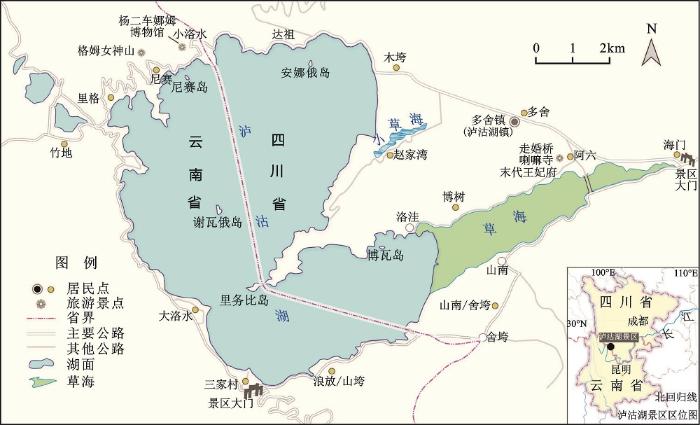
泸沽湖景区地处四川省盐源县和云南省宁蒗县交界处(图1),属于国家4A级旅游景区。泸沽湖是高原断层溶蚀陷落湖泊,湖面海拔2 690 m,水域面积58.8 km2。沿湖居住着汉族、纳西族、蒙古族、藏族、普米族、彝族等多个民族和一个特殊的族群——摩梭人①。摩梭人创造了独特的摩梭文化,至今仍保留着母系家庭和“走婚”习俗,被中外社会学家称为世界上“人类母系氏族社会活化石”[29]。独特的地理环境孕育了摩梭文化,摩梭文化更增添了泸沽湖神秘的色彩。泸沽湖空间相对封闭,距离云南和四川2省的旅游中心城市均在200 km2以上(距丽江247 km2、攀枝花220 km2、西昌270 km2、香格里拉420 km2、成都800 km2),公路等级不高,局地地质灾害严重,只能通过汽车进出,可进入性相对较差。泸沽湖景区所在县属国家级贫困地区(云南省宁蒗县、四川省盐源县均为国家级贫困县)[30],经济发展水平不高,物质资源匮乏,可谓典型的边缘型地区旅游地。
泸沽湖景区的旅游发展起步较晚,1992年云南片率先开发泸沽湖旅游,接待游客3.6万人次,实现旅游总产值115万元;而四川片开发较晚,2001年游客仅1.9万人次,2004年之后才真正取得较快发展②。随着环湖旅游基础设施的改善,2个片区逐渐开始缩小差距,2011年,云南片区共接待游客56万人次,旅游综合收入1.78亿元③,四川片区16.1万人次,旅游综合收入1.43亿元④。【 ① 关于摩梭人的民族归属问题存在很多争议,有的文献将其称为摩梭族,包括当地人也自认为摩梭族,然而中国56个民族中却不包括摩梭族,通常,四川摩梭人归为蒙古族的支系,云南摩梭人归为纳西族的支系。本文并不追溯民族的源流,将其视为一个特殊族群。② 资料来源:四川旅游规划设计研究院:泸沽湖旅游区总体规划和重点景区详规。2007年。③ 资料来源:丽江泸沽湖省级旅游区管理委员会统计资料:“2003~2011年泸沽湖景区接待游客数和门票收入”。 ④ 资料来源:盐源县旅游局2011年工作总结。】
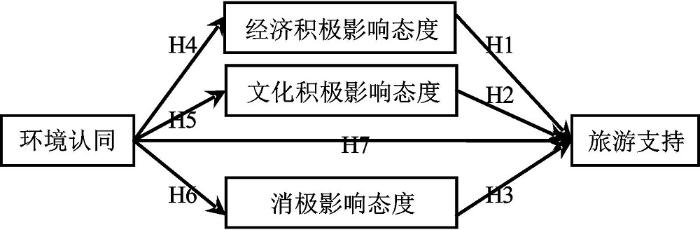
边缘区一方面具有远离核心区、人口稀疏、经济落后(以种植业或渔业为主)等不利条件,但同时往往具有原野性和未被破坏的自然环境;中国中、西部等“边缘的边缘”地区需要加强生态环境保护和土地利用分区;加强社区参与,确保当地居民对旅游发展的认同,并享受带来的收益[31]。中国中西部边缘型地区旅游发展较晚,因其经济基础薄弱,自然环境、文化资源比较脆弱,在旅游起步阶段就十分关注旅游业对经济、自然环境、文化的影响,要避免资源消耗、环境污染等“发达地区‘示范效应’的不良影响”[32]。因此,对于边缘型地区旅游地来说,居民环境认同及对旅游的经济、文化效应的态度,会影响其旅游支持。本文借鉴Robin Nunkoo和Dogan Gursoy关于海岛型旅游地(毛里求斯)居民旅游支持的假设模型[33],并结合中国边缘型地区旅游地的旅游影响特征,对模型进行修正,环境认同及居民对旅游的经济、文化效应的态度是影响居民旅游支持的非常重要的影响因素(图2)。
旅游促进当地经济发展[34]、提高人民生活水平[35]、增加商业和投资机会[36]、增加就业机会[37],积极影响和居民支持有直接的相关关系[38,39]。旅游同时导致了居民生活成本提高、交通拥堵、物价上涨、文化消极变迁、环境污染等各方面的消极影响,部分研究认为居民对消极影响的认识越高会导致旅游支持越低[40]。据此,提出以下假设:
H1:居民对旅游的经济积极影响态度(APIE)与旅游支持(SFT)有直接的积极关系。
H2:居民对旅游的文化积极影响态度(APIC)与旅游支持(SFT)有直接的积极关系。
H3:居民对旅游的消极影响态度(ANI)与旅游支持(SFT)有直接的消极关系。
环境认同与居民所依赖的土地、水、植物、动物等生存资源密切相关,对这些资源的管理直接影响居民的生活质量[41]。居民的环境意识提高影响其旅游态度[42]。因此,提出以下假设:
H4:环境认同(ENI)与居民对旅游的经济积极影响态度(APIE)有消极关系。
H5:环境认同(ENI)与居民对旅游的文化积极影响态度(APIC)有消极关系。
H6:环境认同(ENI)与居民对旅游的消极影响态度(ANI)有积极关系。
H7:环境认同(ENI)对居民旅游支持(SFT)有消极影响。
本研究采用封闭式问卷调查与结构式访谈法收集居民环境认同、旅游影响的态度和旅游支持的资料。调查点主要选择环泸沽湖、且已经参与旅游业发展的行政村或行政村中的自然村(云南省洛水村,四川省多舍、木垮、博树、山南4村),村内至少有一半家庭参与旅游业。调查对象为18~65岁的常住人口①【① 之所以设置年龄上限,主要是考虑到65岁以上老人参与旅游业的可能性较小,对旅游支持和环境认同的感知较弱,故而不予抽样。】,按照先抽取家庭户再抽调查对象的方式进行多阶段概率抽样,依据村委会介绍,在各村主干道按照右手行走原则,隔4户抽取1户作为受访户,再运用简单随机抽样在户内抽取被调查者。调查问卷由访问员携带入户,当面提问、解释,并填答。2012年8月9~27日组织调查,发放居民问卷共计362份,回收有效问卷304份,有效率84%。
研究假设中的环境认同(ENI)(7个观测指标)、消极影响态度(ANI)(9个观测指标)、旅游支持(SFT)(5个观测指标)多个变量主要参考了Nunkoo R等的研究成果[33],将旅游的积极影响态度变量分为经济积极影响态度(APIE)(3个观测指标)、文化积极影响态度(APIC)(5个观测指标)2个变量。钟士恩等研究认为,边缘型地区旅游发展面临的经济、社会(文化)、环境影响,与核心地区旅游发展不同[31],因此将居民对旅游的积极影响态度分为2个变量。同时,结合泸沽湖景区的经济文化特征对各变量的观测指标予以修正,比如,积极影响态度变量中的观测指标“对泸沽湖文化认同有积极影响”、消极影响态度变量中的“摩梭文化变迁”等,旅游支持变量中的“接待游客增至200万人次”、“整合度假村项目”主要查阅了泸沽湖2个片区的相关规划文本而确定,各项观测指标尽可能贴近泸沽湖景区的实际情况。其中,环境认同变量的测量主要通过语义差异量表,在2个关于环境的对立表述之间由被访者选择1~5,1代表非常不认同或不支持,5代表非常认同或支持。积极、消极影响态度和旅游支持变量的测量采取Likert量表,1代表非常不同意,5代表非常同意。
调查对象抽取多舍村43人、木垮村52人、博树村62人、山南村28人、洛水村119人。其中男性157人、女性147人,18~34岁(48.4%)、35~44岁(34.2%)人口占主体,初中以上学历占68.7%,蒙古族43.1%、汉族23.4%、纳西族18.8%,认为自己是摩梭人的占59.5%,职业以务农(29.9%)、旅游业个体工商户(48.6%)为主。
运用主成份法对各变量独立性进行检验,环境认同(ENI)、文化积极影响态度(APIC)、经济积极影响态度(APIE)、消极影响态度(ANI)、旅游支持(SFT)的Cronbach’s Alpha值分别为:0.809、0.777、0.786、0.918、0.832,均大于0.7,说明各变量的可靠性较好。
采取逐步回归模型,以年龄、性别、文化程度、民族作为控制变量,第一步,以SFT为因变量,将ENI、APIE、APIC、ANI作为自变量逐步纳入方程,结果表明APIE、APIC、ENI通过显著性检验;第二步,同样方法,以ENI为自变量分别检验与APIE、APIC、ANI的回归关系,除ANI外,ENI通过显著性检验。从方差膨胀因子和容忍度看,因变量与自变量均存在线性关系(表1)。
结果表明APIE、APIC、ENI3个预测变量进入回归方程,得出回归模型,R2=0.238,p<0.05(表1)。关于经济积极影响态度对旅游支持变量的模型解释率为17%(Fch=61.464,p<0.001),文化积极影响态度变量纳入方程增加了对旅游支持的模型解释率,为21%(Fch=17.781,p<0.001),纳入环境认同变量则对旅游支持的模型解释率合计为23%(Fch=8.915,p<0.05)。
经济积极影响态度和旅游支持有直接的积极关系(ß=0.242,t=3.963,p<0.001),假设1得到验证;以此也能得出文化积极影响态度和旅游支持有直接的积极关系(ß=0.237,t=3.889,p<0.001),支持假设2。环境认同对旅游支持虽然也通过显著性检验,但是方向为负,因此可以得出,环境认同越高,旅游支持越低,支持假设7(ß=-0.156,t=-2.986,p<0.05)。
将环境认同纳入回归方程,结果表明引起因变量(APIE)6.1%的变化(Fch=19.636,p<0.001),支持假设4(ß=-0.247,t=-4.431,p<0.001)。引起因变量(APIC)5.4%的变化(Fch=17.163,p<0.001),支持假设5(ß=-0.232,t=-4.143,p<0.001)。
旅游积极影响态度与旅游支持之间有直接的关系,环境认同与旅游积极影响态度呈消极关系,环境认同也会直接影响居民的旅游支持行为。但环境认同与消极影响态度之间的关系并不显著,对居民旅游支持的影响亦不显著(表2)。
表1 居民旅游支持回归分析结果
Table 1 The result of regression for residents’ support for tourism
| 指标 | R | R2 | 调整R2 | R2增量 | F值变化量 | 回归系数ß | t 值 | 方差膨胀因子 | 容忍度 | |
|---|---|---|---|---|---|---|---|---|---|---|
| 旅游支持度逐步回归 | ||||||||||
| 1 | APIE | 0.411 | 0.169 | 0.166 | 0.169 | 61.464* | 0.242* | 3.963 | 1.469 | 0.681 |
| 2 | APIC | 0.464 | 0.215 | 0.210 | 0.046 | 17.781* | 0.237* | 3.889 | 1.458 | 0.686 |
| 3 | ENI | 0.488 | 0.238 | 0.230 | 0.023 | 8.915** | -0.156** | -2.986 | 1.080 | 0.926 |
| 经济积极影响态度逐步回归 | ||||||||||
| 1 | ENI | 0.247 | 0.061 | 0.058 | 0.061 | 19.636* | -0.247* | -4.431 | 1.000 | 1.000 |
| 文化积极影响态度逐步回归 | ||||||||||
| 1 | ENI | 0.232 | 0.054 | 0.051 | 0.054 | 17.163* | -0.232* | -4.143 | 1.000 | 1.000 |
表2 假设检验结果
Table 2 The result of hypotheses testing
| 假设关系 | 标准化系数 | 结果 |
|---|---|---|
| H1:APIE→SFT(正相关) | 0.242 | 支持 |
| H2:APIC→SFT(正相关) | 0.237 | 支持 |
| H3:ANI→SFT(负相关) | -0.067 | 不支持 |
| H4:ENI→APIE(负相关) | -0.247 | 支持 |
| H5:ENI→APIC(负相关) | -0.232 | 支持 |
| H6:ENI→ANI(正相关) | 0.094 | 不支持 |
| H7:ENI→SFT(负相关) | -0.204 | 支持 |
3.2.1 泸沽湖景区居民强烈的环境认同
泸沽湖景区生态环境比较脆弱,山多地少,农作物种类少、产量低,泸沽湖的水资源和周边耕地就成了居民基本的生存条件,因此,湖边的摩梭人对山和湖充满敬畏,充分体现在摩梭人的转山转海传统节日活动中。转山转海是摩梭人崇拜自然实体的群众性活动,具有浓厚的佛教色彩,每年农历七月二十五被确定为转山转海节;各村各寨、各家各户都来朝拜格姆山神,祈求保佑五谷丰收、人畜平安[43]。摩梭人有强烈的环境保护传统意识,许多宗教禁忌和信仰,在涵养山林、保护动植物资源和维持生态平衡方面,起到了重要作用[44]。旅游业的发展进一步加强了摩梭人的环境认同。如关于机动船代替传统猪槽船(人力划船)的问题,居民的态度充分说明了这一点:“机动船烧油,会污染湖水,也是对湖神不尊重。你看到湖里有种水草,叫海藻花,对水质的要求很高,可以当菜吃的,如果水污染了,海藻花也就没有了”①。可见,泸沽湖周边居民的环境认同已经根深蒂固,甚至愿意放弃短暂的经济利益保护自然环境。
3.2.2 泸沽湖景区居民高度关注旅游的积极影响
泸沽湖旅游发展促进了周边各村社会事业的发展,村民人均收入普遍提高,以云南省洛水村为例,2011年人均年收入3 940元,其中旅游发展较好的里格8 900元,(大)洛水7 860元,小洛水5 600元,实现了脱贫致富②。四川省博树村人均纯收入由2004年的1 200元增至2007年的6 200元,在村旅游协会的带领下统一管理、统一经营、统一按劳分配,从集体收入中按比例提取一定公积金,用于公益事业开发、业务培训等,在增加农民收入的同时,得到了村民的认可③。旅游业的持续发展增强了居民的社区归属感,不仅外出打工者回流,还吸引了大量流动人口来泸沽湖地区经商。如洛水村2012年人口基本情况统计发现,(大)洛水、小洛水、里格3个自然村的户籍人口分别为552人、121人、175人,在村委会登记备案的暂住人口分别为217人、29人、48人,暂住目的全部为经商④。大量外来人口来泸沽湖从事旅游经营,充分说明了居民对旅游支持程度。一项四川省泸沽湖旅游景区管理局的调查也印证了这一点:92.22%的村民支持政府进行“摩梭家园”建设,以此为契机改善自己的生活条件,提高生活水平;91.14%的村民支持政府对景区合理规划⑤。
3.2.3 泸沽湖景区的旅游消极影响不显著
泸沽湖景区旅游客流相对较小且季节性明显,主要集中在每年7~8月,旅游消极影响能够自我消解,居民对旅游消极影响的态度比较包容(表3)。
表3 居民对旅游消极影响的态度差异
Table 3 Difference of residents’ attitude to negative impacts of tourism
| 旅游消极影响 | 不同意 | 均值 | 中值 | 众数 | 标准差 |
|---|---|---|---|---|---|
| 破坏公物行为增加 | 71.1% | 2.09 | 1.00 | 1 | 1.397 |
| 交通堵塞 | 72.7% | 2.04 | 1.00 | 1 | 1.343 |
| 噪音和空气污染 | 72.0% | 2.08 | 1.00 | 1 | 1.423 |
| 犯罪率上升 | 84.2% | 1.67 | 1.00 | 1 | 1.133 |
| 自然环境破坏 | 73.7% | 2.01 | 1.00 | 1 | 1.358 |
| 卖淫增加 | 84.8% | 1.61 | 1.00 | 1 | 1.112 |
| 湖边和其他室外场地变得拥挤 | 65.2% | 2.27 | 2.00 | 1 | 1.352 |
| 居民很可能要忍受旅游目的地的生活 | 52.6% | 2.72 | 2.00 | 2 | 1.382 |
| 摩梭文化变迁 | 60.2% | 2.36 | 2.00 | 1 | 1.462 |
统计表明,50%以上居民并不认为旅游导致了消极影响,其中有6项消极影响指标超70%的居民不同意,可见,居民对旅游发展的态度趋于积极,说明旅游消极影响并未显著呈现。主要原因:① 泸沽湖景区旅游者规模并不大,环湖约70 km2,14个亲水自然村,均可从事旅游接待服务,旅游容量相对较大;② 泸沽湖旅游起步较晚,而且十分重视对旅游消极影响的治理,充分体现了边缘型地区的迟发展效应,如2004年10月27日,云南省政府决定实施泸沽湖环境保护与治理“八大工程”⑥,加大泸沽湖周边环境整治力度,保护泸沽湖流域生态环境,实际上涉及到对泸沽湖景区经济、社会、资源、环境可持续发展的综合性治理,2008年初“八大工程”取得显著成效[45]。
边缘型地区有着独特的文化生态结构,旅游发展有其特殊性,居民的环境认同及对旅游影响的态度是旅游支持的重要影响因素。① 边缘型地区旅游地居民的环境认同较高,对旅游发展持相对谨慎的态度。自然生态环境是居民的生存基础,无论农业,还是旅游业,都必须以其为基础,这种谨慎的态度既有历史上延续下来的原始宗教信仰的原因,也有现实可持续发展的需要,旅游发展不能以牺牲环境为代价。② 在此基础上,边缘型地区旅游地居民的旅游支持还取决于居民对旅游积极影响的态度,而不是对旅游消极影响的态度,一定意义上说明泸沽湖景区作为边缘型旅游地,旅游发展处于初始阶段,相比较旅游消极影响,本地居民更为关注的是旅游在经济、文化方面的积极影响,或者说,居民对旅游消极影响的态度对旅游支持并不起决定作用。但另一方面,随着旅游业的持续发展,居民对旅游消极影响已经有了一定的认识。③ 居民对旅游的文化积极影响关注度略大于旅游经济影响。长久以来,泸沽湖景区已经形成了与泸沽湖及其周边的自然生态环境和谐共生的、独特的、而又相对封闭的摩梭文化生态系统。与自然生态环境相比,该系统中独特的摩梭文化,特别是走婚习俗和母系家庭,显得尤为脆弱。旅游业的发展应该能够促进边缘型地区特殊的族群文化或区域文化的保护与传承,这比获取短暂的经济利益更为重要。
泸沽湖景区作为边缘型地区旅游地的典型,为中国边缘型地区的旅游发展提供了一定的参考和借鉴。首先,边缘型地区旅游地要以环境保护为前提,以旅游利益共享为原则,发展可持续旅游,才能得到居民对旅游业的大力支持,从而避免西方研究者提出的边缘型地区旅游地发展过程中的突出问题,如过度开发、环境污染、过度商业化、文化破坏、利益剥夺等问题[46~48]。其次,统筹规划旅游发展,特别是比较脆弱的生态环境和文化生态,建立生态环境和文化生态保护的准入机制、整体保护机制,促成居民参与保护的自觉性。再次,借鉴旅游核心地区或旅游先发地区成熟的旅游发展经验,建立跨界旅游区旅游发展协同机制,避免自发经营对环境和文化造成的消极影响。
The authors have declared that no competing interests exist.
| [1] |
Tourism in peripheral areas-the challenges for Northeast Scotland [J].https://doi.org/10.1002/jtr.426 URL [本文引用: 1] 摘要
All peripheral regions face significant challenges with tourism development. This research initially acknowledges the challenges facing peripheral regions, which can be either geographical, such as access and infrastructure, or perceptual in nature, such as image related. Subsequently the challenges for tourism provision and development in the northeast of Scotland are discussed. Primary data h...
|
| [2] |
Tourism on the Greek islands: issues of peripherality, competitiveness and development [J].https://doi.org/10.1002/(SICI)1522-1970(199909/10)1:5<341::AID-JTR201>3.0.CO;2-0 URL [本文引用: 1] 摘要
ABSTRACT The Aegean archipelago is the largest island complex in Europe, accommodating 500 000 Greek people, living on 95 inhabited islands. The region's economy depends heavily on tourism, as it is estimated that tourism's contribution varies between 50% and 90% of the Gross Regional Product. The Aegean has been an established destination since the 1960s, offering a great number of facilities. The traditionally built islands and the beautiful landscapes on the one hand, and the unspoiled sea on the other, make it a desirable destination. The major attractions arèsun, sand, sea, sex' types of products, often augmented to take advantage of the cultural, heritage, natural, and historical resources, as well as the events and festivals taking place in the area. Both tourism enterprises and the destination as a whole experience an overdependence upon conventional distribution channels, and especially integrated tour operators, for delivering their products. As the majority of tour operators aim to reduce their prices in order to increase their competitiveness and market share, they constantly aim to minimise the pro庐;t margins of local principals. Consequently, despite the unparalleled environmental and heritage resources, the Aegean islands fail to attract the desirehigh-quality, high-expenditure' tourists. The deterioration of the tourism product and image leads to a lower willingness to pay by consumers, which consequently, leads to a further drop in quality, as the industry attempts to attract customers with lower prices. The concentration of bargaining power in European tour operators, in combination with the inability of the Greek tourism industry to promote itself effectively, inevitably reduce the pro庐;t margins of principals and their ability to yield decent returns on their investment. As a result, tourists' expenditure per capita deteriorates gradually, whereas their volume increases. Consequently, tourism enterprises 庐;nd it dif庐;cult to operate and compete and the economic bene庐;ts for the destination deteriorate dramatically. Socio-cultural and environmental impacts also decay local resources and jeopardise the sustainability of the region in the long term. It is therefore proposed that scienti庐;c research, political debate and community action should be utilised in order to rationalise the strategy for tourism on the Aegean Islands. This will enable the tourism industry to deliver the bene庐;ts it owns to its main stakeholders in the new millennium. Copyright # 1999 John Wiley & Sons, Ltd.
|
| [3] |
Centre and periphery: spatial variation in politics [M]. |
| [4] |
The difficult business of making pleasure peripheries prosperous: perspectives on space, place and environment [ |
| [5] |
Tourism in peripheral areas: case studies [M]. |
| [6] |
Lead, South Dakota: the remaking of a company mining town [J]. |
| [7] |
The Colorado gambling boom: an experiment in rural community development [J].
Three small Colorado towns that faced a declining economy as the mining resource ran out used gambling-based tourism as a strategy for community development. Although economic benefits to the towns have far exceeded expectations, negative social, environmental, and political changes, such as crime alcoholism, traffic problems, and conflicts between cities and county, have lowered county residents' quality of life. (SV)
|
| [8] |
|
| [9] |
Rural resident tourism perceptions and attitudes by community level of tourism [J].https://doi.org/10.1177/004728759002800301 URL [本文引用: 1] 摘要
Focusing on the residents of 28 rural Colorado communities, this research examines differences in resident tourism perceptions and attitudes across communities categorized on the basis of the community's existing level of tourism. The results indicate that the perceived impacts of tourism, both positive and negative, increase with increasing levels of tourism. With respect to resident attitudes toward additional tourism development, however, the results suggest that resident attitudes initially increase in favorability with increasing tourism development, but achieve a threshold level of development beyond which attitudes become less favorable. In this study, this threshold was achieved when approximately 30% ofthe community's retail sales were derivedfrom tourism. Finally, the results also indicate that resident supportfor special tourism user fees and taxes increases with increasing levels of tourism development.
|
| [10] |
Dependency and development in Northern Thailand [J].https://doi.org/10.1016/j.annals.2010.03.005 URL Magsci 摘要
Critics of tourism as a tool for development in poor rural regions have frequently used the dependency theory to examine why a destination area remains underdeveloped. Applications of the dependency theory have been largely restricted to international scales; there is a dearth of studies conducted at smaller spatial scales. This study examines leakages of tourism revenues at four villages in Northern Thailand to illustrate the dependent relationship between a city and its rural hinterland. Study results are based on a survey of 43 small businesses and 40 interviews. Results indicate significant proportion of leakages of village revenues, between 15 and 61%, depending on several factors and strategies adopted by each village.
|
| [11] |
|
| [12] |
Social impacts of tourism on central Florida [J].https://doi.org/10.1016/0160-7383(88)90082-5 URL [本文引用: 1] 摘要
Les impacts sociaux du tourisme en Floride centrale. Le but de cette recherche était d'investiguer les perceptions des habitants de la Floride centrale vis-à-vis des impacts et des conséquences sociales du tourisme. Une enquête par téléphone à 203 ménages en Floride centrale a révélé non seulement que les habitants approuvaient l'ampleur actuelle de l'industrie touristique, mais aussi qu'ils étaient en faveur de son extension. En dépit d'une impression générale positive, les habitants de la Floride centrale ont identifié des impacts spécifiques, négatifs et positifs, que le tourisme apportait à leur communauté. En plus, la recherche a révélé un rapport entre le niveau général de soutien pour le tourisme en Floride centrale et les perceptions des habitants au sujet des conséquences du tourisme.
|
| [13] |
Perdue R R et al. The impact of tourism development on residents’ perceptions of community life [J].https://doi.org/10.1177/004728758802700104 URL [本文引用: 1] 摘要
Thepurpose of this study was to determine whether residents' perceptions of community life satisfaction vary with the levels of tourism development in theircommunity. Thestudy was conducted in 20 rural communities as part of the 1985 Colorado Rural Recreation Development Project administered by the University of Colorado-Boulder. A comprehen sive questionnaire investigating residents'perceptions of the importance of and their satis faction with seven dimensions of community life was distributed to one adult member of randomly selected households in each community. The seven dimensions ofcommunity life were public services, economics, environment, medical services, citizen involvement, for mal education, and recreation services. In order to determine which dimensions were most sensitive to changes in the level of tourism development, canonical analysis was conducted using tourism development ratings and community population as the set of independent variables and the seven importance and seven satisfaction ratings as the set ofdependent variables. Two significant canonical variates (p<.001) were found revealing that the relationship between tourism development and satisfaction or importance of community dimensions is generally nonlinear with citizen involvement, public services, and the environment being most sensitive to tourism development.
|
| [14] |
Tourism dependence and resident attitudes [J].https://doi.org/10.1016/S0160-7383(98)00040-1 URL [本文引用: 2] 摘要
Many rural communities view tourism as a major vehicle for addressing rural economic decline, but several empirical studies suggest that its growth can bring negative social impacts. One group of studies suggests a direct relationship between the level of tourism development in a community and the presence of negative resident attitudes toward it. This "tourism dependence" hypothesis is evaluated using survey data from four rural communities in the United States Rocky Mountain West. Results support the hypothesis with some important qualifications, and suggest a typology of rural communities experiencing tourism growth that includes tourism-saturated, tourism-realized, and tourism-hungry community types. (PsycINFO Database Record (c) 2012 APA, all rights reserved)
|
| [15] |
居民地方感对区域旅游发展支持度影响——以九寨沟旅游核心社区为例 [J].https://doi.org/10.3321/j.issn:0375-5444.2009.06.010 URL Magsci [本文引用: 1] 摘要
基于"地方感"、"期望理论"两个基本理论,从旅游核心社区居民 地方感、旅游发展期望、旅游发展获益感知、旅游发展成本感知以及旅游发展支持度五个结构变量Ⅲ发,通过引入旅游发展期望值作为中介变量,构建居民地方感对 旅游发展支持度内部影响机制的理论模型.以世界遗产地几寨沟为实证研究对象,通过验证性因子分析和三阶段结构方程模型的定量分析,校验理论模型中各结构因 子、结构因子与其所含维度之间影响路径及其系数,定量测度了居民的旅游发展期望在居民地方感与旅游发展正反影响感知关联中的中介效用和影响机制,及对旅游 发展支持度的潜在影响模式.研究结果表明:①居民地方感对居民旅游发展正反影响感知的作用存在差异,地方感对获益感知的作用远大于成本感知.②居民从旅游 发展中感知获益有助于他们对当地旅游发展持更积极态度.而成本感知则会产生消极影响.③居民旅游发展期望中介效用的存在性和有效性,居民地方感通过发展期 望,强化了对旅游发展影响感知及旅游支持度作用.④发展期望在居民旅游发展正反影响感知两结构模型中的中介效用存在强弱,在感知获益子结构模型的中介作用 强于感知成本子模型.
|
| [16] |
Place attachment, identity and community impacts of tourism: the case of a Beijing Hutong [J].https://doi.org/10.1016/j.tourman.2007.06.006 Magsci [本文引用: 1] 摘要
<h2 class="secHeading" id="section_abstract">Abstract</h2><p id="">A significant literature exists on the impacts of tourism on local communities. This paper examines this issue with reference to the impacts of tourism on the residents of Shi Cha Hai hutong in Beijing, but does so with reference to theories of place attachment or place identity. It therefore addresses two gaps in the literature—namely, (a) a comparative lack of empirical evidence on community impacts of tourism in Mainland China and (b) the absence of debate in the tourism literature about place attachment. The study involved both quantitative and qualitative methods, but this paper primarily concentrates upon the results derived from the quantitative study. It was found that, in general, concerns about heritage outweighed perceived advantages from economic development, and the role of heritage in place attachment is duly discussed. Additionally, a structural equation model is suggested whereby attitudes toward tourism are based upon attitudes toward heritage, tourism as a source of potential employment, length of residency and perceived intrusiveness of tourism, all of which impact on a sense of place identity. The findings from these tests raised issues about the role of government and self-efficacy in place identity in a Chinese environment.</p>
|
| [17] |
|
| [18] |
Bringing identity theory into environmental sociology [J].https://doi.org/10.1046/j.1467-9558.2003.00196.x URL [本文引用: 1] 摘要
ABSTRACT In an effort to explain pro-environmental behavior, environmental sociologists often study environmental attitudes. While much of this work is atheoretical, the focus on attitudes suggests that researchers are implicitly drawing upon attitude theory in psychology. The present research brings sociological theory to environmental sociology by drawing on identity theory to understand environmentally responsive behavior. We develop an environment identity model of environmental behavior that includes not only the meanings of the environment identity, but also the prominence and salience of the environment identity and commitment to the environment identity. We examine the identity process as it relates to behavior, though not to the exclusion of examining the effects of environmental attitudes. The findings reveal that individual agency is important in influencing environmentally responsive behavior, but this agency is largely through identity processes, rather than attitude processes. This provides an important theoretical and empirical advance over earlier work in environmental sociology.
|
| [19] |
Tourism in the Northern Rockies: preserving the product, protecting the future [J]. |
| [20] |
Local identity processes and environmental attitudes in land use changes: the case of natural protected areas [J].https://doi.org/10.1016/S0167-4870(02)00121-6 URL Magsci [本文引用: 1] 摘要
The paper concerns pro-environmental attitudes, local identity and place attachment (PA) in the institution of protected natural areas. A theoretical claim is made to frame traditional social psychological research on environmental concern into a 鈥減lace specific鈥 perspective. Two studies are presented in which pro-environmental attitudes, regional identity (RI) and PA are analysed in two different Italian national parks. In study one ( N =115), local residents (people who live inside the park area) and non-local residents (people who live in the same region but outside the park area) were interviewed by questionnaire. The results showed local groups with negative attitudes toward both general and specific natural protected areas and high degrees of RI and PA and non-local groups with the opposite pattern. In study two ( N =854), the same differences between locals and non-locals were confirmed in a larger sample; also, various subgroups of local residents who differ in terms of their prevalent economic activities and specific interests were compared. Subjects more involved in local economic activities showed more negative attitudes toward natural protected areas (generally and specifically) and higher degrees of RI and place attachment than subjects more involved in ecological and pro-environmental activities. Both theoretical and policymaking implications of these results are discussed.
|
| [21] |
目的地居民对旅游影响的认知态度实证研究 [J].https://doi.org/10.3969/j.issn.1002-2104.2006.05.012 URL [本文引用: 1] 摘要
旅游地居民对旅游影响的认知态 度研究是旅游影响研究的主要内容之一。以浙江乌镇为例,在实地调研的基础上,利用问卷调查方法,分析了乌镇居民对旅游的社会文化影响、环境影响和经济影响 的感知程度,以及居民对旅游业发展的态度,归纳总结了乌镇居民对旅游影响的一般认知态度状况,对制定合理的旅游发展政策、改善居民对旅游者的态度和提高居 民对旅游业的支持、促进旅游地可持续发展具有重要的现实意义。本文的调查结果进一步证实了以往居民对旅游影响认知态度研究的研究成果。乌镇居民对旅游给当 地社区带来的社会、文化和环境效益感知强烈令人鼓舞,这与Liu和Var等诸多学者通过研究发现目的地居民对旅游发展产生的各方效益感知明显是一致的。此 外,乌镇居民对旅游经济影响的正面感知一致较强与现有研究成果也是相符的。所有这些证实了旅游地生命周期早期阶段居民更易倾向于正面感知。
|
| [22] |
名山研究的行为地理学解释——以北雁荡山为例 [J].https://doi.org/10.3321/j.issn:1000-0585.2006.06.017 URL Magsci [本文引用: 1] 摘要
从人文地理学角度对名山进行研究,运用行为地理学中环境感应和环 境认知的思想和方法,以人山之间的相互关系为基本研究对象,探求名山形成规律.通过对南北朝至明清时期处于我国浙东南的北雁荡山进行剖析和考证,指出雁荡 山的发展经历了隋唐以前的边缘接触期、唐代的开山期、宋代的兴盛期、明清的稳定发展期这四个主要阶段,并认为北雁荡山作为名山的内在本质在于其可居可游性 而非传统意义上所理解的佛教名山.旨在通过对这种演化过程的探讨,为我国名山研究提供一种可供参考的思路.
|
| [23] |
上海古典园林诗意生成的机制——以古漪园为例 [J].https://doi.org/10.3969/J.ISSN.1671-9964.2011.06.014 URL [本文引用: 1] 摘要
以嘉定古漪园为例探索了上海古 典园林中诗意的生成机制。通过创新性地运用环境心理学、网络和语言学一些方法与理论,开拓性地揭示了古漪园诗意的双重特征:物质结构中的诗性格律、文化语 义中的诗情隐喻,并集中体现在花园建构和环境认知的过程中;两者相辅相承。同时,论文阐明了古漪园"绿竹漪漪"的诗意建构机制是以使用者美学体验为导向; 这对当前上海城市人居环境改造建设是一种启示。
|
| [24] |
农户环境认知、行为决策及其一致性检验——基于江苏农户调查的实证分析 [J].
农业环境的改善,关键在于农 户。通过对江苏省206个农户样本的调查,考察了农户环境认知及行为决策状况,并对两者的一致性进行了检验。研究表明:在以总分为6分的认知问题中,得分 在3.5分以下的农户占到了样本总量的78.7%,表明部分农户的环境认知程度比较低;在以总分为5分的行为决策问题中,得分在3分及以下的农户占到样本 总量的56.3%,表明部分农户决策过程中对环境的考量不足;受教育程度对样本农户环境认知和决策都有显著的影响,农户环境认知与决策之间并不存在显著的 因果性,土地面积、受教育程度、年龄、性别以及主要收入来源等变量对农户环境认知及行为决策影响的差异,在一定程度上解释了这种不一致性。
|
| [25] |
Rural resident tourism perceptions and attitudes [J].https://doi.org/10.1016/0160-7383(87)90112-5 URL [本文引用: 1] 摘要
Les attitudes et les perceptions des habitants ruraux vis-à-vis du tourisme. Le propos du présent article est d'examiner l'influence de la participation dans la récréation en plein air sur les perceptions et les attitudes des habitants ruraux envers le tourisme. On analyse des données de cinq communautés de l'état de Colorado qui dépendent du tourisme pour au moins vingtcinq pour cent de leur vente au détail. Suivant un aspect de la théorie de l'échange sociale, on a formulé l'hypothèse que les gens qui participent à la récréation en plein air, au contraire de ceux qui n'y participant pas, auraient des perceptions négatives au sujet du tourisme. Les résultats, cependant, n'ont pas soutenu l'hypothèse: il n'y a aucune différence entre les attitudes et les perceptions des participants et des non-participants vis-à-vis du tourisme. Néanmoins, au fur et à mesure qu'augmentait l'impact per04u du tourisme sur les possibilités de la récréation en plein air, les habitants voyaient d'un oeil bien moins favorable le développement additionnel du tourisme, et ils appuyaient des taxes spéciaux pour le tourisme.
|
| [26] |
U.S. Virgin islanders’ perceptions of tourism [J].https://doi.org/10.1177/004728757801700106 URL 摘要
This article describes a survey conducted in the Virgin Islands to gain a better understanding of the local residents' perceptions and feelings toward tourists and tourism. Residents were interviewed to obtain their responses to a 56-item ques tionnaire, which provided eight statements in the following general categories: (I) financial, (2) moral, (3) religious, (4) social, (5) physical, (6) human, and (7) cul tural.
|
| [27] |
乡村居民旅游支持度影响模型及机理——基于不同生命周期阶段的苏州乡村旅游地比较 [J].https://doi.org/10.11821/xb201110011 URL Magsci 摘要
基于地方感、可持续发展、居民参与以及利益相关者等理论,选择"地方感"、"环境态度"、"参与度"、"居民感知"和"支持度"5个结构变量,构建影响旅游地居民支持度结构关系模型,以不同生命周期阶段的3个乡村旅游地(渔港村、旺山村、蒋巷村)为实证研究对象,对居民旅游支持度结构模型进行验证分析,并依据结构方程模型分析和因子分析,深入生探命讨不周期同阶生命段周旅游期地阶的段居旅游民地支持的居度影民支响模持度型中的所影起响的机作制用。存研在究差表异明:,①起步基阶本段维旅度游因地素的在"不地同方感"和"环境态度"对支持度起正向作用,而"参与度"对支持度没有产生影响;"地方感"、"环境态度"和"参与度"对迅速发展阶段和稳定发展阶段旅游地的支持度均产生正向用作存用。在差②异"居,民起感步知阶段"在旅不游同地生的命"居周民期感阶知段旅"游没地起的到居中民介支作持用度;影迅响速机发制展中阶所段发旅挥游的地中的介"作居民感知"对支持度产生负向中介作用;稳定发展阶段旅游地的"居民感知"对支持度起到正用向中存介在作差用异。:③起二步维阶影段响旅因游素地在的不"同地生方命认周同期"阶和段"旅基游本地环的境居态民度支";持迅度速影发响展机阶制段中旅所游起地的作的"地方认同"、"可持续性环境态度"和"表层参与"以及稳定发展阶段旅游地的"地方依赖"、"经济代价性环境态度"、"深度参与"和"正面影响感知"对支持度均产生显著正向影响。
|
| [28] |
旅游地居民对旅游影响感知和态度的比较——以西递景区与九寨沟景区为例 [J].https://doi.org/10.11821/xb200806009 URL Magsci [本文引用: 1] 摘要
旅游地居民感知与态度研究是旅游地理学研究的重要主题之一,居民感知的跨区域、跨文化的共时性分析是该领域研究未来努力的方向之一。选择世界遗产地西递和九寨沟为研究案例,进行旅游地居民旅游影响感知的比较研究。结果显示①两地居民对旅游发展均表现出积极态度,但九寨沟居民的响应程度和支持程度更为强烈,其旅游经济收入上要远高于西递。②九寨沟居民在旅游经济收益、旅游社会文化影响、旅游环境影响的上的感知均明显强于西递,同时在旅游经济成本感知上也明显强于西递。③相关分析和回归分析分别从样本基本特征中识别了西递和九寨沟居民支持旅游发展态度的相关因素和判别指标。分析结果表明,不同类型的旅游地具有不同的旅游社区特征,在旅游地性质、对旅游业的依赖程度、经济发展水平、旅游资源产权归属、旅游管理体制、主客文化差异等社区特征上不同的东道主社区应该有着不同的旅游感知。按照社会交换理论,无论是从资产的收益权还是从受干扰补偿方面,西递古村落居民相对九寨沟风景区居民具有更高的收益期望,这也导致了其实际获益远低于期望收益,故相对九寨沟居民,西递表现出低估旅游经济收益、社会收益而高估社会成本的倾向。
|
| [29] |
|
| [30] |
国务院扶贫开发领导小组办公室.国家扶贫开发工作重点县名单 [EB/OL]. . |
| [31] |
国外边缘旅游研究进展及其对中国的启示 [J].
随着旅游全球化趋势的增强,边缘地区越来越被整合到整个世界旅游体系中.边缘地区的原野性和未被破坏的自然环境符合了旅游者对"基于自然的旅游"的需求.边缘地区往往想通过发展旅游,改变落后的现状,但边缘地区的若干先天不足则构成制约条件,限制其可持续发展.边缘发展旅游面临的问题是什么?会产生哪些经济、社会、环境影响?能否缩小区域差异?是否已有一些成熟的经验?针对以上问题,本文对国外边缘旅游的概念、特征、发展的主题、存在的问题以及实现可持续发展的成熟经验进行了回顾,以期对我国旅游发展,特别是中、西部地区旅游的可持续发展有所启示.
|
| [32] |
西部民族地区旅游开发的迟发展效应与后发优势及创新对策 [J].https://doi.org/10.3969/j.issn.1003-4161.2005.01.036 URL [本文引用: 1] 摘要
文章从分析西部民族地区旅游开发的迟发展效应和可以利用的后发优势,提出了在进行旅游开发过程中必须跨越迟发展效应的障碍,以创新思维和整合后发的各种优势,在科学发展观的指导下,寻求西部民族地区旅游业发展的新对策.
|
| [33] |
Residents’ support for tourism: an identity perspective [J].https://doi.org/10.1016/j.annals.2011.05.006 URL [本文引用: 2] 摘要
Studies on residents’ support for tourism have primarily been conducted in the developed world. This study analyzes community support in the island economy of Mauritius by testing a model based on the social exchange theory and the identity theory. The model proposes that the resource-based occupational identity, environmental identity, and gender identity of the residents influence attitudes to tourism impacts and support (behavior). Results indicate that one’s identity has a direct bearing on support, but may not always influence attitudes. Findings confirm the relevance of the social exchange theory and the identity theory in explaining community support for tourism in island economies. The study’s practical implications and limitations are discussed.
|
| [34] |
Host attitudes toward tourism: an improved structural modeling approach [J].https://doi.org/10.1016/j.annals.2003.08.008 Magsci [本文引用: 1] 摘要
<h2 class="secHeading" id="section_abstract">Abstract</h2><p id="">Drawing from current literature, a theoretical tourism support model with a series of hypotheses was proposed. The model and the hypotheses were tested by utilizing a two-stage structural equation modeling approach. The findings of this study revealed that the host community backing for tourism development is affected directly and/or indirectly by nine determinants of residents’ support: the level of community concern, ecocentric values, utilization of tourism resource base, community attachment, the state of the local economy, economic benefits, social benefits, social costs, and cultural benefits. Further, results indicated that there are interactions among five dimensions of impacts. The proposed model explained the majority of the variance.</p><h2 class="secHeading" id="section_abstract">Résumé</h2><p id="">Les attitudes de la communauté d’accueil envers le tourisme: un modèle structurel amélioré. En se basant sur la littérature récente, on a proposé un modèle théorique de soutien de tourisme comprenant une série d’hypothèses. Le modèle et les hypothèses ont été mis à l’épreuve en utilisant une approche de modelage d’équation structurelle à deux stades. Les résultats de cette étude révèlent que le soutien par la communauté d’accueil du développement du tourisme est influé directement et/ou indirectement par neuf déterminants du soutien des habitants: niveau d’intérêt de la communauté, valeurs écologiques, utilisation de la base de ressources pour le tourisme, attachement de la communauté, état de l’économie locale, bénéfices économiques, bénéfices sociaux, coûts sociaux et bénéfices culturels. En plus, les résultats ont indiqué qu’il y a des interactions parmi les cinq dimensions des impacts. Le modèle proposé a expliqué la plus grande partie de la variance.</p>
|
| [35] |
Resident support for tourism development [J].https://doi.org/10.1016/0160-7383(90)90029-Q URL [本文引用: 1] 摘要
L'appui des habitants au développement du tourisme. Le but de cet article est de mettre à l'épreuve un modèle des liens entre les perceptions des habitants ruraux vis-à-vis des impacts du tourisme, le soutien au développement additionnel du tourisme, les restrictions au développement du tourisme et le soutien à des imp00ts spéciaux pour le tourisme. En mai 1987, on a rassemblé des informations par un sondage dans 16 localités rurales du Colorado. On a trouvé, sur le plan des avantages personnels qu'on tire du développement du tourisme, que les perceptions de ses impacts n'avaient aucun rapport avec les caractéristiques socio-démographiques. L'appui au développement additionel avait un rapport positif ou négatif selon la perception des impacts positifs on négatifs du tourisme. Le soutien au développement additionel du tourisme avait un rapport négatif vis-à-vis de la perception de l'avenir de la localité.
|
| [36] |
Mapping resident perceptions of gaming impacts [J].https://doi.org/10.1177/0047287505278997 URL [本文引用: 1] 摘要
This article explores Macao residents' perceptions of the impact of gaming development at a significant time in Macao's long experience with gaming, just after the end in 2002 of the 70-year-old monopoly system for the gaming sector and the introduction of new casino operators into the market. Principal components analysis, cluster analysis, and analyses of variance were used to understand the ...
|
| [37] |
Gendered jobs and social change [M]. |
| [38] |
Long P et al. Residents’ perceptions of casino impacts: a comparative study [J].https://doi.org/10.1016/j.tourman.2009.02.011 Magsci [本文引用: 1] 摘要
<h2 class="secHeading" id="section_abstract">Abstract</h2><p id="">The primary purpose of this study was to explore differences in residents' perceptions of casino development between South Korea and Colorado. The communities surveyed are former depressed mining areas with significant historic characteristics. The secondary purpose was to investigate whether social exchange theory is appropriate to explain residents' perceptions of the impact of casinos on community support for casino development. In general, three factors of residents' perceptions and support were found to be significantly different between the two study sites. Furthermore, the effects of positive social impact on benefits, of both positive social impact and negative environmental impact on support, and the benefit factor on support level were significantly different between the two data collection areas. The study findings support the appropriateness of social exchange theory in explaining residents' responses in both study areas.</p>
|
| [39] |
Modeling community support for a proposed integrated resort project [J].https://doi.org/10.1080/09669580903290991 URL [本文引用: 1] 摘要
In recent years Mauritius has experienced a rapid increase in integrated resort developments, which have been intended to secure income from new tourism segments and to boost the local economy. Using data on the responses of residents of Le Morne, Mauritius, to a proposal to construct an integrated resort, this study develops and tests a model of community support for the proposed development. The structural model indicates that residents' satisfaction with their own community, their utilization of the resource base, their perceptions of the state of the local economy and their environmental attitudes are antecedents of their views about the costs and benefits of the project. Opinions about the benefits and costs of the project were also found to determine the level of community support. All factors in the model were found to be determinants of the perceived costs and benefits of the project, except for residents' perceptions of the impact of the development on their utilization of the resource base. The ...
|
| [40] |
Local’s attitudes toward mass and alternative tourism: the case of Sunshine Coast, Australia [J]. |
| [41] |
Small island states and territories: sustainable development issues and strategies-challenges for changing islands in a changing world [J]. |
| [42] |
Maltese responses to tourism [J].https://doi.org/10.1016/S0160-7383(03)00023-9 Magsci [本文引用: 1] 摘要
<h2 class="secHeading" id="section_abstract">Abstract</h2><p id="">This study of residents’ responses to tourism in the Maltese islands adopts a contextual rather than tourism-centric approach, with responses related to the sociocultural and political setting as well as to tourism development. Scattered published sources are brought together and analyzed to develop a new research agenda. Several forms of response among the Maltese are examined, including attitudes to tourism’s general and specific impacts, and protest action against its schemes. The study shows that after the mid-80s some people’s views about the industry became more negative. Consideration is given to likely influences on the continuities and changes in responses since the 60s.</p><h2 class="secHeading" id="section_abstract">Résumé</h2><p id="">La réponse maltaise au tourisme. Cette étude des réponses des habitants au tourisme à l’archipel de Malte adopte une approche contextuelle plutôt que centrée sur le tourisme, avec des réponses liées aux cadres socioculturel et politique aussi bien qu’au développement du tourisme. On rassemble et analyse diverses publications pour développer un nouveau programme de recherches. On examine plusieurs sortes de réponses pa les Maltais, y compris leurs attitudes envers les impacts généraux et spécifiques du tourisme et leurs actes de protestation contre ses projets. L’étude montre que l’opinion publique au sujet du tourisme est devenue plus négative à la fin des années 80. On tient compte des influences probables sur les continuités et les changements dans les réponses depuis les années 60.</p>
|
| [43] |
|
| [44] |
泸沽湖摩梭人传统文化与生态环境的适应 [J].https://doi.org/10.3969/j.issn.1005-8036.2009.03.004 URL [本文引用: 1] 摘要
本文采用民族生物学的参与式农村评估法以及人类学的半结构式访谈法、关键人物访谈法对泸沽湖地区生态环境和摩梭人传统文化进行了深入的调查,以摩梭人传统文化与泸沽湖生态环境之间的关系为切入点,从生产方式、生活方式、自然资源管理机制和婚姻家庭模式等方面,阐明摩梭人文化适应与其所处环境之间的关系.结果表明:摩梭人的母系制社会制度是其对泸沽湖特定的生态环境进行文化适应的结果.并提出为了保留迄今为止中国境内唯一保留的母系制社会群体以及保护泸沽湖地区生态环境的建议和方法.
|
| [45] |
中华人民共和国环境保护部,云南泸沽湖环境保护整治八大工程顺利完成 [EB/OL].. |
| [46] |
The Golden Hordes: international tourism and the pleasure periphery [M]. |
| [47] |
Dependency and agency in peripheral tourism development [J].https://doi.org/10.1016/j.annals.2012.08.003 URL 摘要
The notion of dependency provides useful insights into tourism’s relationships between peripheral and core regions. Overly simple applications of this idea can be deterministic, however, suggesting that tourism development inevitably entails exploitation of the periphery by the core. This study in peripheral tourism development in relation to human agency, strategic calculation and strategic selectivity. These relationships are evaluated for tourism’s core-periphery relations between a main island and a nearby smaller and more peripheral island. It was found that the peripheral island of Gozo exhibited dependency on the main island of Malta, but Gozo’s actors also exerted agency within various constraints. Consideration is given to both economic and political dimensions of these relationships.
|
| [48] |
Peripheral tourism: development and management [J].https://doi.org/10.1016/0160-7383(95)00005-Q URL [本文引用: 1] 摘要
Le tourisme périphérique: développement et gestion. Cet article donne un aper04u des problèmes économiques, environnementaux et sociaux que l'on rencontre dans le développement et la gestion du tourisme dans des régions périphériques. Ces problèmes comprennent les grandes pertes économiques des dépenses du tourisme, les difficultés dans la défense de l'environnement et des impacts sociaux. On prend comme exemple la croissance du tourisme dans la Péninsule du Cap York (Australie) en utilisant les résultats d'une enquête des touristes et des tour operators. Cette région est loin des grands centres urbains, est relativement sous-développée et contient une population aborigène proportionnellement élevée.
|

/
| 〈 |
|
〉 |