



南亚地缘环境的空间格局与分异规律研究
作者简介: 胡志丁(1986-),男,江西上饶人,讲师,博士研究生,主要从事经济地理与地缘环境研究。E-mail:huzhiding2007@126.com
收稿日期: 2012-09-19
要求修回日期: 2013-01-20
网络出版日期: 2013-08-20
基金资助
国家科技支撑计划项目(2012BAK12B03)和国家自然基金项目(41171097,41071100)资助
The Spatial Pattern and Differentiation Laws of Geo-setting in South Asia
Received date: 2012-09-19
Request revised date: 2013-01-20
Online published: 2013-08-20
Copyright
地缘环境研究是中国地理学界复兴政治地理学的第二次尝试,也是政治地理学从单一要素向多要素、综合化发展的体现。基于对在北京召开的两次“地缘环境”国际研讨会和对早期地缘环境研究归纳的基础,将地缘环境界定为由地理环境、地缘关系和地缘结构3部分组成,其中,地理环境由自然环境、人口经济环境和社会文化环境构成,地缘关系包括经济关系、政治军事关系和社会文化关系,地缘结构则包含政治军事结构、经济结构和空间结构。采用AHP决策分析和模糊综合评价相结合的方法对南亚地缘环境进行定量评估。研究结果表明:南亚在地理环境、地缘关系和地缘结构上都存在明显的空间分异,并最终导致南亚在地缘环境上可以划分为4类,即印度为一类,巴基斯坦和孟加拉为一类,不丹和尼泊尔为一类,斯里兰卡和马尔代夫为一类。造成这种空间分异的原因大致有3个,即“地理决定论”、相互依赖论和制度论。
胡志丁 , 葛岳静 , 鲍捷 , 于伟 . 南亚地缘环境的空间格局与分异规律研究[J]. 地理科学, 2013 , 33(6) : 685 -692 . DOI: 10.13249/j.cnki.sgs.2013.06.685
The geopolitical setting study is the second attempt to revive the political geography of the geographical circles, also it reflects the political geography studied from a single element to multiple elements and integrated development. Based on the two “geopolitical setting” international seminar which held in Beijing and the early geographical environment research, the geo-setting is defined which contains geographical environment, geographical relations and geographical structure in this article. Geographical environment is consist of the natural environment, economic and population environment, and the social and cultural environment. Geopolitical relations includes economic relations, political and military relations, and social and cultural environment. The geographical structure contains political military structure, economic structure and space structure. And then, the article uses a combination of AHP decision-making analysis and fuzzy comprehensive evaluation method to evaluate the geo-setting of South Asia quantitatively. The results show that: In South Asia there exists significant space divided differences in the geographical environment, geopolitical relations and geo-structures, which eventually led to the geo-setting in South Asia can be divided into four categories, India for a class, Pakistan and Bangladesh for a class, Bhutan and Nepal for a class, Sri Lanka and Maldives as a class. There are three reasons which caused this spatial differentiation, which are geographic determinism, interdependence theory and institutional theory.
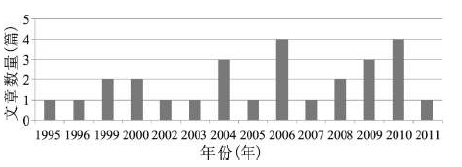
Fig.1 The number of thesis whose topic contains "geopolitical environment" published in China图1 1999~2011年 中国发表论文题目中含有“地缘环境”的文章数量 |
Table 1 The evaluation index system of Geo-setting表 1 地缘环境评价指标体系 |
| U:地缘环境 评价指标体系 | 一级评价指标集合 | 二级评价指标集合 | 具体评价指标 |
|---|---|---|---|
| U1:地理环境(1/9) | U11:自然环境(1/7) | U111:森林覆盖面积比例(0.122) U112:城市污染(0.320) U113:国土面积(0.558) | |
| U12:人口经济环境(4/7) | U121:人均GDP(0.223) U122:收入基尼系数(0.061) U123:GDP年均增长率(0.188) U124:人口总量(0.435) U125:城市人口比例(0.093) | ||
| U13:社会文化环境(2/7) | U131:平均受教育年限(0.172) U132:出生时预期寿命(0.081) U133:孕产妇死亡比率(0.051) U134:未成年人生育率(0.023) U135:接受过中等教育的人口比例(0.472) U136:公共教育支出(0.163) U137:医疗卫生支出(0.036) | ||
| U2:地缘关系(5/9) | U21:地缘政治军事关系(4/7) | U211:国家间的政治军事冲突(0.528) U212:国家间的领土冲突(0.333) U213:国家间跨界河流冲突(0.14) | |
| U22:地缘经济关系(2/7) | U221:与南亚国家第一大进口国贸易所占比重(1/6) U222:与南亚国家第一大出口国贸易作占比重(1/6) U223:与南亚国家贸易额占其总贸易额的比例(4/6) | ||
| U23:地缘社会文化关系(1/7) | U231:国家宗教信仰冲突(0.333) U232:国家间的民族冲突(0.667) | ||
| U3:地缘结构(3/9) | U31:地缘政治军事结构(4/7) | U311:各国国家政治军事实力所占南亚比重 | |
| U32:地缘经济结构(2/7) | U321:各国国家经济总量所占南亚比重 | ||
| U33:地理空间结构(1/7) | U331:各国所处南亚地理位置的重要性 |
注:受过中等教育的人口比例分为男性和女性,数据取两者归一化的平均值;地缘关系中的各指标计算采用各国与南亚每一个国家的地缘关系评估指的累积,表示每一国与南亚的总体地缘关系;表内括号中的数据为各等级指标的权重,采用AHP决策分析方法计算获得。 |
Table 2 The evaluation results of Geo-setting in Southern Asia表 2 南亚地缘环境评价结果 |
| 国家 | 地理环境 | 地缘关系 | 地缘 结构 | 地缘 环境 | |||||
|---|---|---|---|---|---|---|---|---|---|
| 自然 环境 | 人口经济 环境 | 社会文化 环境 | 地缘经济 | 地缘政治 军事关系 | 地缘社会 文化关系 | ||||
| 印度 | 0.7479 | 0.8279 | 0.5657 | 0.9716 | 1 | 1 | 1 | 0.9679 | |
| 巴基斯坦 | 0.3241 | 0.2734 | 0.4866 | 0.7238 | 0.5862 | 0.4512 | 0.3859 | 0.5014 | |
| 孟加拉国 | 0.2794 | 0.2217 | 0.5184 | 0.8299 | 0.4343 | 0.3335 | 0.1275 | 0.3696 | |
| 斯里兰卡 | 0.4139 | 0.1793 | 0.9814 | 0.7073 | 0.0293 | 0.1177 | 0.1681 | 0.2236 | |
| 不丹 | 0.3469 | 0.3477 | 0.2976 | 0.0198 | 0.088 | 0.3339 | 0.0238 | 0.1040 | |
| 尼泊尔 | 0.1964 | 0.0274 | 0.4604 | 0.3109 | 0.1911 | 0.3162 | 0.0633 | 0.1780 | |
| 马尔代夫 | 0.5730 | 0.4632 | 0.9239 | 0.8483 | 0 | 0 | 0 | 0.2076 | |
注:地缘关系各指标数据归一化并不是根据好坏之分,而是根据实际的需要采用大小表示一国与南亚地缘关系的疏密。 |
The authors have declared that no competing interests exist.
| [1] |
|
| [2] |
|
| [3] |
|
| [4] |
|
| [5] |
|
| [6] |
|
| [7] |
|
| [8] |
中国行政区划研究会.中国行政区划研究[M].北京:中国社会出版社,1991.
|
| [9] |
|
| [10] |
|
| [11] |
|
| [12] |
National Research Council of NAS. Understanding the changing planet strategic directions for the geographical sciences [M]. Washington, D.C.: The National Academies Press,2010.
|
| [13] |
|
| [14] |
|
| [15] |
|
| [16] |
|
| [17] |
|
| [18] |
|
| [19] |
|
| [20] |
|
| [21] |
|
| [22] |
|
| [23] |
中国政策科学研究会国家安全政策委员会.中国地缘安全环境评估报告(2010-2011)[M].北京:中央编译出版社,2011:216-227.
|
| [24] |
|
| [25] |
|
| [26] |
世界军事年鉴编辑部.世界军事年鉴[M].北京:解放军出版社,2011.
|
| [27] |
|
| [28] |
|
| [29] |
|
| [30] |
|
| [31] |
|
/
| 〈 |
|
〉 |