



旅游开发背景下传统村落功能演变的过程与机制——以黄山市西溪南村为例
|
陆林(1962−),男,安徽芜湖人,博士,教授,博导,研究方向为旅游管理与旅游地理。E-mail: llin@263.net |
收稿日期: 2021-06-28
修回日期: 2021-10-09
录用日期: 2022-04-10
网络出版日期: 2022-05-20
基金资助
安徽省社会科学重大投标项目资助(AHSKZD2019D03)
版权
Process and Mechanism of Function Evolution of Traditional Villages Under the Background of Tourism Development: A Case Study of Xixinan Village, Huangshan City
Received date: 2021-06-28
Revised date: 2021-10-09
Accepted date: 2022-04-10
Online published: 2022-05-20
Supported by
Anhui Provincial Social Science Major Bidding Project(AHSKZD2019D03)
Copyright
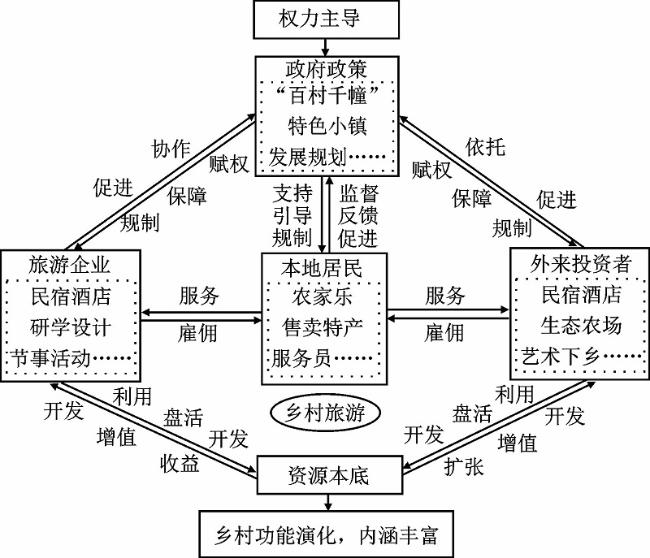
以黄山市传统村落西溪南村为例,通过对多元利益主体进行深度访谈,运用扎根理论方法从微观视角探索乡村功能演变的过程与机制。研究发现,西溪南村发展规划明晰,乡村旅游业形态丰富,乡村多元功能价值体系日益凸显。西溪南村乡村功能演变是地方政府、外来旅游企业、外来民宿投资者、本地居民与游客等多方利益主体协作共生的必然结果。政府政策引导是促进由内而外要素流动、乡村多功能转型的基础保障,外来旅游企业是推动西溪南村旅游开发经营的主导力量,外来民宿投资者是建构乡村民宿与生态空间、引领乡风文明实践的关键先驱,本地居民是填补细分市场、实现居业协同的重要践行者,各利益主体间的协作共生推动西溪南村乡村功能发展演变。
陆林 , 陈慧峰 , 符琳蓉 . 旅游开发背景下传统村落功能演变的过程与机制——以黄山市西溪南村为例[J]. 地理科学, 2022 , 42(5) : 874 -884 . DOI: 10.13249/j.cnki.sgs.2022.05.013
Tourism development is an important path to guide the transformation of rural functions and realize rural revitalization. Taking Xixinan Village, a traditional village in Huangshan City, as an example, the study applied in-depth interviews with government employees, exterior tourism companies, exterior homestay investors, local residents, and tourists to explore the process and evolution mechanism of rural functions from a micro perspective. It was found that the rural function evolution of Xixinan Village has gone through three stages: 1) The budding stage of tourism (2003-2008). The theme development project of ‘Jinpingmei Cultural Park’ was implemented in Xixinan Village, but the benefits and impact of tourism development were not obvious. There was no substantial evolution of rural functions. 2) In the tourism exploration stage (2009-2014), exterior investors purchased and repaired the ancient houses in Xixinan Village. Then they were opened to the tourists. It gave full play to the diversified functions of living, production and consumption of ancient dwellings, and showed the cultural and aesthetic values of Hui-style architecture. Furthermore, the tourism development strategy of Xiesheng Tourism Development Company in Xixinan Ancient Village has failed. 3) In the tourism development stage (2015-), the team of Professor Yu Kongjian from Peking University fully undertook the tourism development and management of the ancient village of Xixinan Village. The rural business has been continuously enriched. Xixinan Village has gradually realized the simplification of agricultural production functions and living functions to cultural protection and inheritance, ecological conservation, leisure and tourism, research and education, and other multi-functional shifts. In general, Xixinan Village has a clear development plan, a rich rural tourism industry, and an increasingly prominent rural multi-functional value system. The functional evolution of Xixinan Village is the certain result of the co-existence of multi-stakeholders such as local government, exterior tourism companies, exterior homestay investors, local residents and tourists. Government policy guidance is the basic guarantee to promote internal and external factor flow and rural multifunctional transformation. Exterior tourism companies are the leading force in promoting the development and operation of Xixinan Village tourism and carrying out various forms of cultural and creative activities. Exterior homestay investors are the key forerunners in constructing rural homestay space, constructing ecological space and leading the practice of local culture civilization. Local residents are vital practitioners who use their own resources to fill market segments and realize home-employment coordination. The cooperation and symbiosis among various stakeholders promote the development and evolution of the rural functions of Xixinan Village. From the perspective of rural function evolution, this study reveals the logic behind the return of villagers, capital and citizens to the countryside to build villages in Xixinan Village, and provides a realistic template and case reference for the transformation and development of Huizhou traditional villages.
表1 西溪南村功能演变机制分析:开放编码分析示例Table 1 Function evolution mechanism of Xixian Village: Open coding analysis examples |
| 范畴 | 标签 | 访谈文本 | 样本编号 |
| C1.规范制约 | c1.产权交易 | 到后面这些老房子,可以去给政府收 | V14 |
| c2.房屋整修 | 政府他们出钱来帮帮,这些老房子如果是没倒掉的之前他们是来修的 | V14 | |
| c3.规范摆摊 | 城管来了一下,就到摊位上去卖,有人管 | V2 | |
| c4.环境卫生 | 镇里都要叫人搞管理的,天天都要叫人搞垃圾 | V6 | |
| c5.景观保护 | 树林全部都是村里管理,也是政府管理 | G1 | |
| c6.秩序管控 | 几个旺季的时候,我们政府也要叫人值班 | V10 |
表2 西溪南村功能演变机制分析:主轴编码分析Table 2 Evolution mechanism of Xixinan Village’s function: Analysis of main axis coding |
| 主范畴 | 次范畴 | 材料数量 | 参考点 |
| D1.政府政策引导 | C1.规范制约 | 21 | 64 |
| C2.基础建设 | 13 | 29 | |
| C3.宣传引导 | 14 | 17 | |
| C4.招商引资 | 13 | 28 | |
| C5.政策引领 | 10 | 17 | |
| D2.企业创新驱动 | C6.编制规划 | 2 | 3 |
| C7.丰富业态 | 24 | 56 | |
| C8.研学实践 | 8 | 18 | |
| C9.盘活古民居 | 9 | 13 | |
| C10.办节事活动 | 8 | 19 | |
| D3.外来民宿投资者带动 | C11.产业发展 | 17 | 35 |
| C12.思想带动 | 7 | 21 | |
| C13.移民居住 | 22 | 50 | |
| D4.本地居民融入 | C14.摆摊卖货 | 20 | 31 |
| C15.接纳态度积极 | 12 | 30 | |
| C16.酒店民宿雇佣 | 20 | 38 | |
| C17.本地创业 | 15 | 24 |
| [1] |
王淑佳, 孙九霞. 中国传统村落可持续发展评价体系构建与实证[J]. 地理学报, 2021, 76(4): 921-938.
Wang Shujia, Sun Jiuxia. Construction and empirical research on the evaluation system of sustainable development of Chinese traditional villages. Acta Geographica Sinica, 2021, 76(4): 921-938.
|
| [2] |
黄震方, 陆林, 苏勤, 等. 新型城镇化背景下的乡村旅游发展——理论反思与困境突破[J]. 地理研究, 2015, 34(8): 1409-1421.
Huang Zhenfang, Lu Lin, Su Qin et al. Research and development of rural tourism under the background of new urbanization: Theoretical reflection and breakthrough of predicament. Geographical Research, 2015, 34(8): 1409-1421.
|
| [3] |
李伯华, 周鑫, 刘沛林, 等. 城镇化进程中张谷英村功能转型与空间重构[J]. 地理科学, 2018, 38(8): 1310-1318.
Li Bohua, Zhou Xin, Liu Peilin et al. Function transformation and spatial reconstructuring of Zhangguying Village in urbanization. Scientia Geographica Sinica, 2018, 38(8): 1310-1318.
|
| [4] |
刘春腊, 徐美, 刘沛林, 等. 传统村落文化景观保护性补偿模型及湘西实证[J]. 地理学报, 2020, 75(2): 382-397.
Liu Chunla, Xu Mei, Liu Peilin et al. Cultural landscape protection compensation model of traditional villages and its application in Xiangxi. Acta Geographica Sinica, 2020, 75(2): 382-397.
|
| [5] |
陆林, 任以胜, 徐雨晨. 旅游建构城市群“乡土−生态”空间的理论框架及研究展望[J]. 地理学报, 2019, 74(6): 1267-1278.
Lu Lin, Ren Yisheng, Xu Yuchen. Theoretical framework and research prospect of “ruralismecology” space of urban agglomeration constructed by tourism. Acta Geographica Sinica, 2019, 74(6): 1267-1278.
|
| [6] |
陆林, 任以胜, 朱道才, 等. 乡村旅游引导乡村振兴的研究框架与展望[J]. 地理研究, 2019, 38(1): 102-118.
Lu Lin, Ren Yisheng, Zhu Daocai et al. The research framework and prospect of rural revitalization led by rural tourism. Geographical Research, 2019, 38(1): 102-118.
|
| [7] |
何艳冰, 张彤, 熊冬梅. 传统村落文化价值评价及差异化振兴路径——以河南省焦作市为例[J]. 经济地理, 2020, 40(10): 230-239.
He Yanbing, Zhang Tong, Xiong Dongmei. Evaluation on cultural value of traditional villages and differential revitalization: A case study of Jiaozuo City, Henan Province. Economic Geography, 2020, 40(10): 230-239.
|
| [8] |
贾衍菊, 李昂, 刘瑞, 等. 乡村旅游地居民政府信任对旅游发展支持度的影响——地方依恋的调节效应[J]. 中国人口·资源与环境, 2021, 31(3): 171-183.
Jia Yanju, Li Ang, Liu Rui et al. Influence of residents’ trust in government on support for tourism development in rural tourism destinations. China Population, Resources and Environment, 2021, 31(3): 171-183.
|
| [9] |
王维艳. 社区参与旅游发展制度增权二元分野比较研究[J]. 旅游学刊, 2018, 33(8): 58-67.
Wang Weiyan. Comparative study of dual division in the institutional empowerment for the involvement of residential communities in the development of tourism. Tourism Tribune, 2018, 33(8): 58-67.
|
| [10] |
Gao J, Wu B. Revitalizing traditional villages through rural tourism: A case study of Yuanjia Village, Shaanxi Province, China[J]. Tourism Management, 2017, 63(12): 223-233.
|
| [11] |
朱亮亮, 欧阳如晨. 西溪南: 旅游+民宿经济掀起了“红盖头”. 黄山日报[N]. 2019-07-22.
Zhu Liangliang, Ouyang Ruchen. Xixinan: Tourism + Home stay economy raises ‘red cover head’. Huangshan Daily, 2019-07-22.
|
| [12] |
房艳刚, 刘继生. 基于多功能理论的中国乡村发展多元化探讨——超越“现代化”发展范式[J]. 地理学报, 2015, 70(2): 257-270.
Fang Yangang, Liu Jisheng. Diversified agriculture and rural development in China based on multifunction theory: Beyond modernization paradigm. Acta Geographica Sinica, 2015, 70(2): 257-270.
|
| [13] |
Holmes J. Impulses towards a multifunctional transition in rural Australia: Gaps in the research agenda[J]. Journal of Rural Studies, 2006, 22(2): 142-160.
|
| [14] |
Spataru A, Faggian R, Docking A. Principles of multifunctional agriculture for supporting agriculture in metropolitan peri-urban areas: The case of Greater Melbourne, Australia[J]. Journal of Rural Studies, 2020, 74: 34-44.
|
| [15] |
徐凯, 房艳刚. 辽宁省乡村多功能评价和演变特征分析[J]. 经济地理, 2021, 41(1): 147-157.
Xu Kai, Fang Yangang. Rural multi-function evaluation and evolution characteristics in Liaoning Province. Economic Geography, 2021, 41(1): 147-157.
|
| [16] |
卓蓉蓉, 余斌, 曾菊新, 等. 中国重点农区乡村地域功能演变及其影响机理——以江汉平原为例[J]. 地理科学进展, 2020, 39(1): 56-68.
Zhuo Rongrong, Yu Bin, Zeng Juxin et al. Change and mechanism of influence of rural territorial functions in major agricultural areas of China: A case study of the Jianghan Plain. Progress in Geography, 2020, 39(1): 56-68.
|
| [17] |
谭雪兰, 欧阳巧玲, 于思远, 等. 基于CiteSpace中国乡村功能研究的知识图谱分析[J]. 经济地理, 2017, 37(10): 181-187.
Tan Xuelan, Ouyang Qiaoling, Yu Siyuan et al. Knowledge structure of rural function in China: An analysis based on CiteSpace Map. Economic Geography, 2017, 37(10): 181-187.
|
| [18] |
Vrebos D, Bampa F, Creamer R E et al. The impact of policy instruments on soil multifunctionality in the European Union[J]. Sustainability, 2017, 9(3): 407-424.
|
| [19] |
杨兴柱, 杨周, 朱跃. 世界遗产地乡村聚落功能转型与空间重构——以汤口、寨西和山岔为例[J]. 地理研究, 2020, 39(10): 2214-2232.
Yang Xingzhu, Yang Zhou, Zhu Yue. Rural settlements functional transformation and spatial restructuring in world heritage sites: Take Tangkou, Zhaixi and Shancha as examples. Geographical Research, 2020, 39(10): 2214-2232.
|
| [20] |
俞孔坚. “新上山下乡运动”与遗产村落保护及复兴——徽州西溪南村实践[J]. 中国科学院院刊, 2017, 32(7): 696-710.
Yu Kongjian. New ruralism movement in China and its impacts on protection and revitalization of heritage villages: Xixinan experiment in Huizhou district, Anhui Province. Bulletin of Chinese Academy of Sciences, 2017, 32(7): 696-710.
|
| [21] |
黄山市徽州区档案局地方志编纂委员会. 民国《丰南志》[M]. 合肥: 黄山书社, 2017: 2-3.
Local History Compilation Committee of the Archives Bureau of Huizhou District, Huangshan City. Republic of China Fengnan annals. Hefei: Huangshan Public House, 2017: 2-3.
|
| [22] |
黄盛, 王伟武. 基于结构主义的徽州古村落演化与重构研究——以西溪南古村落为例[J]. 建筑学报, 2009, 68(S1): 44-47.
Huang Sheng, Wang Weiwu. Research on the evolution and reconstruction of ancient villages in Huizhou based on structuralism idea: A case study of Xixinan Village. Architecture Journal, 2009, 68(S1): 44-47.
|
| [23] |
Matteucci X, Gnoth J. Elaborating on grounded theory in tourism research[J]. Annals of Tourism Research, 2017, 65(7): 49-59.
|
| [24] |
苗学玲, 解佳. 扎根理论在国内旅游研究中应用的反思: 以旅游体验为例[J]. 旅游学刊, 2021, 36(4): 122-135.
Miao Xueling, Xie Jia. A review and reflection on the application of grounded theory: Taking studies of tourist experience as a case. Tourism Tribune, 2021, 36(4): 122-135.
|
| [25] |
姚国荣, 陆林, 章德辉. 古村落开发与旅游运营机制研究——以安徽省黟县宏村为例[J]. 农业经济问题, 2004(4): 68-70.
Yao Guorong, Lu Lin, Zhang Dehui. Study on the mechanism of exploitation and tourism operation of ancient villages: A case study of Hongcun Village, Yixian County, Anhui Province. Issues in Agricultural Economy, 2004(4): 68-70.
|
| [26] |
赵晓飞. 面向国家治理现代化的乡村振兴制度框架构建[J]. 中南民族大学学报(人文社会科学版), 2020, 40(6): 121-128.
Zhao Xiaofei. Construction of rural revitalization framework facing the modernization of national governance. Journal of South-Central University for Nationalities (Humanities and Social Sciences), 2020, 40(6): 121-128.
|
| [27] |
申明锐, 沈建法, 张京祥, 等. 比较视野下中国乡村认知的再辨析: 当代价值与乡村复兴[J]. 人文地理, 2015, 30(6): 53-59.
Shen Mingrui, Shen Jianfa, Zhang Jingxiang et al. Reunderstanding rural China from a comparative perspective: Contemporary perception, value and renaissance of the countryside. Human Geography, 2015, 30(6): 53-59.
|
| [28] |
樊友猛, 谢彦君, 王志文. 地方旅游发展决策中的权力呈现——对上九山村新闻报道的批评话语分析[J]. 旅游学刊, 2016, 31(1): 22-36.
Fan Youmeng, Xie Yanjun, Wang Zhiwen. The role of power in decision making by tourist destinations: A critical discourse analysis of news on Shangjiushan Village, China. Tourism Tribune, 2016, 31(1): 22-36.
|
| [29] |
Kline W, McDermott K. Evolutionary stakeholder theory and public utility regulation[J]. Business and Society Review, 2019, 124(2): 283-298.
|
| [30] |
周振, 涂圣伟, 张义博. 工商资本参与乡村振兴的趋势、障碍与对策——基于8省14县的调研[J]. 宏观经济管理, 2019, 35(3): 58-65.
Zhou Zhen, Tu Shengwei, Zhang Yibo. The tendency and obstacles of and countermeasures for the engagement of industrial & commercial capital participation in rural revitalization. Macroeconomic Management, 2019, 35(3): 58-65.
|
| [31] |
孙九霞, 周一. 日常生活视野中的旅游社区空间再生产研究——基于列斐伏尔与德塞图的理论视角[J]. 地理学报, 2014, 69(10): 1575-1589.
Sun Jiuxia, Zhou Yi. Study on the reproduction of space of tourism community from the perspective of everyday life: Based on theories of Lefebvre and De Certeau. Acta Geographica Sinica, 2014, 69(10): 1575-1589.
|
/
| 〈 |
|
〉 |